
What is a Mesh Network and Its Role in the Military

Dmytro Shumlianskyi



A mesh network is a good example of a niche technological solution that for a long time remained primarily a topic for specialists in computer networks, telecommunications, and industrial automation. However, with the proliferation of smart devices, wireless sensors, and communication systems for unmanned platforms and drones, this concept has gradually entered the mainstream.
At first glance, a mesh network may seem like just another type of Wi-Fi, but in reality, it is not about a specific technical implementation; rather, it is about the principle of building communication networks.
What is a mesh network
A mesh network is a decentralized network topology in which nodes or devices can connect directly to one another. This approach creates multiple possible paths for data transmission. If one route is unavailable, the system can use another.
In a traditional network, there is a central point—a router, base station, server, or other node—through which most connections pass. If this element fails or communication with it is lost, the network’s operation is disrupted.
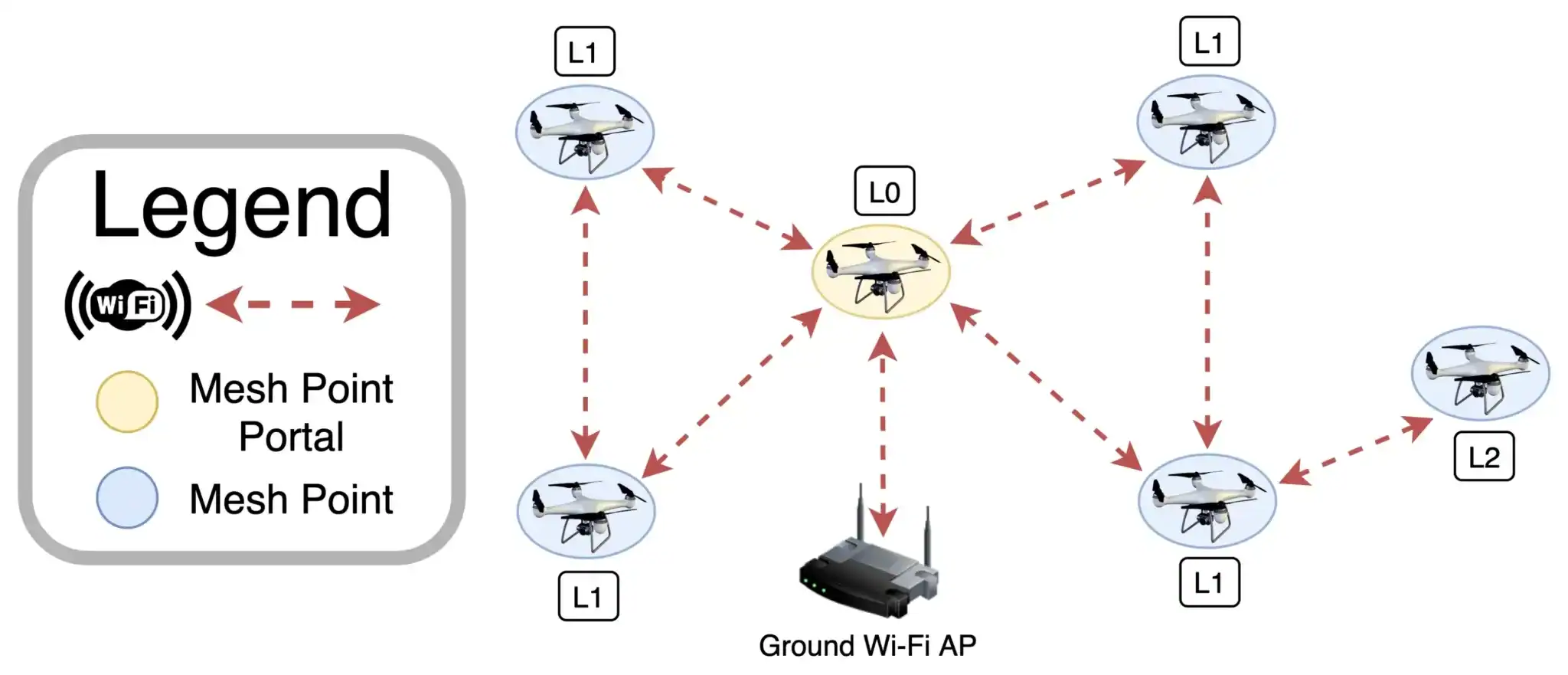
A mesh network operates based on the interaction of many nodes. One of them may be connected to an external network, such as the Internet or a WAN. Other nodes connect to it directly or through intermediate devices. The result is not a linear chain, but a network of interconnected nodes.
Data in such a network can travel along multiple paths. If the nearest node is unavailable or the channel is overloaded, a packet can be routed via an alternative path. This is achieved through dynamic routing—a set of algorithms that determine the most efficient path at any given moment.
Various factors are taken into account: node availability, connection quality, latency, network load, channel status, and other parameters. In practice, this means that a mesh network is not a static structure. It can change routes depending on conditions.
One of the key properties of such networks is self-healing. If one node stops working, neighboring nodes can reroute traffic and continue data transmission. This does not mean that a mesh network is invulnerable. If there are too few nodes or all possible routes are interrupted, the connection will also be lost. However, with alternative paths available, such a network is more resilient than a system that relies entirely on a single central element.
Types of mesh networks
Mesh networks can differ in how nodes are connected, their topology, and their architecture. They are divided into several main types.
Full mesh topology
In a full mesh topology, each node has a direct connection to all other nodes in the network. If there are six nodes in the network, each is connected to the other five.
This structure creates many possible paths for data transmission. If one channel between nodes is unavailable, data can be transmitted via another path. However, this architecture faces challenges over long distances between modules or when there are many signal obstacles.
Partial mesh topology
In a partial mesh topology, not every node has a direct connection to all other nodes. Some nodes are connected directly, while others transmit data through intermediate nodes.
In such a network, there are also several possible routes for data transmission, but the number of connections is smaller than in a full mesh topology.
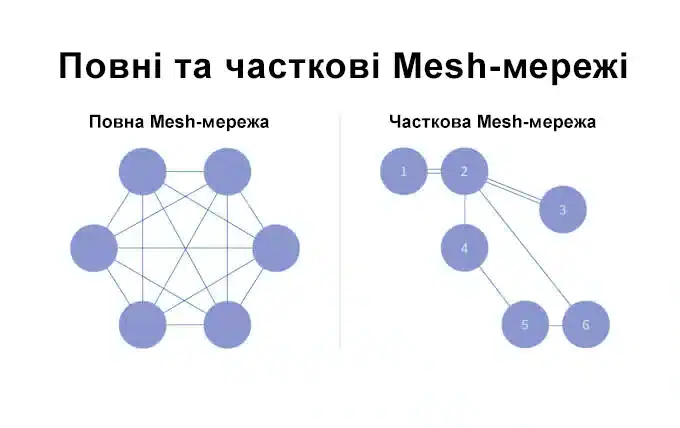
A partial mesh topology is typically used in wireless networks, sensor networks, industrial systems, Wi-Fi mesh systems, and other networks where nodes do not necessarily have a direct connection to all other devices.
Infrastructure mesh networks
In an infrastructure mesh architecture, the network is built around special mesh routers that serve as anchor nodes. They handle routing, data transmission, and connectivity to external networks.
Client devices in this architecture connect to the mesh routers. However, the client devices themselves may not participate in forwarding data between other nodes.
Client mesh networks
In a client mesh architecture, the client devices themselves can connect to one another and forward data. In such a network, a device can serve not only as an end recipient or sender but also as an intermediate node for other devices.
Client-based mesh networks are similar to ad hoc networks. They can form without a permanent backbone infrastructure, and nodes can autonomously establish connections with one another.
Such networks are typically used where there is no centralized infrastructure or where nodes can change their location.
Hybrid mesh architecture
A hybrid mesh architecture combines infrastructure-based and client-based approaches. In such a network, there are backbone mesh routers, but some client devices can also participate in data transmission.
Mesh routers form the backbone of the network, while client nodes can supplement it by transmitting data to each other or through other nodes.
This type of architecture can be used in wireless networks, sensor systems, ad hoc networks, unmanned systems networks, and tactical communications.
Advantages and disadvantages of mesh networks
The main advantage of a mesh network is the absence of a single point of failure.
If one device stops working, it does not necessarily result in the loss of the entire network.
The second advantage is flexible scalability. New nodes can be added to the network to expand coverage or increase system resilience. Building on this principle, it is possible to create self-forming and self-healing networks.
The third advantage is the ability to balance the load. Since data can travel along different paths, the network can distribute traffic and avoid overloading individual routes. This is especially important in large systems where many devices operate simultaneously.
Despite these advantages, mesh networks are not a universal solution that overcomes the physical limitations of radio communication.
Walls, terrain, distance, metal structures, weather conditions, radio interference, and other signal sources affect connection quality.
In addition, they are typically more expensive than simple centralized systems, especially when many nodes, radio modules, antennas, and other equipment are required.
Furthermore, if a node must remain active at all times and transmit data not only for itself but also for others, it consumes more energy than a conventional two-way communication channel.
Another challenge is the complexity of installation and maintenance. The more nodes in the network, the more difficult it is to monitor its status, channel quality, routing, load, and potential failure points.
Mesh networks for military applications
Mesh networks are becoming increasingly important for providing battlefield communications, both as an architecture for traditional tactical radios and as a means of establishing a stable control channel for unmanned aerial vehicles deep behind enemy lines.
In addition, a distributed communications structure is essential to the development of autonomous or semi-autonomous drone swarms.

Mesh communication also allows drones, ground-based robotic platforms, manned systems, operators, and command posts to be integrated into a single network.
Mesh in Russian drones
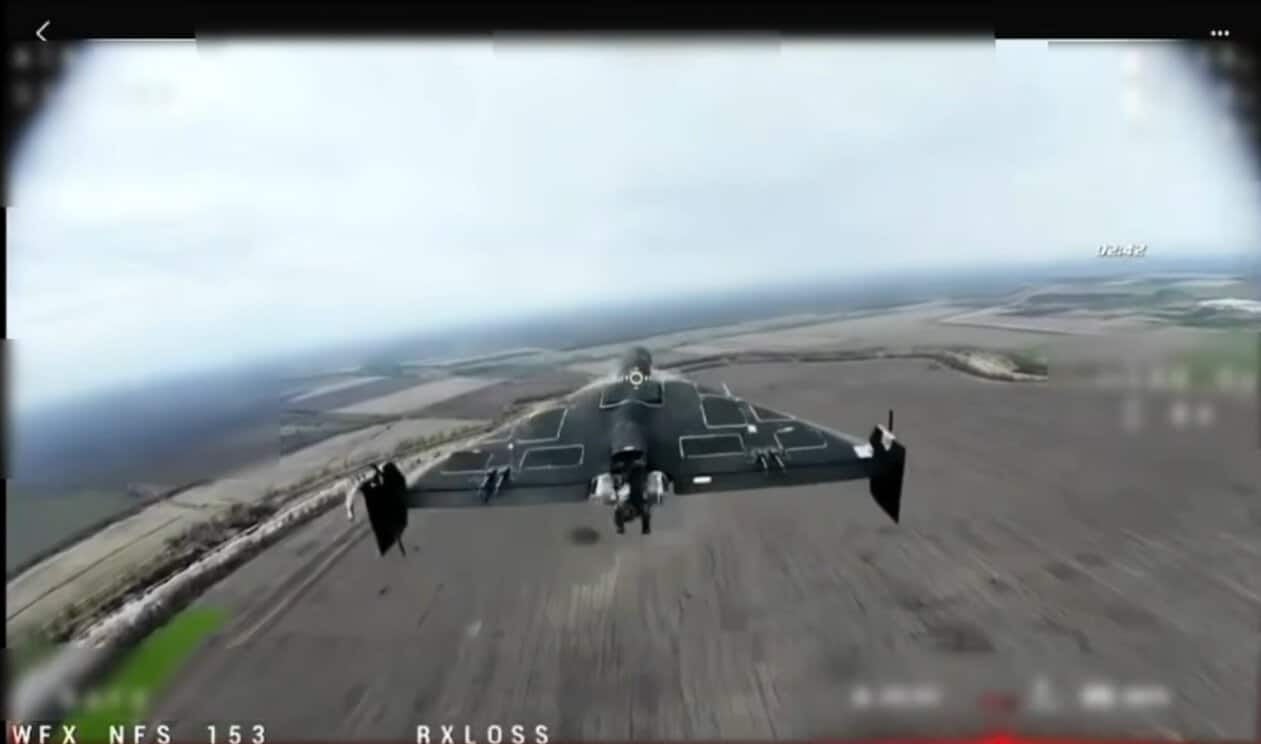
Russian UAV developers, who currently lack access to a satellite-based drone control system, are paying particular attention to developing this technology. In particular, control via mesh networks has been widely used since the fall of 2025 on drones such as the Geran, Gerbera, and V2U models and serves as the primary communication channel for strike and reconnaissance variants equipped with cameras and online control capabilities.

Typically, Russian drones use XK-F358 mesh modems manufactured by the Chinese company Xingkay Tech. The use of HX-50 series routers from the Chinese company Shenzhen Sinosun Technology has also been documented.
Currently, such modules are not installed on every drone. Mesh networks are typically used during mass launches, when a large number of “Shaheds” are in the air simultaneously.
Thanks to mesh networks, the routes or behavior of some drones can be adjusted even during the attack. Some drones may divert away from a danger zone, while others may head toward areas where Ukrainian defenses have proven less effective.
This approach increases the overall survivability of a group attack, as the drones can respond quickly to changes in the situation.
Coordination of drone actions within such a network can take various forms. There have been documented cases where the enemy uses algorithms or elements of artificial intelligence, in which case interaction between the drones occurs automatically.
At the same time, reports indicate that operator-controlled guidance is currently more effective in practice. However, the algorithms themselves are already built into the system: it can automatically detect that a drone has successfully navigated through electronic warfare (EW) or air defense (AD) systems in a specific area and, based on this, direct other “Shaheds” along a similar route without direct operator intervention.

The next logical stage in the development of such systems could be full autonomy, where the entire group operates without operator involvement. According to experts, given the current pace of development, such solutions could emerge as early as 2026.
At the same time, there is little publicly available information on the use of mesh networks in Ukrainian products, partly due to significant competition from satellite-based control systems. However, they are used in drones, UGVs, and Ukrainian-made tactical radios.
Brief conclusion
For drones, mesh networks are a key technology that enables unmanned aerial vehicles to operate not only as individual units but as an interconnected group. They extend communication range and increase the system’s resilience to the loss of individual nodes.
For Ukraine, the Russians’ scaling up of such solutions poses an additional challenge both in the realm of electronic warfare—where simply jamming or spoofing attack UAVs is no longer sufficient—and in the organization of air defense lines, if drones are able to autonomously reroute their paths based on data regarding the percentage of intercepted drones directly during an attack.



Xi Jinping’s Washington Visit Outlines the Timeframe for the Active Phase of the Confrontation: Beijing Openly Demands Taiwan’s Return
On September 23–25, 2026, Chinese President Xi Jinping held talks with President Trump at the White House during the first Chinese state visit to t...

A Sharp Shift in the Dynamics of Global Confrontation Forces Washington to Rethink How It Builds Its Key Partnerships
On September 12–13, 2026, the 18th BRICS Summit was held in New Delhi. Xi Jinping traveled to India to lead the Chinese delegation, marking his fir...

Netanyahu’s Visit to Abu Dhabi: Israel Builds Partnerships from a Position of Strength, but the Middle East Conflict Is Eroding the Edge of Its Weapons
On September 27, 2026, Israeli Prime Minister Benjamin Netanyahu traveled to Abu Dhabi with the head of Mossad and the head of the National Securit...
