
Russian Unmanned Ground Vehicles Deployed in the War Against Ukraine
Andrii Sukharov



Unmanned ground vehicles (UGVs) are being used increasingly by the Russian military for logistics, casualty evacuation, mine-laying, engineering tasks, and fire support. The adversary is steadily expanding their use across these roles.
The scale of this effort is reflected in statistics on Russian equipment losses. According to a unit of the Security Service of Ukraine’s Special Operations Center “A,” its personnel struck 8,748 unmanned aerial vehicles (UAVs) and unmanned ground vehicles (UGVs) of various types in July 2026.
These figures do not allow the number of UGVs hit to be determined separately, as the SSU groups them together with UAVs in a single category. At the same time, the data indicate the overall scale of unmanned-systems employment, against which ground robotics is gradually emerging as a distinct capability. Meanwhile, according to the General Staff’s August 11, 2026 statistics, 2,190 systems had been destroyed, although the actual figure may be higher. Since May 3, the General Staff of the Armed Forces of Ukraine has included unmanned ground robotic systems in its daily reporting of Russian equipment losses.
Russia is developing several lines of UGVs simultaneously, ranging from relatively simple transport platforms to systems equipped with offensive weapons. Some of these systems are already being employed directly on the battlefield, while others remain at the testing or demonstration stage.
Notably, Russian forces continue to employ UGVs despite their limitations, including problems with communications, speed, and cross-country mobility. In effect, a distinct class of relatively inexpensive, expendable equipment is emerging, enabling hazardous tasks to be performed without exposing personnel directly to the associated risks.
Kurier – Russia’s Most Widely Deployed Robotic Platform
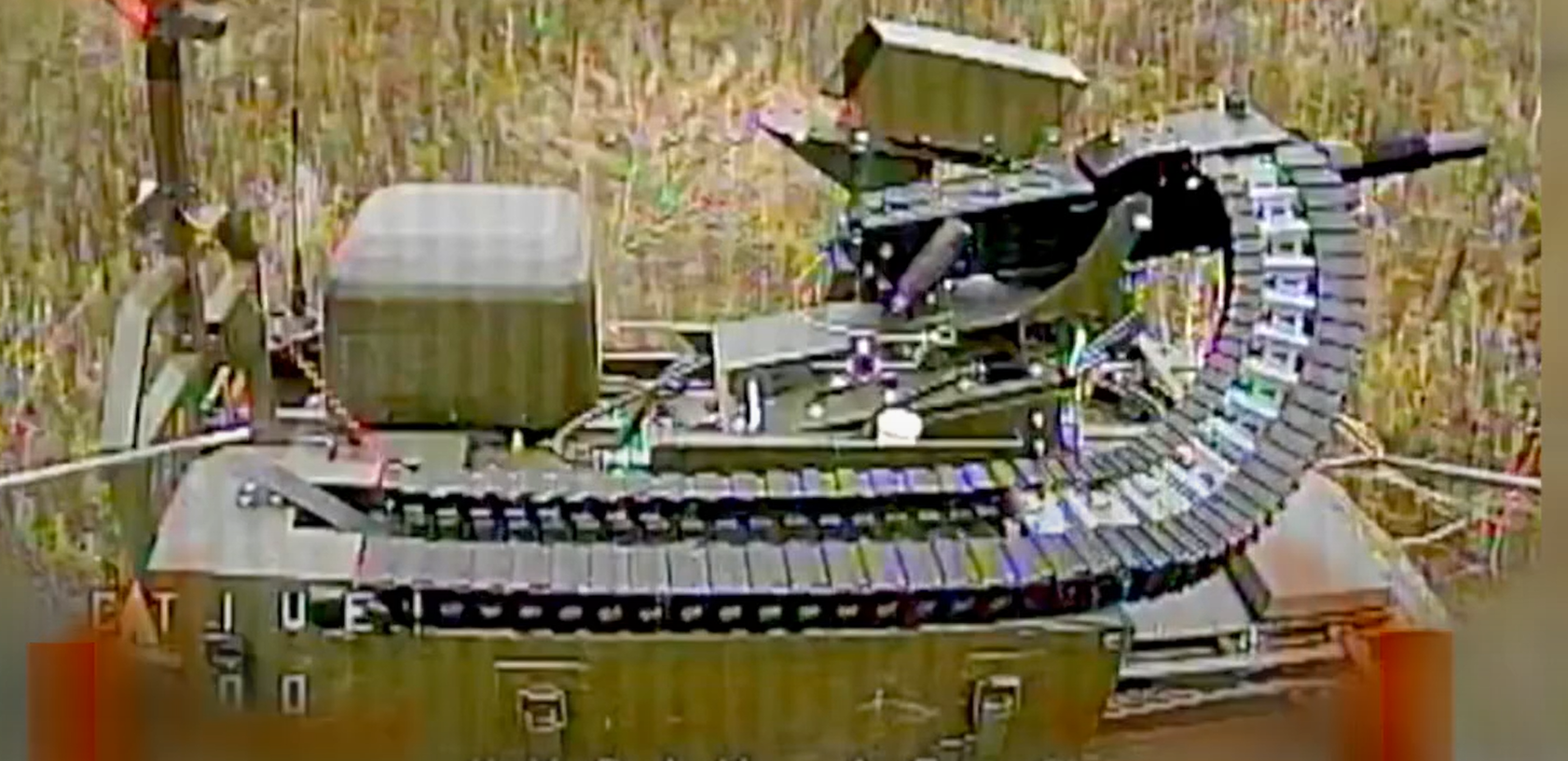
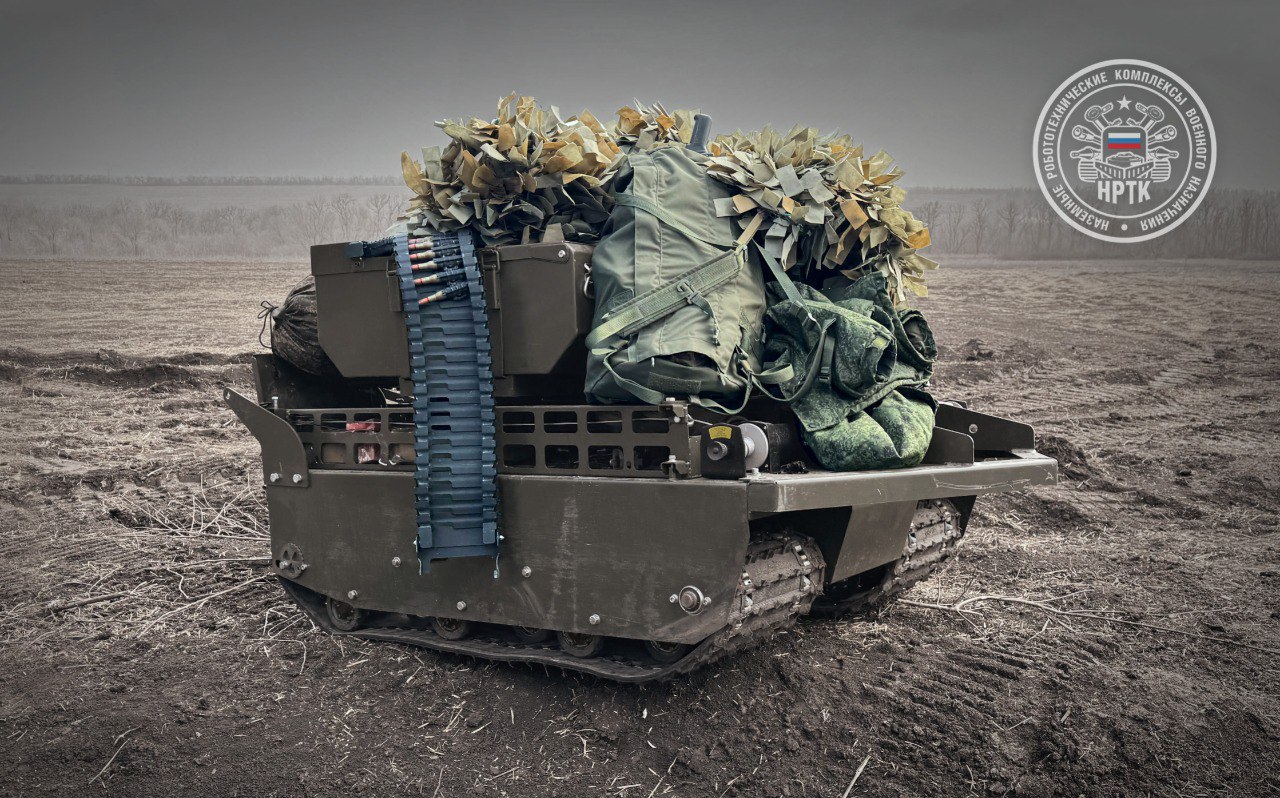
Some of the earliest documented instances of the Russian Kurier UGV equipped with weapons date back to the fighting for Avdiivka in 2024. At the time, Russian units employed tracked platforms armed with AGS-17 automatic grenade launchers. Both documented vehicles were destroyed by Ukrainian FPV drones using air-dropped munitions.
Visually, the Kurier UGV features a tracked undercarriage protected by metal panels, a combat module equipped with an AGS-17, and a large ammunition container. A mast, presumably fitted with a surveillance camera, was mounted at the rear of the platform.
However, throughout its combat employment, the Kurier’s primary role has remained logistics rather than fire support. The platform is used to deliver ammunition, equipment, and other supplies, while its modular design allows different mission-specific equipment to be installed.
The Kurier UGV can be fitted with combat modules armed with machine guns or automatic grenade launchers, as well as equipment for remote mine-laying. Depending on the configuration, the system can be controlled via a radio link, fiber-optic cable, or satellite communications.
According to the commander of the Lava Unmanned Systems Regiment of the 2nd Khartia Corps of the National Guard of Ukraine, the Kurier UGV is currently one of the Russian UGVs regularly observed on the battlefield.
“They definitely use it quite frequently. I hear a lot about them in operational reports, and I personally see these platforms being destroyed,” the serviceman told Militarnyi.
Meanwhile, communications remain one of the main limitations of Russian UGVs. According to the commander, the Kurier’s operator has to remain relatively close to the platform because its operational range is constrained by the capabilities of its radio link.
“If we use Starlink, it allows us to control the system remotely. With the Kurier UGV, however, it is not that simple. The operator has to be somewhere nearby, as close as the radio signal allows them to control the UGV,” the commander explained.
Despite the availability of weaponized modules, the Russians primarily employ the Kurier as a transport platform in actual combat conditions.
“I have never seen the armed variants, only demonstration modules. At its core, it is a logistics platform. The same applies to both sides: 80–90% of robots are used primarily to transport supplies,” the serviceman said.
Thus, for the Russian military, the most practical application of UGVs so far is not direct assault operations, but the delivery of supplies through areas where using conventional vehicles or moving infantry would entail significant risk.
Logistics Platforms of the Russian Military
In addition to the Kurier UGV, Russian forces employ a number of other platforms designed to support forward positions. At present, logistics vehicles represent the most practical application of ground robotics.
One such platform is the Lyagushka.
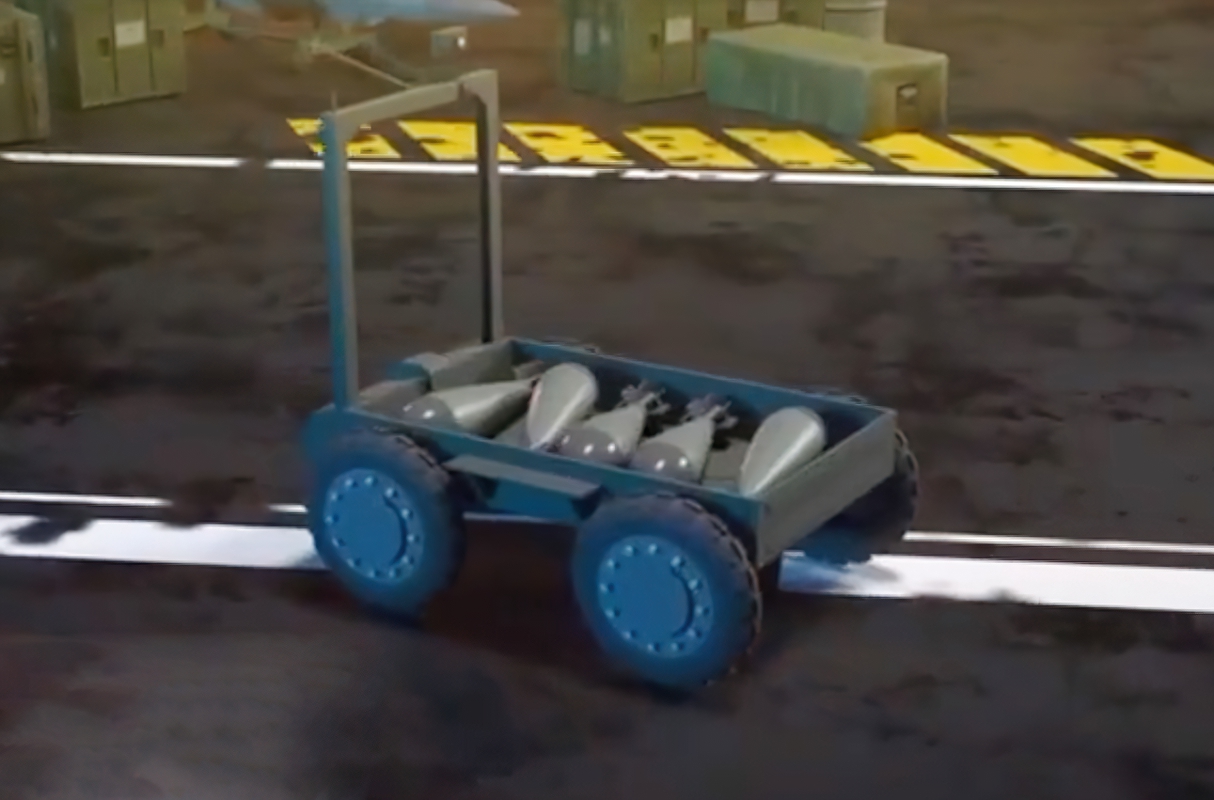
The system is designed to deliver ammunition, equipment, and provisions. The platform is equipped with a remote control and an FPV camera. To extend its operating range, it uses a remote control station, a video-signal repeater, and a telescopic mast.
Another logistics platform is the Omich-2. Militarnyi previously reported its appearance near the combat zone.

The platform is designed to deliver ammunition and equipment, transport assault groups, and evacuate wounded personnel. According to its stated specifications, the Omich-2 can carry a payload of up to 350 kg.

The platform weighs approximately 650 kg, with a claimed endurance of up to 40 minutes and a range of up to 20 km.
Another example is the Chelnok robotic platform, which the Russians present as a transport platform for delivering supplies to forward positions. In 2024, the platform was presented as an engineering mine-clearance vehicle, including with an UR-83P mine-clearing system.
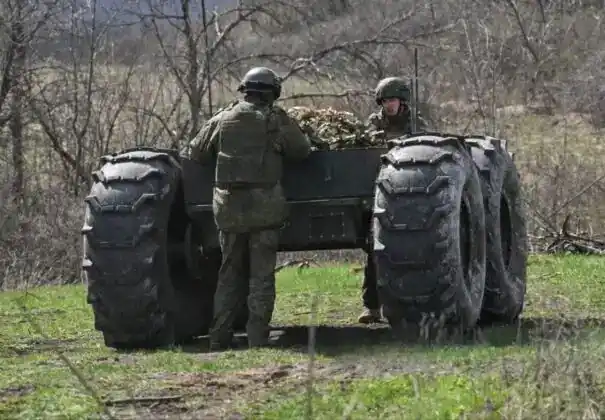
Another example in the same category is the Bogomol V5.

This is a multipurpose platform with FPV control, designed for logistics and the performance of specialized tasks.
Meanwhile, Russian developers are attempting to expand the capabilities of such platforms by equipping them with electronic warfare (EW) systems, engineering equipment, and weapons. One example of this trend is a Russian platform equipped with the Volnorez EW system, which has also been documented in the combat zone.

Thus, Russian unmanned ground vehicles (UGVs) are gradually evolving from dedicated transport robots into versatile platforms capable of performing different tasks depending on the equipment installed. At the same time, logistics remains their primary area of practical application for now.
A Universal Platform Instead of a Dedicated Vehicle
Modularity has become a distinct area of Russian UGV development. Instead of creating a separate platform for each task, developers are attempting to use a single base chassis for different configurations.
The most illustrative example is the Impuls family.

Depending on the modification, the platform can be used for remote mine-laying, engineering operations, surveillance, bridge deployment, electronic intelligence, and counter-UAV operations.
The family includes the Impuls-DM and Impuls-TM for remote mine-laying; Impuls-D (Dozor) for surveillance; Impuls-Most for bridge deployment; Impuls-E, configured as a robotic excavator; as well as Impuls-RER and Impuls-Redut for electronic intelligence and counter-UAV operations.
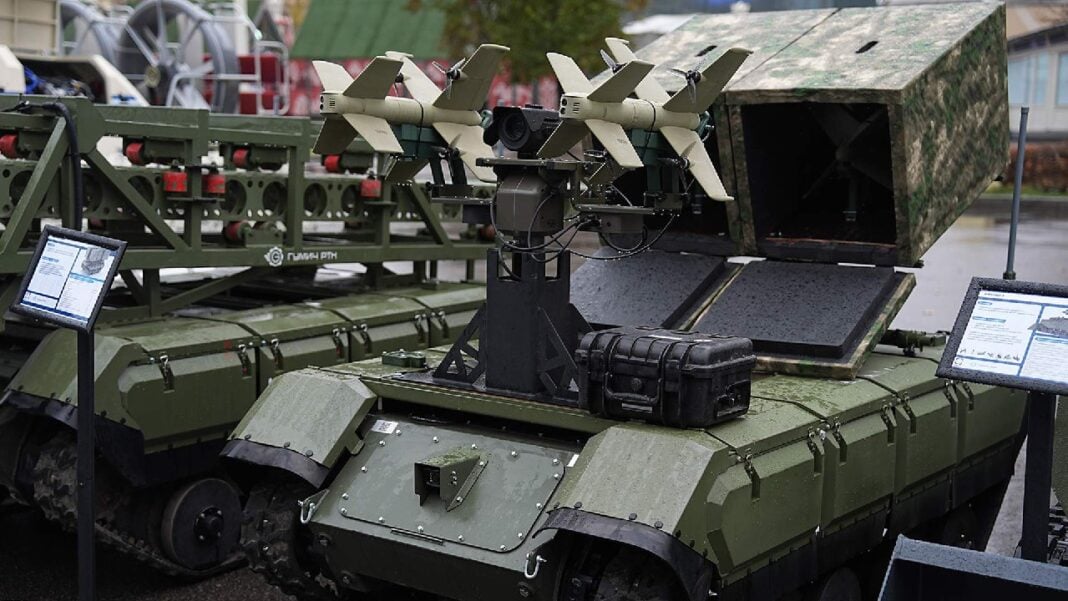
The Russians also demonstrated an adaptation of the platform for an 82 mm mortar and a 107 mm Type 75 multiple rocket launcher (MRL) of North Korean manufacture.

This approach allows a single base platform to be adapted for different missions by changing only the equipment installed on it.
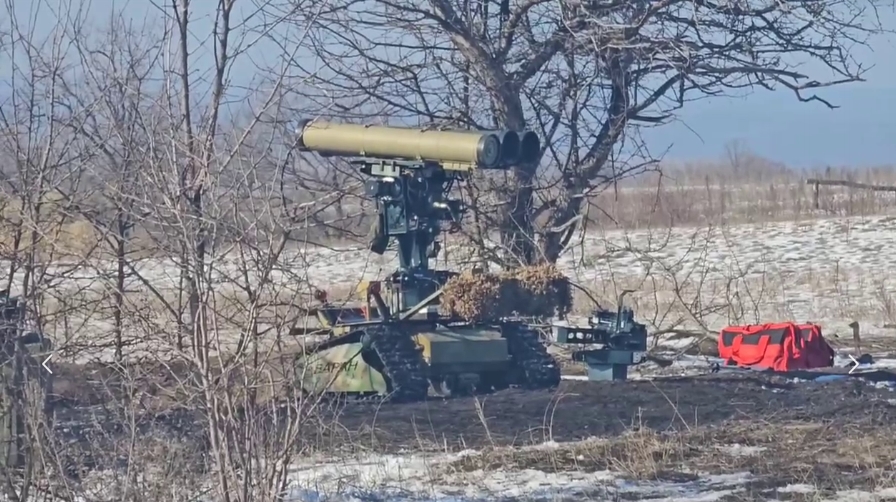
The Varan is a heavier multipurpose vehicle.
Another example of a modular platform is the Varan tracked UGV, developed by the Svarog Research and Production Centre.
The platform can be equipped with reconnaissance equipment, electronic warfare (EW) systems, engineering equipment, and weapons ranging from machine guns and automatic grenade launchers to anti-tank guided missile systems (ATGMs).
Its claimed modularity allows the Varan to be used as a transport, engineering, or combat vehicle.
Engineering Unmanned Ground Vehicles
Another area is the development of robotic systems for carrying out hazardous engineering tasks.

One such system is the Kolun-4 TRD.
According to Russian developers, the tracked platform is designed for the remote clearance of anti-personnel mines using a mine-clearing roller.
Another representative of the engineering systems category is the Uran series.

The Uran-3 UGV is a multipurpose engineering robotic system designed to carry out demining and other tasks in hazardous areas. It is armed with a machine gun. The system comprises several robotic vehicles that can operate together with a transport vehicle.
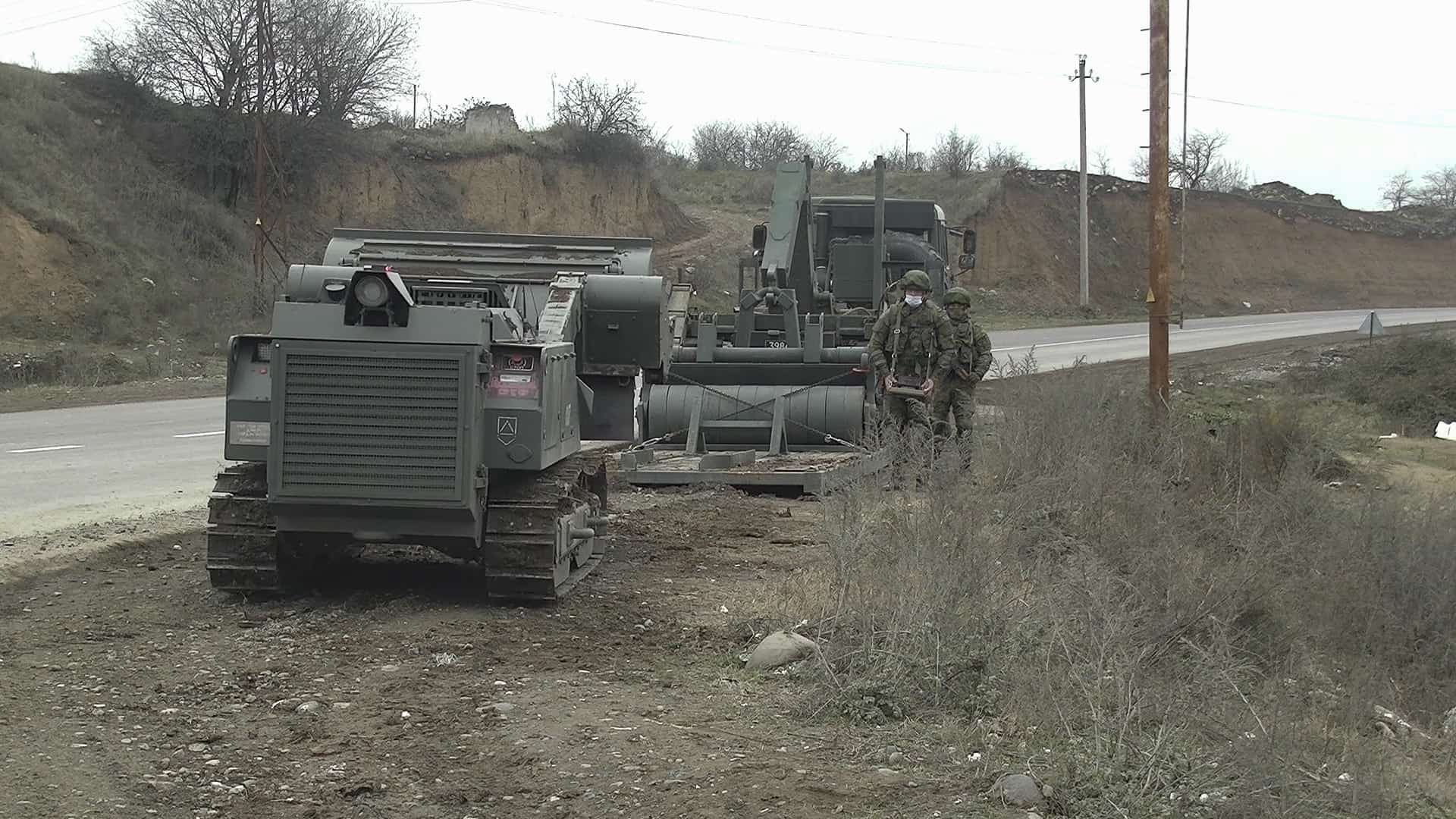
The Uran-6 is an engineering vehicle designed for remote-controlled mine clearance. It is a tracked, remotely operated system equipped with an interchangeable mine-clearing attachment. Russian forces have used it for demining operations, including in Syria, and in December 2020 demonstrated the Uran-6 operating in Nagorno-Karabakh. Since the beginning of the full-scale invasion, it has also been used in Ukraine.
Experimental Vehicles
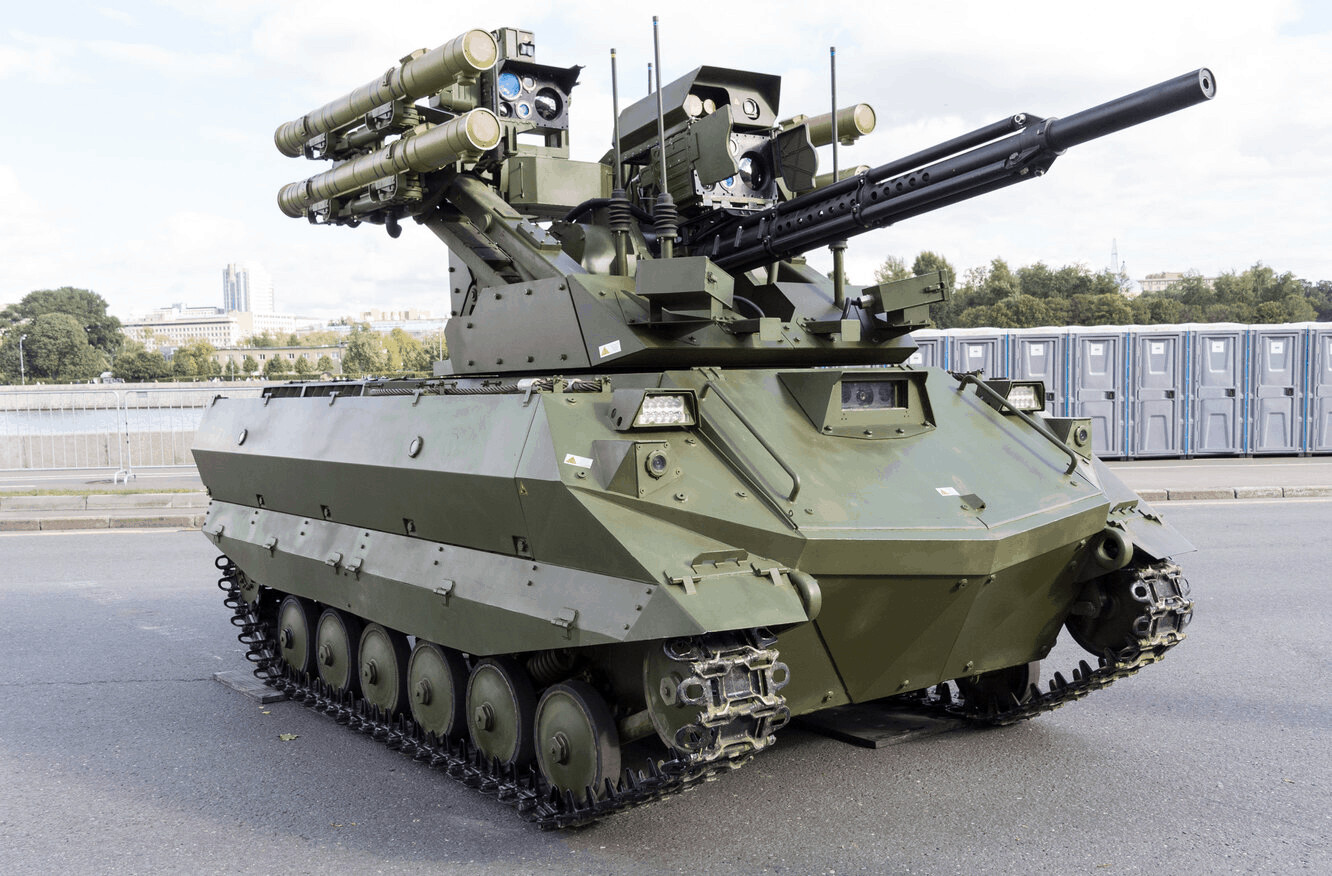
Russia has been experimenting with unmanned ground vehicles (UGVs) for years. Russian efforts to develop armed ground robotic systems began well before the full-scale invasion. One of the best-known projects was the Uran-9 – a tracked, remotely controlled combat vehicle that the Russian military planned to use for facility security, reconnaissance, and engaging enemy personnel and equipment.
-

- An Uran-9 combat robotic vehicle. Photo from open sources
-

- An Uran-9 combat robotic vehicle. Photo from open sources
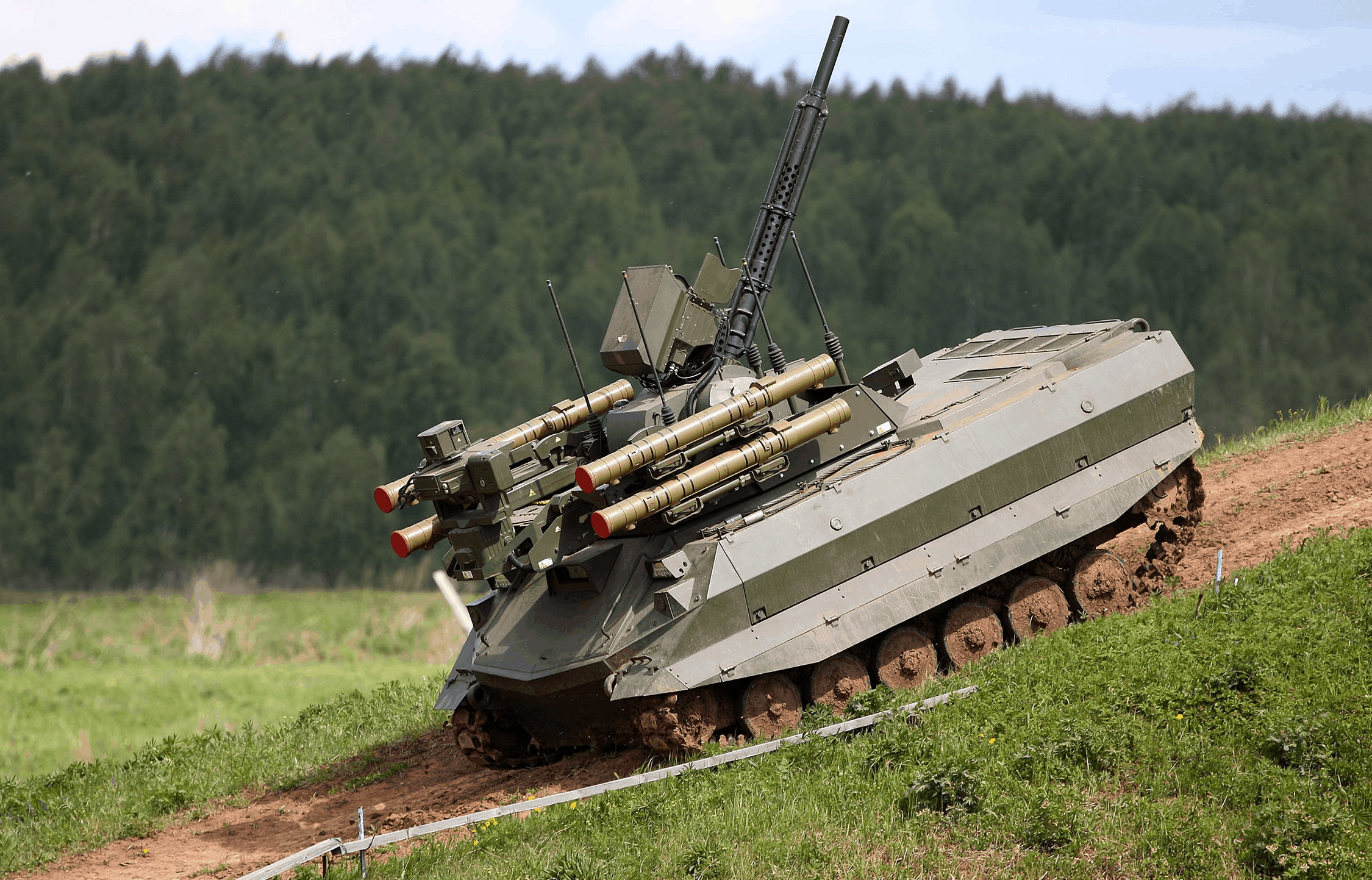
As early as 2021, Russia planned to test the Uran-9 during the Zapad military exercises. The vehicles were intended to provide security for field infrastructure, including warehouses and command posts, as well as detect unmanned aerial vehicles (UAVs) and relay information about them to other air-defense assets.
The Uran-9 is equipped with a 2A72 30 mm automatic cannon, a coaxial 7.62 mm machine gun, Ataka anti-tank guided missiles (ATGMs), and Shmel-M rocket-propelled flamethrowers. Thus, even at an early stage, the Russians viewed ground robots not only as transport or engineering vehicles, but also as platforms for carrying and employing weapons directly.
Meanwhile, the practical use of such systems remained limited for a long time. Russian forces used the Uran-9 during military exercises and also claimed to have deployed it in Syria and during the full-scale war against Ukraine. However, the system has not achieved widespread deployment on the battlefield.
One of the more recent examples is the Argus, presented at the Archipelago-2025 forum.

Its key feature is the ability to transport FPV drones on a ground-based platform. According to the developers, the robot can be deployed by an operator to the area of operations and left in ambush, after which the drones can be launched directly from the platform.
The system is controlled using the NSU HERMES 2.0 control system. Russian developers claim it can operate with several FPV drones simultaneously and use the ground platform as a communications relay.
However, such systems should currently be distinguished from the Kurier UGV and other platforms that have already been regularly observed carrying out combat missions. The Argus demonstrates the direction in which the Russians are seeking to develop unmanned ground vehicles (UGVs), but its presence at an exhibition does not indicate widespread deployment at the front.
Shturm heavy robotic platform

Heavy robotic combat vehicles remain a separate area of Russian military development. One such project is the Shturm robotic assault complex, based on T-72 tanks.
In July 2025, footage emerged showing a combat vehicle belonging to the system that had been built on a modified T-72 chassis. A tank-chassis command vehicle was also shown alongside it. However, in the published video, the combat vehicle was operating with a crew on board rather than in a remotely controlled mode, so the complex’s actual capabilities remain unclear.
The Shturm project has been under development by the Russian Uralvagonzavod (“Research and Production Corporation Ural Wagon Factory”) enterprise since 2018. The concept calls for a heavy robotic combat system intended for assault operations, particularly in urban environments.
One of the vehicle’s proposed features was a 125 mm gun with a shortened barrel, intended to improve maneuverability in confined spaces. The Russians also considered variants equipped with rocket launchers, 30 mm automatic cannons, and thermobaric rockets.
The system was also planned to include a dedicated command vehicle. According to the developers’ concept, a single command post would control a platoon of robotic combat vehicles. Meanwhile, the Shturm can not yet be considered a fully autonomous robotic combat system.

An even more ambitious experiment was the Kultivator unmanned ground robotic system (UGV). The platform was developed by the engineering section of the Separate Regiment of Unmanned systems ‘Burevestnik’. Its distinguishing feature was the installation of aircraft weaponry on a ground-based chassis.
In this configuration, the UGV is equipped with two UB-16-57 rocket pods, allowing it to launch up to 32 S-5 unguided aircraft rockets.
The Russians have also demonstrated other armed UGV configurations. These include Malvina, fitted with two launchers from the TOS-1A thermobaric multiple rocket launcher system; Roy, armed with six RPO-A Shmel rocket-propelled infantry flamethrowers; as well as platforms equipped with mortars and other weapon systems.
Russian UGVs Lag Behind in Speed and Communications
Despite the expanding range of configurations, Russian ground robots have a number of limitations. Communication remains one of the main problems.
The commander of the Lava Regiment notes that the use of satellite communications gives Ukrainian operators the ability to control robotic platforms from considerably greater distances, whereas Russian operators are often forced to remain close to their platforms.
Fiber-optic control is another issue. According to the serviceman, he has experimented with such systems but considers them vulnerable because of the risk of the cable being damaged.
He identifies increasing speed as another key area for development. In his assessment, modern platforms are often unable to maintain speeds of around 30 km/h for extended periods because of limitations in their running gear, the lack of a proper suspension system, and maneuverability problems.
“The first direction they will move in is speed. Speed is the limiting factor that directly affects the probability of destruction,” the serviceman said.
He explains that the longer a robot remains in an exposed area, the more time the enemy has to detect and engage it. Therefore, the next stage in UGV development may involve not simply mounting new equipment on existing platforms, but creating an entirely new chassis with a faster drivetrain, proper suspension, and improved off-road mobility.
Thus, Russian UGVs are no longer merely exhibition prototypes. Some platforms are being used regularly for logistics and other missions on the front line, while the Russians continue experimenting with weapons, electronic warfare (EW) equipment, engineering systems, and the integration of UGVs with other unmanned systems.
Meanwhile, the main trend remains practical – the robot is intended to perform dangerous tasks in place of a servicemember. Logistics, casualty evacuation, and engineering tasks remain the most obvious areas of application, while fully-fledged combat UGVs have not yet become a widespread capability.




Washington Backs Syria’s Emergence as an Independent Actor in the Islamic World and Its Reintegration into the Western Sphere
On August 24, 2026, the United States revoked Syria's designation as a state sponsor of terrorism, a status the country had carried since 1979. The...

Visits by Senior Washington Officials to Moscow: The Factors Driving the Kremlin’s Rejection of the White House’s Proposals
In late August and early September 2026, three senior U.S. officials visited Moscow, marking a level of concentrated contact in U.S.-Russian relati...

A Sharp Shift in the Dynamics of Global Confrontation Forces Washington to Rethink How It Builds Its Key Partnerships
On September 12–13, 2026, the 18th BRICS Summit was held in New Delhi. Xi Jinping traveled to India to lead the Chinese delegation, marking his fir...
