
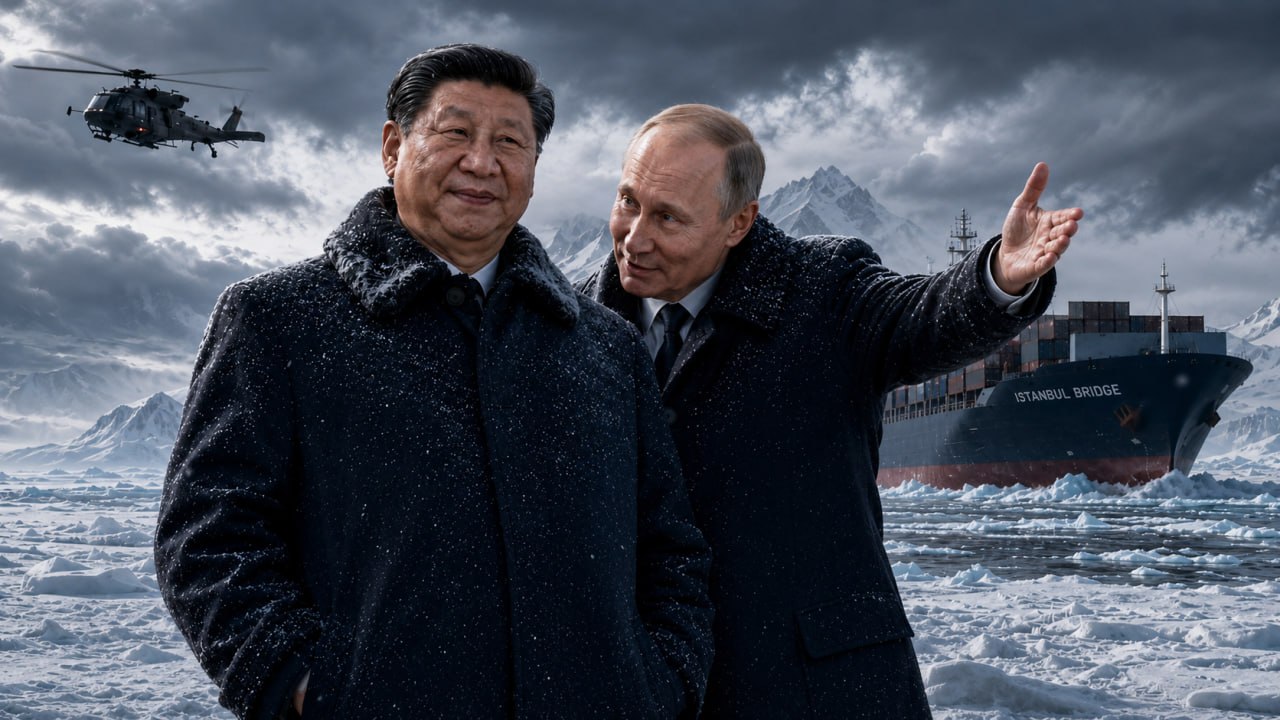


The northern route between Asia and Europe has scheduled container service for the first time. On August 12, 2026, the container ship Istanbul Bridge left the Chinese port of Ningbo for Felixstowe in the United Kingdom on the first sailing of a regular line that China’s Sea Legend Shipping has opened along the Northern Sea Route. The company announced a schedule of eight sailings through October 27 and a transit time of roughly twenty days, against forty on the conventional route.
Two weeks earlier, the U.S. Senate Foreign Relations Committee reported out S. 4708, a bill that bars vessels linked to China, Russia, Iran, and North Korea from conducting marine scientific research in American Arctic waters.
Both events drew global press coverage within a week, and the Senate initiative amplified it considerably. The Sea Legend Shipping launch was read as proof that the alternative route now works, and the bill as Washington’s admission that it is falling behind in the Arctic race.
In expert circles and in the political establishments of a number of states alike, the Arctic question is understood in a badly distorted form, one that Moscow and Beijing have shaped through years of systematic effort.
The Kremlin presents the first container sailing along the Arctic route as proof that the Northern Sea Route has reached the standing of a third trunk corridor between Asia and Europe, and Russian and Chinese outlets reproduced that assessment within a week.
Rosatom head Alexei Likhachev tied the development of the Northern Sea Route to political uncertainty in the Persian Gulf, and China’s Ministry of Transport picked up the same frame, noting that the Arctic track to Baltic ports cuts the distance by roughly a third and avoids the Red Sea and the Strait of Malacca.
In October 2025, the two sides approved a plan of joint measures and set a benchmark of twenty million tons of Russian-Chinese cargo traffic by 2030, extending cooperation to the construction of Arctic-class vessels and the training of specialists.
Moscow and Beijing inflate expectations for the northern route deliberately. Distorted narratives about Arctic potential reach the political establishments of a number of states and shape decisions on investment, security priorities, and what goes on the table in negotiations — while the assessments themselves do not survive contact with the numbers.
The statistics rule those plans out. The northern route has no physical capacity to absorb the volume of cargo that moves along the southern lanes.
More than 102,500 vessels passed through the Strait of Malacca in 2025; 12,758 went through the Suez Canal and 13,404 through the Panama Canal. The Northern Sea Route handled 103 international voyages over the same year.
Istanbul Bridge carries 4,890 containers, against 20,000–24,000 on the ships that work the Suez lane, and the combined capacity of all eight sailings on the CAX line (China-Europe Arctic Express) equals a single such vessel over a season.
Asia shipped 19.6 million containers to Europe in 2025, and the Arctic share of that flow comes to less than one-tenth of a percent.
The ceiling on the route is set by the size of the icebreaker fleet. Rosatomflot’s six nuclear icebreakers escort 37 million tons of cargo a year — mostly Russian oil, liquefied gas, coal, and metals — and that figure has not moved in three years. The advertised hundred million tons would require doubling the fleet to twelve hulls, and the ships would have to come from an industry weakened by sanctions and Ukrainian long-range strikes.
Moscow also sells the route as insurance against a shutdown of the southern lanes. The northern route cannot fill that role: year-round navigation is available only in the Kara Sea, a ship covers the rest of the passage unescorted between late July and late September, and a winter closure of Hormuz or Malacca has no Arctic alternative at all. The dependence of Chinese oil imports and container exports on four southern chokepoints is the same after the line opened as it was before.
What Russia is actually pursuing with the narrative of an expanding northern route is something else: above all, support and capital from Beijing.
Chinese operators are adding Arctic sailings and testing scheduled service to Europe, and the structure of the cargo flow is not changing as a result. Of the 37.02 million tons moved along the route in 2025, transit accounted for about 8.6 percent.
The bulk of the traffic through the Arctic corridor consisted of deliveries to Arctic ports and outbound shipments of Russian oil, liquefied gas, coal, and metals.
Chinese oil imports and container exports to Europe pass through the same chokepoints after the Arctic line opened as they did before it — the Strait of Malacca, Hormuz, and the Suez and Panama canals. Beijing plans plant siting and supply routing decades ahead, and those calculations are built around the capacity the Arctic corridor will have in the 2030s.
As long as China-Europe shipping through the Arctic remains seasonal and experimental, Russia has no way to attract significant Chinese investment into building out the infrastructure there.
Another factor behind the sharp contraction of Chinese direct investment in new Russian Arctic projects was the U.S. sanctions imposed on Arctic LNG 2.
Those restrictions from Washington stopped Chinese financing for gas-production initiatives on the Gydan Peninsula and pushed back Chinese direct investment in the deepwater port at Arkhangelsk and the Belkomur railway.
Nuclear Icebreakers Notwithstanding, Western Sanctions Have Left Russia’s Cargo Fleet Exposed
Nuclear icebreaker construction is the one industry where Russia has kept the full production cycle inherited from the Soviet school: reactor plants, the nuclear fuel for them, and the main power-plant equipment, with no imported components in the critical assemblies.
As of August 2026, Atomflot operates four new Project 22220 icebreakers, while the nuclear vessels Chukotka, Leningrad, and Stalingrad are at various stages of fitting out. Russia continues to produce RITM-200 reactor plants and their fuel, steam-generating equipment, and main turbogenerators — the complete power plant on which construction of new icebreakers and repair of existing ones depends.
The loss of cooperation in building high ice-class gas carriers and tankers under Western sanctions has left the production and expansion of the cargo fleet far more vulnerable. Until 2022, Russian output depended on South Korean yards, French membrane technology, and other Western-made equipment; once those supplies stopped, the shipbuilding sector contracted sharply.
Chinese companies have shown neither the appetite nor the capability to replace Western suppliers for the Russian shipbuilding industry. For Chinese corporations, exposure to secondary sanctions and the risk of losing access to global markets is the decisive constraint on any deeper involvement in sanctioned projects.
Alongside tighter screening and the blocking of Russian transactions by Chinese state banks, and the suspension by Chinese firms of talks on investment in Russian processing industries, Wison New Energies ended its participation in Russian projects.
The Shanghai-based engineering and construction company took that decision after sanctions were imposed on Arctic LNG 2.
Sanctions from the democratic states and the unwillingness of large Chinese companies to carry sanctions risk have together slowed the expansion of Russia’s fleet of specialized high ice-class cargo ships far below the planned pace.
The nuclear fleet Russia has preserved serves a cargo flow that does not cover the cost of keeping that fleet running.
The Arctic’s Resource Potential Is Bounded by the Accessibility of Its Deposits
Russian and Chinese outlets distort perceptions of Arctic subsoil, presenting the region as a “treasure chest under the ice” and citing figures for explored reserves of oil, gas, and rare earth elements. The distortion rests on substituting a geological estimate for industrial availability.
The U.S. Geological Survey puts Arctic subsoil at 90 billion barrels of undiscovered oil and 1,669 trillion cubic feet of gas — 13 percent of the world’s undiscovered oil and 30 percent of its gas. But 84 percent of that volume lies on the continental shelf or slope.
The region’s workable oil and gas reserves sit on the shallow shelves of the Barents, Kara, and Pechora seas and onshore, and 90 to 95 percent of the current economic output of Arctic subsoil comes from traditional commodities — hydrocarbons and base metals. The new generation of critical minerals is still at the exploration and pre-project study stage.
Beyond difficult shipping conditions, climatic limits, and the sanctions regime against Russia, China’s thin interest in developing Russian Arctic infrastructure comes down to the capital required to bring most Arctic deposits into production. The same resources are available to China in regions where exploration and extraction cost far less.
The Arctic holds substantial reserves of nickel, copper, cobalt, iron ore, platinum-group metals, graphite, and rare earth elements, but they have only been surveyed, not prepared for mining.
Russian Arctic deposits matter less to China because China already holds a commanding lead in processing. In 2024, China accounted for roughly 60 percent of world mining of the rare earth elements used in magnets and 91 percent of their industrial refining.
Chinese and Chinese-affiliated companies also mine rare earths across the Global South — in Indonesia, the Democratic Republic of the Congo, Brazil, and South Africa — under long-term contracts with governments.
Russia produced 50 tons of finished rare earth compounds in 2024 against domestic demand of 1,500 tons, and covers the balance with imports from China.
The Arctic delivers exactly one critical mineral at industrial scale — nickel — at up to 5 percent of world production from 1.7 percent of world reserves. Every other category stays within statistical noise. China is therefore in no hurry to put serious money into Arctic rare earth extraction.
Access to new deposits in the Russian Arctic is not the resource without which Beijing’s current industrial advantage would be at risk.
Most new Arctic deposits require heavy up-front investment, so participation by Chinese companies in industrial development above the Arctic Circle would mean building mines, laying roads to port infrastructure, and supplying power.
Global Warming Is Driving Up the Cost of Maintaining and Upgrading Russian Infrastructure in the Arctic
One of the largest distortions Moscow and Beijing sell abroad is the notion of warming as a factor that increases the region’s potential. A longer navigation season does make shipping easier, and everywhere else the same process runs the other way.
Thawing reduces the stability of the permafrost soils that carry Russian ports, pipelines, railways, and extraction and processing facilities, and the cost of maintaining those assets is rising faster than the gain from a few extra weeks of navigation.
A study in Nature Communications finds that by the 2050s roughly 70 percent of infrastructure in the permafrost zone will sit in areas at high risk of thaw.
In the Russian Arctic, 45 percent of oil and gas fields lie in areas at elevated risk of ground instability, and by the middle of the century some 1,260 kilometers of trunk gas pipelines and 280 kilometers of the railway serving the Yamal gas fields will fall inside the projected zone of near-surface permafrost thaw.
Substantial permafrost degradation will affect 54 percent of residential buildings, 20 percent of commercial and industrial structures, and 19 percent of infrastructure assets in Russia’s Arctic and sub-Arctic zones.
The Russian economy, which draws a large share of its revenue from oil and gas exports out of the polar regions, will have to modernize the chains already built and adapt them to new climatic conditions.
Keeping up the infrastructure on which Vostok Oil, Yamal LNG, and their associated transport capacity depend calls for thermosyphons, ground-cooling systems, the raising of individual pipelines and roadbeds above the surface, and rerouting across the least stable sections.
Whatever Moscow gains from a longer navigation season, it faces capital costs on an entirely different scale for the assets through which Arctic resources reach foreign markets.
Permafrost thaw in Russia alone will cause more than $80 billion in infrastructure damage by 2050 and critically damage about 20 percent of all capital facilities built on frozen ground. The operating season for ice roads shortens every year, and coastal erosion and storm activity in ice-free waters are destroying port structures and tailings ponds. The net economic effect of warming on Russian Arctic extraction is negative.
Moscow Converts Chinese Commodity Purchases Into an Argument for New Budget Spending on the Arctic
Where China plays a longer game, Russia uses the economic weight of the Northern Sea Route and its industrial Arctic infrastructure to attract additional investment and to convince foreign capital that money placed in Russia’s northern regions converts into industrial and logistical advantages for importers of Russian resources.
The ports of Sabetta and Dudinka handle raw-material exports for Yamal LNG and Nornickel, while the Bukhta Sever oil terminal, scheduled for completion by 2030, is meant to become the central export hub of the Vostok Oil project.
In August 2026, seven cargoes of Russian crude totaling roughly six million barrels moved along the Northern Sea Route to Asia, where China remained the principal buyer.
Traffic of that kind gives the Russian government grounds to keep funding the ports, icebreakers, and transport infrastructure required to develop the northern fields further.
Chinese purchases of Russian commodities strengthen the case for new spending on Arctic ports, icebreakers, and transport, because even with Chinese direct investment above the Arctic Circle down since the Arctic LNG 2 sanctions, Beijing has already committed substantial sums to the region’s largest gas projects.
China National Petroleum Corporation (CNPC) holds 20 percent of Yamal LNG, and China’s state Silk Road Fund controls another 9.9 percent of the venture. CNPC and the oil company CNOOC together own one-fifth of Arctic LNG 2, and a Silk Road Fund loan of roughly €730 million to the gas producer Novatek is further evidence of the long-running Russian-Chinese partnership in the region.
For Russia, those investments and loans work as leverage: they give Chinese companies a direct financial stake in the continued extraction, shipment, and sale of Russian Arctic gas. In return, Russia gets to keep energy cooperation as one of the pillars of its relationship with China.
The icebreaker program is designed to lose money in construction and in operation alike, and the way it is financed reproduces a model of systemic corruption that runs inside ordinary government procedure and requires no concealment.
The best-documented episode involves the very yard that later received the program’s flagship contract. Igor Borbot headed the Far Eastern Center for Shipbuilding and Ship Repair within the United Shipbuilding Corporation and was responsible for erecting the Zvezda complex at Bolshoy Kamen. A corporation audit in May 2014 found 500 million rubles missing from Rosoboronexport funds transferred for completion of the nuclear submarine Nerpa for the Indian Navy, after which investigators turned to construction of the yard itself.
Investigators established that Borbot, together with RDS group head Alexei Kharis and three accomplices, siphoned funds through contracts with affiliated entities at inflated prices for the work. The construction estimate was revised upward from four billion rubles to seven with no corresponding justification of the volumes involved. Charges were filed in absentia, the assets surfaced in Singapore and the United States, and on April 22, 2016, U.S. Immigration and Customs Enforcement detained Borbot in New York. The Prosecutor General’s Office and the Russian Investigative Committee filed extradition papers, but he never returned to Russia, having built his defense on a claim of political persecution. Borbot handed American investigators valuable information about corruption mechanisms in the Russian shipbuilding industry.
Four years later the same yard became the sole contractor for the lead ship of Project 10510 Leader, the most expensive award in the Arctic program. Vladimir Putin took the decision personally, no competitive tender was held, and Zvezda had no experience building nuclear icebreakers: the serial Project 22220 ships come from the Baltic Shipyard. Zvezda sits inside the Rosneftegaz holding run by Igor Sechin, and the Leader project was pushed by Yuri Kovalchuk together with Sergei Kiriyenko and Rosatom’s leadership against every economic argument.
The change of contractor on an order of that size happened with no public procedure and no explanation of why the work bypassed the yard that specializes in it.
Rosatom has managed the Arctic program since 2018, combining functions that any accountable system keeps separate. The corporation issues transit permits, sets the tariff for icebreaker escort, owns the icebreaker fleet, keeps the tally of cargo traffic, and submits its request for further budget funding against the figure it produced itself, while no outside body has access to the primary transit data.
Under the tariffs of Russia’s Federal Antimonopoly Service, the operator of a Panamax-class transit vessel pays $450,000 to $550,000 for that escort, covering 12 to 15 percent of what the service actually costs.
A convoy of three to five ships yields $1.5 million to $2.5 million in tariff revenue and covers direct operating costs, but no configuration covers the cost of capital and depreciation. At least half the capital cost of new icebreakers arrives as non-repayable budget investment, and Atomflot’s declared break-even is reached by moving the cost of capital off the corporate balance sheet and cross-subsidizing from energy exports.
The budget pays the gap between the tariff and the true cost, and the gain settles with the companies that ship gas, nickel, and oil along the route — Yamal LNG, Nornickel, and Vostok Oil.
The Arctic program absorbs budget money in volumes that neither tariffs nor cargo traffic return. No participant has any interest in stopping the outlay, because every link in the chain draws its own benefit from it.
Rosatom collects operating revenue from escort services and holds the status of the route’s infrastructure operator, assigned to the corporation in 2018. The relevant ministries get a growth figure for cargo traffic in their reports, one that counts outbound Russian commodities together with transit, which is under nine percent of the turnover.
The consequences show up in the reporting itself. In October 2025, Alexei Likhachev announced 400,000 tons of Chinese container cargo to Western ports, double the previous year, while the independent Center for High North Logistics counted roughly 287,000 tons over the same period; a forty-percent gap between the route’s operator and outside accounting passed through the reporting with no consequences whatsoever for the corporation.
A permanent Sea Legend Shipping presence on the Arctic route makes it possible to justify new spending on the Northern Sea Route by the prospect of wider Chinese and third-country use.
External factors are pushing the cost of the Russian icebreaker program up as well. On March 25, 2026, Ukraine’s Defense Forces struck the patrol icebreaker Purga, under construction at the Vyborg Shipyard for the FSB Border Guard Service, demonstrating that the program’s narrow production base — the Baltic Shipyard, Zvezda, and several Rosatom plants — is within reach of Ukrainian long-range systems.
Each successful strike sets the program back several years: damaged facilities require a repeat cycle of work, subcontractors halt deliveries, and delivery dates for the rest of the series slip down the chain.
Arctic Research Is Expanding China’s Options for Under-Ice Navigation and Naval Planning
Unlike Arctic logistics and resource extraction in the High North, where Chinese projects remain modest in scale, years of research activity in the region have already given China its own datasets on pack ice, the seabed, and the water properties of the Arctic Ocean.
China operates the Yellow River Station on Svalbard and the China-Iceland Arctic Science Observatory at Kárhóll, and its maritime expeditions have become annual campaigns that run for months and involve several ships at a time.
The fifteenth Arctic expedition, in 2025, deployed the vessels Xue Long 2, Jidi, Shenhai-1, and Tansuo-3 along with about a hundred researchers. In July 2026, China’s Ministry of Natural Resources sent four ships on a four-month mission to the Arctic Ocean to study hydrology, biology, the atmosphere, and the seabed.
Multibeam echo sounders aboard Chinese research ships and icebreakers generate digital bathymetric models of the seabed — continuous depth grids that underpin covert submarine navigation, since they allow a boat to be steered by terrain without switching on active sonar.
The quiet Type 095 submarines, which will reach operational maturity around the turn of the 2030s, are being built for the Pacific basin rather than for the Arctic.
Moving to regular combat patrols under the ice requires a separate layer of support: basing points with access to Arctic waters, very-low-frequency communications, search-and-rescue forces able to work in ice, and navigational support for terrain-following — the same body of data the research ships are collecting now. At current rates, building out that infrastructure will run at least to 2035–2038.
China is not the world leader in Arctic bathymetry or under-ice acoustics. The historical record, the volume of classified and civilian datasets, and the length of operational experience held by the United States, Russia, Canada, and Norway substantially exceed what China has accumulated.
The public digital seabed models are maintained by the Seabed 2030 and IBCAO international consortia, led by Stockholm University with American, Norwegian, and Swedish institutions taking part. On coverage density of the continental shelf and the deep basins, Russia is ahead, having mapped the seafloor for decades to support its UN claim to an extended shelf.
In under-ice acoustics the advantage belongs to the United States and Russia, both of which collected measurements directly from nuclear submarines at varying depths and in every season.
The largest historical body of data belongs to the American SCICEX program, collecting since 1993, and to Russian polar expeditions. The depth of military integration is a separate matter: in the U.S. Navy, oceanographic data is loaded directly into combat information and control systems and into models of the acoustic environment, whereas the Chinese data has not yet been integrated at that level.
The deep-sea submersible Fendouzhe made 43 dives in 2025 and reached 5,277 meters, and the Jiaolong operated directly beneath the ice mass for the first time.
Beijing is preparing the environment for operations its fleet is ready for neither technically nor doctrinally. The Type 093A/B and 094A nuclear submarines now in service have no documented structural reinforcement of the hull or sail for passage through thick ice, and no dedicated under-ice navigation suite has been integrated into their combat information and control system.
Not a single under-ice patrol by the PLA Navy has been recorded, and a seabed map does not change that: terrain supplies a route, not a hull able to pass beneath the ice or a crew with experience of such a transit.
The research program under a civilian flag covers the one component within that horizon that cannot be acquired quickly: the body of environmental data. American and Canadian services track Chinese missions for precisely that reason.
The Chinese ships that transited the U.S. exclusive economic zone in the Bering Sea during the summer 2026 expedition were monitored by the U.S. Coast Guard, because detailed seabed surveys assist submarine navigation and covert maneuvering, and water-column properties are needed to model sonar performance.
In 2025 and 2026 alone, Chinese expeditions surveyed in detail the area covered by American and Canadian continental shelf claims, systematically gathering data in the Chukchi Sea, the Canada Basin, the Beaufort Sea, the central Arctic Ocean, and the waters west and north of Alaska.
The speed with which China’s fleet can add North American Arctic waters to its datasets has drawn a response from Washington and Ottawa.
Vice Admiral Dan Charlebois, commander of the Royal Canadian Navy, has said the service needs to grow its personnel by 40 percent, and the Carney government has agreed to fund the purchase of 12 submarines to replace the aging fleet.
Against that background, the White House treats restricting access to American waters as the key safeguard against China’s ability to expand its datasets in areas that matter for the defense of Alaska, the Canadian Arctic, and the islands of the northern Pacific.
The American Arctic Security and Diplomacy Act singles out for that reason the need to restrict seabed mapping and to bar states of the authoritarian axis from collecting hydrographic, oceanographic, and other information about undersea infrastructure.
Civilian research supplies China with information that Beijing will put to military use once global confrontation intensifies in the North Pacific and the Arctic.
China Uses Its Arctic Presence to Claim a Seat Where Shipping Rules and Resource Access Are Decided
Regular expeditions, research stations, and the work of Chinese vessels in polar latitudes allow Beijing to present itself as a state with global ambitions and to justify its participation in setting the rules for logistics, scientific research, and resource use in the Arctic.
The strategy accelerated markedly once Xi Jinping took office as president and the Chinese political elite settled on a course of “major-country diplomacy with Chinese characteristics.”
In 2014, Xi Jinping set out the goal of China becoming a “polar great power,” and in 2017 he proposed that Russia join in building an “Ice Silk Road.”
In his 2017 Geneva speech, Xi Jinping stressed that the Arctic, the deep sea, outer space, and cyberspace remain domains where the international rules of engagement and the mechanisms of cooperation are still taking shape.
By singling those areas out, China’s leader signaled an intent to take part in writing the rules for them and in dividing the resources they are capable of yielding.
A white paper, among the official government documents issued by China’s State Council, defined the country in 2018 as a “near-Arctic state” and fixed research, use of High North resources, and participation in governing the region as the tasks of Chinese Arctic policy.
Since Russia is the only state of the authoritarian axis with substantial territory in the northern latitudes and access to Arctic waters, China pursues its Arctic course by building standing frameworks of cooperation with Moscow.
In May 2024, the mechanism of regular meetings between the Russian and Chinese heads of government produced a Subcommission on Northern Sea Route Cooperation, and in 2026 the development of Arctic routes was written in as a separate track of Chinese-Russian cooperation covering logistics and polar shipbuilding.
Xi Jinping sells the Arctic track first of all at home. To the interest groups in the Politburo and the party apparatus, the polar program is presented as planning at a range earlier generations of leadership could not reach.
China takes its seat among the Arctic states now, while access to the region is still unallocated, and secures a claim on resources that will become technically recoverable in twenty or thirty years.
The long-term drive to place China among the states that set the rules and divide the resources in the newest and most contested domains puts the value of the Arctic to Beijing well beyond the profitability of the Northern Sea Route or access to particular deposits. The research program costs little, the payoff sits past a horizon for which none of today’s decision-makers will answer, and China’s presence in polar institutions already serves as evidence of the foresight of Xi Jinping’s course.
Beijing backs the Russian Arctic initiative exactly as far as it opens access to the waters, and takes on none of the costs the initiative generates. Research ships and a seabed map cost China an order of magnitude less than icebreakers and terminals and deliver more, which is why the military component of the Chinese presence outpaces the normative one even as Beijing publicly insists on the latter.
Western Arctic Programs Are Trailing the Russian-Chinese Initiative
The United States, Canada, and Finland set out the icebreaker component in the ICE Pact, signed on the margins of the 2024 NATO summit in Washington. On July 2, 2026, the U.S. Coast Guard finalized $3.3 billion in contracts for six Arctic Security Cutters and, together with the $3.5 billion contract awarded to Davie Defense in May, closed out an eleven-ship program.
The first hulls are being laid down in Finland to a design from Canada’s Seaspan Shipyards developed jointly with Finland’s Aker Arctic, so that American yards build up competence alongside the Finns: the United States has not built a heavy icebreaker since the 1970s, and the loss of that competence derailed the earlier Polar Security Cutter program.
In April 2026, the government of Greenland approved the transfer of a controlling stake in the Tanbreez heavy rare earth deposit to the American company Critical Metals Corp, raising its holding to 92.5 percent.
On May 21, REalloys signed a fifteen-year agreement for 15 percent of first-phase output, with priority rights to concentrate enriched in dysprosium and terbium.
The deposit holds roughly 4.7 billion tons of rare earth ore, about 27 percent of it in the heavy elements needed for magnets in combat aircraft, missile systems, and radars.
Canada is developing mining of its own in parallel. Agnico Eagle produces about 485,000 ounces of gold a year in Nunavut and in May 2026 put more than $2 billion into the new Hope Bay mine, accepting a cost of $1,483 an ounce — an Arctic premium that no southern region carries.
The United Kingdom and South Korea run polar research programs of their own and belong to the same alliance formats within which the United States is building its icebreaker series.
Both components of the Western response convert the Arctic potential that actually exists into contracts with stated deadlines, named buyers, and binding obligations, and it is that form of participation that keeps Western states at the table while the rules for the region are written.
The Arctic as a Bargaining Asset for Beijing
Beijing works the Arctic on two audiences. At home, the polar program belongs on the list of tracks by which the party leadership reports world-power status — alongside space and deep-sea research, which Xi Jinping placed in the same category back in the 2017 Geneva speech.
The structure of Chinese spending reveals a different appraisal of the route. In the eight years since the Ice Silk Road was announced, China has ordered no ice-class icebreaker for commercial shipping, entered no port project along the route, and builds only research vessels serving military research.
Chinese operators run container services seasonally, on Rosatom permits, and without a high ice-class fleet of their own.
A year after the meeting there was not a single signed agreement on this track, and the Secretary of State confirmed that the Anchorage meeting between the American and Russian presidents covered proposals rather than accords.
Exclusive access to the Russian Arctic gives Beijing something to discuss with Washington at no cost to itself. The Chinese side pushes promises of resource extraction past 2030, beyond the point at which they can be checked, and keeps the Russian side in the position of a partner whose plans depend on a Chinese decision to buy.
Both programs survive because neither the Russian nor the Chinese system contains a mechanism that would stop them. The losses are built into the design from the outset, since it is the losses that make the arrangement attractive to all its participants at once, while the political leadership acquires the outward attribute of a state with a polar corridor of its own.
Not one of the potentials the Arctic story is built around exists today. The route has no capacity to absorb the southern flow of goods and will not have it within the horizon in which decisions on plant siting are taken. The deposits remain a matter of geological exploration rather than actual mining. Russia, holding the world’s largest rare earth reserves, produces fifty tons of finished compounds against domestic demand of fifteen hundred.
Climate change, rather than opening the region, is destroying coastal infrastructure, and its net economic effect for Russia is negative. The route carries no military weight either: Chinese missile submarines are not built for ice, no under-ice patrols by the PLA Navy have been recorded, and a force capable of regular operations beneath the ice will not come together before 2035–2038 under the baseline scenario.
Two or three decades from now, when the navigation window widens and several states have ice-class fleets, the situation around the Arctic will change. Until that happens, the Arctic story remains a bluff that authoritarian states are already paying for today.
In open societies, public competition for multi-year budget funding makes support for loss-making projects politically risky for those in power. It is the impartial modeling of the economic consequences of budget spending that creates the difference by which closed societies always lose to open ones in the end.
This publication is the result of a partnership between MILITARNYI and SOLID INFO. An extended version is available on the website of the analytical center.

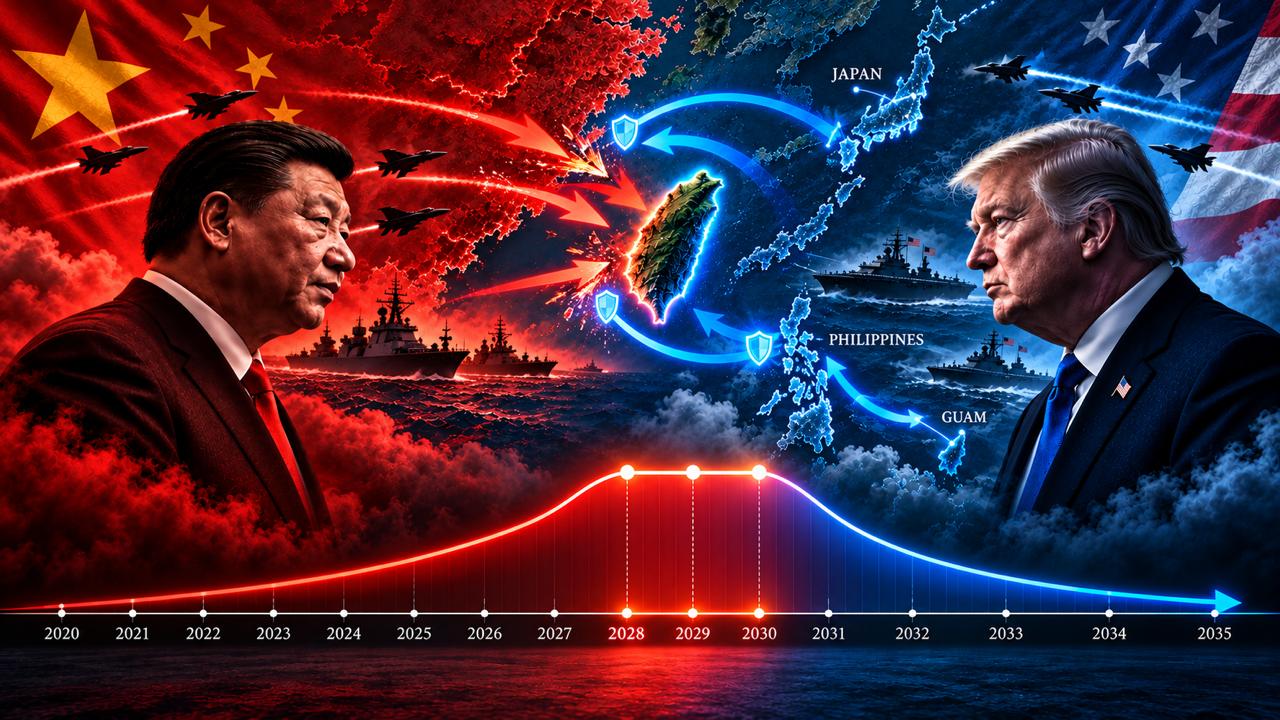
Xi Jinping’s Washington Visit Outlines the Timeframe for the Active Phase of the Confrontation: Beijing Openly Demands Taiwan’s Return
On September 23–25, 2026, Chinese President Xi Jinping held talks with President Trump at the White House during the first Chinese state visit to t...

Netanyahu’s Visit to Abu Dhabi: Israel Builds Partnerships from a Position of Strength, but the Middle East Conflict Is Eroding the Edge of Its Weapons
On September 27, 2026, Israeli Prime Minister Benjamin Netanyahu traveled to Abu Dhabi with the head of Mossad and the head of the National Securit...
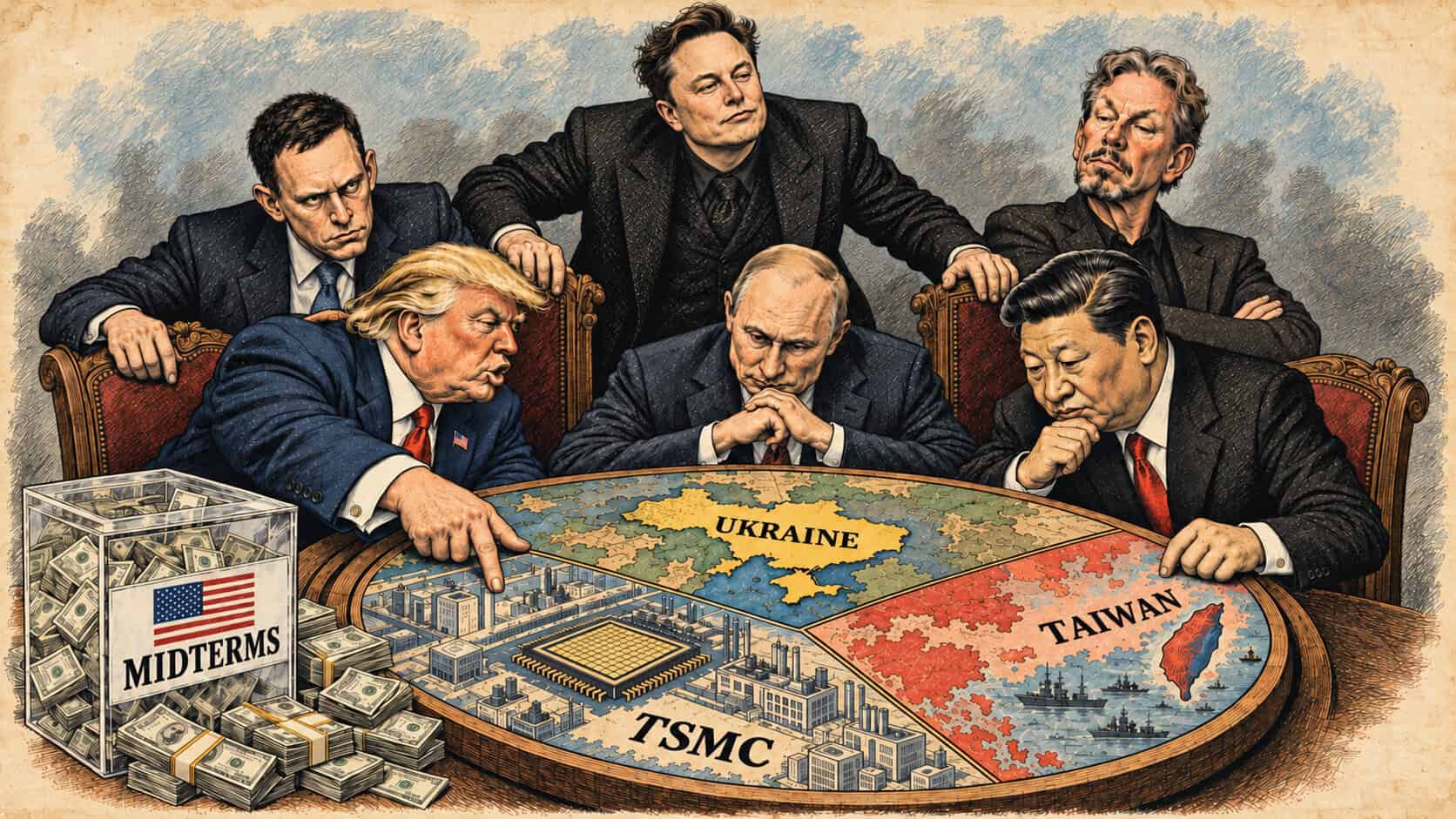
Big Tech Pushes the White House Toward Global De-escalation: The Stance of Tech Capital Shapes the Terms for a Deal Between Trump, Putin, and Xi Jinping
As of October 14, 2026, political advertising expenditures in the current U.S. election cycle, including reserved airtime, had exceeded $10 billion...

Japan Rapidly Builds Up Its Defense Capabilities: Personnel Shortages and Low-Cost Weapons Set the Pace of the Self-Defense Forces’ Modernization
On October 13, 2026, lawmakers from Japan’s ruling Liberal Democratic Party, led by former Defense Minister Itsunori Onodera, established a parliam...
