
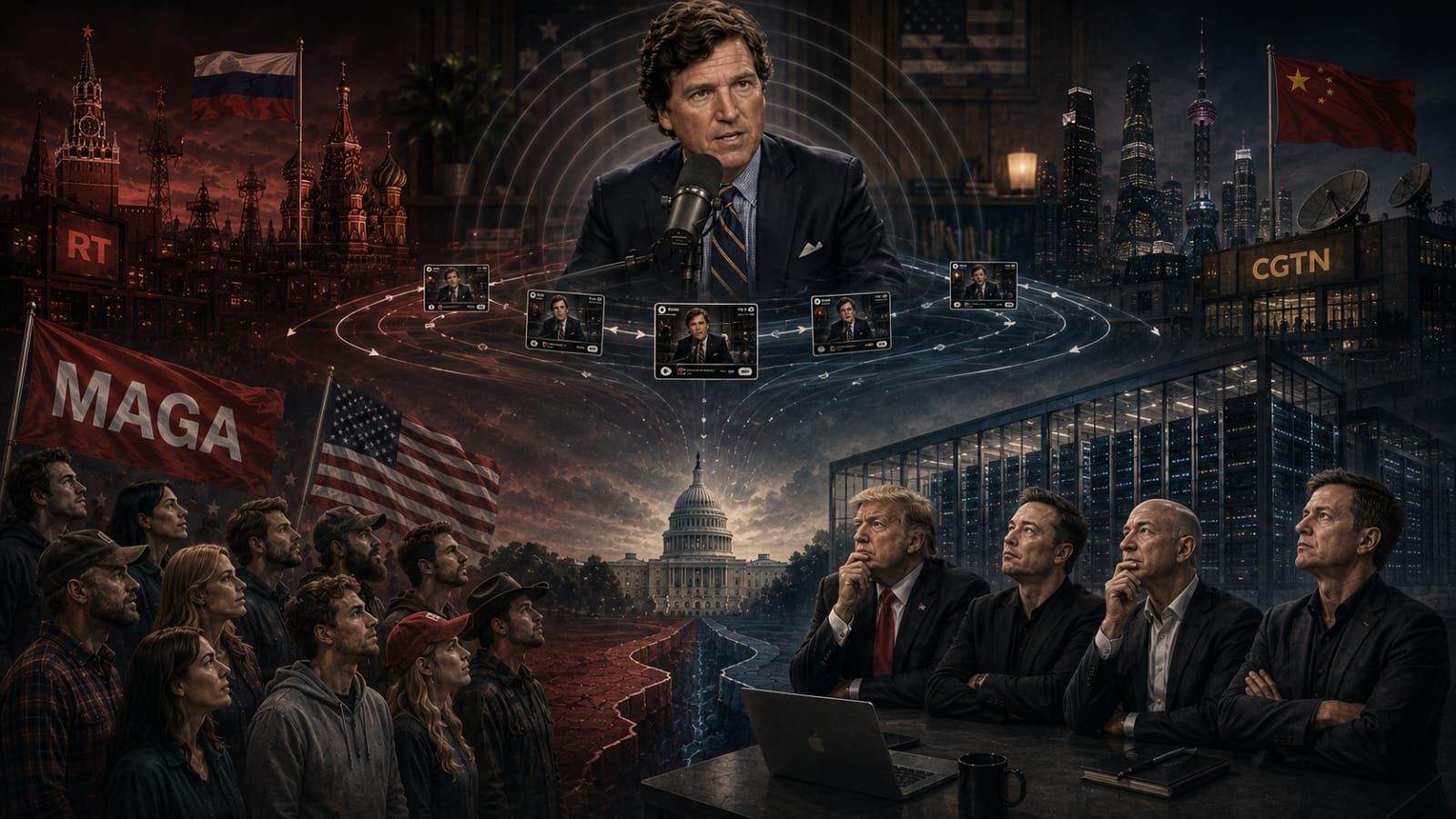
Tucker Carlson’s Manifesto: Autocracies Turn the Openness of American Politics Against Washington

Solid Info






On August 1, 2026, Tucker Carlson met with Marjorie Taylor Greene, Representative Thomas Massie, and former National Counterterrorism Center Director Joe Kent. Four days later he published a ten-point manifesto. Carlson is pressing for tighter federal regulation of the high-tech sector, the kind that would foreclose unchecked development of artificial intelligence. For Washington he proposes stepping back from an active role in the world and staying out of foreign conflicts. The document drew more than a million views on YouTube in its first two days. The consolidation of MAGA isolationists around it strikes at the Republican majority whose cohesion determines whether the campaign against autocratic expansion gets funded at all.
The United States built an advantage over the autocratic axis through the simultaneous expansion of “coercive diplomacy” and active technological development in artificial intelligence, space exploration, and defense-oriented projects.
By combining these avenues for consolidating American influence in geopolitical competition with China, the White House has reduced China’s presence in Latin America and Europe while making it more difficult for Beijing and Moscow to establish themselves at key nodes of global logistics and resource extraction.
At the same time, Washington is expanding the country’s domestic computing base, on which the ability of American standards to shape the global digital environment of the next decade depends. According to the International Energy Agency, the United States accounts for 45 percent of global electricity consumption by data centers, compared with 25 percent for China.
Electricity consumption by U.S. data centers rose to 176 TWh in 2023, equivalent to 4.4 percent of national consumption, and the Lawrence Berkeley National Laboratory projects that it will reach between 325 and 580 TWh by 2028.
Lacking the ability to directly counter the foreign-policy and military-technological course chosen by the White House, the autocratic axis is turning the openness of the U.S. media environment into an advantage of its own.
By contrast with the Russian and Chinese information sectors, which are censored and controlled by the state apparatus, the openness of the American political system allows Moscow and Beijing to circulate fabricated material through controlled networks of accounts, covertly financed influencers, and media outlets whose origins cannot be unequivocally traced to a foreign state.
Once this content reaches American citizens, it is subsequently disseminated by local users, bloggers, and media outlets, causing the narratives embedded in it to begin appearing as part of the domestic American debate.
The spread of narratives promoted by the autocratic axis does not require direct control over politicians or media figures. When the rhetoric of some American speakers coincides with arguments supported by Russian and Chinese structures, statements by those figures receive additional distribution through media outlets and account networks operated by autocracies.
By expanding the audience for arguments that intensify domestic resistance to the White House’s technological and foreign-policy decisions, autocracies steadily weaken the American social consensus and the Republican Party’s internal political consolidation.
Because conservatives still control Congress, the funding and legislative backing for the White House’s policy of countering autocratic expansion depend on coordinated action within the Republican coalition.
The emergence of an autonomous center of power within the Republican Party formed by the conservative wing of the MAGA movement and independent of the White House constrains the pace of American technological development and reduces the administration’s ability to implement geopolitical initiatives more effectively than attempts to counter the Trump team’s policy through external pressure.
The positions advanced by isolationists align with the views of a majority of American voters. Even at the beginning of Operation “Epic Fury,” around 60 percent of Americans said they disapproved of the campaign against Iran, while 52 percent of respondents expressed a negative view of corporate influence in the summer of 2026. At the same time, Americans are expressing skepticism toward U.S. technological projects, particularly the development of the AI sector.
Among those surveyed in June 2026, 64 percent viewed the rapid construction of data centers across the United States as a negative trend, while 71 percent of Americans opposed such projects in their own regions.
For the autocratic axis, an important consequence of the split within the MAGA movement is the Republican coalition’s loss of internal unity. Constructive cooperation between political groups and BigTech elites allows the administration to secure material support ahead of the midterm elections, which the White House seeks to convert into continued control of Congress after the 2026 campaign.
Because Republican electoral success would demonstrate the coherence and effectiveness of the current administration’s course, the autocratic axis benefits from a conflict whose dynamics are pulling part of the MAGA electorate away from the strategy chosen by the White House.
The Technology Sector Has Changed Its View of the U.S.-China Global Confrontation
For Washington, an isolationist approach reduces the range of instruments through which the White House can influence its geopolitical competitors.
As China, Russia, Iran, and North Korea simultaneously expand their military, technological, logistical, and political capabilities, the American presence in key regions of the world remains a deterrent that forces autocracies to account for the risk of a U.S. military, economic, and political response even at the planning stage of expansionist moves.
The “coercive diplomacy” approach has deprived the autocratic axis of several key footholds for expanding its influence and forced Moscow and Beijing to redirect their efforts toward areas where the American presence is weaker, including the Korean Peninsula.
This strategy by the Republican administration raises the opponent’s costs of sustaining further confrontation and gives Washington the ability to offer the democratic bloc its own vision of the future.
Although the expansion of “coercive diplomacy” is achieved through traditional instruments of confrontation, the United States’ ability to carry out its foreign-policy objectives increasingly depends on maintaining competitiveness in the technological sphere, where China is seeking to seize the advantage.
The lead in modern defense and space technologies that the United States maintained for decades now faces China’s growing ability to reproduce technological solutions that until recently were the monopoly of American BigTech companies.
U.S. private investment in AI, which reached $285.9 billion in 2025, still substantially exceeds Chinese investment, which was 23 times lower that same year.
The United States’ 5,427 data centers — ten times the amount of data-processing infrastructure in any other country — give American computing infrastructure a scale that Beijing has yet to reproduce.
Global private investment in artificial intelligence reached $344.7 billion in 2025, with American companies attracting around 83 percent of that amount. In 2025, 1,953 newly funded AI companies emerged in the United States, compared with 161 in China.
The pace of China’s technological deployment presents American BigTech elites and the White House with a shared task: rapidly scaling their own infrastructure, artificial intelligence models, and automation.
The U.S. technology sector, which previously had little reason to support a policy of “coercive diplomacy,” was primarily interested in converting capital, engineering talent, and energy resources into long-term investment in computing infrastructure, software, and the expansion of digital platforms.
The expansion of military campaigns increased competition for the resources needed by BigTech elites without generating a commensurate commercial return for most civilian technology companies.
During the first six days of Operation “Epic Fury,” the Pentagon spent an amount comparable to the cost of constructing the Stargate campus in Michigan, which the OpenAI and Oracle consortium valued at $16 billion. Capital invested in computing infrastructure, however, generates revenue for years and supports the development of adjacent industries, while funds invested in weapons are spent without producing a reproducible economic result.
Representatives of the BigTech sector revised this position once confrontation between the United States and the autocracies became inevitable and the escalation of that confrontation proved to be a consequence of the expansionist ambitions of the autocratic axis.
The position of high-technology elites was also adjusted by the realization that an American defeat in this conflict would be unacceptable, because competition over resources and political influence is now being joined by competition over the right to define the standards of the digital environment.
The quality and speed of training large language models depend on the volume of computation and data available to them. As a result, the AI market is becoming concentrated around several dominant systems that accumulate the largest volumes of synthetic knowledge.
These systems set the standard for the rest of the market. The state whose technologies dominate the open world therefore determines the boundaries of reliable information for billions of people and influences their political views and ideological orientations.
China’s advantage in the competition between AI models stems from the fact that the national firewall’s blocking of American neural networks has transformed the Chinese information space into a closed system in which Chinese artificial intelligence programs answer politically sensitive questions in accordance with Beijing’s position.
BigTech Elites Convert Economic Resources Into Political Influence
Recognition of the interdependence between BigTech businessmen and the American political establishment prompted U.S. technology elites to create political infrastructure designed to lobby for their technological interests and support groups of politicians in both parties aligned with BigTech priorities.
The Leading the Future network, backed by executives and investors from OpenAI, Andreessen Horowitz, and other representatives of the sector, had raised more than $125 million by the end of January 2026.
Affiliated organizations Think Big and American Mission invest in Democratic and Republican candidates respectively. Their objective is to support politicians who favor unified regulation and rapid deployment of AI infrastructure.
A shared interest in preserving the U.S. technological advantage does not eliminate disagreements among companies over the rules governing AI development, because different monetization models, technological solutions, and market positions shape their attitudes toward regulatory restrictions.
In February and July 2026, Anthropic contributed a combined $40 million to Public First Action, which promotes stricter transparency and model-safety requirements, while another segment of the industry is pressing for faster infrastructure deployment and uniform federal rules designed to restrict states’ ability to impose additional requirements.
As a result, disagreements within the American technology sector concern how the U.S. advantage should be preserved, how the costs of complying with new rules should be distributed, and how quickly technological modernization should proceed.
For the White House, the emergence of major technology investors interested in preserving the American advantage in AI, autonomous systems, space technologies, and defense development broadens domestic support for technological modernization.
Peter Thiel, Palmer Luckey, Marc Andreessen, Ben Horowitz, and other representatives of technology capital have directed significant funds toward Republican candidates and political organizations.
The companies with which they are affiliated generate revenue from civilian markets and from government contracts in defense, space, data analysis, and autonomous systems. Federal procurement, AI regulation, export restrictions, and funding for technology programs therefore have a direct impact on their commercial interests.
Palmer Luckey’s Anduril is carrying out a $20 billion contract for the U.S. Army and is participating in the $175 billion Golden Dome missile-defense program, while Peter Thiel’s Palantir supplies data for Project Maven in the United States and NATO.
Because BigTech elites have access to defense contracts and participate in government programs, the confrontation within the MAGA movement has evolved from a conflict over the Republican Party’s foreign-policy course into a dispute over the White House’s broader strategy, whose decisions determine the scaling of production, government procurement, and long-term investment in American technology programs.
Technological Modernization Becomes a Basis for Criticism Among Part of the American Electorate
The technological and financial benefits that BigTech groups have obtained from intensified cooperation with the White House strengthen Washington’s competitiveness in its confrontation with the autocracies. At the same time, they are creating the basis for a more critical American public attitude toward this model of cooperation.
The expansion of the AI sector has triggered employment losses and rising unemployment in industries where young people account for a large share of the workforce.
In March 2026, the development of artificial intelligence became the leading factor behind worker layoffs, while the share of job cuts attributed to the development of neural networks rose from 0.6 percent in 2024 to 13 percent in 2026.
In occupations most exposed to automation, employment is declining fastest among graduates aged 22 to 25. Amazon has eliminated more than thirty thousand positions since late 2025, Salesforce reduced its support division from nine thousand to five thousand employees, and other American corporations are directing increasing amounts of capital toward computing infrastructure while reducing headcount.
Another factor giving the conflict over AI development an increasingly socioeconomic character is opposition to the construction of new data centers.
Only one in three Americans approves of the rapid pace of data-center construction, while the share opposing new server infrastructure in their own communities increased from 42 percent in December 2025 to 71 percent in June 2026.
The main sources of opposition are rising electricity and water prices, land-use concerns, and fears that the number of jobs will decline once construction is completed.
The number of voters unwilling to pay more for electricity and other resources because of the expansion of AI infrastructure is growing. This creates a shared audience for progressive Democrats and the most conservative wing of the MAGA movement, whose support both groups are seeking.
Progressive Democrats are already engaging voters dissatisfied with the accelerating development of AI technologies by calling for restrictions on major technology companies, stronger AI regulation, and moratoriums on certain data centers.
The isolationist wing of the MAGA movement is using public dissatisfaction to criticize White House initiatives.
Tucker Carlson Fuses Isolationism With an Attack on the Tech Elite
Tucker Carlson combines public frustration over the White House’s economic policy with an attack on coercive diplomacy and Big Tech influence, and that combination has made him the leading voice of MAGA isolationism.
After the Iran campaign began, Carlson publicly withdrew his support for the Republican Party, declaring that it had abandoned the America First approach.
Until August 2026, criticism of the White House inside the MAGA movement remained scattered, and each critic lost to the administration alone. Representative Marjorie Taylor Greene resigned early in the year after repeatedly attacking administration initiatives. Representative Thomas Massie lost his House primary over conflicts with Republican leadership. Joe Kent left his post as director of the National Counterterrorism Center over his opposition to the campaign against the ayatollahs’ regime.
The August 5 manifesto pulled those grievances into a single platform, which part of the MAGA isolationist bloc adopted as an alternative to the current course. The isolationist wing has moved from criticizing individual administration decisions to challenging the premises on which Trump assembled his 2024 coalition, and it is now competing with the White House for the same voters.
Republican consensus requires every faction inside the party to hold the line, and holding it grows harder as the MAGA bloc refuses to accommodate Big Tech interests.
Carlson’s name recognition turns his attacks on the White House’s geopolitical priorities and the American tech sector into a ready-made instrument for weakening Republican unity.
Carlson’s channel has more than two million YouTube subscribers and more than eleven million followers on X, and roughly a third of Republicans hold a favorable view of him.
Tucker Carlson Network runs on a $72 annual subscription with revenue between twelve and thirty million a year, and reports average viewership of 56.8 million per episode across all social platforms. The initial push behind those numbers comes from account networks run by Russia and China, which spin up through VPNs to imitate Western viewing behavior the moment a video posts. YouTube and X algorithms read the artificial spike as organic interest and surface the clip to real viewers.
Advertising revenue and subscriptions both scale with reach, which means Moscow and Beijing fund Carlson indirectly by inflating the metrics the platforms pay against. Without that push his reach would fall along with his income, and his editorial line accounts for which material gets amplified and which does not.
Carlson’s personal approval among Americans stands at roughly 17% and continues to slide, and he lacks the resources to build a competitive party of his own. His influence is measured not by how much Americans like him but by how widely other outlets pick up his talking points.
Moscow and Beijing understand that consensus between political groups and technology elites is essential to the United States, because it is what links coercive diplomacy to the country’s technological buildup.
Carlson and other isolationist voices are laying the groundwork to break that link, pulling part of the MAGA electorate away from the White House’s chosen strategy.
The Trump administration is using Vance to hold the support of Republicans with isolationist leanings. The vice president speaks to those voters in their own language while, as part of the administration, lending legitimacy to active American operations abroad.
JD Vance channels much of what Carlson-aligned conservatives believe and holds isolationist views himself; his role in the Iran campaign and his public defense of the administration’s course are obligations of office. He also has a long track record with Big Tech.
Peter Thiel put roughly $15 million into a committee supporting Vance’s 2022 Senate campaign, and his Silicon Valley connections helped secure Vance the running-mate slot in the 2024 presidential campaign.
Vance long argued for an approach in which Washington deals directly with the adversary and trades away allied positions for gains of its own. He used that framework to justify negotiations with Moscow and pressure on Kyiv over territorial concessions, and Carlson’s audience shares the same view. The journalist and the vice president are personal friends, and the present conflict is straining that friendship. Carlson attacks the White House directly, and staying close to a man who publicly goes after your own boss gets harder by the month.
Vance’s image as a figure who balances competing camps inside the Republican movement improves his odds of winning the party’s nomination in the next cycle. His personal rating stands at 32% in YouGov polling, above his disapproval, and 40% of Republican voters back the idea of nominating him.
Vance’s isolationist convictions leave him open to being used from the outside. The media environment in which Carlson articulates those convictions is amplified in large part by Moscow and Beijing, and every campaign in favor of reducing the American presence abroad works to Vance’s political benefit regardless of who is paying for it. A president holding those views entering the White House in 2028 would serve Moscow’s and Beijing’s interests.
Vance’s straddling position does not eliminate the centrifugal pull inside the party, but it does deny Carlson sole ownership of the America First banner and forces him to look for support beyond the Republican electorate.
He finds it among Democratic voters who share his economic grievances against the technology corporations. Carlson maintains a personal friendship with Robert F. Kennedy Jr., who now serves in the Trump administration, and backed his 2024 presidential campaign with his own media platform. A New York Times survey found that 12% of Kennedy’s supporters identified as liberals and either belong to the Democratic Party or lean toward it.
On August 10, 2026, Carlson released an interview with Hunter Biden on his own platform — a figure conservative media had used as a target for years. The former president’s son was given a hearing in the very environment that had built campaigns around his legal troubles.
Reaching past the conservative audience gives the autocratic axis a double return on a single media asset. The split in the MAGA movement weakens the Republican majority that funds the counter-expansion effort, while the erosion of the Democratic core removes the force that could replace that majority.
Carlson’s Rhetoric Allows Him to Gain Support From Part of the Progressive Electorate
The views of MAGA isolationists and left-leaning voters on U.S. foreign-policy priorities and the influence of technology elites are increasingly converging, giving Carlson a foundation for competing with Democrats for this audience.
Carlson reaches this audience through his personal relationship with Robert F. Kennedy Jr., whose 2024 presidential campaign he publicly supported and amplified through his media platform.
Kennedy Jr. built his campaign around criticism of corporate influence and major companies, skepticism toward U.S. assistance to Ukraine and Israel, and support for an isolationist approach to foreign policy.
According to a May 2024 New York Times poll, 12 percent of his supporters identified as liberals. Access to this audience therefore gives Carlson the ability to reach voters who typically remain beyond the influence of conservative commentators.
On August 10, 2026, Carlson released an interview with Hunter Biden on his own platform — a figure whom conservative media had used as a target for years. The former President’s son was given a platform within the same media environment that had built entire campaigns around his affairs.
Promoting Hunter Biden among the audiences of far-right commentators creates a separate center of gravity for some Democratic voters outside the current party leadership. These voters do not move into the Republican camp, but they become more distant from the Democratic Party’s official line, giving Carlson a channel of influence into both partisan camps.
For the autocratic axis, this configuration doubles the return from a single media asset. A split within the MAGA movement weakens the Republican majority on which funding to counter expansion depends, while erosion of the Democratic core weakens the force capable of replacing that majority.
The Iran Conflict Becomes an Instrument for Spreading Isolationist Sentiment
U.S. spending on the campaign against the ayatollahs’ regime and support for Israel has triggered a debate within American society over whether the White House’s Middle East policy serves the interests of ordinary Americans.
Carlson and other isolationist voices are seeking to turn public dissatisfaction with the administration’s Middle East policy into a political demand for a U.S. withdrawal from the region.
Broad public support for these arguments is turning the White House’s Middle East policy into an electoral vulnerability for Republicans ahead of the elections.
An April 2025 UMass Lowell and YouGov poll found that 65 percent of Americans believed U.S. spending on the Middle East conflict was too high, while 42 percent of respondents said that maintaining close relations with Israel does more harm than good to American interests.
Although a substantial share of those who favor revising relations with Israel and ending the campaign against Iran do not share Carlson’s political positions, the intensification of isolationist rhetoric can transform public doubts about the merits of U.S. Middle East policy into a deeper conflict within the country and the Republican Party.
For the autocratic coalition, the consequences of such a conflict are valuable because a decline in American willingness to support Israel reduces pressure on Iran and the Shiite “axis of resistance,” against which Jerusalem has demonstrated the most effective resistance.
A reduction in military, sanctions, and political support for Ukraine, which MAGA isolationists are also seeking, weakens deterrence of Russia and gives the autocracies greater instruments for pressuring the security, political stability, and economy of the European continent.
Isolationist speakers are turning public attitudes formed in response to inflationary pressure, the fuel crisis, and declining living standards into political demands that reduce U.S. willingness to support the partners most actively containing the autocracies and restricting their expansionist plans.
Although the Gulf states do not share the foreign-policy objectives of the autocratic axis, the elites of these monarchies have an interest in Washington aligning its regional policy less closely with Israel’s priorities and giving greater consideration to the interests of America’s Arab partners.
To advance this objective and spread such positions within the domestic U.S. political discourse, Gulf states use lobbying structures and sympathetic media resources.
The Qatari government pays the American lobbying firm Lumen8 Advisors $180,000 per month, and in filings under the Foreign Agents Registration Act the firm reported that it had arranged Carlson’s interview with the Qatari Prime Minister.
Carlson posts each such interview on his own platform, supplementing his criticism of U.S.-Israeli relations with the position of Middle Eastern elites.
The Openness of the American System Becomes a Vulnerability to Autocracies
The domestic political debate intensified by conservative MAGA commentators in the summer of 2026 has simultaneously benefited the autocratic axis, the Gulf monarchies, and isolationists within the United States.
Although none of these interest groups coordinates its actions with the others, the information and propaganda systems of autocratic states employ arguments advanced by isolationist leaders for their own purposes.
The Kremlin established the model of autocracies exploiting content created by others at the beginning of the full-scale invasion of Ukraine. An internal memorandum issued in March 2022 recommended that Russian state media make extensive use of clips from Carlson’s broadcasts because they aligned with Moscow’s narratives about the causes of the war against Ukraine. Since then, this approach has become standard and has required no revision.
In February 2024, the Kremlin gave Tucker Carlson the opportunity to interview the President of the Russian Federation, explaining the decision by pointing to Carlson’s position as distinct from that of other Western journalists.
During proceedings in the Tenet Media case, the U.S. Department of Justice reported that Russian employees of the propaganda outlet RT had covertly financed American conservative opinion leaders, illegally providing them with as much as $400,000 per month.
Among the tasks assigned to these influencers was a requirement to distribute videos featuring Carlson, although the journalist himself appeared in the case solely as the creator of the content.
Alongside the active circulation of clips from Carlson’s programs in Russian media and among Western media outlets cooperating with Moscow, Chinese state media including China Daily, Global Times, and CGTN similarly reproduce the journalist’s arguments as support for their own interpretation of the global confrontation between autocracies and democracies.
Moscow and Beijing select a popular figure whose position already conflicts with the policy of his own government and then amplify his arguments across their networks, state media, and controlled media resources.
Although the White House possesses the administrative instruments and material resources to accelerate technological modernization and expand the use of “coercive diplomacy,” the Trump administration does not enjoy a high level of public support for these initiatives, and that support is declining further under the media influence of MAGA isolationists.
The ability to embed their own narratives within the political debate of democratic states remains an advantage of autocracies for which the West has no symmetrical response. China’s and Russia’s political and information environments restrict access for independent foreign media, opposition organizations, and foreign funding, while the American system remains open to competition among ideas, lobbying, and media entrepreneurship.
This openness remains a source of innovation and allows the administration to correct unpopular decisions, but it simultaneously allows U.S. competitors to exploit existing divisions and increase their political weight for their own benefit.
Washington’s response depends on whether the White House can show voters which threats the American presence abroad is containing and why technological modernization is a condition of the country’s own security.
Growing public resistance to foreign commitments and major technology projects makes it more difficult for the White House to secure congressional support for funding allies, new military programs, and the construction of energy and computing infrastructure.
If this situation persists, it will constrain the United States’ ability to preserve its role as the political and ideological leader of the democratic world and create the risk that the autocratic axis will strengthen its ability to influence the pace, parameters, and trajectory of the global confrontation.
This publication is the result of a partnership between MILITARNYI and SOLID INFO. An extended version is available on the website of the analytical center.

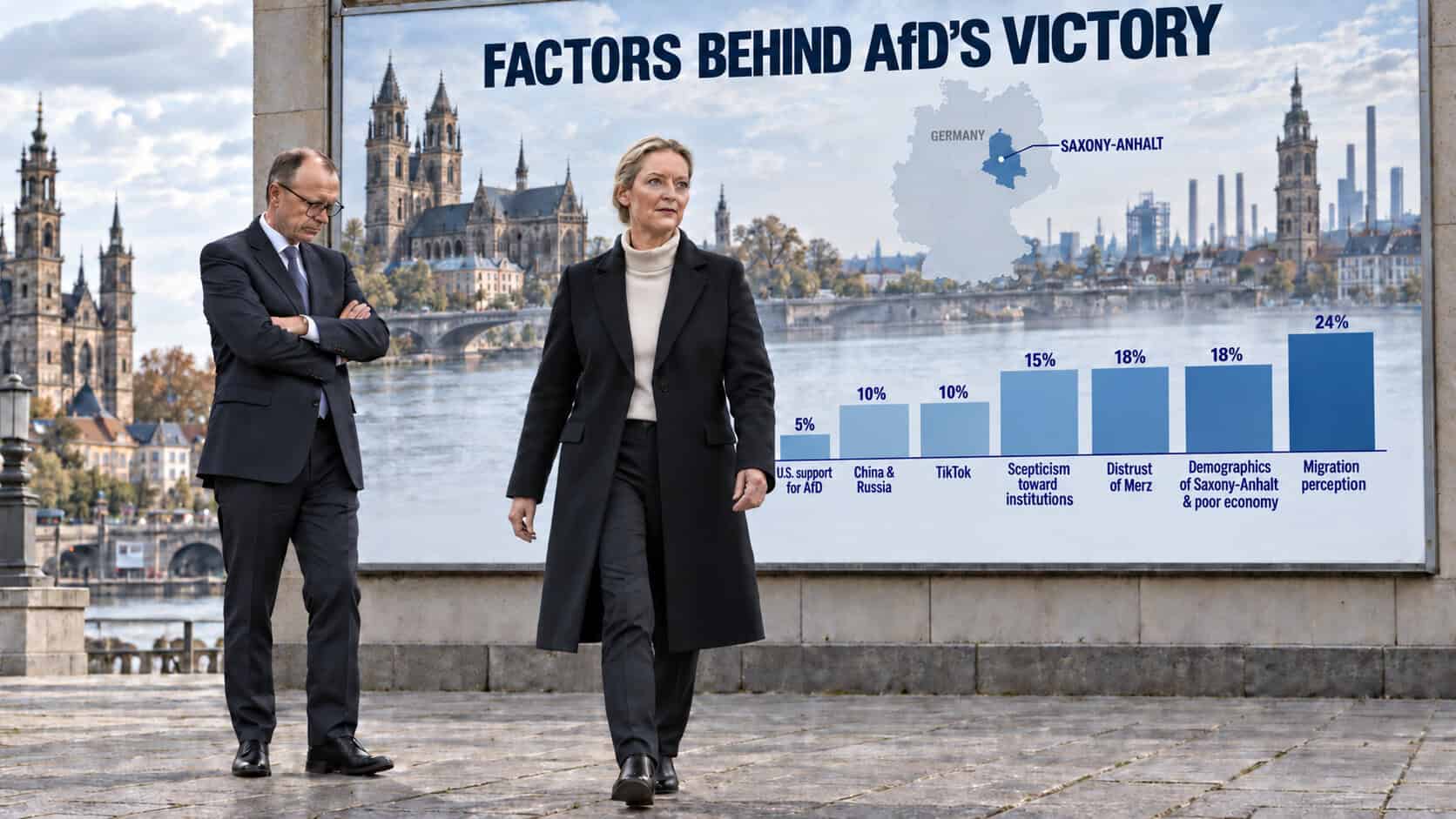

Visits by Senior Washington Officials to Moscow: The Factors Driving the Kremlin’s Rejection of the White House’s Proposals
In late August and early September 2026, three senior U.S. officials visited Moscow, marking a level of concentrated contact in U.S.-Russian relati...
A Sharp Shift in the Dynamics of Global Confrontation Forces Washington to Rethink How It Builds Its Key Partnerships
On September 12–13, 2026, the 18th BRICS Summit was held in New Delhi. Xi Jinping traveled to India to lead the Chinese delegation, marking his fir...
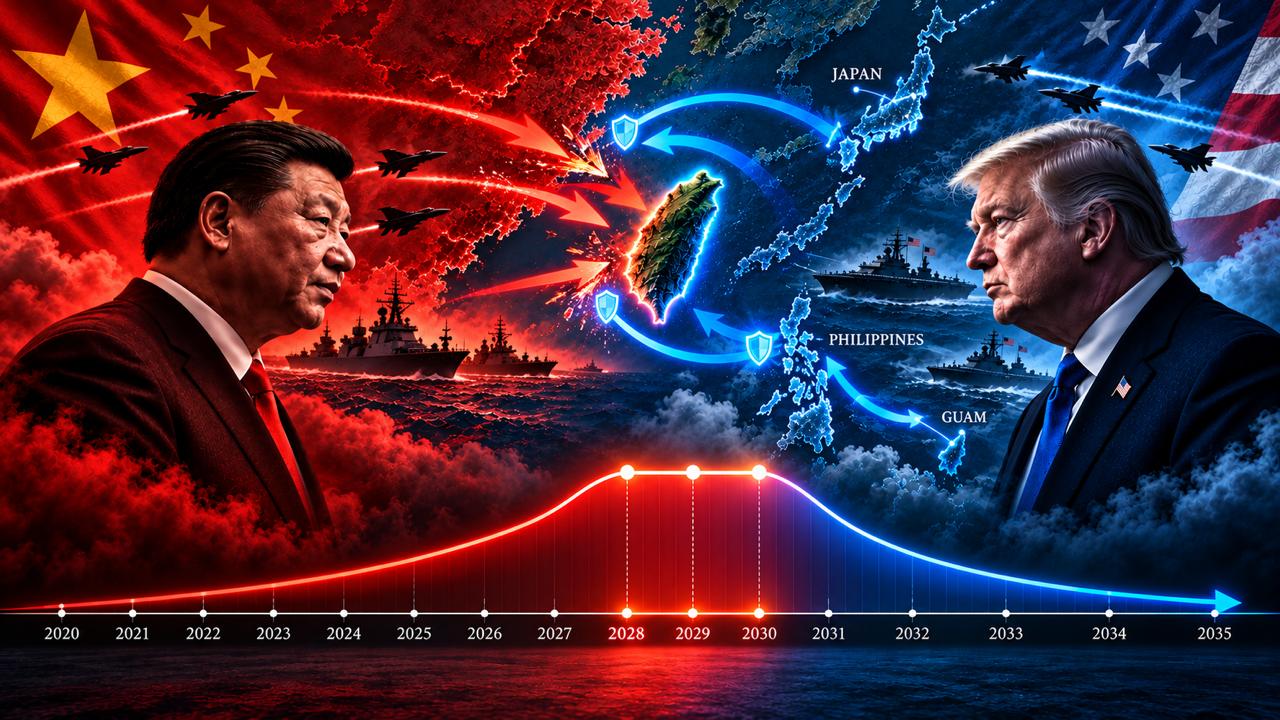
Xi Jinping’s Washington Visit Outlines the Timeframe for the Active Phase of the Confrontation: Beijing Openly Demands Taiwan’s Return
On September 23–25, 2026, Chinese President Xi Jinping held talks with President Trump at the White House during the first Chinese state visit to t...
