
Ruta and Kryla Missiles, Head-On Interceptors: How Destinus is Building Sword and Shield for Europe

Катерина Супрун
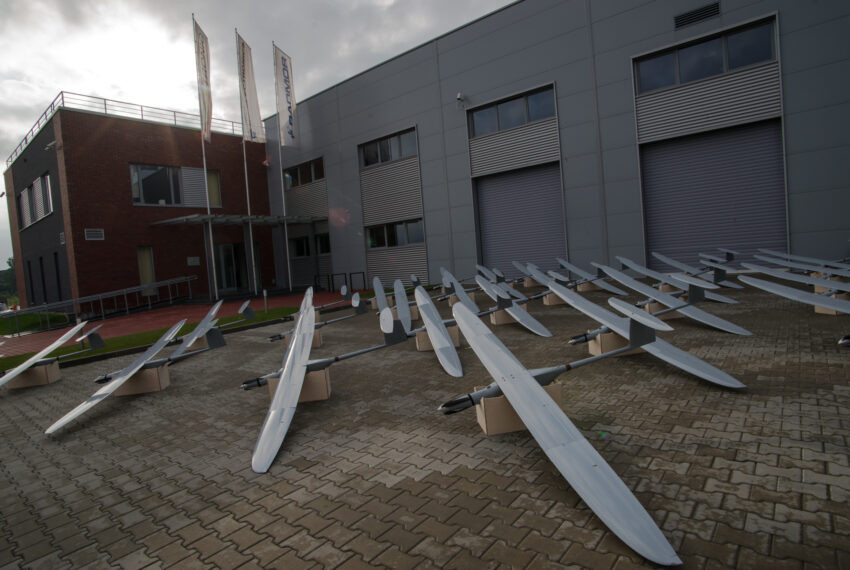



Hornet interceptors, Kryla and Ruta missiles, and deep-strike drones are products of the European-Ukrainian company Destinus. Some of them—the Ruta Block 1 missiles and Da Vinci long-range drones—are already in use in Ukraine, while new products will undergo combat testing. Destinus co-founder, president, and director of strategic development Oleksandr Danyliuk calls missiles as the company’s core product, but the company will not manufacture them solely in-house.
There is already a joint venture with the German conglomerate Rheinmetall—Rheinmetall Destinus Strike Systems. The focus here is on the development and production of the Ruta B3 long-range missiles, as well as on scaling up production of the Ruta B2 and Kryla missiles. The Ruta B3 missile will have a range of 2,000 km and will be capable of carrying a 250-kg warhead.
The Ukrainian branch of Destinus will participate in the missile’s development and operational testing. In addition, key components will be manufactured at the facility in Ukraine. The in-house production of such systems within the EU will create new opportunities for European armies.
“Systems that are critical in a protracted, high-intensity conflict are not only those capable of striking deep into enemy territory, but also those that can be built, stored, transported, and launched at an industrial pace. Rheinmetall’s Destinus strike systems were designed precisely with this logic in mind,” according to a statement on the company’s website dedicated to the development of its joint venture.
To bring all its projects to fruition, the company is developing its own rocket engines and autonomy systems. At Eurosatory 2026 in Paris, Militarnyi met with Oleksandr Danyliuk for a brief interview to discuss the company’s system concepts.

Ruta and Kryla Rockets
Ruta Block 1 rockets are in use in Ukraine. What about the next versions? Are those rocket drones as well?
We no longer make rocket drones, and I’ll explain why. We started with the Ruta Block 1—and that really is a drone-missile. Now we’ve switched to a completely different launch model—the Ruta Block 2, which you see here.
It has folding wings and launches differently. It’s actually built to NATO standards so that large numbers of these systems can be launched quickly and easily at the same time.
This system will be launched from a classic standard container that holds four missiles. In fact, deployment and launch will take minutes—not tens of minutes, but just a few minutes for all four missiles.

This is very important. I personally participate in launches from time to time and understand the danger of staying at a launch position for too long. That’s why it’s important to complete the launch quickly and move to a safe position.
Will the launch containers also be compatible with different platforms?
Yes, these are universal containers designed for various platforms.
Is an airborne launch possible?
We’ve specifically developed the Kryla system for airborne launches. But not for launches from fighter jets or attack aircraft—rather, from military transport aircraft such as the Airbus 400M. This is the European version of the American Rapid Dragon.

The advantage is obvious—instead of individual launches from a fighter jet’s pylons, the launch will be carried out from several containers dropped from a transport aircraft—quickly, in large numbers, safely, and cheaply.
One container holds 16 missiles and is dropped from a military transport aircraft.

It’s dropped—and what happens next?
The missiles are launched from a special container. From four containers, each with 16 cells, we get 64 missiles. It is extremely difficult—practically impossible—for air defense systems to shoot down that many targets. Therefore, the main objective of this system is to overwhelm, exhaust, and destroy air defense systems.
What stage is the Kryla project currently at?
We are currently developing an engine specifically for this missile—a compact one with a unique geometry. We expect to begin deploying the ground-based version by the end of the year. The airborne version is planned for the middle of next year.
Testing or deployment?
In Ukraine, there isn’t much of a difference between the two.
Let me get back to the Ruta missiles. The Block 1 is in use by the Armed Forces of Ukraine. What about the second version?
The Ruta Block 2 is currently in the testing phase.
What about Lord drones that were demonstrated in Saudi Arabia?
In Ukraine, Lord is known as ‘Da Vinci’—we continue to produce it. Recently, we launched another platform, a heavy one—so to speak, ‘Da Vinci squared.’ Today, by the way, it was deployed. But our main focus is on missiles, because we understand that this is what the Ukrainian Defense Forces need right now.
Hornet interceptors will engage targets ‘head-on’
It was recently announced that you are collaborating with the German company Diehl Defence. Specifically, this involves integrating Hornet interceptors as an additional capability into the IRIS-T systems. What stage are the development and the partnership currently at?
We announced our collaboration with Diehl at the exhibition in Berlin, but that doesn’t mean nothing had been happening prior to that. In fact, we’ve been in contact over the past year—they’ve been looking at our technologies, we’ve been looking at theirs, and we’ve been working together. So this is a formal announcement.

The interceptors themselves are already being tested, and these are completely new systems with a very long range—more than 100 km.
It can also function as a loitering munition, in which case the range is 150 km.
The Hornet carries a 3-kg warhead and travels at a speed of 400 km/h.
Why such a large range? What is the primary scenario for using such an interceptor?
There is a classic method of drone interception: the target is moving at a speed of 180–220 km/h—for example, a hypothetical “Shahed”—and the interceptor drones tail it, getting as close to the target as possible.
The next stage in aerial warfare is the transition by the enemy—and, in fact, by Ukraine as well—to turbojet systems. This is the future, and I believe that gasoline engines will gradually be phased out. Strategically, as a company, we have already decided to focus exclusively on high-speed turbojet systems.
Accordingly, the classic approach here is the same—to get on the tail and attempt to execute the same interception model—but we’ve taken a different approach.
We will intercept ‘head-on’—moving into a head-on trajectory to shoot down the target. This allows us to engage not only targets like the classic Shahed, but also turbojet systems and even cruise missiles. The key is to move into a head-on trajectory. This is a completely different technology.
This requires an onboard radar. We’re currently developing it in collaboration with a NATO-affiliated institute.
And here at our booth, you can see the Hornet Block 2—this is the one featured in our project with Diehl.
Is this its actual size? Is this what it looks like?
Yes, this is its actual size; it’s displayed here at full scale. Of course, the paint scheme will be a little different—since pink is already ‘taken,’ we’ll pick some other nice color, maybe lilac. (Laughs—ed.)
It’s important to note that this is a fundamentally different method of interception. That doesn’t mean it’s easy; on the contrary, it’s quite complex. But we’re pursuing this path because it effectively solves many problems and allows us to make the product versatile, rather than having to develop a new solution for every new threat. This is where we’re on the same page with Diehl.
What about deploying the Hornet in Ukraine?
This interceptor is designed for other markets, primarily NATO countries. But deployment in Ukraine is certainly also in the plans.
Hornet interceptors are launched from containers. Is this a universal launch system that can be adapted to various platforms?
Yes, we’ve created universal containers, so they can be mounted on various platforms—vehicles, ships, or simply as fixed installations.
The main demand in the West right now is for installing these systems on ships.
Shortly after our conversation, the company shared footage of the Spanish Navy testing the launch system with Hornet Block 1 interceptors from aboard the frigate Santa María.
These tests focused on evaluating the system’s performance in a maritime environment.
Also, following Eurosatory 2026, Defence Minister of Ukraine Mykhailo Fedorov and his Dutch counterpart Dilan Yeşilgöz-Zegerius visited the Destinus production facility in the Netherlands.
This visit took place against the backdrop of the announcement of a new aid package for Ukraine from the Netherlands totaling €500 million. This aid will be used to fund long-range artillery, drones, and missiles for the Ukrainian Defense Forces.



Xi Jinping’s Washington Visit Outlines the Timeframe for the Active Phase of the Confrontation: Beijing Openly Demands Taiwan’s Return
On September 23–25, 2026, Chinese President Xi Jinping held talks with President Trump at the White House during the first Chinese state visit to t...
A Sharp Shift in the Dynamics of Global Confrontation Forces Washington to Rethink How It Builds Its Key Partnerships
On September 12–13, 2026, the 18th BRICS Summit was held in New Delhi. Xi Jinping traveled to India to lead the Chinese delegation, marking his fir...

Netanyahu’s Visit to Abu Dhabi: Israel Builds Partnerships from a Position of Strength, but the Middle East Conflict Is Eroding the Edge of Its Weapons
On September 27, 2026, Israeli Prime Minister Benjamin Netanyahu traveled to Abu Dhabi with the head of Mossad and the head of the National Securit...
