
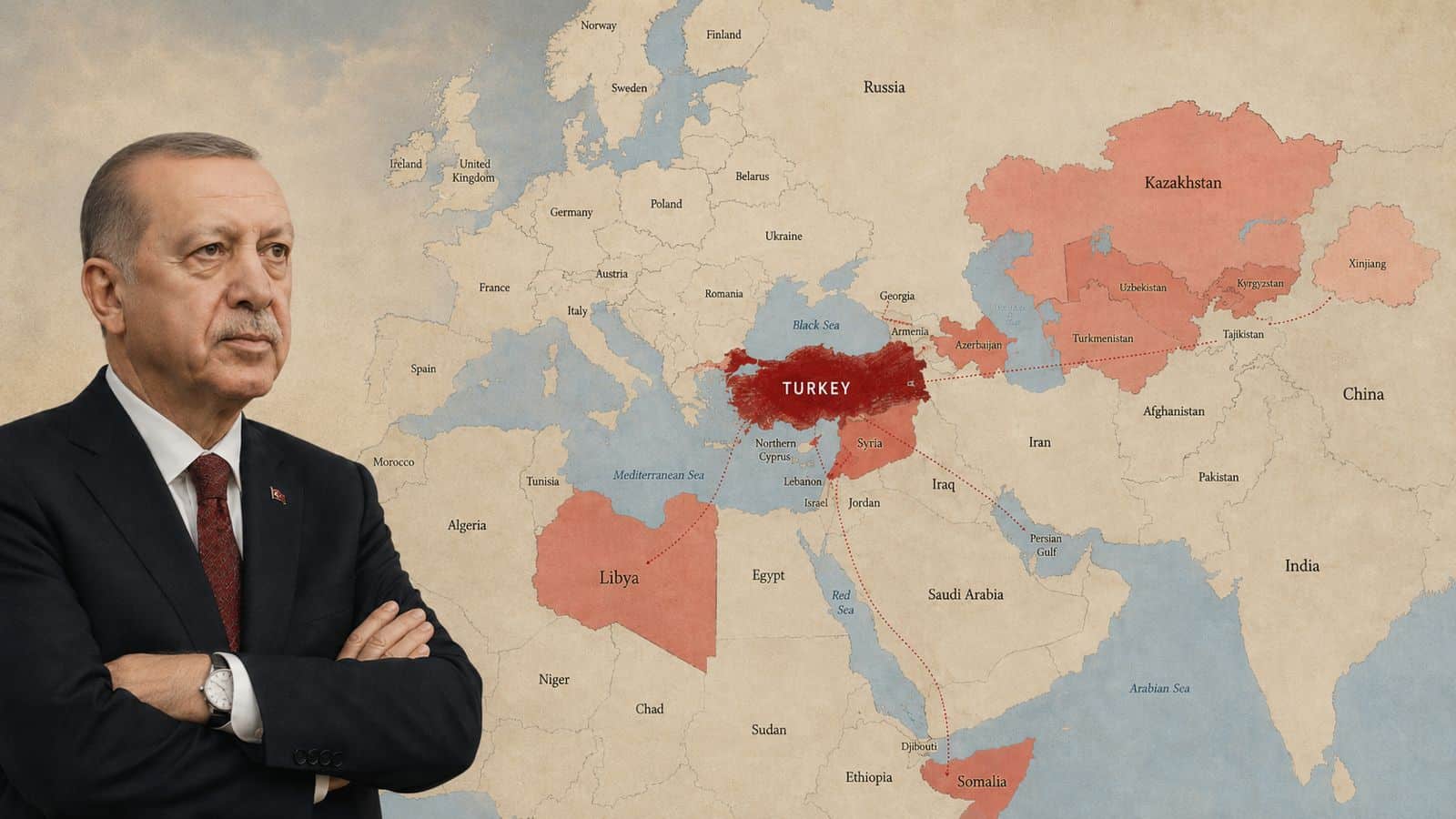
A New Framework for U.S.-Turkey Relations: Ankara Emerges as the Chief Conduit of American Strategy in the Middle East

Solid Info

On July 7-8, 2026, Ankara hosts a NATO summit for the second time in the Alliance’s history. Although the host country is agreed well in advance on a rotating basis, the top-level gathering comes at a moment of steadily expanding military-political cooperation between Turkey and the United States.
Behind this rapprochement lies a factor that has largely escaped expert attention, yet it is precisely what places Turkey in a zone of special strategic interest for Washington. Ankara has proven necessary to the United States in two cycles at once, the current cycle of global confrontation with China and the next one, in which the rapid spread of the Islamic geopolitical dynamic becomes the principal challenge to the open world.
The ability to operate in both arenas transforms Turkey from a traditional NATO partner into a pillar of America’s long-term calculus in the region. The rapprochement is driven by a fundamental restructuring of the model of American presence in the Middle East.
For decades, Israel, the Gulf monarchies, and Kurdish forces gave the United States its projection of influence across the Middle East, but after Operation Epic Fury each of these pillars became dysfunctional.
The crisis of Washington’s existing partnership models opened a window of opportunity for the Turkish government. Ankara is accelerating its pan-Turkic regional momentum, embedding a neo-Ottoman model of influence in states whose territories once belonged to the Ottoman Empire, and entrenching itself in Azerbaijan and Central Asia.
The weakening of Russia and Iran, the collapse of the Assad regime, and the partial loss of combat capability by the pro-Iranian “Shiite axis” cleared the way for Turkey and its key junior partner, Azerbaijan, to reshape the balance of power in the Middle East and North Africa.
Turkey’s rise stands in contrast to Israel’s strategic decline. Despite its diaspora, financial leverage, and decades of embeddedness in American politics, Jerusalem grew less and less inclined to synchronize its moves with Washington’s political needs, and Operation Epic Fury formalized a rift that had been maturing for years.
The Israeli government’s actions, geared toward exploiting a narrow window for pressure on Iran, translated into tangible electoral losses for the Trump team, while Jerusalem grew indifferent to the price its chief ally was paying for this course.
Within the realist framework on which American foreign policy rests, even the closest partner loses its value the moment it begins to inflict systemic damage on Washington’s interests and a more self-sufficient alternative appears.
American support for Jerusalem will endure but become more limited, and the most powerful lobbying organization, the American Israel Public Affairs Committee (AIPAC), is losing part of its influence for the next one or two election cycles.
Turkey is that alternative, a resource-rich, autonomous power with a formidable army and a tightly managed society, while from Israel Washington is prepared to gradually keep its distance.
The expansion of Turkey’s network of influence makes Ankara a fitting anchor for America’s model of delegated regional presence, freeing U.S. resources for other theaters. The two sides’ coordination is tactical in nature. Turkey acts independently of Washington in its dealings with the autocratic axis, yet the narrowing of other pillars leaves the White House little choice but to lean on Ankara, which can shoulder part of the burden of countering the autocratic axis in the region.
Ankara supplies itself with resources and weaponry and therefore requires none of the external upkeep on which Washington’s previous partnerships in the region depended.
Added to this self-sufficiency is Turkey’s place in the next geopolitical cycle, whose defining challenge comes from the Islamic geopolitical dynamic, part of which operates outside that calculus and places religious motivation above economic gain. On this front, Turkey, which combines secular statehood with influence across the Muslim world, becomes Washington’s key partner in the strategy of shaping the architecture of the Islamic dynamic.
Another potential lever for Ankara lies in its kinship with the Uyghurs, a Turkic people of Xinjiang whose largest diaspora outside Central Asia lives in Turkey. Beijing views this kinship as a long-term vulnerability, since the repression of a Uyghur population of nearly twelve million leaves the region sensitive to outside influence built on shared identity.
For the sake of economic ties with China, Ankara has scaled back its support for the Uyghur community, yet in long-range planning the mere potential of this lever sets Turkey apart from other Islamic states.
Washington Builds a New Network of Partnerships to Advance Its Interests in the Middle East
Israel became a less viable pillar of America’s Middle East strategy above all because support for the Netanyahu government’s actions collapsed among American voters, giving the White House grounds, for the first time in the history of the bilateral relationship, to revisit the format of its engagement with Jerusalem.
By early 2026, the share of Americans more sympathetic to the Palestinians had reached roughly 40 percent, three times the 2013 level.
Among Democrats, support for Israel fell from 34 percent in 2023 to 13 percent in 2026; among independents it dropped 12 points over 2025-2026 to a historic low; among Republicans it sank to its lowest level since 2004.
Voter discontent with how Israel is waging its military campaign, together with the Israeli government’s slumping popularity, convinced part of the public that the White House had grown excessively dependent on Jerusalem.
Fifty-two percent of Americans surveyed said the Israeli government influenced the White House’s decision to launch Operation Epic Fury, and 47 percent said the administration supports Israel excessively.
The collapse in support turns close association with the Netanyahu government into an electoral liability for Republicans heading into the midterms.
The reassessment of relations with Jerusalem marks a historic break, with the very principle of American support under revision for the first time since Israel declared independence in 1948.
The model of near-unconditional military and political backing, which for decades weakened Israel’s incentives to align its decisions with U.S. interests, gave way in 2026 to direct White House criticism of the Netanyahu government and demonstrative distancing from Jerusalem’s most controversial moves.
The clearest expression of this shift came in public signals from the top of the U.S. government. On June 18, Vice President Vance publicly drew a line between Israel’s right to self-defense and strikes on civilian districts of Beirut, and the next day Trump made statements aimed at restraining the Israeli government from further escalation in Lebanon.
Measured criticism of the Netanyahu cabinet lets the White House win back some moderate voters and parts of the MAGA base, but it simultaneously weakens a mechanism of U.S. influence projection in the Middle East.
The public demand for recalibrating relations will outlast this administration regardless of which party holds the next one, and Jerusalem can no longer count on the predictability of American support.
The Gulf monarchies cannot compensate for Israel’s loss of its anchor role. The Gulf states are unwilling to become the main pillar of the American presence, because Operation Epic Fury battered their security and economies and eroded their societies’ trust in the United States.
For decades, the United States provided the monarchies a security umbrella, crisis mediation, and access to top-of-the-line weaponry in exchange for political loyalty and stable energy supplies, and high-value arms contracts cemented the bargain.
Between 2009 and 2024, Saudi Arabia purchased $110 billion in U.S. defense articles, more than any other buyer. During Trump’s 2025 Middle East trip, the United States and Saudi Arabia agreed on $142 billion in American arms sales, the largest defense-cooperation deal in U.S. history. Qatar and the UAE also rank among the top five importers of American weapons.
The operation against the ayatollahs’ regime exposed the limits of a model in which procurement substituted for a genuine defense architecture. In the first eleven days of the conflict, Saudi Arabia expended roughly two-thirds of its stock of approximately 730 PAC-3 MSE interceptors for its Patriot batteries, yet never achieved reliable coverage of critical sites against Iranian strikes.
The clearest evidence of the partnership’s limits was Washington’s inability to protect even its own aircraft stationed at Gulf airfields.
By May 2026, 42 American military aircraft had been destroyed or damaged at Gulf airbases after failing to disperse in time under threat of strikes. For decades Washington sold the monarchies air defense, intelligence, logistics, and command systems as a single package that was supposed to guarantee protection, and the recurring attacks on CENTCOM airbases and logistics hubs convinced the Gulf states that the commercial side of American offerings outweighs their actual protective value.
Distrust of American guarantees curbed the monarchies’ willingness to serve as the primary channel of U.S. influence in the region.
A 2025 survey of 40,000 people across 15 Middle Eastern countries found that 77 percent of respondents view U.S. policy as a threat to regional security.
The Gulf states’ interest in preserving a restrained posture toward Iran, together with popular distrust of U.S. policy, led the region’s monarchies to deny Washington the use of their airspace for strikes on Iran.
After the unveiling of the U.S.-Iran ceasefire memorandum, Saudi Arabia rejected the American proposal to enlist Arab states in financing the reconstruction of Iran’s economy.
Washington had counted on a large-scale rebuilding program whose funds would flow substantially to American companies, but the monarchies refused to carry that burden, one more sign of their reluctance to bankroll U.S. regional initiatives.
That restraint drew on the Gaza reconstruction experience. In February 2026, the UAE, Qatar, Saudi Arabia, and Kuwait each pledged at least $1 billion to the American-led Board of Peace, yet by May they had transferred roughly one percent of the promised sums, an episode that hardened the monarchies’ caution toward new commitments to U.S. regional projects.
The economic fallout of the operation against the ayatollahs’ regime further limited the monarchies’ appetite for additional regional roles. The campaign against Iran accelerated capital flight, as strikes on oil and civilian infrastructure stripped the Gulf of its status as a safe destination for investment.
Repairing the region’s damaged energy infrastructure will cost more than $25 billion, and by IMF and Bloomberg estimates, between $180 and $220 billion was pulled out of Gulf markets from March through June 2026.
A shrinking financial base leaves the monarchies without the resources for regional commitments, and the loss of investment appeal further diminishes the Gulf’s value to Washington as a pillar of the American presence.
Kurdish forces in Syria became yet another ally stripped of its role as a channel of American influence. Under an understanding between Washington and Ankara, the United States allowed the Syrian military to launch an operation in Kurdish-held territories.
In January 2026, the Syrian army under the al-Sharaa government took up to 80 percent of the Kurdish autonomous territory, and an agreement between Damascus and the Kurdish-led Syrian Democratic Forces (SDF) obligated the SDF to hand Raqqa and Deir ez-Zor over to central-government control.
A statement by U.S. Special Envoy Tom Barrack confirmed that Washington backed Damascus’s position and narrowed its cooperation with the SDF. The formal justification was the changed military situation. It became possible because the United States, intent on closing ranks with Turkey, rolled back the level of support for the SDF that for years had deterred any move against Kurdish positions.
Kurdish-controlled districts of northeastern Syria long served as a source of crude oil that was exported under the watch of American security structures and financed particular strands of the U.S. presence in the region.
Winding down the Kurdish project stripped that resource base from both the SDF and the structures within the American security establishment that relied on it, so the deal with Ankara simultaneously solved two problems for the Trump team, consolidating control over those structures and ending their financial autonomy from the White House.
At the same time, the preserved autonomy of Iraqi Kurdistan and the U.S. military presence there leave Washington the option of returning to the Kurdish question as a lever of pressure on Ankara should the current engagement with the Erdogan government fall short of expectations.
Turkey’s Rapid Rise Forces the United States to Rethink the Terms of Regional Partnership
Turkey has already built a network of influence across several regions at once, and Washington intends to lean on it rather than rebuild its lost levers in Western Asia on its own.
Filling the vacuum left by the weakening of Russia and Iran in the South Caucasus and the Middle East, Turkey is slotting itself into the role of security and diplomatic broker for local governments, collecting in return new transport corridors and a stake in mineral extraction.
In the border areas most critical to its security, Ankara is creating buffer zones that serve as staging grounds for extending Turkish influence, first and foremost southward.
In Syria, Turkey has secured the position of chief external guarantor of the new government, which opens the reconstruction market to Turkish business and lets Ankara keep an armed presence along its own border.
In the fall of 2025, despite the end of the main phase of Syria’s civil war, the Turkish parliament extended the authorization for military operations in Syria and Iraq through at least 2028.
The al-Sharaa administration looks to Ankara for economic and investment projects, for the development of bilateral trade, and for diplomatic backing in international negotiations. A lopsided bilateral trade, which reached $1.9 billion in the first seven months of 2025, is steadily locking Syria in as one of Turkey’s export markets.
To entrench the dominance of its goods in Syrian markets, Turkey initiated a Joint Economic and Trade Committee with the al-Sharaa government, and Turkish companies have declared their ambition to claim a share of Syria’s reconstruction market, currently valued at $400 billion.
Ankara converted its diplomatic protection into the lifting of a substantial share of the sanctions on Syria after talks between the U.S. and Turkish presidents and foreign ministers in May 2025, lowering the barriers to the return of Western capital.
Economic, military, and diplomatic patronage has turned Damascus into the forward base of Turkey’s regional momentum, through which Ankara’s influence extends into neighboring Lebanon.
Israel’s military campaign against Hezbollah, under way since 2024, has destroyed much of the group’s military-political leadership, its command centers, depots, and weapons-production sites.
The collapse of the Assad regime and the subsequent U.S. and Israeli campaigns against the ayatollahs’ regime cut off the Iranian flows of weapons, equipment, and money that had long reached Hezbollah through Syrian territory.
Although the White House-initiated disarmament of Hezbollah, endorsed by the Lebanese government, has stalled, the degradation of the Shiite group’s coordination and logistics is producing a vacuum of political influence that Turkey is filling at speed.
Ankara is locking in the role of external arbiter in a country where Iranian influence once dominated. Over 2025-2026, the Turkish and Lebanese leaderships stepped up diplomatic contacts, and Erdogan’s dictum that Turkey’s security is decided in Aleppo, Damascus, and Beirut fixed the priority of this vector in Turkish strategy.
In Lebanon, Ankara combines diplomatic mediation, logistics projects, and a limited armed presence. A Turkish contingent has served for twenty years in the UN Interim Force in Lebanon (UNIFIL), and government proposals envision turning Beirut into a Middle Eastern logistics hub for Turkish cargo. Ankara’s first-order task is to shore up Lebanon’s security, with Turkey positioning itself as its principal guarantor.
Anchored on the Middle Eastern front, Ankara is rolling out its network to the north. In the South Caucasus, Turkey is building a transit hub linking the Middle Eastern theater to Central Asia through Azerbaijani and Armenian territory.
Reliable, predictable logistics through the South Caucasus and the Caspian required Turkey to tighten its bond with Azerbaijan, eliminate the regional flashpoint in Karabakh, and restore political and commercial ties with Armenia.
In the first half of the 2020s, the Erdogan government achieved each of those goals. Turkey cemented its partnership with Azerbaijan through the 2021 Shusha Declaration, oversaw the Azerbaijani army’s transition to NATO standards under Turkish advisers, and gained sway over the Zangezur Corridor after the initialing of the Azerbaijani-Armenian peace agreement and the creation of the TRIPP transit route.
Normalization with Armenia under the Crossroads of Peace initiative opened Turkish railways to Armenian exports, and the restored links through Armenia and Azerbaijan are turning the South Caucasus into the connective tissue between the Middle Eastern and Central Asian vectors of Turkish expansion.
Rising trade through the Zangezur Corridor and the Trans-Caspian International Transport Route lifted Turkey’s annual trade with the Central Asian states from $6 billion in 2018 to $14.5 billion in 2025.
Between 2016 and 2024, Turkish investment in the region grew 2.5-fold, and the number of Turkish companies operating there rose from 4,000 to 7,000.
Having made Central Asia a priority destination for its capital and secured stable trade routes across the Caucasus, Turkey gained additional leverage to draw the states of the wider region into its own political orbit through shared energy interests.
Talks on exporting Turkmen gas via the Trans-Anatolian Natural Gas Pipeline (TANAP) envision doubling its capacity from 16 to 32 billion cubic meters, while the Trans-Caspian Green Energy Corridor project is to connect Central Asian power grids with Azerbaijan for electricity exports to Turkey and Europe.
The need for new energy sources is pushing Turkish expansion onto the African continent. Turkey covers only 18 percent of its oil consumption from domestic production, so Turkish capital is expanding extraction in countries with weak institutions and thin technical capacity.
Under a 2024 agreement between Turkish Petroleum and the Somali Petroleum Authority, Ankara secured up to 90 percent of the revenue from future production on the Somali shelf, where Turkish vessels are already conducting deepwater drilling. Civil war and a weak central government threaten those interests, so Turkey keeps enlarging its military footprint in Somalia to protect future oil production and its influence over the shipping lanes of the Indian Ocean and the Gulf of Aden.
In late January 2026, Ankara deployed F-16 fighters to Somalia, the Turkish parliament extended the navy’s mandate in the country’s territorial waters, and the National Security Council formally designated Somalia a strategic priority.
TURKSOM in Mogadishu, Turkey’s largest overseas military base, along with financial aid to Somalia and the blocking of Somaliland’s recognition, shields Turkish assets in ports and energy.
The Somali front has become one of the sharpest in Turkey’s intensifying rivalry with Israel. On December 26, 2025, Israel became the first country in the world to recognize the independence of the self-proclaimed Somaliland in northern Somalia.
For Ankara the recognition was a direct challenge, undercutting the authority of the Somali federal government, whose chief external guarantor is Turkey, and weakening Turkish positions in the strategically vital Red Sea basin.
Ankara led the regional pushback, joining Somalia, Egypt, and Djibouti in condemning the Israeli decision and stepping up its own military and economic presence in Mogadishu.
The expansion of the Turkish presence across Africa, the South Caucasus, and the Middle East inevitably multiplies the points of direct friction between Ankara and Israel.
As Turkey moves into regions where Israeli security and economic networks once operated, Jerusalem loses part of its accumulated partnerships and must hunt more actively for new footholds. The Azerbaijani vector is telling. Israel spent years cultivating close cooperation there and now competes for influence with a far more powerful Turkish network.
A Standalone American Strategy in Libya Becomes Possible Thanks to Turkey
Ankara’s demand for a stable, predictable Libya, the precondition for entrenching Turkish capital there, prompted the United States to test a model of coordination with Turkey precisely in this country, through mediation between the warring armed factions.
The government of Abdul Hamid Dbeibah in Tripoli holds the country’s west thanks to Turkish military support encompassing drones, military advisers, and Syrian mercenaries.
For its part, the Tripoli government in 2019 signed an agreement with Turkey delimiting economic zones in the Eastern Mediterranean, which enlarged Turkey’s maritime area, allowed Ankara to step up seismic surveying and drilling in the region, and laid the groundwork for prospective Turkish-Libyan energy projects.
The maritime accord, concluded alongside a Turkey-Libya memorandum on military cooperation, made it possible to halt the anti-government offensive on the capital and to lock in Ankara’s economic presence in western Libya.
At the same time, the scaling of Turkish economic projects in Libya is constrained by the central government’s lack of control over the country’s east.
Most of the country’s territory is run by the Libyan National Army (LNA) under Khalifa Haftar, which leans on a Russian armed presence.
After the failed 2019-2020 offensive on Tripoli, the LNA’s role shrank to the constant destabilization of the country through oil-terminal blockades and manufactured internal conflicts, which served the interests of the autocratic axis and kept Turkish investments in Libya’s oil and gas sector, power industry, and ports at risk.
The United States, which until 2025 had held back from direct involvement in the Libyan conflict, changed course, opening direct contacts with the LNA to pry Haftar’s forces out of the autocratic axis’s exclusive orbit.
On June 22, 2026, the U.S. president’s senior adviser for Africa, Massad Boulos, met in Cairo with the LNA’s deputy commander, Saddam Haftar, and on June 29 the younger Haftar arrived in Washington for talks with Secretary of State Rubio.
In 2026, AFRICOM staged the Flintlock military exercise on Libyan territory, with forces subordinate to the Tripoli government and the LNA taking part together for the first time.
Through joint maneuvers, moderation of the talks between the Tripoli government and Saddam Haftar, and mediation of the first unified national budget in a decade, the United States is integrating Libya’s east into a single military-political system.
Washington is offering the Haftar family a weighty political role in a future unified government in exchange for curbing Russian and Chinese influence, and it calculates that once the bargain is executed, Haftar’s forces will cease to be a source of destabilization.
Reducing military-political instability directly protects Turkish capital in Libya. Turkish Petroleum has taken a 40 percent stake in two Libyan oil and gas blocks, Turkish contractors run reconstruction projects in the country’s west and east, and deliveries of Bayraktar TB2 drones have anchored Ankara’s military presence on the southern shore of the Mediterranean.
American mediation in Libya is shaping a security model acceptable to both the United States and Turkey, since the plan to reunify the country through a power-sharing arrangement between the Dbeibah government and the Haftar family removes the threat of renewed fighting that had capped the full deployment of Turkish investment.
Libya’s fuel reserves hand Washington a lever over the global energy market. Before the civil war, Libya exported roughly 2.5 million barrels of oil per day, and the country’s consolidation lays the groundwork for returning those volumes to the world market.
After the signing of the unified Libyan budget in April 2026, the United States guaranteed the restoration and security of oil production by Libya’s National Oil Corporation, and the American energy companies ConocoPhillips and Chevron signed new investment agreements extending, among other assets, to oil fields controlled by the LNA.
Turkey opened much of this possibility for Washington, since it was Turkish support for the Tripoli government and Ankara’s consolidation in the country’s west that created the conditions for Libya’s reunification and the return of its oil to the world market.
Restoring full-scale production in one of the world’s most resource-rich countries will help push oil prices down and soften the impact of the Gulf fuel crisis on the democratic bloc.
Libya is becoming one more tangible example of Turkish expansion delivering a direct material payoff to Washington. It is precisely Ankara’s ability to convert its regional presence into concrete economic opportunities for the United States that sets it apart from Israel, whose partnership increasingly registers on Washington’s ledger as a cost.
At the same time, American corporate investment in Libyan hydrocarbons belongs to a broader strategy of locking in U.S. influence over key production regions and energy-transport routes.
Taken together, these levers give Washington the capacity to adjust global prices and supply routes, an indirect instrument of pressure on China, whose economy remains dependent on energy imports.
Turkey’s Domestic Stability Makes the Erdogan Government a Predictable Partner
Turkey’s value to Washington as a long-term partner is reinforced by the predictability of its political system, in which the risk of a sudden foreign-policy reversal is reduced to a minimum.
Since the start of his presidency, Erdogan has consolidated power by weakening the opposition, through the suppression of the 2016 coup attempt, the 2025 conviction of Istanbul mayor Ekrem Imamoglu, and the taming of mass protests.
Although Erdogan’s political opponents act in disarray and lack the means to rally the public against the incumbent government, Turkish youth remain the most oppositional group in society, favoring democratization and closer ties with the EU.
More than 72 percent of young Turks want to live in a secular state on the European model, and more than 60 percent are ready to emigrate. Yet the mood of the young and of the more affluent urban population does not convert into political change, because the system limits the opposition’s ability to shape decisions.
For the White House, the durability of Erdogan’s rule and the constancy of the Turkish government’s course make Ankara a predictable long-term partner.
The absence of any real risk that elections will upend Ankara’s foreign-policy priorities allows Washington to fold Turkey into a long-horizon strategy for projecting U.S. influence across the Middle East.
The U.S.-Turkey rapprochement is accelerating at the very moment Washington has exhausted its traditional means of projecting influence in the Middle East.
With the strategy of relying on allies who shared American strategic aims having run its course, Washington is shifting to partnership with a regional political force that has its own agenda and is building an independent system of influence. The chosen model lets the United States keep its regional presence at a lower cost in resources that Washington needs to pursue its geopolitical interests beyond the Middle East.
Behind this choice lies a calculus aimed at the next geopolitical cycle, whose principal challenge is an Islamic political dynamic largely beyond the reach of economic levers. It is here that the bet on Ankara turns from a tactical decision into strategic preparation for a competition whose contours are only beginning to emerge.
This publication is the result of a partnership between MILITARNYI and SOLID INFO. An extended version is available on the website of the analytical center.

Visits by Senior Washington Officials to Moscow: The Factors Driving the Kremlin’s Rejection of the White House’s Proposals
In late August and early September 2026, three senior U.S. officials visited Moscow, marking a level of concentrated contact in U.S.-Russian relati...
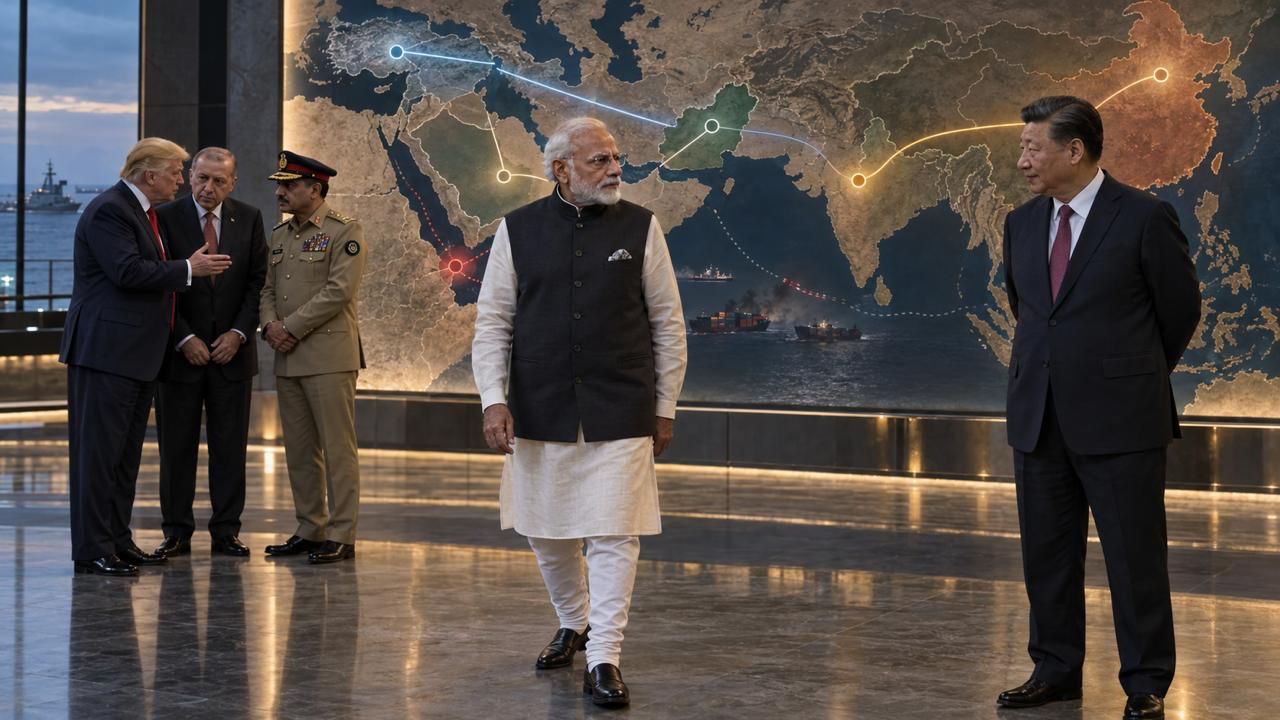
A Sharp Shift in the Dynamics of Global Confrontation Forces Washington to Rethink How It Builds Its Key Partnerships
On September 12–13, 2026, the 18th BRICS Summit was held in New Delhi. Xi Jinping traveled to India to lead the Chinese delegation, marking his fir...
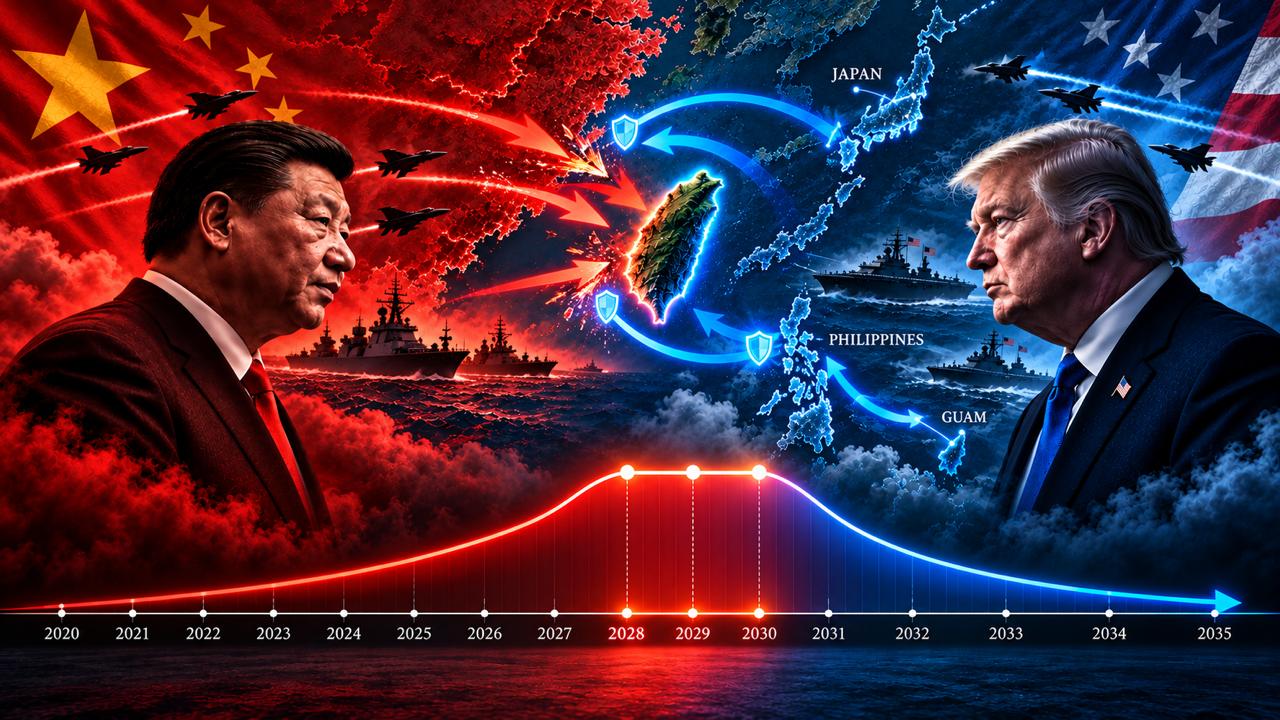
Xi Jinping’s Washington Visit Outlines the Timeframe for the Active Phase of the Confrontation: Beijing Openly Demands Taiwan’s Return
On September 23–25, 2026, Chinese President Xi Jinping held talks with President Trump at the White House during the first Chinese state visit to t...
