
The White House Armenia Strategy: The U.S. Stakes Out the South Caucasus as a Zone of Its Own Interest

Solid Info




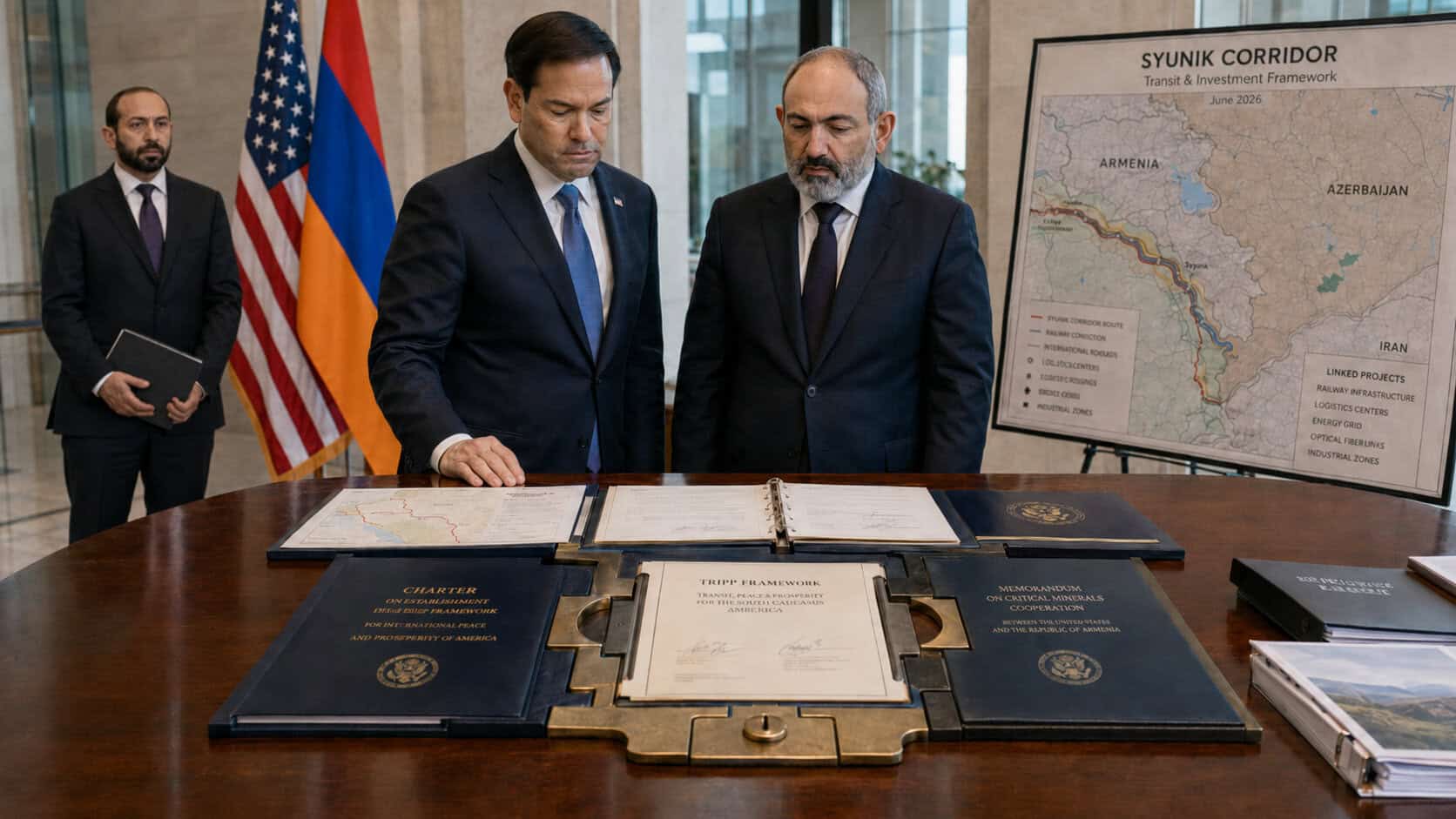
On May 26, 2026, U.S. Secretary of State Marco Rubio arrived in Yerevan, where, together with Armenia’s Foreign Minister Ararat Mirzoyan, he signed a Charter on Comprehensive Strategic Partnership, initialed the framework agreement on the TRIPP transit corridor, and signed a memorandum on the mining of critical minerals and rare earth elements. Ten days before the parliamentary elections of June 7, the parties locked in a package of agreements under which the U.S. government receives a majority stake in the company operating the TRIPP corridor, while Pashinyan’s government receives the political backing of the democratic camp on the eve of the vote.
In the post-Soviet space, this is the first case in which the United States is carrying out a large-scale economic project that gives it leverage over a country and publicly marks that country as a zone of special American interest. Instead of backing loyal governments, Washington establishes its own ownership interest in a project of national scale whose size equates it with the state as such. Any action against the project becomes a violation of American interests, and any attempt to reverse course places the government in a posture of direct confrontation with Washington.
The model is unfolding ahead of the elections with an explicit articulation of support for the incumbent government. On May 28, 2026, Trump called Pashinyan a friend and a reliable partner on Truth Social, urged Armenians to vote for him, and wrote that his reelection serves Washington’s interests. For the first time since the start of the new term, the Republican administration has publicly backed a specific candidate in an election in a post-Soviet state, in a region that has traditionally remained a sphere of influence of Russia and China.
This approach was set in motion by the Armenian-Azerbaijani negotiations under American mediation in the summer of 2025. The peace agreement between Baku and Yerevan and the corridor plan — the development rights to which went to TRIPP Development Company, with a U.S. majority stake — cemented Armenia’s relations with the United States before the elections, alongside existing contracts, the participation of American capital, and access to Armenian rare earth deposits beyond the Chinese monopoly.
Washington’s strategy in the region mirrors the one Rubio promoted toward Latin American states. During the 2025–2026 election campaigns in Chile, Honduras, and Bolivia, the White House signaled support for candidates acceptable to the United States while the electoral process was still under way, without waiting for the outcome. The fact that it was Rubio — the architect of this strategy — who visited Armenia, together with the agreement in Washington and JD Vance’s negotiations, demonstrated the U.S. readiness to extend the early-entrenchment model to regions that for decades had remained points of economic and logistical influence for autocracies. Success in the South Caucasus would provide grounds to transfer it to other post-Soviet states and to the Kremlin’s traditional strongholds.
The parliamentary elections of June 7 do not decide Armenia’s foreign-policy vector — society has already settled that question, as more than 70% of citizens support a course of integration with Europe. What is distinctive about these elections is that there is no clear alternative to Pashinyan within that course. He is the one who led the country through its break with the Russian orbit and most consistently embodies the pro-European line, while the opposition forces are associated with a return to Moscow, which lost its electoral appeal after Nagorno-Karabakh.
The vote decides not the direction but how firmly the team will retain control of the government, and on what terms partners will gain access to the strategic assets of the South Caucasus. The coming to power of an opposition coalition of Karapetyan, Kocharyan, and Tsarukyan would not open room to revise the agreements, because the cost of revisiting them is built in up front and remains extremely high for any composition of government.
The Absence of a Consolidated Pro-Russian Bloc in Armenia Deprives Moscow of a Foothold
The ruling Civil Contract party begins the campaign with a high level of unpopularity for the Prime Minister and, at the same time, the best results of any party. A poll by the International Republican Institute (IRI) in early May 2026 records 23% of undecided voters and roughly 40% of potential boycotters. Pashinyan’s personal rating has fallen to 10–17%, compared with 82% at the start of his first term, yet support for Civil Contract holds at 28–32%. Combined sympathy for the three main opposition forces does not exceed 36%, while IRI projects their election result at just 10% — the gap is explained by the high share of opposition supporters among those who plan to boycott or have not yet decided.
The paradox is explained not by Pashinyan’s popularity but by the public consensus on the country’s course and the weakness of his opponents. About 72% of citizens support EU accession, and despite low engagement in electoral processes, a majority are prepared to personally vote for membership in a referendum. Voters hold the government responsible for economic problems and the defeat in Nagorno-Karabakh, but the strategic vector is endorsed by most of society. The electoral system works additionally in the leader’s favor — the votes of forces that fail to clear the five-percent threshold are redistributed to the winners, and the three pro-Russian parties are going into the elections without a single bloc.
The weakness of the pro-Russian camp stems from the absence of a political force willing to build a campaign on a return to the Russian orbit. Robert Kocharyan, a former president and a figure from the Karabakh clan, relies on an electorate whose legitimacy was undermined by the fall of Nagorno-Karabakh in 2023 — without Russian intervention, despite the presence of its peacekeeping contingent. Samvel Karapetyan, a billionaire and owner of the Tashir Group, leads Strong Armenia, the only opposition force capable of clearing the threshold, but criminal charges, house arrest, and the nationalization of part of his assets have narrowed the campaign’s financial base. Gagik Tsarukyan, the founder of Prosperous Armenia, remains a businessman rather than a politician. None of them advances the pro-Russian vector as an advantage, because after 2023 that association became a losing one on the Armenian electoral field. Moscow approaches the vote without a figure it could publicly rely on, and this reproduces the pattern of its displacement from other zones of influence, from Syria to the South Caucasus.
Russia’s tactic of economic coercion against Armenia reproduces the model of ultimatum pressure on Ukraine ahead of the Vilnius Eastern Partnership Summit in 2013. In response to Rubio’s visit, the Russian government threatened to revoke the preferential regime for gas supplies, and the Russian President declared that membership in the Eurasian Economic Union is incompatible with a course of integration with the EU. In parallel, Moscow is tightening restrictions on Armenian food exports and is considering suspending Armenia’s membership in the EAEU. The ultimatum confronts Yerevan with a choice between two geopolitical dynamics while simultaneously threatening the loss of export markets and fuel resources.
For the pro-Western majority, this pressure has the opposite effect. It confirms the very fact of the dependence the country is seeking to escape, and it converts not into a course correction but into a stronger demand for a final break. The pro-European majority forms the social reserve prepared to withstand temporary losses as the price of breaking free from Russian influence.
The very intensity of the pressure reveals the institutional weakness of the Kremlin — the loss of Armenia could have been foreseen at the moment Moscow withdrew from defending Nagorno-Karabakh despite its obligations under the CSTO. The fact that the Kremlin did not anticipate the consequences and is now compensating with pressure points to the absence of long-range strategic planning. Unlike in 2013–2014, when European states failed to build alternative routes before Russia turned Ukraine’s dependence into an instrument of coercion, this time Washington, Brussels, and Ankara are preparing measures in advance.
Squeezing Russia out of its traditional zones of influence also narrows the space available to China, which in its own calculations relied on Moscow’s ability to hold the shared periphery.
The South Caucasus shows Beijing that the partner it counted on cannot hold even its own rear, and China’s wager on Russia’s weight in the confrontation with the United States loses its footing. In a strategically important region, China yields ground to its principal competitor, and this marks the line beyond which the autocratic axis can no longer hold the perimeter of its own control.
The Armenian Lobby Becomes a Political Asset for the Republican Party
Despite the course Trump has proclaimed of winding down soft-power institutions, Armenia is becoming yet another country where the United States is compelled to return to cultivating them. Backing a government during a single electoral cycle does not lock in a state’s foreign-policy orientation unless it is reinforced by structures that outlast a particular composition of power. That is why Washington is building a foundation that does not depend on the outcome of individual elections, combining property assets, diaspora capital, and security commitments into a single mechanism for holding Yerevan’s course.
What sets the U.S. Armenian community apart is that it builds its influence not on numbers but on the density of its ties — a cohesive community with an extensive network in business, finance, and law, capable of acting in concert through private channels. Historically, this resource worked mainly for the Democratic Party. Washington’s Caucasus strategy changes that alignment — a shared interest around the Armenian course gives Republicans access to a community that previously oriented itself toward their opponents, and it is precisely the capture of this resource that makes the Armenian track valuable to the party regardless of its weight in the Caucasus itself.
For Secretary of State Rubio, the Caucasus track removes an internal contradiction in Republican policy, in which a hard line against the autocratic axis must be reconciled with the skepticism of part of the party toward foreign commitments. By presenting a presence in the Caucasus as an investment project with measurable returns, the Secretary of State translates containment into categories acceptable to the business wing of the Republicans.
As a result, the public discussion around Armenia in the United States is increasingly conducted in the language of investment and risk — a language set by the Armenian lobby itself.
One of the most influential financiers of Armenian descent, who headed the insurance giant MetLife and the U.S. Pension Benefit Guaranty Corporation, Steven Kandarian links Armenia’s interests to the categories of risk, return, and asset protection through which the American financial sector evaluates foreign-policy decisions.
The political weight of the Armenian diaspora is also reinforced by its ability to finance campaigns and work with Congress on the model of ethnic lobbying structures such as the pro-Israel AIPAC. The Armenian Assembly of America relies on major donors of Armenian descent and advances an agenda in which support for Armenia is combined with American security and investment priorities.
The Armenian National Committee of America (ANCA), one of the oldest and traditionally pro-Democratic diaspora structures, backed Rubio’s nomination for Secretary of State in 2025. For a community that had worked with the Democrats for decades, this was a notable step toward the Republicans and proof that the Caucasus strategy gives the party access to a previously unreachable resource.
The public support for the TRIPP project from the Hovnanian family, one of the largest development fortunes of Armenian descent in the United States, showed that diaspora business, too, is ready to stand alongside American capital in the Caucasus.
Rubio himself was for a long time a co-author of bipartisan resolutions condemning Azerbaijan’s actions in Nagorno-Karabakh, supported a bill to protect Armenia (S.3000), and called for Magnitsky Act sanctions against Azerbaijani officials — and this cooperation gives him the electoral support of a cohesive community and a channel of communication between Republican business elites and the diaspora.
Prospects for Developing the “Armenian Corridor”
The entrenchment of the United States in the Caucasus directly strengthens Europe’s energy security. The South Caucasus remains the only region of the post-Soviet space whose logistics and resources allow the United States, the EU, and Turkey to reduce their dependence on Russian infrastructure, so backing the Armenian government becomes part of a broader restructuring of transit between the Caspian and the European market.
Azerbaijan remains a key gas supplier for European diversification, which since 2022 has relied on the Southern Gas Corridor. But Baku’s capacity is limited by the structure of its production — in 2025 the country produced 51.5 billion cubic meters, yet the bulk was absorbed by domestic consumption and supplies to Turkey, while only 12.8 billion reached the EU, less than the year before.
The existing infrastructure is operating at its limit, and this volume is not enough for Europe’s diversification. The stated goal of increasing supplies to the EU to 20 billion cubic meters by 2027 requires new capacity, and Armenian transit offers a route that links the Caspian, Nakhchivan, Turkey, and the European market without passing through Russian or Iranian territory.
The Igdir–Nakhchivan pipeline, launched in March 2025 with a capacity of about 730 million cubic meters per year, has already connected Turkey to the Azerbaijani exclave, and the project documentation provides for doubling its capacity after expansion through the Zangezur Corridor, along which the TRIPP route will run. This will cement Ankara’s role as a transit hub between Europe and the Caspian and reduce the space for Russian and Iranian interference. The route resolves a key condition — Turkmen gas will be supplied to Europe across the territory of the Caucasus states and Turkey, without creating a new dependence on states of the autocratic axis.
The TRIPP Corridor as a Mechanism for Irreversibly Locking In Armenia’s Course
The structure of the TRIPP agreements is subordinated to the logic of locking in an American presence over the long term. The right to develop the corridor has been transferred to TRIPP Development Company, in which the United States receives 74% of the capital while Armenia retains 26%. The initial term is 49 years, with the possibility of an extension for another 50, after which Armenia’s share rises to 49% — together this forms an arrangement lasting up to 99 years. The route runs along a 43-kilometer stretch through Syunik, along the border with Iran.
Two documents have different legal status. The baseline 74% stake and the operator structure were fixed by the Implementation Framework signed in Washington in early 2026, while on May 26 in Yerevan the parties initialed the interstate agreement on TRIPP — the next step after the January signing, but not yet the final, ratified agreement. The process is at an advanced but unfinished stage, which makes the outcome of June 7 a direct factor in its final formalization. The combination of a majority stake with investment mechanisms already in motion complicates any sharp reversal. Breaking a 99-year concession with 74 percent American capital would mean arbitration suits, an exodus of investors, and direct confrontation with the United States — a pro-Russian cabinet would pay that price more dearly than it would gain from a return to the Russian orbit.
The Armenian corridor at the same time brings the American presence up to the Iranian border. According to IRI, in 2025 53% of Armenians named Iran their main political partner and 49% named it their key security partner, reflecting the growth of its role against the backdrop of the decline of Russian guarantees after 2020. Tehran has consistently characterized a direct border with Armenia as its own red line. The U.S. entrenchment creates the potential for deploying military and intelligence infrastructure near Iran’s northern border, on a flank that Tehran regarded as a secure rear, and turns Yerevan’s rapprochement with the United States into a direct security concern.
The Caucasus is simultaneously intercepting air transit. Operation Epic Fury on February 28, 2026, disrupted air links across the Middle East — Dubai’s airport sustained damage from Iranian drones, regional traffic in the Persian Gulf fell by more than 20%, and leading carriers restored most routes only in May.
Armenia’s Zvartnots is being expanded on a large scale — in January 2026 the government extended the concession to 2067 with the operator’s commitment to invest about $425 million.
Although the operator is the Argentine company Corporación América Airports rather than an American structure, the development of an air corridor independent of Russia and Iran reinforces the economic rationale for a pro-Western course. In parallel, Azerbaijan is expanding Heydar Aliyev Airport, and Turkey is building up Erzurum, Kars, and Igdir — control over regional air transit, which previously belonged almost exclusively to the Middle East, is becoming an instrument of political influence for the Caucasus and Turkey.
Losing its economic and security levers, Russia is shifting its main effort to cyberspace. Against the Armenian elections it is waging a large-scale disinformation operation involving the same networks that operated against elections in the United States, Germany, France, and Moldova — Storm-1516, the Foundation to Battle Injustice, and Matryoshka. The information campaign is supplemented by attempts to influence the vote through employers linked to pro-Russian oligarchs and by the transport of tens of thousands of voters from Russia, some of whom Armenian security agencies have blocked. The effectiveness of the technologies themselves is meanwhile increasingly in doubt — the same toolkit produced no result in Romania, Hungary, and Moldova, where the repeated use of recognizable schemes raised voters’ wariness and exhausted their effect.
Creating a Logistics Corridor Through Armenia Affects Beijing’s Middle Corridor Project
The current route between the Caspian and the EU passes through Georgia and its Black Sea ports of Batumi and Poti. This route is a forced one and not optimal for the West, given Tbilisi’s political trajectory.
Georgia is drifting toward China and Russia — in July 2023 it concluded a strategic partnership agreement with China, and the ruling party is steadily moving closer to Moscow.
Logistics through Batumi objectively strengthens Georgia, and with it Chinese and Russian influence in the region, because it is through Georgian territory that the Baku–Tbilisi–Kars railway artery runs, a key link of the Middle Corridor.
Shifting transit through Armenia strengthens Azerbaijan as a transit state independent of Georgia and reinforces Turkey, which gains direct transit across the Turkic belt from Azerbaijan via Nakhchivan, while Armenia, as the weaker party, falls under Turkish logistical influence.
The United States has no direct logistical interests in the Caucasus, but it gains a number of strategic advantages — it weakens Russia by reducing its transit monopoly and energy revenues, obtains control over a critical route through a majority stake in the corridor’s operator, and acquires the ability to monitor flows of goods, including Chinese ones.
For China, this situation is a complication but not a loss of its positions in the Caucasus. Beijing signed a strategic partnership with Armenia in August 2025 and with Azerbaijan in April 2025, and both states flexibly balance between China and the United States. Trade between Armenia and China grew from $1.43 billion in 2022 to $2.28 billion in 2024, yet Armenia is not for Beijing the central node of the Middle Corridor, which runs through Georgia.
American management of the corridor through Syunik narrows Beijing’s ability to operate flows, part of which shift to a route beyond its influence. China’s positions in Georgia and Azerbaijan are preserved, but control over the Syunik segment passes to the United States, and the full scale of the consequences of this for Chinese logistics is revealed in the broader configuration of bypasses of the sea lanes.
The Armenian Factor Becomes a Lever of Pressure on the Georgian Regime
Soft power is formed over decades and does not lend itself to rapid deployment at the needed moment, so its ready-made infrastructure is a strategic asset in its own right. Armenia is such an asset, one the United States acquires with the change in Yerevan’s foreign-policy course. The Armenian community is distinguished by its ability to form horizontal ties and networks, and until recently this social capital was largely converted to Russia’s benefit. The capture of this resource by the democratic camp yields the greatest return on the Georgian flank.
Georgian Armenians number more than 160,000 and compactly populate the Samtskhe-Javakheti region directly on the border with Armenia, where in the municipalities of Akhalkalaki and Ninotsminda Armenians make up more than 90% of the population. Business and personal ties between the two countries turn the Armenian factor into a channel of Western influence inside Georgia.
This is about generating pressure on the Georgian regime in the direction of a drift toward the United States, without turning the interaction into a format of overt external interference. The economic ground beneath Tbilisi’s pro-Russian course is meanwhile narrowing — remittances from Russia fell by roughly two-thirds in 2024, and Georgia’s gas needs can be fully covered by Azerbaijan. The rapprochement with Moscow rests solely on the interests of the ruling elite, and that is precisely why it is vulnerable. To this lever a logistical one is added.
The Georgian government’s orientation toward Moscow and Beijing rested on the fact that the only overland segment of the Middle Corridor passed through Georgian territory, which made the country indispensable to both. When part of the flow goes around Georgia, that indispensability diminishes, and with it the resource that allowed the regime to ignore Western pressure. A weaker Georgian government becomes more vulnerable to a change of power, and such a change deprives Russia and China of the main pillar of their influence in the Caucasus.
Control Over the Armenian Segment Constricts China’s Overland Bypass Routes
The appearance of American control on the Armenian segment affects the entire Middle Corridor for Beijing. The route retains value for China as long as it passes through states in its orbit, and a pro-Western Armenia on a key segment, together with a weakened Georgia, add an American presence along this route. The Middle Corridor, meanwhile, had remained one of the few functioning bypasses of the sea lanes.
The northern route through Russian territory was closed by the 2022 sanctions. The southern route through Iran is constrained by American sanctions. The China-Pakistan corridor, after ten years and $62 billion in investment, never reached its design capacity because of instability in Pakistan and terrorist attacks; the China-Myanmar corridor retains limited throughput and remains exposed, as its oil and gas infrastructure could readily be brought under fire and the Northern Sea Route is usable only seasonally.
All these routes Beijing built around its dependence on the Strait of Malacca. About 80% of China’s oil imports pass through it, and in the event of a conflict the U.S. navy is capable of closing it. The overland corridors were meant to reduce this dependence, but one after another they have either failed to materialize or are passing under the control of the United States and its security partners.
The Armenian case outlines a new model through which the United States fixes a country in its own orbit at the moment of its geopolitical transition. The model combines three mutually reinforcing components. An economic project of national scale with a majority American stake ties the state’s course to a specific asset whose revision becomes a direct confrontation with Washington.
Engagement with the diaspora converts ethnic capital into a domestic political resource and binds the business wing of the Republican Party to the project. The geopolitical potential of a transit state inscribes it into the broader architecture of European energy security and the containment of China on the overland bypasses of the sea lanes.
Taken together, these components form a stable orientation of Armenia toward the coalition of Western democracies — one the next government cannot easily revise regardless of the outcome of individual elections. The elections of June 7 will be the first test of this model — an indicator of how firmly the combination of an ownership interest, diaspora capital, and transit weight holds the state in the Western orbit against the counterpressure of Moscow and Beijing.
This publication is the result of a partnership between MILITARNYI and SOLID INFO. An extended version is available on the website of the analytical center.




RM-48U Missiles for the S-400 Cannot Be Launched Without Foreign Components: How Russia Depends on the West for Its New Ballistic Missiles
Russia continues to use RM-48U ballistic missiles against Ukraine, which are based on the 48N6 anti-aircraft missiles of the S-400 system. Analysis...

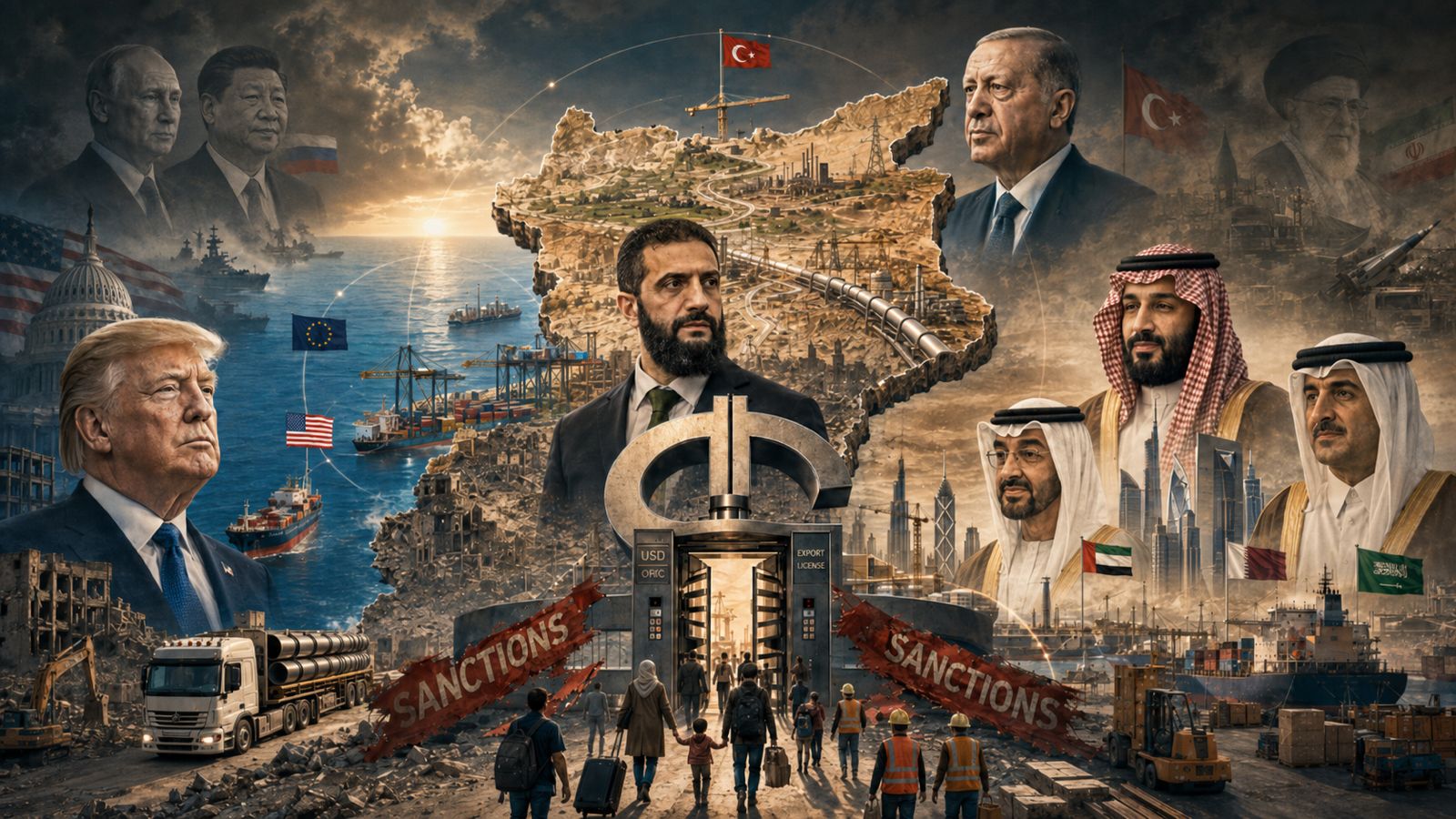
Washington Backs Syria’s Emergence as an Independent Actor in the Islamic World and Its Reintegration into the Western Sphere
On August 24, 2026, the United States revoked Syria's designation as a state sponsor of terrorism, a status the country had carried since 1979. The...
Visits by Senior Washington Officials to Moscow: The Factors Driving the Kremlin’s Rejection of the White House’s Proposals
In late August and early September 2026, three senior U.S. officials visited Moscow, marking a level of concentrated contact in U.S.-Russian relati...
