
The AfD’s Victory in Saxony-Anhalt: A Convergence of Factors That Skews the Forecasts

Solid Info








On September 6, 2026, Alternative for Germany (AfD) won the state election in Saxony-Anhalt with 43.8% of the vote, finishing 26.6 percentage points ahead of the governing Christian Democratic Union (CDU), which took 17.2%.
Since the previous state election in 2021, the AfD has doubled its support, delivering the strongest state election result any conservative Euroskeptic party has posted in the history of the Federal Republic.
The outcome of a vote in a single eastern German state has drawn the attention of governments and policy experts in countries whose security and economic policies depend on where Berlin stands.
The AfD’s record support came from a convergence of factors with different origins, each with its own underlying cause.
Assessments of the vote have concentrated largely on the campaign’s most visible players, while the factors shaping the long-term trend in European political sentiment have drawn far less attention.
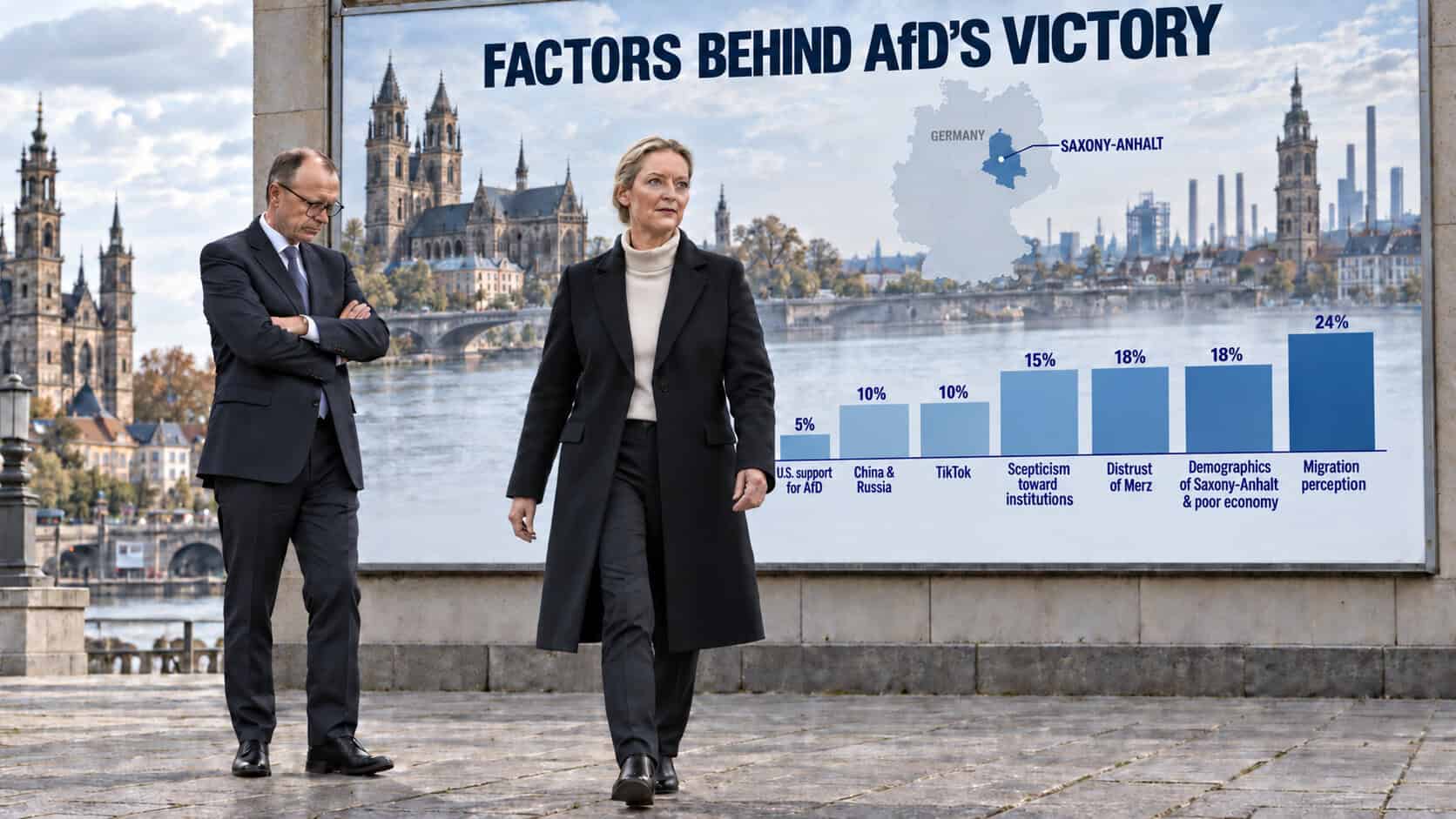
The factors at work include record turnout and the mobilization of voters who had previously stayed home, Saxony-Anhalt’s demographic and economic condition, the perception of migration as the country’s biggest problem, the loss of trust in the federal government and in Chancellor Friedrich Merz personally, the spread of Euroskeptic sentiment, and a U.S. stance that legitimizes the AfD in European politics.
Among them, the information environment shaped by platforms under foreign jurisdiction stands apart, amplifying the AfD’s visibility and accelerating the mobilization of its voters.
Saxony-Anhalt’s Demographics and Economy Set the Scale of the AfD’s Win
Of the structural conditions behind the Saxony-Anhalt result, the state’s own demographic and economic situation carries the most weight. The region has the highest median age and the lowest GDP per capita of any German state.
These factors, compounded by Saxony-Anhalt’s high public debt and the weak tax base of its municipalities, are driving steady out-migration from a region whose population has shrunk by 25% since 1990.
No other German state is losing population as fast, and Saxony-Anhalt has lost about 700,000 residents since reunification.
German citizens living in the state have an average age of 48.7 years, while foreign nationals make up 7.9% of the population, one of the lowest shares in the country.
These indicators shift over decades. They explain the AfD’s persistently high support in the east, but not the doubling of its result within a single electoral cycle. That jump came from turnout, which rose from 60.3% in 2021 to 77.8%, the highest the state has recorded since reunification.
According to Infratest dimap’s voter-flow analysis for public broadcaster ARD, the AfD posted a net gain of about 170,000 votes from people who sat out the previous election and about 83,000 from the CDU. The region’s structural conditions determined where those votes went, while the mobilization of previously passive voters determined how many there were.
People with an immigrant background make up 10% of Saxony-Anhalt’s population, one-third of the national share. The region’s economic and social problems nonetheless generated a much stronger demand for change among local residents and fueled a protest vote in 2026.
Saxony-Anhalt has one of the lowest shares of foreign nationals among German states, yet it handed the AfD a record result. That disconnect shows that perceptions of migration take shape outside voters’ everyday experience.
Record support in a single state does not, however, carry over to the national level. The AfD’s ability to turn its results in eastern Germany into a federal victory is constrained by the population imbalance between the country’s eastern and western regions.
The five states that made up the former East Germany are home to about 12.5 million people, or one-sixth of the country’s population.
The political edge that right-wing Euroskeptics hold in these regions does not translate into comparable results for the AfD nationwide. The party’s performance in the next Bundestag election will hinge on its ability to expand its support in the densely populated west.
European media and analysts across the West are reading the successful voter mobilization as evidence that the party is gaining strength nationwide.
Opinion polls lend further support to that reading. Since April 2026, they have consistently projected Alternative for Germany to finish first in the next Bundestag election, with an average lead of 5 to 8 percentage points over the governing CDU/CSU bloc.
The expectation of further AfD victories is widespread among the German public and the country’s political elites alike. The party’s leadership, its rivals, the media, and voters are all adjusting their decisions accordingly. Political strategies in Germany are being rebuilt around forecasts that have yet to come true.
An INSA poll conducted in the spring of 2025 found that 51% of Germans consider an AfD victory the most likely outcome of the next Bundestag election.
AfD co-leader Alice Weidel has set the goal of winning about 40% of the vote in 2029, a share that would make it harder for centrist parties to keep refusing to cooperate with the AfD at the federal level.
The mainstream parties’ refusal to cooperate with the AfD in any form, known in German politics as the “firewall” (Brandmauer), keeps the party politically isolated, with other parties declining to form coalitions with it or support its initiatives.
Years of isolation allow the AfD to argue that the mainstream parties are unwilling to take the views of a large part of the electorate into account. At the same time, the “firewall” itself helps the AfD present itself as the
alternative to the established parties.
In the 2026 state elections, the factors behind the AfD’s traditionally stronger appeal in Germany’s economically weaker regions were compounded by declining trust in the Merz government and by disillusionment with the CDU/CSU over its failure to keep its campaign promises on migration and the economy.
Despite gradual growth in 2025 and 2026, GDP has been slow to recover from its 2023 contraction. Migration flows have fallen steadily, yet more than 14 million foreign nationals lived in Germany in 2025, 3.2 million of them classified as protection seekers.
A Record-High Immigrant Share Keeps German Society Polarized
Migration, which Germans rank as the country’s biggest problem, was the next factor behind the AfD’s result. The party’s electoral gains in the eastern states grew out of a mismatch between the post-2024 decline in migration figures, which the governing party points to, and the strain on municipal budgets, driven in part by spending on foreigners who arrived in earlier years.
Immigration to Germany fell 35% in 2024 compared with 2023, and arrivals dropped by a further 45% year over year in 2025.
First-time asylum applications in Germany followed the same trend, falling to about 113,000 in 2025 from nearly 330,000 in 2023.
Even as new arrivals slow, the total number of foreign nationals in Germany continues to hit record highs. That persistently high number keeps migration fixed in the public mind as one of the country’s most serious problems.
An INSA poll conducted on January 25, 2026, found that 50% of Germans consider the migration crisis and its consequences the country’s biggest problem.
Immigrants actually make up 13% to 15% of Germany’s population, but Germans estimate the share at about 25% on average.
Fewer new arrivals have not made the public any more favorable toward migration, which is why policy on foreigners remains the main driver of polarization.
The run-up to the state elections showed that the AfD aims to turn public anxiety over migration, along with most Germans’ demand for an immigration moratorium and mass deportations, into support at the ballot box.
The AfD leadership’s rhetoric consistently links the high share of foreigners in Germany’s population to the CDU/CSU’s failure to overcome the country’s economic challenges and to break with the migration policy of Olaf Scholz’s government.
After the coalition agreement was unveiled on April 9, 2025, and signed on May 5, Weidel held its provisions up against Merz’s campaign pledge to change course on migration.
Heading into the 2026 state elections, the AfD leadership factored in that only 48% of eastern German voters are satisfied with how democracy works in the country, and that easterners’ main grievances with the federal government are socioeconomic.
AfD politicians kept anti-migration rhetoric at the core of their campaign but shifted the emphasis from reducing migration flows to the social and fiscal consequences of earlier waves of arrivals and to whether the federal government can ease the financial burden on municipalities.
By tying together public discontent over migration, budget pressures, and economic stagnation, the AfD drew support from a far broader range of voters than in previous campaigns.
The Federal Government Has Lost Voters’ Trust Faster Than Any Cabinet in Decades
The federal government’s reputation was a separate factor in the Saxony-Anhalt vote. Trust in the chancellor has sunk to the lowest level German pollsters have ever recorded. In ARD’s July DeutschlandTrend survey, just 13% of Germans approved of Merz’s performance, the weakest rating for any sitting chancellor in the survey’s nearly 30-year history.
A Forsa poll in early August 2026 put his approval at 14% against 85% disapproval, and fewer than half of CDU/CSU voters said they were satisfied with their own leader.
In June 2025, that figure stood at 39%, meaning the chancellor lost 23 percentage points in a year and slid to 16th place among the 18 members of the federal cabinet.
The slide traces back to a sequence of decisions that cost Merz support on both sides of the political spectrum. In late January 2025, he broke with the policy of isolating the AfD for the first time by pushing a migration motion through the Bundestag with the party’s votes.
Two and a half months later, his coalition agreement with the Social Democrats (SPD) enshrined migration provisions that departed from the position he had campaigned on.
Economic strains and adverse demographic and social trends in Saxony-Anhalt had been eroding the Christian Democrats’ electoral standing. To present itself as the force mobilizing protest voters, however, the AfD combined social polarization with attacks on federal government policy and pinned responsibility for the region’s accumulated problems on the mainstream parties.
Euroskeptic Sentiment Has Spread Beyond the AfD’s Base
The next factor behind the AfD’s victory in Saxony-Anhalt extends to voters outside its base, as the party’s criticism of EU-level decision-making resonates with supporters of centrist parties.
This is not about leaving the European Union. The spring 2026 Eurobarometer recorded the highest support for membership among Europeans since the survey began tracking it in 1983.
The discontent centers on whether EU institutions can cope with the cost of living, industrial regulation, and the distribution of the migration burden among member states. Germany, along with France and Austria, has one of the highest shares of citizens who expect their standard of living to decline, at 38%.
As these views spread among CDU/CSU supporters, the governing party finds it harder to counter the AfD’s positions with a European agenda of its own, and criticism of Brussels is no longer the preserve of conservative Euroskeptics alone.
The AfD Launched Its Campaign Ahead of Its Rivals and Took It Online
The only factor in the AfD’s Saxony-Anhalt victory that the party secured on its own was the way it organized its campaign. In the 2026 cycle, the AfD reached out to voters before its rivals did, dropped the formal style of campaigning, and shifted most of its effort to digital channels, above all TikTok.
On TikTok, AfD messaging surfaced disproportionately often in content recommendations for users who did not follow any party-affiliated accounts.
Drawing on social media and the wide reach of right-leaning content, the AfD was more effective than other parties at weaving economic, social, and migration problems into a single explanation for voters’ discontent.
U.S. Conservative Networks Lent the AfD Legitimacy From Abroad
The last of these factors originates abroad. The AfD’s ties to American conservative influence groups lend the party legitimacy in European politics and present Germany’s conservative Euroskeptics as full-fledged participants in the country’s political process.
White House attempts to prepare Germany’s political establishment for a coalition with the AfD have come to nothing. Even so, the AfD leadership’s public meetings with U.S. officials and Washington’s criticism of efforts to keep the party at arm’s length give it added public legitimacy.
These factors pull in different directions and operate on different timelines, so their combined impact on future election campaigns will be uneven.
The chancellor’s personal reputation will fade fastest as a factor, since the CDU leadership sees it as a source of the party’s electoral losses. Replacing the chancellor, however, will not restore the trust the party lost by failing to keep its commitments.
The demographic and economic condition of the eastern states, the spread of Euroskeptic sentiment, and the algorithms that determine which political content gets seen will stay in play regardless of who forms the federal government.
TikTok’s Algorithms Carry the AfD’s Migration Rhetoric Beyond Its Base
The AfD’s edge in engaging voters comes from a change in the way Germans get their political information.
Reading the news, in print or online, is losing ground to watching short videos, and the two habits split the electorate along partisan lines. Voters who have kept the reading habit mostly back the mainstream parties, while those who rely on short-video feeds as their main source of political news are more likely to choose the conservative Euroskeptics.
That divide shapes how effective a campaign can be. TikTok reaches 20% of Germans every week, and half of those aged 14 to 29 watch it regularly.
The platform’s recommendation algorithms create an uneven playing field, favoring content that provokes stronger emotional reactions and holds users’ attention longer.
In European politics, that design favors messages and stories that exploit protest sentiment and erode public trust in sitting governments and centrist parties, giving them a far better chance of spreading.
The AfD is more active than most of its rivals in producing digital content, which centers on pitting the interests of most Germans against those of migrants, on the socioeconomic threats posed by migration, and on holding its political opponents responsible.
An analysis of more than 25,000 political videos posted on TikTok during the 2025 Bundestag campaign found that about 78% of the AfD’s digital campaign content carried negatively charged messages about specific social groups.
Confrontational content, by contrast, accounted for less than 50% of other German parties’ messaging, which is why TikTok’s recommendation system more often gave extra reach to the political messages spread by Alternative for Germany.
A February 2025 investigation by Global Witness found that 78% of the political content TikTok recommended to new users supported the AfD. Ahead of Germany’s federal election, a similar imbalance appeared on X (formerly Twitter), where 64% of the political posts the platform served to politically neutral accounts portrayed the AfD in a positive light.
A study conducted during Germany’s parliamentary election found that TikTok began recommending AfD content to newly created profiles within 11 to 12 minutes of first use, while politically neutral accounts did not see their first SPD videos until 70 minutes in.
AfD messaging was served to nine in 10 new users and appeared twice as often as SPD content. As a result, people who were not engaged in the campaign took in the AfD’s interpretation of political problems and their causes before forming their own political judgments.
Regular TikTok viewing does not change users’ attitudes toward migration or directly shape their political views. Even so, the sheer volume of AfD material means the conservative Euroskeptics’ messages appear more often among algorithmic recommendations.
This raises the salience of the issues around which Alternative for Germany builds its campaigns, making the platform’s users more inclined to support the conservative Euroskeptics. The AfD won 16% of voters aged 24 and younger in the 2024 European Parliament election, and its share among young voters rose to 19% in Germany’s 2025 federal election.
That increase shows that when the AfD’s priority issues move up users’ political agenda, the party is better able to mobilize voters who were inclined to judge the federal government and the mainstream parties critically before they ever encountered AfD content.
Looking to counter the AfD’s rise with an agenda of its own, the CDU/CSU leadership stepped up its promotion of the measures and decisions it had taken to reduce the share of migrants in Germany.
The federal government expanded border controls and began turning back some asylum seekers, suspended family reunification for people granted subsidiary protection in Germany, accelerated the deportation of convicted foreign nationals, and started preparing to implement the EU Pact on Migration and Asylum.
The AfD’s digital advantage in communicating with voters, however, made it harder for Germany’s mainstream parties to compete with the conservative Euroskeptics.
Heavy coverage of immigration by the AfD and affiliated outlets led 50% of CDU voters, 36% of SPD voters, and about a quarter of Green and Die Linke voters to identify migration as the top problem.
Concern over migration compounded broader dissatisfaction with the Merz government. In the spring of 2026, only 11% of Germans credited the new government with success in handling the migration crisis.
By centering its dialogue with voters on migration and other issues that had long defined the AfD’s agenda, the CDU raised the profile of the conservative Euroskeptics’ priorities in public debate. The CDU and the other mainstream parties, which offered a more moderate approach to migration policy, failed to convince voters that their policies were working.
The AfD, by contrast, strengthened its electoral advantage, as its messages achieved broad digital reach and its platform became firmly associated with the issues voters increasingly use to judge the government in power.
Beijing Retains Information Access to European Audiences
The European Union regulates TikTok through the Digital Services Act (DSA), which requires large online platforms to assess how their algorithms affect elections, counter the coordinated promotion of political content, and, where necessary, change how their recommender systems work.
Enforcement relies in part on independent European researchers, who can obtain access to platform data to examine how its algorithms affect elections and public debate. TikTok’s Project Clover provides for storing European data in a specially secured environment, restricting China-based employees’ access to certain categories of personal information, and having NCC Group independently audit these procedures.
The DSA’s obligations for large online platforms give European regulators partial oversight of TikTok. With the service owned by China’s ByteDance, however, EU institutions have no power to define or change the logic of its recommendation algorithm.
The NCC Group audit, moreover, does not constitute official certification that TikTok fully complies with the General Data Protection Regulation (GDPR), so the risk remains that Beijing could gain remote access to European users’ data.
The EU’s measures have strengthened personal data protection, but unlike in the United States, where TikTok’s American business was transferred to a consortium of mostly U.S. investors, they have not separated the platform’s European operations from ByteDance.
Because the app remains under the control of a Chinese corporation, the European Commission lacks full access to the data it needs to independently verify how TikTok’s algorithms work.
On December 17, 2024, the Commission opened formal proceedings against TikTok over manipulation risks tied to its recommender system during Romania’s presidential election, including the coordinated use of inauthentic accounts and automated content distribution.
In October 2025, the Commission reached the preliminary conclusion that TikTok had restricted accredited researchers’ access to some of the data that the DSA requires platforms to make available for outside scrutiny. As of September 2026, no final decision has been issued.
Chinese control over TikTok’s European operations gives Beijing the ability to use the platform to shape the news agenda and amplify protest narratives, while shielding the Chinese leadership from the spread of critical information on issues tied to China’s international reputation.
Of the content TikTok surfaced about the Xinjiang Uyghur Autonomous Region, where Chinese authorities are waging a campaign of persecution and pressure against the Uyghur population, about 59% framed the subject in terms favorable to Beijing. On human rights in China, 35% of the content was likewise framed positively, and 89% of the results TikTok returned for searches on China’s “re-education camps” were unrelated to the search topic.
Tilting content visibility toward conservative Euroskeptic parties makes it easier to attract voters to the AfD, a party that opposes European initiatives aimed at curbing China’s economic influence.
Alternative for Germany has consistently criticized the EU’s additional tariffs on Chinese electric vehicles, and in 2024 its Bundestag group introduced a motion to end mutual EU-China sanctions and resume talks on the Comprehensive Agreement on Investment between Brussels and Beijing.
The AfD’s growing representation at various levels of German and European politics, aided by algorithm-driven visibility, makes it harder for the EU to forge a common policy on tariff protection for the European market and on the terms under which Chinese companies can access it.
China’s approach differs from Russia’s in both its tools and its footprint. Moscow works through covert assets and information operations, as well as cryptocurrency financing, which Czech counterintelligence exposed in the spring of 2024.
Since 2022, those channels have become toxic and attributable, whereas algorithmic amplification of a political wave generated by others requires no direct payments to parties and involves no interference that can be proven. That is why Beijing extracts a cheaper and more durable benefit from European polarization than Moscow does.
Ultraconservative Euroskeptics champion handing most of the EU’s sovereignty back to national governments, an idea that aligns with China’s economic ambitions and weakens Brussels’ ability to counter China’s economic presence in Europe. Even so, the interests of Beijing and the EU’s ultraconservatives overlap only in part.
Euroskeptic parties remain divided over economic cooperation with China, but Beijing still benefits from their rise. The ultraconservatives’ political gains and their potential edge in upcoming national election cycles are making the EU’s economic policy toward China more beholden to the sectoral interests of individual member states.
The decentralization of the EU that French and German Euroskeptics are pushing for is also a priority for the Chinese leadership, since a united European bloc carries far more weight in China-Europe relations than any single EU member state.
At its current level of integration, Europe is better positioned to resist the entrenchment of Chinese capital on its soil by imposing regulations and restrictions on Chinese companies.
The growing political clout of conservative Euroskeptics and their expanding representation in regional and national parliaments and in the European Parliament reduce these risks for the Chinese leadership.
The rise of parties seeking to subordinate EU-wide trade policy to the interests of their own national producers makes it harder for Brussels to implement a unified strategy on Chinese electric vehicles, state support for manufacturers, market access, and investment.
By retaining influence over the course, intensity, and direction of political debate in Europe, Beijing turns the fragmentation of European economic policy to its advantage.
Attempts to Isolate Euroskeptic Parties Have Pushed Mainstream EU Elites to Seek New Ways to Contain Them
The rise of ultraconservative parties has forced political systems across the EU to respond to the electoral surge of forces that can no longer be shut out of decision-making, yet cannot be brought into existing coalitions unless the political center rethinks its own principles.
Until the mid-2020s, the strategy France and Germany pursued toward conservative Euroskeptics rested on the mainstream parties’ refusal to cooperate in any way with the AfD and the National Rally (RN). Political shifts driven by voter demand for an alternative to centrist parties and by the influence of social media algorithms on public debate in Europe have shown that this old tool for containing the AfD and the RN has run its course.
Over its lifespan, the strategy of isolating Euroskeptics in France and Germany achieved only part of its goal. In Germany, the unwritten understanding under which centrist parties have so far refused to work with the AfD at the federal level prevented the formation of any coalition that included the party. As a result, even after winning 20.8% of the vote in the last Bundestag election, the ultraconservative Euroskeptics remained in opposition.
In France, a combination of electoral pacts among centrist parties, efforts to isolate the RN in parliament, and the refusal to invite the National Rally into governing coalitions kept the RN out of key posts in the government and the National Assembly.
At the same time, the isolation policy deepened social polarization in Europe’s leading countries. Protest voters, who were gradually coalescing around the conservative Euroskeptics, saw their governments’ refusal to work with the RN and the AfD as a sign of unwillingness to give political weight to the will of a large segment of the population.
The ultraconservatives were able to cast themselves as the main opposition and anti-establishment force, and to criticize most of the decisions made by the French and German governments without bearing political responsibility for their own proposals.
The Euroskeptics used Germany’s “firewall” and France’s “cordon sanitaire” as a window of opportunity to consolidate support among new voter groups. Since the AfD formed its first Bundestag group in 2017, its electoral support has more than doubled.
German voters’ disillusionment with the current political agenda is reinforced by a more critical view of how Germany engages with EU institutions.
While two-thirds of German respondents support their country’s EU membership, 43% of Germans are critical of the policy course Brussels is pursuing.
A growing share of German voters wants national governments to regain broader powers over migration, the economy, foreign trade, and industrial policy.
With the policy of isolating ultraconservatives exhausted and Euroskeptic poll numbers still climbing ahead of the 2027–2029 electoral cycle, mainstream elites now need to replace the “firewall” and “cordon sanitaire” strategies with other approaches.
Rhetoric from Friedrich Merz and Emmanuel Macron about stepping up the fight against uncontrolled migration shows that Europe’s centrist elites intend to borrow part of the agenda the AfD and the RN have claimed in recent years and use it in the political battles ahead.
The AfD’s record result does not give the party a national mandate. No party is willing to form a coalition with the AfD, and the political consequences of this vote are confined to a single state.
A change in CDU leadership will win back some protest voters only if the party delivers on its promises on migration and the economy, since it was the failure to keep those promises that produced today’s level of distrust.
The EU’s capacity to act has to hold through the 2027 and 2029 election cycles, because it determines whether member states can simultaneously sustain the sanctions regime against Russia, fund the defense industry, and support the United States in its confrontation with the axis of autocracies.
Moscow and Beijing benefit from European polarization on different timelines. Russia reaps immediate gains, since gridlock at the EU level slows the adoption of new sanctions packages and reduces the volume of military aid to Ukraine.
China’s gains are long-term and concern the terms of access to the European market. It is the bloc’s common position that allows the EU to impose tariffs on Chinese electric vehicles, restrict Chinese companies’ participation in public procurement, and screen investment in critical infrastructure.
If that position fragments, Beijing regains the ability to strike deals with individual capitals, which carry less negotiating weight on their own and are more likely to put their own producers’ interests first.
This publication is the result of a partnership between MILITARNYI and SOLID INFO. An extended version is available on the website of the analytical center.

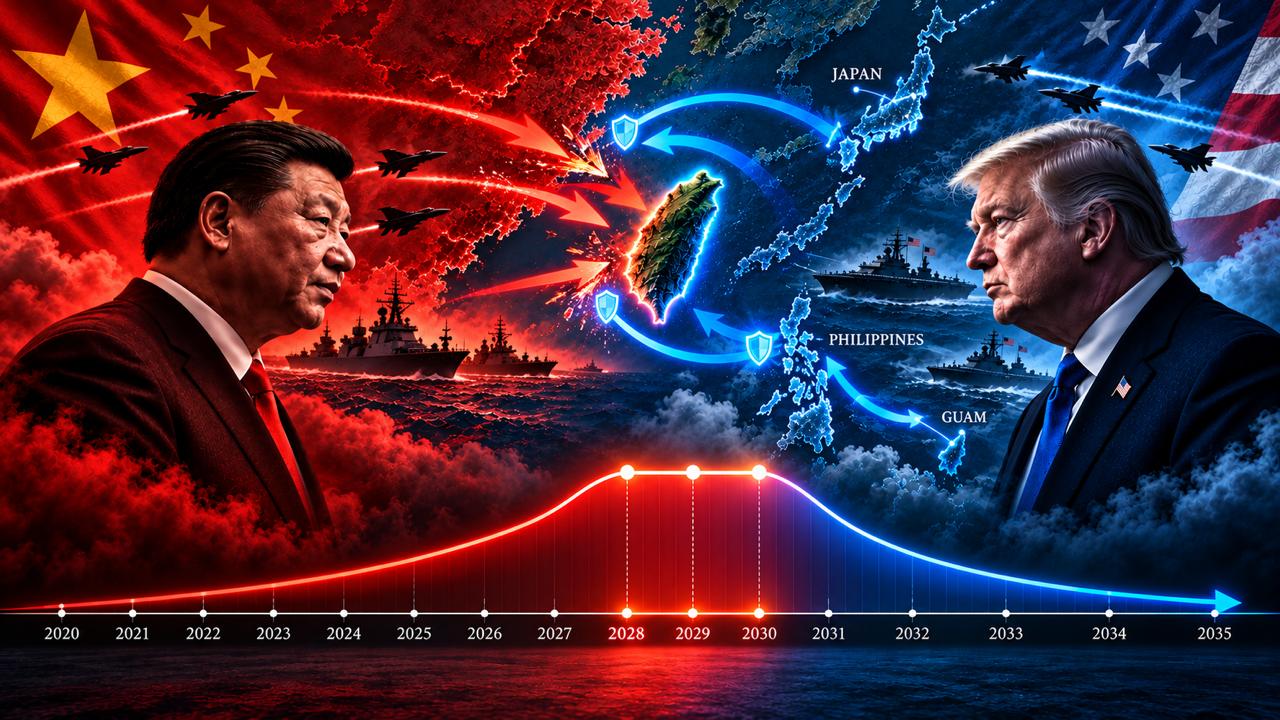
Xi Jinping’s Washington Visit Outlines the Timeframe for the Active Phase of the Confrontation: Beijing Openly Demands Taiwan’s Return
On September 23–25, 2026, Chinese President Xi Jinping held talks with President Trump at the White House during the first Chinese state visit to t...
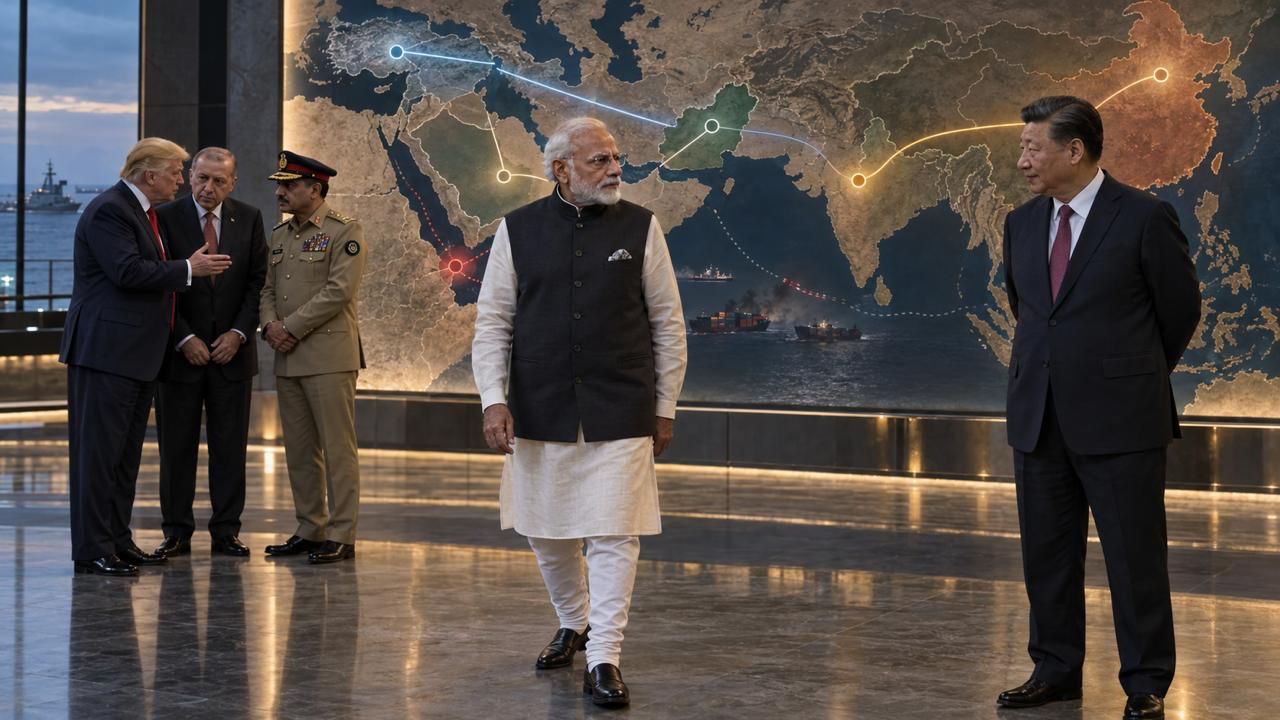
A Sharp Shift in the Dynamics of Global Confrontation Forces Washington to Rethink How It Builds Its Key Partnerships
On September 12–13, 2026, the 18th BRICS Summit was held in New Delhi. Xi Jinping traveled to India to lead the Chinese delegation, marking his fir...
