
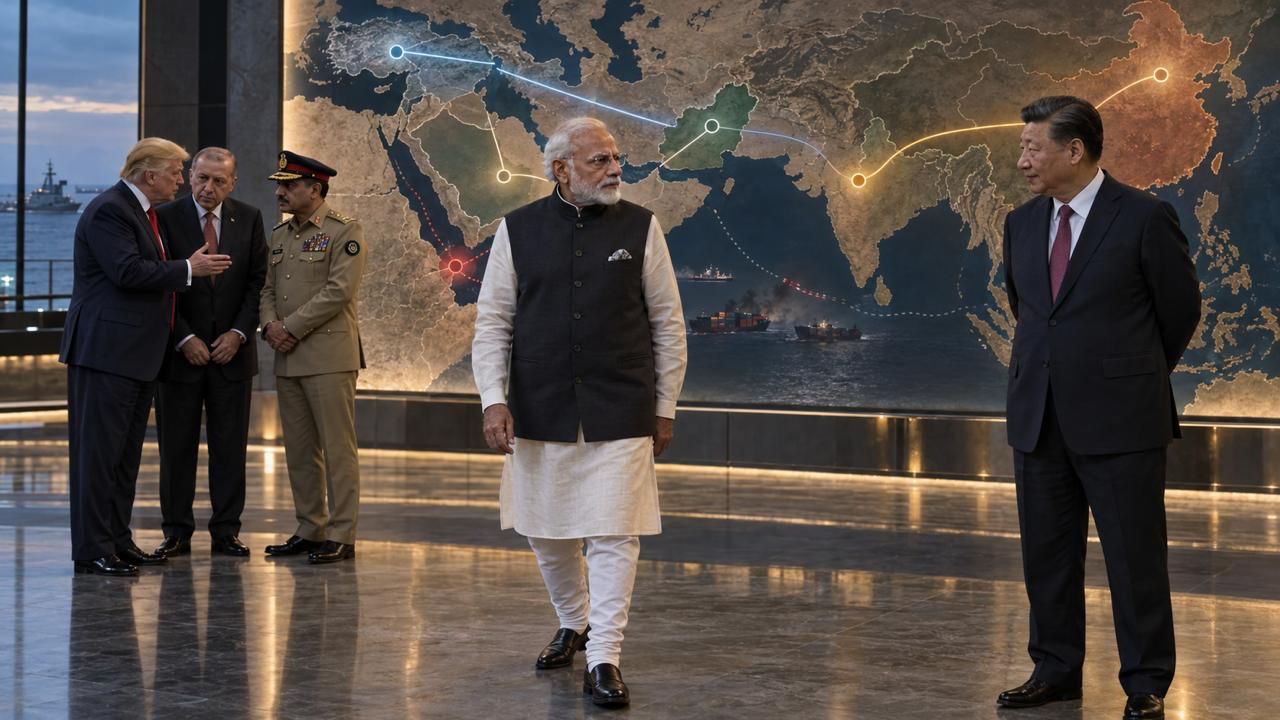
A Sharp Shift in the Dynamics of Global Confrontation Forces Washington to Rethink How It Builds Its Key Partnerships

Solid Info




On September 12–13, 2026, the 18th BRICS Summit was held in New Delhi. Xi Jinping traveled to India to lead the Chinese delegation, marking his first visit to the country in seven years.
During the summit, Indian Prime Minister Narendra Modi held separate talks with Chinese President Xi Jinping. Following the meeting, New Delhi and Beijing agreed to develop trade, economic, and business ties and identified peace along the border as the foundation for further stabilization of bilateral relations.
The summit resulted in the New Delhi Declaration, adopted unanimously by the participants. Among its provisions was a condemnation of terrorism, including the April 22, 2025, attack in Pahalgam that killed 26 people and became the trigger for the May war between India and Pakistan. By agreeing to this language, Beijing accommodated New Delhi, even though in 2019, at Pakistan’s request, China had initiated a closed-door meeting of the UN Security Council after India revoked the special status of Jammu and Kashmir.
The declaration also condemned unilateral sanctions and tariff and non-tariff measures that violate World Trade Organization rules. Although it did not name any country, for India these provisions primarily concern the U.S. tariffs imposed in 2025.
A defining feature of the new BRICS interaction has been the visible rapprochement between China and India despite their unresolved border dispute. In recalibrating its strategy, New Delhi is responding to changes in U.S. foreign policy, under which Washington has downgraded India’s place in the hierarchy of its interests.
Under President Biden, Washington openly favored New Delhi, while the U.S. President, for the first time in decades, held neither a bilateral meeting nor a phone call with Pakistan’s Prime Minister, limiting contact to a single letter in March 2024. The Republican administration reversed that hierarchy and gave clear priority to Turkey and Pakistan, although it has still not built a systematic alliance with Islamabad.
The White House reception of Pakistan’s army chief, Asim Munir, without Pakistan’s civilian leadership, together with President Trump’s statements about U.S. mediation in ending the India-Pakistan war, effectively placed New Delhi and Islamabad on an equal footing as the two parties to the conflict.
President Trump hosted Munir for lunch in the Cabinet Room on June 18, 2025, two days after leaving the G7 Summit in Kananaskis early. Previous Pakistani army chiefs received at this level had simultaneously served as President, meaning that Washington’s treatment of Munir amounted to acknowledgment of him as an independent center of power.
The parallel expansion of U.S. engagement with Ankara, which provides Pakistan with political and military support on the Kashmir issue, reinforced the Indian leadership’s perception that Washington was no longer building its regional strategy around New Delhi.
On September 25, 2025, President Trump received Turkish President Recep Tayyip Erdoğan at the White House — Erdoğan’s first visit since 2019 — and, on the same day, hosted Pakistani Prime Minister Shehbaz Sharif together with Munir.
The talks with President Erdoğan addressed Turkey’s return to the F-35 program and the lifting of CAATSA sanctions imposed over its purchase of Russian S-400 “Triumf” systems. In November, U.S. Ambassador to Turkey Tom Barrack described the talks as the most productive in nearly a decade.
This reassessment of priorities is taking place against the backdrop of the September escalation, when the Iran-backed Houthis attacked the capital of a U.S. ally, seized the Bab el-Mandeb coastline, and on September 9 captured one of Yemen’s largest military bases.
The Houthis, who call themselves Ansar Allah, are a military-political movement exercising de facto state functions. They control roughly one-third of Yemen’s territory but 70–80 percent of its population — between 24 million and 30 million people — together with the capital, Sanaa, and the port of Hodeidah. Regular Houthi formations number about 200,000 fighters, while the United Nations estimates that approximately 350,000 personnel are under arms when reserves and new recruits are included.
The Houthi arsenal is predominantly Iranian in technological origin or components and includes ballistic missiles with ranges of up to 1,500 kilometers, cruise and anti-ship missiles, long-range drones, and unmanned surface vessels.
The movement’s air defenses are built around upgraded Soviet surface-to-air missile systems equipped with Iranian electronics, while its military-technical capabilities remain dependent on Tehran.
As early as April 2025, the State Department accused Chang Guang Satellite Technology, a company linked to the Chinese military, of supplying the Houthis with satellite imagery for attacks on U.S. vessels. Beijing said it was unaware of the situation, although according to U.S. information, the assistance continued even after formal approaches to the Chinese government.
On September 10, 2026, the Houthis captured the port city of Mocha. The following day, they reached Perim Island, which divides Bab el-Mandeb into two shipping channels, completing their takeover of Yemen’s entire Red Sea coastline.
On September 19, for the first time since the escalation began, the Houthis targeted Riyadh with a ballistic missile and also attempted to strike infrastructure in Yanbu, where Saudi Arabia’s key oil pipeline terminates.
The Houthis now exercise fire control over the strait, although its western shore lies outside Yemen. Combined with Iran’s blockade of the Strait of Hormuz, this has placed maritime routes that carried roughly one-third of global seaborne trade before the war under the control of U.S. adversaries.
With Hormuz blocked and the Saudi oil pipeline terminating on the Red Sea at Yanbu, Houthi control of Bab el-Mandeb threatens the maritime route for Saudi oil exports to Asia.
Drone strikes launched from Iraqi territory on September 10 had already forced one of the Kingdom’s pipelines to suspend operations, pushing the threat to Riyadh beyond the issue of maritime navigation.
The pipeline in question is the roughly 1,200-kilometer East-West Pipeline, which reached its full capacity of seven million barrels per day in March 2026 and supported crude oil exports through Yanbu of around five million barrels per day.
The Houthis survived the six Saada Wars of 2004–2010, the Saudi campaign launched in March 2015, and U.S. and British strikes in 2024–2025. The mountainous terrain of northern Yemen, dispersed formations under centralized command, and their own air-defense capabilities allowed them to preserve their capacity. The window for a consolidated military solution has closed, while direct U.S. ground involvement in the Yemeni conflict does not correspond to the White House’s priorities.
Crown Prince Mohammed bin Salman urged President Trump to strike the Houthis, but President Trump agreed only to provide Riyadh with intelligence and targeting data. U.S. officials instead met with representatives of the movement in Muscat, where the Houthis pledged not to attack American vessels.
The Pentagon subsequently prepared an operation against the Houthis on President Trump’s orders, but on September 20 he called it off. The last-minute cancellation handed the initiative to the Houthis, who in the meantime launched an offensive toward strategic high ground in the Taiz and Lahj governorates.
Riyadh must now rely on its own air force, which, according to the Houthis themselves, has carried out hundreds of strikes on their positions in recent days but has failed to stop the offensive.
The escalation around Yemen has opened another front in the war with Iran and marked the next phase of the global confrontation, with a new level of threats and the involvement of states whose participation in a conflict of this scale had not been anticipated. For the White House, the period when allies could be assessed solely by their economic and demographic contribution to the overall capacity of the democratic world has passed.
Washington had previously assigned India the role of a pillar in the confrontation with China. In wartime, however, that function gives way to the need for partners capable of participating in military operations.
The Republican administration is looking to partners whose value is determined by their willingness to employ their own armed forces, and the White House sees Ankara as such a partner. Over the past decade, Turkey has conducted three ground operations in Syria, reversed the course of the war in Libya in 2020, and that same year supplied Azerbaijan with drones for its campaign in Karabakh.
The Turkish Navy is already present on the southern approaches to Bab el-Mandeb and has operated in the Gulf of Aden since 2009, where Turkey has commanded the international Combined Task Force 151 (CTF-151) seven times.
TURKSOM, the Turkish military’s largest overseas base, has operated in Somalia since 2017, while a 10-year agreement signed in 2024 entrusted Ankara with developing Somalia’s naval forces and protecting its coastline.
The mandate, which Parliament extended in January 2026 through February 2027, is focused on counter-piracy and counterterrorism and does not cover operations against the Houthis, although strengthening the Navy’s operational experience is explicitly listed among its objectives.
Turkey has NATO’s second-largest military, while exports from its defense and aerospace industries rose 48 percent in 2025 to $10.05 billion. Combat use makes Turkish systems more competitive in international markets, while India continues to pursue strategic autonomy and avoids participation in U.S.-led coalitions.
As a result, India is leaving the group of partners Washington relies on in its confrontation with the autocratic axis, but it is not moving into Beijing’s camp. A significant share of Indian society identifies with democratic values, while the country’s modernization depends on Western technology and capital. Economically, India therefore remains within the Western orbit.
At the same time, this leaves New Delhi vulnerable to pressure from the United States itself, which unilaterally changes the terms of trade. India has lost political weight in Washington and part of its market access. In August 2025, the Trump administration raised the total tariff burden on some Indian goods to 50 percent, half of which consisted of a secondary tariff imposed over purchases of Russian raw materials.
The White House removed that tariff in February 2026 only after President Trump announced that New Delhi had agreed to end those purchases, turning access to the U.S. market into an instrument of influence over India’s energy policy.
New Delhi is broadening its circle of partners out of a pragmatic calculation that it needs resources for its own development. Yet even after the political dialogue cooled, U.S. capital expanded its presence in India, with Google, Microsoft, and Amazon announcing a combined $67.5 billion in investments between October and December 2025.
In the 2025–2026 fiscal year, the United States and the European Union together accounted for 37 percent of Indian merchandise exports, compared with approximately 5.3–5.5 percent for China and Russia combined. Western markets therefore remain critical to the Indian economy.
Russia’s share of Indian arms imports fell from 70 percent in 2011–2015 to 40 percent in 2021–2025, while France and Israel together already accounted for 44 percent.
Pakistan, India’s regional adversary, is moving in the opposite direction, with its arsenal increasingly dependent on China and Turkey.
Turkey Arms Pakistan and Joins Its Defense Alliance with Saudi Arabia
New Delhi views the priority Washington has given Ankara through the lens of the Pakistan factor. India has no direct dispute with Turkey as a state; the conflict arises from Ankara’s support for Pakistan as India’s regional opponent. President Recep Tayyip Erdoğan raises the Kashmir issue at the UN General Assembly almost every year, something New Delhi considers a red line.
Diplomatic support is reinforced by defense cooperation. In 2018, Pakistan signed a $1.5 billion contract for four Babur-class corvettes, two of which were built in Turkey and two in Karachi with technology transfer.
Turkey has modernized dozens of Pakistani F-16 fighter jets, Bayraktar Akıncı combat drones are in service with the Pakistan Air Force, and components for the Anka drone are produced jointly with Pakistan’s NESCOM.
During the May 2025 war, according to Indian officials, Pakistan attacked Indian cities with Turkish-origin drones. Eight days after the fighting began, New Delhi revoked Turkish company Çelebi’s authorization to provide ground-handling services at nine Indian airports, citing national security interests.
In December 2025, plans emerged to establish assembly of Turkish combat drones in Pakistan, while Ankara and Islamabad are negotiating Pakistan’s participation in the KAAN fighter program, which already involves around 200 Pakistani engineers.
This cooperation acquired an institutional form when Pakistan and Saudi Arabia signed a Strategic Mutual Defense Agreement on September 17, 2025, and Turkey joined it on August 7, 2026. Under the Mecca Agreement on collective defense, an attack on one state is considered an attack on all three. On August 31 in Istanbul, the participants agreed to establish a secretariat in Saudi Arabia headed by a Pakistani secretary-general.
Together, the three states have around 1.4 million military personnel and 3,400 aircraft, according to the 2026 Global Firepower index, while Turkish Foreign Minister Hakan Fidan has said that the alliance is intended to expand.
The threat for India is that in a new conflict with Pakistan, New Delhi would face a state formally backed by a collective commitment from three participants. Turkey’s involvement generates the greatest concern because it is Pakistan’s most capable allied state.
Pakistan’s Defense Commitments to Riyadh Reduce China’s Leverage and Draw Beijing Closer to New Delhi
Pakistan’s defense alliance with Turkey and Saudi Arabia also concerns China, although Beijing’s reasons differ from New Delhi’s. For Beijing, Pakistan has for years constrained India in South Asia, cooperated against groups threatening Xinjiang, and provided the territorial foundation for the China-Pakistan Economic Corridor (CPEC) to Gwadar.
Cooperation deepened through Pakistan’s membership in the Shanghai Cooperation Organisation and the Belt and Road Initiative, under which CPEC, agreed in 2015, became its most developed overland project. Between 2005 and 2024, Chinese investment in Pakistan’s economy reached approximately $68 billion, and Beijing reinforced this commitment with diplomatic cover.
In 2021–2025, China supplied 80 percent of Pakistan’s arms imports, while Pakistan accounted for 61 percent of all Chinese arms exports, making Islamabad the largest buyer of Chinese weapons.
In 2019, at Pakistan’s request, China initiated a closed-door meeting of the UN Security Council after India revoked the special status of Jammu and Kashmir.
The Mecca Agreement gives Pakistan defense commitments outside the framework of Chinese-Pakistani cooperation, meaning that the risk of Islamabad being drawn into a Gulf war now depends on Riyadh’s security decisions.
The same agreement affects another dimension of Chinese regional policy, which had relied on maintaining a balance between Saudi Arabia and Iran. Beijing is linked to Iran through the 25-year cooperation agreement signed in 2021, while in March 2023 China itself mediated the restoration of relations between Riyadh and Tehran. That role gave Beijing influence on both shores of the Gulf, but it depended on Iran maintaining a regional presence and on the two capitals remaining outside opposing sides of a war.
The war with Iran and the Mecca Agreement undermine those conditions, because Saudi Arabia, the main target of Houthi strikes, is now bound by a collective defense commitment to two Washington partners. The alliance shifts the regional balance by linking Riyadh to nuclear-armed Pakistan and Turkey, which has NATO’s largest military after the United States.
The stability of Iranian oil supplies also depends on the outcome of this war; China purchased 87 percent of Iran’s oil exports in 2025. Riyadh, Ankara, and Islamabad have formally assumed no anti-Iranian commitments, and this uncertainty still allows Beijing to avoid responding officially to the alliance.
The new security environment in the Middle East and the emergence of the Mecca alliance have given Beijing reason to stabilize its southwestern flank and accelerate its rapprochement with India — a direction New Delhi itself has been moving toward after reassessing its relationship with Washington.
The first signs of this course appeared even before President Trump’s second term. On October 21, 2024, New Delhi and Beijing agreed to disengage troops in eastern Ladakh, where the border had remained the principal obstacle to bilateral relations since the 2020 clashes.
The intensification of dialogue in 2025 coincided with an increase in Indian imports from China to $131.6 billion in the 2025–2026 fiscal year, up from $113.4 billion a year earlier, while Indian exports to China amounted to only $19.5 billion.
India’s record $112 billion deficit makes expanded trade more advantageous for Beijing, meaning economic interest alone does not explain why New Delhi is accommodating China.
Shared concern over Pakistan’s defense alliance gives New Delhi and Beijing grounds for rapprochement despite their unresolved territorial disputes in Aksai Chin and Arunachal Pradesh. For Washington, this rapprochement is the price of its geopolitical bet on Ankara and Islamabad.
Backing the Gulf States, Turkey, and Pakistan Costs Washington Its Relationship with India
Washington is relying on Saudi Arabia, Turkey, and Pakistan to contain Iran and narrow China’s room for maneuver, while assigning part of the region’s security burden to those states.
Yet beyond the deterioration of relations with India, this course is complicating Washington’s relationship with Israel, the key U.S. ally in the Middle East, which sees the expansion of Turkey’s presence as a threat.
Following the fall of the Assad regime in December 2024, Israel became a direct competitor with Ankara for influence in Syria. The rivalry has already moved into the military domain. On the night of August 18, 2026, the Israeli Air Force struck Abu al-Duhur Air Base in Idlib, 60 kilometers from the Turkish border, to prevent Turkish forces from deploying there.
The Israeli Prime Minister’s Office described a Turkish military deployment in Syria as a red line, while U.S. Ambassador to Turkey Tom Barrack called the strike an unnecessary escalation. Washington began developing a deconfliction mechanism between Israel and Turkey, placing itself in the position of mediator in a dispute between two of its own partners.
Ahead of the NATO Summit in Ankara, the divergence between the United States and Israel extended to defense supplies. Benjamin Netanyahu urged President Trump not to sell Turkey fighter engines or readmit it to the F-35 program. On July 7, 2026, President Trump said at the summit that the United States would consider selling the aircraft to Ankara and described Turkey as, in many respects, more loyal than other countries.
In search of new partners, Israel has begun moving closer to Turkey’s opponents. Together with Greece and Cyprus, Israel is building counterweights to the Turkish presence in the Eastern Mediterranean.
In December 2025, Jerusalem hosted the 10th trilateral summit, after which the three states signed a military cooperation plan for 2026 that included joint exercises and intelligence sharing.
The parties are also discussing the creation of a 2,500-strong rapid reaction force, to which Israel and Greece would each contribute 1,000 troops and Cyprus 500.
At the summit, Netanyahu, without naming Turkey, warned those who dream of restoring empires and domination over the lands of the region. Cypriot President Nikos Christodoulides explicitly linked the trilateral mechanism to the India-Middle East-Europe Economic Corridor (IMEC), which is intended to connect India with Europe through the Middle East.
In February 2026, India and Israel elevated their relations to a special strategic partnership, and their bilateral investment agreement entered into force in July. In this rivalry, New Delhi therefore stands on Israel’s side.
In Indian expert debate, the Mecca Agreement is interpreted as a response to this rapprochement and to the broader architecture New Delhi is building with Israel, the UAE, and the United States through I2U2 and the IMEC corridor.
Saudi Arabia is a transit link in IMEC between the UAE and Jordan, while the route bypasses Turkey. As early as 2023, President Erdoğan declared that no corridor could exist without Turkey. For New Delhi, Riyadh’s alliance with Islamabad and Ankara therefore calls into question a project through which India expected to shorten its route to Europe while bypassing the Suez Canal.
Deepening U.S.-Turkish rapprochement to the level of a strategic alliance would require the White House to reconsider the scale of its support for Israel.
At the same time, the United States has already paid the price for an incomplete rapprochement with Ankara through the loss of part of the Indian leadership’s trust and a deterioration of its position with Israel, without receiving any alliance commitments from Turkey in return.
Washington’s choice is compelled by circumstances: Saudi territory is being attacked by the Houthis and groups operating from Iraq, while a UN Panel of Experts linked Houthi ballistic missiles to Iranian manufacturers in 2017–2018, although Tehran denies supplying them.
Saudi Arabia’s importance to the White House is reinforced by the Trump circle’s ties to Riyadh. In 2022, the Kingdom’s sovereign wealth fund, the Public Investment Fund (PIF), invested $2 billion in Affinity Partners, the firm founded by Jared Kushner, who now serves as an administration envoy.
The Kingdom’s principal importance to Washington, however, stems from its role in global oil supplies, which the war with Iran has disrupted. Before the war, according to Bloomberg, around 15 million barrels of crude oil passed through the Strait of Hormuz each day, meaning that alternative exports through Yanbu covered only about one-third of that volume.
The disruption of part of the East-West Pipeline removed four to five million barrels per day from global supply, according to Al Jazeera, while repairs are expected to take three to five weeks. Kpler estimated that inventories at Yanbu were sufficient for approximately four days, while a month-long disruption would keep as much as 120 million barrels of oil off the market.
Every week without a military response increases these losses for Washington’s principal Gulf ally. Delay therefore weakens the U.S. position in the region, while Washington needs partners prepared to act in its place.
The White House is counting on Ankara to serve as precisely such a partner. The test is therefore Turkey’s willingness to employ its own armed forces in Yemen, which will determine whether Washington obtains the result for which it has already incurred these costs.
Turkey twice condemned Houthi strikes against the Kingdom in September, while on September 19–20, Fidan said Ankara was prepared to meet “certain technical” military needs of Riyadh under the Mecca Agreement.
The Houthis responded with direct threats. On September 17, Brigadier General Abid al-Thawr said that Turkey would lose if it intervened. An expeditionary operation against a movement with 200,000 regular fighters operating in mountainous terrain currently exceeds the price Ankara is prepared to pay.
Turkey’s caution also has a political explanation. President Trump approves countermeasures systematically developed by the Pentagon and the intelligence community, only to sporadically revise them at the final stage according to his own judgment. The Iran campaign, which was approved as a lightning special operation, has already entered its seventh month. In Yemen, President Trump abandoned the strike at the last moment, when the bombers were ready to depart on their mission.
This pattern of behavior erodes the accumulated trust of partners, which, together with adherence to commitments and consistency of policy, forms the foundation of durable alliances. Ankara therefore has no guarantee that the U.S. plan for Yemen will not be revised after Turkey enters the active phase of a direct confrontation with the Houthis.
Kushner and Special Envoy Steve Witkoff, who manage the Israeli track of U.S. diplomacy, belong to President Trump’s inner circle. Ankara has reason to interpret the canceled U.S. strike against the Houthis as an attempt to draw the Gulf states and Turkey itself more deeply into the war in Yemen.
From the Turkish leadership’s perspective, U.S. actions appear to be drawing Turkey into a confrontation that shifts the Houthis’ focus from Israel toward Saudi Arabia and Turkey.
The defense alliance among Turkey, Pakistan, and Saudi Arabia is still being tested politically, because the agreement requires ratification in Pakistan and Turkey before acquiring full legal force. Houthi strikes on Saudi Arabia formally constitute an attack on one of the three participants, yet Pakistan and Turkey have not responded with military force, while Riyadh, according to statements from Ankara and Islamabad, has not requested their assistance.
Following the September 2025 agreements, Pakistan reportedly deployed around 8,000 troops, a squadron of JF-17 fighters, and a Chinese-made air-defense system to the Kingdom, but these forces have not been used against the Houthis.
The text of the agreement has still not been made public, and its implementation mechanism remains undefined. Fidan has also stressed that the agreement identifies no common adversary and is not directed against Iran. In April 2026, Pakistan opened six overland routes for third-country cargo transit to the Iranian border. They did not provide a full alternative to maritime shipping, but the step itself demonstrated that Islamabad was not joining U.S. pressure on Tehran.
Reliance on regional allies has therefore not yet relieved the United States of the need to respond independently to threats to maritime navigation. On September 22, the leaders and foreign ministers of the six Gulf Cooperation Council states are meeting with President Trump on the sidelines of the UN General Assembly, after Washington repeatedly rejected Riyadh’s requests for strikes.
If Ankara and the Gulf states are ultimately compelled to undertake a military operation to contain the Houthis, the White House strategy will have justified itself, and India’s departure from the group of core U.S. partners will become the price of shifting risk onto regional allies.
If Turkey refuses such an operation, it will demonstrate that the United States surrendered ground in India without obtaining any strategic result in return. New Delhi will maintain its neutrality and will not return to its role as a pillar of Washington’s regional strategy as long as U.S. policy evaluates partners by their willingness to fight.
This publication is the result of a partnership between MILITARNYI and SOLID INFO. An extended version is available on the website of the analytical center.

Xi Jinping’s Washington Visit Outlines the Timeframe for the Active Phase of the Confrontation: Beijing Openly Demands Taiwan’s Return
On September 23–25, 2026, Chinese President Xi Jinping held talks with President Trump at the White House during the first Chinese state visit to t...
A Sharp Shift in the Dynamics of Global Confrontation Forces Washington to Rethink How It Builds Its Key Partnerships
On September 12–13, 2026, the 18th BRICS Summit was held in New Delhi. Xi Jinping traveled to India to lead the Chinese delegation, marking his fir...

Netanyahu’s Visit to Abu Dhabi: Israel Builds Partnerships from a Position of Strength, but the Middle East Conflict Is Eroding the Edge of Its Weapons
On September 27, 2026, Israeli Prime Minister Benjamin Netanyahu traveled to Abu Dhabi with the head of Mossad and the head of the National Securit...
