
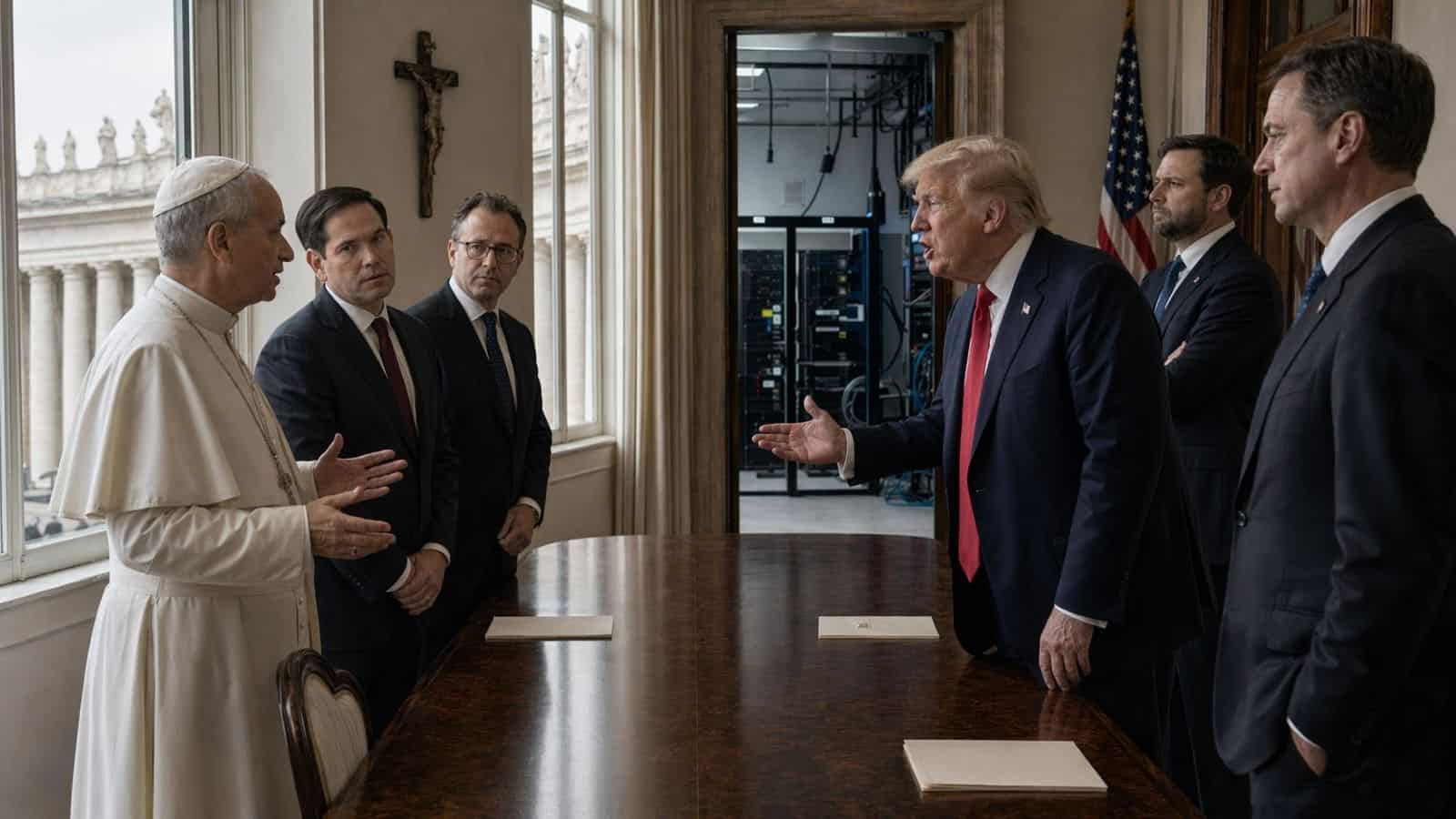
White House vs. the Vatican: Big Tech — Trump’s Allies Compete for Control Over AI Regulatory Boundaries

Solid Info






On April 12, 2026, in response to Vatican criticism of the Iran campaign, the Trump administration entered into open public confrontation with the Holy See. In a post on Truth Social, President Trump accused Pope Leo XIV of “pandering to the radical left,” and the following day shared an AI-generated image of himself styled as Christ.
Beyond the visible portion of the conflict observed by the general public, a parallel confrontation is unfolding that involves processes of far greater significance. The Vatican under Leo XIV is pursuing a strategy of responding to two processes that will reshape the geopolitical configuration of the world by the middle of the 21st century. Islamic demographic dynamics — 3.1 children per woman versus 2.7 among Christians globally, and twice that gap in Western countries — will by 2050–2070 bring Islam to parity with Christianity in numerical terms.
Islam is expanding its audience not only through fertility rates; it is also filling the ideological vacuum in societies where the separation of church and state (secularization) has dismantled the institutional authority of the church but has failed to provide answers to questions about the limits of technological intervention in human life.
Against this backdrop, a second process is unfolding — the uncontrolled development of artificial intelligence, which transfers moral judgment from humans to AI algorithms. Models that make decisions in the fields of medical diagnostics, the judiciary, financial operations, the military use of force, and the education of children are taking away from humanity a sphere that the Christian tradition has for two millennia regarded as the exclusive province of morality.
Without a value-based foundation, AI undermines the moral authority of the Church, which the Church has historically held. The Vatican is defending this authority against the expansion of American technology corporations, which deploy models without external ethical verification and seek moral justification for doing so at the international level.
The Vatican views these two processes as interconnected. AI undermines the moral competence of Christian institutions from within at the very moment when Islamic dynamics are filling the demographic and ideological vacuum from without.
The Vatican has chosen the United States — the leading developed power that decisively shapes the rules in the domains of technology and security — as the center for implementing this strategy. Unlike European countries, in particular Germany, France, and the Benelux states, where the Catholic faithful declines every year, the Catholic Church in the United States is showing significant growth. 2024 was the first year in a decade to produce a net increase in the Catholic faithful. According to the 2025 Official Catholic Directory, approximately 90,000 adults joined the US Catholic Church in 2024. This is twice the 2020 figure and a sustained part of a trend that has been developing since 2021.
The horizon of the Vatican’s strategy is measured in decades and extends beyond any electoral cycle. Its implementation requires control over demographic dynamics. Global Catholic growth is driven by three sources: high birth rates in Latin America, rapid expansion of Catholic communities in sub-Saharan Africa, and conversions — in particular, the movement of young people out of Protestant denominations in developed countries.
The Vatican Insists on Human-Centered AI Algorithm Development
On January 28, 2025, the Vatican released the Note Antiqua et Nova — a joint document of the Dicastery for the Doctrine of the Faith and the Dicastery for Culture and Education that establishes the limits of moral legitimacy for artificial intelligence and reserves the sphere of independent judgment exclusively for the human person. On this foundation rests the concept of algorethics — a system of built-in ethical safeguards in AI models championed by the Pope’s chief AI adviser, the Franciscan Paolo Benanti.
Throughout 2025, Benanti presented the Church’s position at UN forums and at the G7 summit, stressing the dangers of the technocratic paradigm. Pope Leo XIV reinforced this position publicly: “the human being is not a system of algorithms: he is a creature, a relationship, a mystery.”
The Vatican’s position on AI regulation has begun to acquire increasing institutional weight and to directly threaten the doctrine promoted by key Big Tech players. Representatives of the American high-tech industry resorted to organizing a series of non-public events aimed at persuading the Catholic Church to reconsider its position.
From March 15–18, 2026, Palantir founder Peter Thiel delivered a series of lectures in Rome devoted to theology and the regulation of artificial intelligence. The events had a semi-private status and were held in one of the private palazzos near the Vatican and in a venue rented through structures affiliated with conservative Catholic groups.
US Pentagon technology contractors are being transformed into centers in which a doctrinal view is being shaped on the application of AI as an instrument of deterrence — with the expectation that this view will become official state doctrine. This shift is altering the structure of global demand for dual-use technologies in the direction of deterrence through AI in place of nuclear deterrence. Thiel characterized attempts at international and ecclesiastical regulation of artificial intelligence — including the Vatican’s algorethics and UN treaties — as the harbinger of the most effective tyranny in human history and “the handwriting of the Antichrist.”
Thiel’s visit to Rome ended in public defeat. The bishops’ newspaper Avvenire characterized the lectures as theological manipulation. The Vatican labeled Thiel’s position a heresy, characterized him as a theological adversary, and closed off the possibility of institutional contact with Rome on the question of AI regulation.
After the failure of their attempt to change the Vatican’s position, leading US technology giants launched a broader campaign to legitimize a new doctrine of global security. In April 2026, Palantir formalized this doctrine in a public 22-point document in which the company places artificial intelligence on par with nuclear weapons as an instrument of deterrence and enshrines the military application of AI as an inevitable process requiring only the selection of targets. With this document, Palantir and related companies are formalizing a demand for a new hierarchy of relations between the technology sector and the state, in which private developers of models receive a status previously reserved for manufacturers of nuclear arsenals.
The Vatican’s concept of algorethics calls this status into question, as it requires independent ethical verification of models prior to their military application.
The conflict between Palantir and its related contractors, on the one hand, and the Holy See, on the other, is a conflict over the right to determine who sanctions the moral legitimacy of the new instrument of deterrence.
At the same time, the Vatican is actively employing artificial intelligence in its own activities and is consistently expanding its use across all areas of the Church’s work. The Holy See has deployed the Magisterium AI chatbot based on official Church documents, launched the MAIL educational program at Catholic universities, and uses a real-time liturgical translation system into 60 languages at St. Peter’s Basilica. This refutes any accusations that the Vatican holds a technophobic attitude toward AI.
Leading Institutions of the Islamic World Use the Threat of AI Encroachment to Expand the Ummah
In parallel with the Vatican, leading Islamic centers are developing their own AI ethics. In 2024, Al-Azhar issued a doctrinal communiqué on artificial intelligence as a tool without the right to independent legal rulings.
The UAE, through G42 and the Technology Innovation Institute, has developed the Falcon LLM model with built-in sharia filters, and Qatar’s CILE is shaping an ethical framework based on the objectives of sharia.
The cumulative effect is the emergence of religiously validated AI models as a tool for maintaining the cultural and political loyalty of Muslim communities in the Global South.
Under this scenario, the struggle over the moral framework of artificial intelligence takes on strategic significance for the Vatican. The Holy See’s calculation assumes that consolidating the Islamic world’s status as the primary moral arbiter of AI in the Global South would push the Catholic Church out of the intellectual field in which it is able to compete for audiences in the regions where it lags demographically.
The 2023 “Rome Call for AI Ethics,” the 2024 Hiroshima meetings, and the algorethics concept perform a dual function for the Vatican — that of a theological project and of an instrument for maintaining global moral leadership. Pope Leo XIV’s soft public rhetoric and his attention to interreligious dialogue during his African tour are part of the same strategy. The Vatican avoids open confrontation with Islam and instead establishes for itself the role of a universal norm-setter that speaks on behalf of the Abrahamic traditions — a position unavailable to any individual Islamic center due to their confessional limitations.
Latin American Migrants and Youth Strengthen the Catholic Church’s Position in the United States
In 2007, Hispanics made up 29% of all US Catholics; by the end of 2024, their share had risen to 36%. The fertility rate among Hispanic women is holding at 1.86 children per woman, while among white American women and African American women it has declined to 1.54 and 1.44 births, respectively.
The transition of young people away from Protestantism has provided the second source of growth. A Harvard University study published in April 2025 recorded an increase in the share of Catholics among American millennials from 16% to 20%, and among Generation Z from 15% to 21% over 2022–2023. Young respondents explained their choice as a search for unchanging truths and a weariness with chaotic contemporary culture. The share of Protestants among American adults has fallen from 63% in 1993 to 44% in 2020.
The White House’s deportation policy directly undermines the first driver of the Catholic Church’s growth in the United States. During 2022–2024, the United States Conference of Catholic Bishops (USCCB) received increasing amounts of federal funding for migration programs — $123 million in 2022, $130 million in 2023, and $180 million in 2024.
In January 2025, the White House issued an executive order suspending USRAP (the United States Refugee Admissions Program) and freezing funding for non-governmental partners. In April 2025, the USCCB, under the leadership of Archbishop Timothy Broglio, declined to renew its agreements with the federal government, and Pope Leo XIV endorsed this decision. The severing of the $180 million financial tie deprived the administration of its largest religious partner in implementing migration programs and repositioned the US Catholic Church from a government partner to a public opponent of the deportation agenda.
Without the growing share of Hispanic Catholics, the Roman Church is losing the main channel of support for the size of its faithful in the United States — the demographic resource that in 2024 produced the first net increase in the community in a decade.
The Electoral Cost of the Conflict for the Republican Party
The demographic dynamics of the US Catholic Church directly affect political ratings. Even before the White House’s public attacks on the Vatican, a March Fox News poll recorded a decline in the President’s support among Catholics from 52% to 48%.
According to the Pew Research Center, the administration’s approval rating among white Catholics fell from 59% in February 2025 to 52% on the eve of Operation Epic Wrath, and among Hispanic Catholics from 31% to 23%. Sixty percent of American Catholics disapprove of the White House’s methods of waging war against Iran, and 55% oppose the use of military force against Tehran.
Support for Pope Leo XIV exceeds the US President’s approval rating. An NBC News poll from March 2026, conducted before the public conflict with the White House, recorded 42% approval of the Pope’s performance among all Americans. Among American Catholics, the Pontiff’s approval rating is significantly higher: a Pew Research Center poll showed that 8 in 10 US Catholics hold a favorable view of him.
In parallel, support for the administration among white Evangelical Protestants has fallen from 76% in May 2025 to 69% in February 2026, amid a structural decline in their share of the country’s religious landscape.
The distribution of the Catholic electorate across states makes its stance decisive for the outcome of the midterm elections. Catholics constitute a majority in Massachusetts, New Jersey, New York, Connecticut, and Rhode Island — states that traditionally vote Democratic. In the predominantly Republican states of Texas, Florida, and Arizona, as well as the swing states of Pennsylvania, Michigan, and Wisconsin, Catholics make up between 22% and 28% of the local electorate.
In these states and districts, the margin between candidates traditionally does not exceed a few percentage points. A refusal by the Catholic electorate to support the White House’s course could reduce the number of seats controlled by the Republican Party in Congress in the midterm elections in the fall of 2026.
Vice President Vance’s attacks on the Vatican simultaneously deepen the intra-party split within the Republican Party and drive a decline in support for his candidacy among the Catholic electorate. As recently as 2023–2024, Vice President Vance publicly argued that religious institutions are better prepared than the government for moral leadership in the field of AI. However, after being elected Vice President, and under pressure from the administration and from his political patron Peter Thiel, Vance has become a leading proponent of the hardline course against the Vatican.
In states where the winner’s margin is measured in a few percentage points, the loss of Catholic support — combined with the intra-party split — poses a direct threat to maintaining the Republican majority in Congress in the fall of 2026.
Marco Rubio, a practicing Catholic of Hispanic descent, has publicly refrained from attacks on the Holy See and from endorsing Thiel’s rhetoric. No other top-tier figure in the Republican Party combines working contacts with the American episcopate, with the Hispanic Catholic audience inside the United States, and with European conservatives of the rank of Prime Minister Meloni.
Rubio is shaping an alternative conservative platform within the Republican Party, one that relies on religious institutions as moral arbiters of technological development. The Vatican’s strategy of concentrating the faithful in the United States is creating electoral dynamics in which Rubio’s platform has the potential to grow into a dominant force in the conservative camp.
The growth of the Catholic electorate in the United States is producing a field favorable to an electoral victory for Rubio. The Vatican does not make public gestures of support for Rubio — such a gesture would immediately expose the Secretary of State to political risk from the Trump team and would compromise the process of growing the faithful by associating the Church with a party faction.
The structural logic of the Vatican’s presence in the American arena places Rubio in the position of a natural beneficiary without direct coordination with the Holy See, and on the horizon of the next presidential cycle makes him a figure on whom the Vatican can place a bet without announcing it publicly.
The demographic dynamics of the Catholic faithful in the United States, which rest on the Holy See’s strategy, place Rubio in a position from which he can claim leadership in the conservative camp after the end of Trump’s term.
The administration is losing the Catholic electorate in the United States. The share of white Evangelical Protestants in the country’s religious landscape is structurally declining. At the same time, the Catholic electorate is growing demographically, rallying around the authority of the Pope, and losing loyalty to the current administration.
In the short term, this creates the preconditions for Republican Party defeats in a number of competitive districts in Pennsylvania, Michigan, Wisconsin, Texas, Florida, and Arizona in the fall of 2026. In the strategic perspective, it amounts to the formation of a long-term legitimacy deficit for the current Republican model at a time when the ethics of artificial intelligence is becoming a defining arena of global competition, and the moral authority of the Holy See is becoming a key resource in shaping its rules.
A Fundamental Difference in Approaches Signals a Deepening Conflict Between the Trump Team and the Vatican
The Vatican is not an adversary of the technology industry; it lays claim to the role of a normative arbiter in a sphere that the industry itself is unable to regulate by its own means. Leading developers of algorithmic systems themselves turn to the Holy See for ethical expertise, acknowledging that the question of the moral legitimacy of their products lies beyond the bounds of their technical competence.
Anthropic co-founder Chris Olah personally appealed to the Catholic Church for help in developing an ethical framework for Claude, acknowledging that the technology is developing faster than its creators are able to control. In March 2026, a representative of the Dicastery for Culture and Education, Father Jean Gové, at a conference in Rome called Anthropic a leader among developers on issues of ethics and safety, and observed that even the most responsible player in the industry leaves its models without a clear definition of the good or of the ultimate end of moral action.
The Holy See’s strategy simultaneously encompasses the demographic balance at the center of global power and the ethical architecture of AI algorithms. Both dimensions are being realized on a horizon of decades. The Trump administration and its technology contractors, who are advancing the doctrine of deterrence through AI, operate in planning cycles tied to the nearest electoral and financial outcome.
Washington’s decisions are pragmatic but are not aligned with the consequences that will shape the institutional configuration of society over the next twenty years. The fundamental difference in the length of planning cycles, and in the ethical frameworks embedded within them, sets the stage for a deepening of the conflict between the Holy See and President Trump’s Big Tech allies.
This publication is the result of a partnership between MILITARNYI and SOLID INFO. An extended version is available on the website of the analytical center.


Visits by Senior Washington Officials to Moscow: The Factors Driving the Kremlin’s Rejection of the White House’s Proposals
In late August and early September 2026, three senior U.S. officials visited Moscow, marking a level of concentrated contact in U.S.-Russian relati...
A Sharp Shift in the Dynamics of Global Confrontation Forces Washington to Rethink How It Builds Its Key Partnerships
On September 12–13, 2026, the 18th BRICS Summit was held in New Delhi. Xi Jinping traveled to India to lead the Chinese delegation, marking his fir...
