





Popular

An analysis of debris showed that the submunitions of the medium-range ballistic missile Oreshnik (Kedr) in its conventional configuration weigh about 50 kilograms.
An expert from the Ukrainian Ministry of Defense who examined recovered fragments of the Russian Oreshnik missile shared this in an exclusive comment to Militarnyi.
According to the expert, the striking elements are essentially “solid metal chunks.” They are simple cast pieces rather than precision-engineered penetrators. Instead of steel or tungsten, which are typically used for kinetic impact munitions, they are made of cast iron.
Based on observed damage, the effects of such impacts are relatively limited, despite the very high speed at which the missile reaches during atmospheric re-entry.

In one of the strikes, the submunitions penetrated the roof and floor slabs of five stories, stopping on the first floor. The resulting holes measured roughly half a meter by half a meter. In another case, a submunition pierced only the roof and the first-floor slab, stopping in the basement.
According to military journalist Serhii Misyura of Army TV, who investigated the strike site in Bila Tserkva, one of the submunitions hit beside the road, creating a crater approximately 2 meters in diameter and 60 centimeters deep.
The dispersion of the submunitions depends on the altitude at which the missile’s warhead separates. Experts estimate that the standard detonation altitude for a nuclear version is around five kilometers, which would allow coverage of the maximum area.
“In Lviv, it opened at about five or six kilometers, so the submunitions scattered widely. In Bila Tserkva, they opened at a relatively low altitude, so they specifically hit the garages. All six clusters, with six submunitions each, struck these three unfortunate garages,” the missile researcher explained in a comment to Militarnyi.

At the same time, the expert stressed that the missile would be extremely dangerous in a nuclear configuration. According to estimates, the design of the submunitions could allow them to carry nuclear warheads with yields of up to 10 kilotons each. With a total of 36 submunitions, this would be enough to effectively “wipe out a city like Kyiv or Kharkiv.”
The Russian medium-range ballistic missile is believed to be based on the RS-26 Rubezh. However, the Defense Intelligence of Ukraine states that the system’s real designation is not Oreshnik but Kedr.

The missile lacks an individual warhead guidance system, which would allow each warhead to be directed to its own target. The warheads themselves are unguided and function as submunition containers. Overall, the missile carries six warheads, each containing six submunition elements – 36 units in total.
The missile’s payload is estimated to be between 1,250 kg, which is typical for a Topol-M / MR, and 3,000 kg.
Preliminary calculations indicate that, using standard first and second stages of an intercontinental ballistic missile, a range of up to 4,100 km is possible with such a payload.
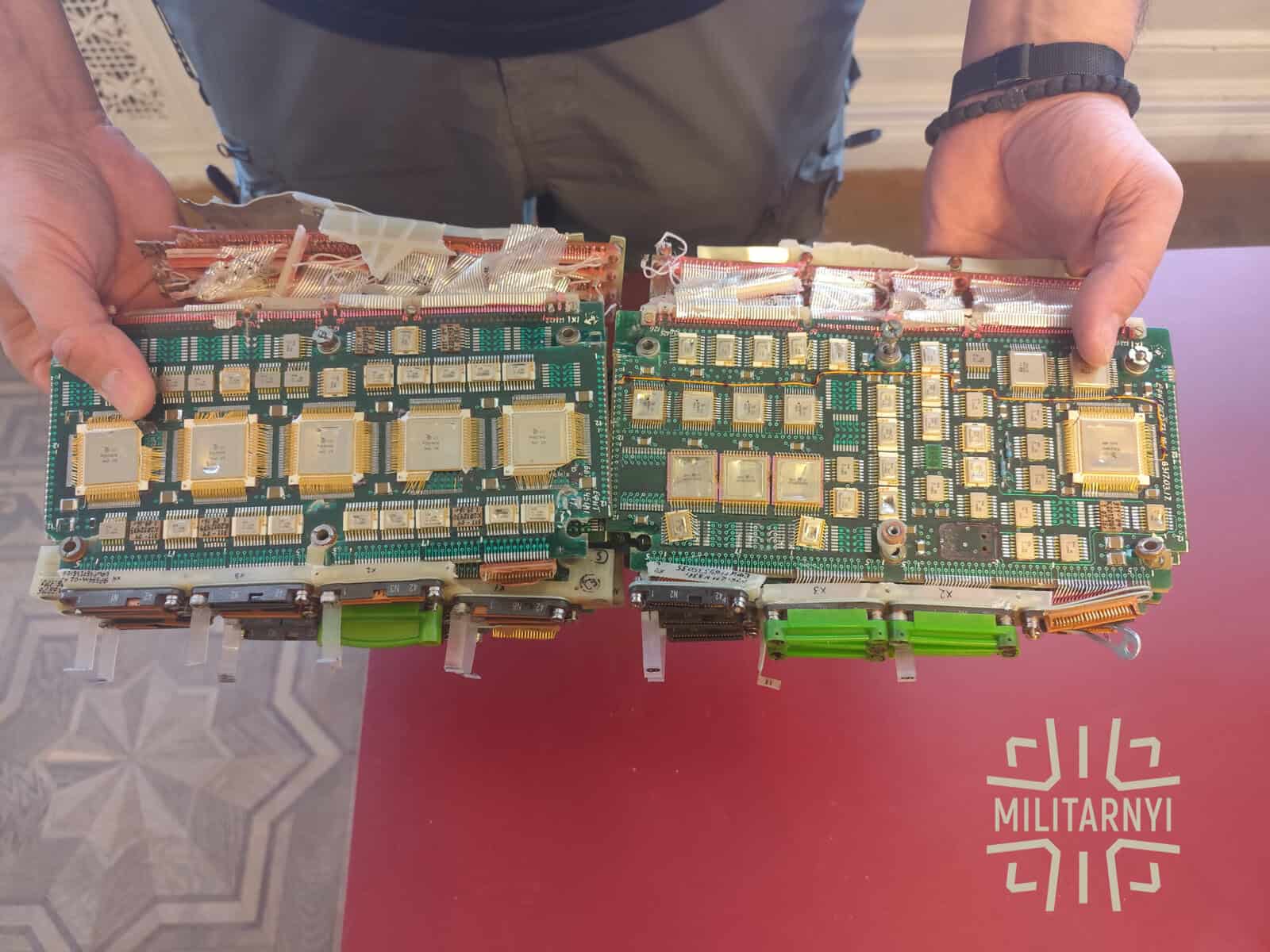
Analysis of the debris indicates that the missile is essentially a product of deep modernization of existing Soviet or Russian missile systems, with certain technological modifications introduced into its design.
In contrast to Russian unmanned aerial vehicles, which are frequently found to contain modern foreign components produced in 2024–2025, no new American, Chinese, or European parts were identified in this missile. All printed circuit boards and microchips found inside the processor unit were manufactured between 2014 and 2016.
Підтримати нас можна через:
Приват: 5169 3351 0164 7408 PayPal - [email protected] Стати нашим патроном за лінком ⬇
Subscribe to our newsletter
or on ours Telegram
Thank you!!
You are subscribed to our newsletter