
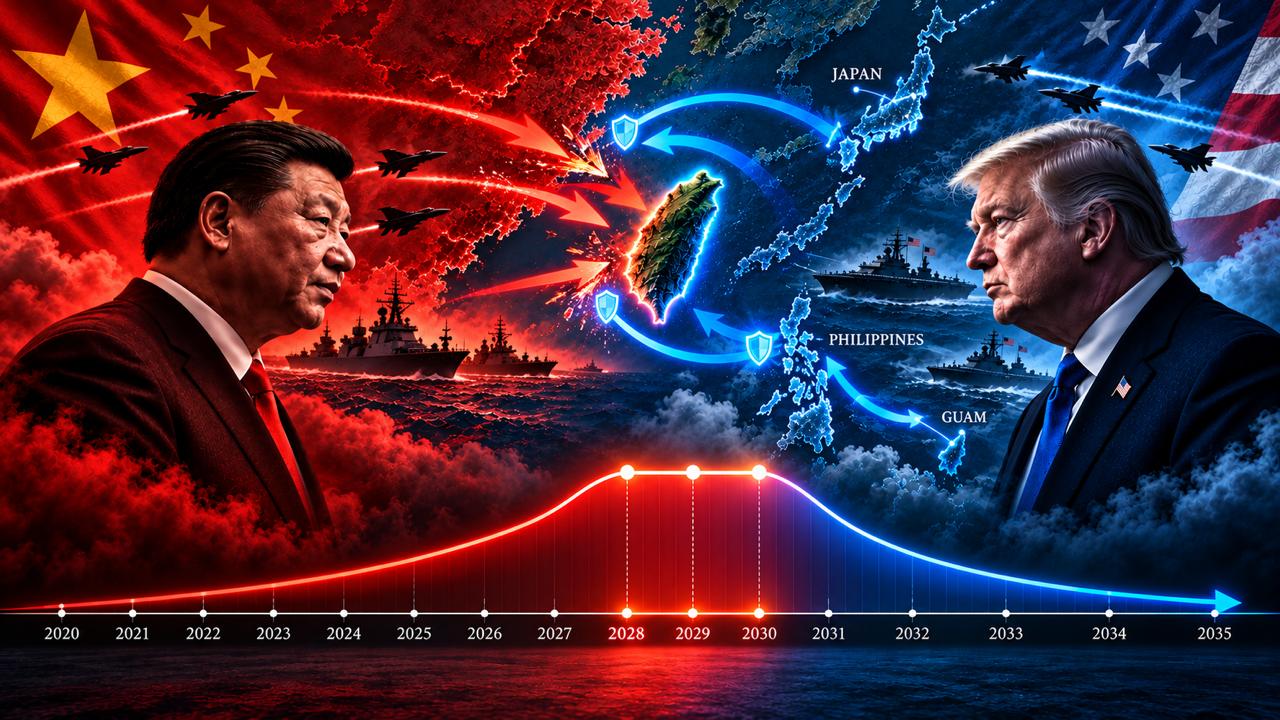
Xi Jinping’s Washington Visit Outlines the Timeframe for the Active Phase of the Confrontation: Beijing Openly Demands Taiwan’s Return

Solid Info

On September 23–25, 2026, Chinese President Xi Jinping held talks with President Trump at the White House during the first Chinese state visit to the United States in eleven years. The talks confirmed that Xi will make no concessions on Taiwan and that China’s confrontation with the West has become inevitable. Both Beijing and Washington are already preparing for it. The range of issues discussed by the two leaders makes it possible to outline the timeframe in which the confrontation over the island is likely to reach its peak.
The Washington meeting broke the balance that had held on Taiwan since the Reagan era because, on September 24, Xi for the first time directly demanded that Trump “oppose” Taiwan independence. Until now, Beijing had asked Washington only to handle the Taiwan issue with caution. It is now demanding a change in the U.S. position itself — from the formula of “not supporting independence,” which underpinned Washington’s policy of “strategic ambiguity,” to active opposition.
Beijing has unequivocally made the Taiwan issue a precondition for any broader agreements, and the other issues Xi raises internationally are increasingly filtered through the Taiwan question.
Beijing’s rhetoric is sharpening from one meeting to the next, gradually preparing the international community for the idea that the United States and the West will ultimately have to make concessions over Taiwan.
For Xi Jinping, the return of Taiwan is a measure of his own historical contribution and a matter of principle on which he allows no compromise. On July 1, 2026, at a ceremony marking the 105th anniversary of the Chinese Communist Party, Xi described resolving the Taiwan issue as the Party’s historic mission and unwavering obligation. The CCP Central Committee’s 2021 Resolution calls resolving the Taiwan issue an unchanging historical task of the Party, while the Party itself dates the “new era” from 2012, when Xi took the helm.
CCP documents do not explicitly state a date for resolving the Taiwan issue. But the timeframe within which Beijing is preparing to do so is clearly established by the sequence of stages laid down in decisions of Party congresses, which in China carry the force of strategic programs.
In his report to the 19th Party Congress in 2017, Xi described China’s trajectory as a transition from the stages of “standing up” (站起来) under Mao Zedong and “growing rich” (富起来) under Deng Xiaoping to “becoming strong” (强起来), which the Party associates with Xi’s own “new era.”
The same congress divided China’s path toward the centenary of the People’s Republic into two stages. By 2035, China is to “basically realize socialist modernization” (基本实现社会主义现代化), and by mid-century it is to become a “great modern socialist country” (社会主义现代化强国) that is “a global leader in terms of composite national strength and international influence.”
The Fourth Plenum of the CCP Central Committee in October 2025 designated the 2026–2030 Five-Year Plan as a “critical period” (关键时期) for achieving this goal.
That five-year period includes the centenary of the People’s Liberation Army (PLA) in 2027, for which the Party set a separate “centenary goal” (建军一百年奋斗目标) for the military as early as 2020.
CIA Director William Burns said in 2023 that Xi had instructed the military to be ready to conduct an invasion of Taiwan by that date, making the PLA centenary a point at which Xi must demonstrate the military’s readiness for a force scenario. In 2027, the 21st CCP Congress will also decide whether Xi receives a fourth term.
This periodization gives grounds to conclude that the stage of “becoming strong” is intended to begin with the first use of China’s military power, with Taiwan the most likely target. The period from 2030 to 2035 is then reserved for stabilizing the situation after the island’s incorporation, securing international acknowledgment of the new reality, avoiding sanctions, and absorbing the consequences of international condemnation.
Under this timeline, Xi places the active phase of his own leadership through 2035, when he will turn 82.
Xi arrived in Washington with a clear position, a strategy, a timetable structured around Party milestones, and an understanding of his own window of opportunity. That gave him an advantage in the negotiations.
Washington, by contrast, had no clear plan of countermeasures. The talks showed that it had nothing with which to answer Beijing’s demands, further strengthening Xi’s position.
Beyond the rhetorical shift, Beijing also secured an important domestic political result from the visit — one that matters to Xi ahead of the Fifth Plenum of the CCP Central Committee, scheduled for October 26–29 in Beijing. Chinese state media widely circulated footage of Trump personally greeting Xi at the aircraft stairs, even though Trump himself had been met in Beijing in May only by Vice President Han Zheng.
An analysis of the influence programs China has systematically developed since 2020 indicates that Beijing expects to resolve the Taiwan issue through pressure rather than a direct military clash, reaching such an advantage in conventional weapons by the peak of the confrontation that armed resistance by Taiwan and its allies would cease to make sense.
An equally important factor in securing control over Taiwan without the use of force is intended to be the general exhaustion of the global economy from the cumulative effects of local conflicts, combined with Chinese intervention in the political processes of key countries. In this environment, the main narratives of political discourse would be algorithmically amplified on social media in favor of avoiding a conflict between China and the democratic world through concessions to Beijing.
Washington Is Retreating From the Legal Framework That Restrained Beijing on Taiwan for Decades
Rather than de-escalating the global confrontation, the visit confirmed the course toward a force-based resolution of the Taiwan issue. The legal framework of U.S. policy toward Taiwan rests on the fundamental principle that the issue must be resolved peacefully. Xi’s objective for the island conflicts with the legal framework Washington has used for decades to constrain Beijing.
U.S. policy toward Taiwan is defined by the three Joint Communiqués of 1972, 1979, and 1982, the Taiwan Relations Act of 1979, and the Six Assurances President Reagan gave Taipei in 1982.
In these documents, Washington merely acknowledges Beijing’s position that there is one China. It does not adopt that position as its own and takes no position on sovereignty over the island.
Xi’s demand that the United States “oppose” Taiwan independence goes beyond this framework because it requires Washington to adopt language that appears in none of these documents.
The 1982 communiqué and Reagan’s internal memorandum tied a gradual reduction in arms sales to Taiwan to China’s continued peaceful approach, meaning the PLA’s systematic blockade exercises give the United States a formal basis for increasing those deliveries.
The Six Assurances Reagan gave Taipei that same year separately bar Washington from consulting Beijing on arms sales to the island.
Trump departed from this framework when, on May 11, he said he would discuss arms sales to Taiwan with Xi. On May 15, in an interview with Fox News, he said of a $14 billion package of PAC-3 MSE interceptors and NASAMS systems that he was keeping it “in limbo” because it “depends on China.”
The package had already passed informal review in congressional committees in January, but Trump did not allow the formal notification to proceed. After the May summit, the package was put on hold, with the administration alternately citing the need for munitions for Operation “Epic Fury” against Iran and insufficient production capacity.
On September 23, Rubio explained the delay by citing the need to balance the U.S. defense-industrial base and acknowledged that the issue was “not Taiwan specifically, but when we sell something, we don’t have it anymore.”
At the May summit in Beijing, Xi called Taiwan the most important issue in relations with the United States and warned that mishandling it risked confrontation and conflict.
At the same time, Taiwan remains the center of advanced-chip production underpinning U.S. artificial-intelligence platforms, linking the Taiwan issue directly to the technological competition between the two powers.
Beijing Is Closing the Gap With the United States in the Chips Underpinning AI Platforms
The first summit issue that helps define the timeframe is the competition to develop artificial-intelligence platforms, in which China has already moved ahead of the United States across most dimensions except advanced-chip production.
Control over the island will determine the outcome of the competition between the American and Chinese technology ecosystems — from software to hardware infrastructure — for the right to become the foundation of the fourth industrial revolution.
Chinese AI developers’ legal access to TSMC’s advanced nodes has been blocked by U.S. export controls, and customers from China accounted for only 9 percent of the company’s revenue in 2025.
China, by contrast, is building its own vertically integrated stack around Huawei Ascend accelerators, the CANN software platform, and open models. The number of generative-AI users in China increased by 141.7 percent in a year, while computing capacity for AI rose by 177 percent, according to China’s Ministry of Industry and Information Technology. Beijing benefits from delaying a direct confrontation until domestic chips allow its AI platforms to operate without American and Taiwanese technologies.
Experts consider China’s gap with the United States in the quality of the best AI models to be narrow, and this assessment reassures the Western technology community because the United States still remains ahead.
Yet across most other dimensions, China has already overtaken the United States, including in user numbers: generative AI has 602 million users in China, compared with roughly 130 million Americans who use chatbots.
According to the Artificial Analysis index, the American Claude Opus 5.5 scores 58 points, while the best Chinese model, MiMo-V2.6-Pro, scores 46. At the same time, one task on Claude Opus 5.5 costs $5.98, while the same metric for MiMo-V2.6-Pro is 13 cents.
The United States retains a substantial advantage only in the technological architecture of computing, whose hardware foundation is produced in Taiwan, where every Nvidia accelerator for U.S. data centers undergoes CoWoS packaging.
The Trump administration has built its economic strategy around this advantage, and its 2025 AI Action Plan explicitly sets the objective of winning the global artificial-intelligence race. U.S. laboratories are simultaneously restricting Chinese companies’ access to their models to prevent them from copying capabilities through distillation — training their own models on the outputs of foreign ones.
Washington must preserve this advantage through a constant release of new model generations because it is supposed to give U.S. companies the scale of deployment China is already achieving through low prices and openness.
Almost all of TSMC’s advanced-node capacity, as well as all CoWoS packaging — without which a graphics processor cannot be connected to HBM memory — is physically located in Taiwan. North American customers account for 75 percent of TSMC’s revenue.
In the first half of 2026 alone, graphics modules generated roughly $51 billion of Taiwan’s trade surplus with the United States, while servers added another $39.4 billion.
Technology equipment accounted for 81 percent of Taiwan’s exports to the United States in the first half of the year, up from 49 percent in 2023. From January through August 2026, the United States accounted for 31.4 percent of the island’s total exports, compared with 24.3 percent for mainland China and Hong Kong. The island’s economy is becoming increasingly tied to the U.S. AI market, while Beijing is losing economic instruments of influence over Taipei.
Expanding U.S. power capacity for data centers is only a matter of time and money. Every new generation of American models, however, requires the latest chips manufactured in Taiwan.
The United States is meanwhile moving production onto its own territory, but TSMC’s Arizona facilities currently mass-produce only the N4 node. N3 will not appear there before the second half of 2027, meaning U.S. dependence on Taiwan will persist through the end of the decade.
U.S. dependence on Taiwanese chips makes it more difficult for Beijing to establish control over Taiwan in any form, from a blockade to a military operation. Beijing therefore has an incentive to guarantee Washington continued access to Taiwanese chips itself, because without such an assurance escalation around the island becomes excessively dangerous.
Beijing seeks to demonstrate to the United States that control over the island would not deprive it of continued access to Taiwanese chips. It is precisely such a transitional period of pressure without direct confrontation that China is counting on.
The U.S. retreat from its own legal framework is compounded by Taiwan’s weak armament, and together these factors encourage Beijing to plan an operation because it sees little prospect of serious resistance.
Taiwan Is Buying Weapons That Do Not Meet the Requirements of Modern Warfare
The United States continues to sell Taiwan weapons in response to its requests, and the December $11.1 billion package of HIMARS, Javelin, TOW, and M109A7 howitzers remains in force despite the pause on the new $14 billion package.
Yet the composition of these purchases does not correspond to the threats that emerge when modeling a Chinese attempt to seize the island in light of the lessons of Russia’s war against Ukraine.
Beijing, as the principal supplier of dual-use goods to Russia’s military-industrial complex, is studying this war at close range, absorbing its lessons and rapidly adjusting its own defense procurement in line with practices revealed by Russian and Ukrainian combat operations.
This is precisely what gives China an understanding that modern warfare consists of continuously updated doctrines for the combined use of different capabilities, drawing on data from multiple precision sensors capable of operating reliably under electronic interference, autonomous decision-making algorithms, and the maximum possible robotization of military platforms.
Taiwan’s defense procurement contains nothing close to such an approach, and the island continues buying platforms designed for a previous generation of warfare.
Large traditional platforms account for 43.5 percent of Taiwan’s procurement, while electronic-warfare capabilities and infrastructure protection are almost entirely absent.
The problem is compounded by inadequate planning because delivery itself is followed by additional time required for deployment, equipment familiarization, and personnel training.
The four largest programs, which account for 62 percent of the $29.7 billion in outstanding U.S. deliveries, stretch from 2028 to 2034, placing them beyond the period China identifies as a possible window for military confrontation.
The period between notification and delivery is unpredictable. ALTIUS loitering munitions arrived within 14 months, while Stinger man-portable air-defense systems took more than ten years.
None of the 66 F-16 Block 70 fighters Taiwan has ordered has yet arrived, while the first M109A7 howitzers will be delivered only from 2030.
Taiwan has not launched mass production of its own drones because the opposition Kuomintang, which favors dialogue with Beijing, removed funding for them from the special budget along with integrated air defense and command-and-control systems.
The government plan called for procuring roughly 200,000 drones and 1,320 uncrewed surface vessels, while Taiwan currently has fewer than 10,000 unmanned systems suitable for military operations. A separate $6.6 billion drone bill covering 2026–2031 was blocked in a parliamentary committee on June 18.
Taiwan’s first domestically produced submarine, Hai Kun, was supposed to be delivered to the navy in November 2025 but remains under testing.
On May 8, the Legislative Yuan cut procurement funding from $39.3 billion to $24.5 billion and tied disbursements to U.S. Letters of Offer and Acceptance, meaning Washington’s pause and the Kuomintang’s decisions are blocking the same funds.
In August, the Lai government decided to restore the $39.3 billion through the 2027 budget, but until that budget is adopted, drone procurement remains unfunded.
By the end of 2027, Taiwan will primarily receive HIMARS rocket systems, coastal Harpoon batteries, and U.S. loitering munitions. These capabilities pose a threat to a Chinese landing force, but their scale is not commensurate with the forces Beijing is concentrating against the island.
Chinese maritime pressure is growing, with the number of coast guard and naval operations around the island increasing by 89 percent.
The Council on Foreign Relations (CFR) warns that the pause in the $14 billion package creates a precedent for Beijing to exercise an effective veto over arms sales to Taiwan, while the State Department viewed delays in Taiwan’s defense spending as a concession to China as early as May.
Washington’s negotiating position was substantially stronger in the spring, but President Trump did not use it because, ahead of the midterm elections, he had a greater interest in avoiding another trade war and the risk of escalation for which the United States was unprepared. CSIS estimates confirm that lack of readiness, projecting that simply replenishing stocks of Tomahawk, Patriot, and THAAD systems expended in the war with Iran will take four years.
Beijing Is Offering the World Global De-Escalation in Exchange for Support on Taiwan’s Return
Beijing continues to prioritize Taiwan as the central focus of negotiations. The Trump administration, by contrast, is concentrating on other geopolitical processes and demanding concessions over security arrangements in Eastern Europe, the Middle East, and other regions where conflicts are sustained in part by Chinese economic support.
Beijing is not withdrawing economic support from the parties to these conflicts. At the same time, it warns that continued U.S. intransigence over support for Taiwan opens the way to a much larger conflict that would, in one form or another, draw in states across the region, from South Korea and Japan to the Philippines and Australia.
The cost of such a conflict to the world can already be seen in current wars. The closure of the Strait of Hormuz has cut off a route carrying as much as 30 percent of global fertilizer trade, and the UN World Food Programme estimates that another 45 million people are at risk of acute hunger.
The closure of the Strait of Hormuz and Houthi attacks in the Red Sea have already triggered a global energy-price shock. Brent crude traded between $91 and $108 per barrel in September and closed at $106.60 on September 24. Liquefied natural gas in Asia and Europe is trading at roughly $27–29 per million British thermal units, meaning energy-importing countries are bearing the brunt of the shock.
The U.S. campaign in Iran has become one of the weakest elements of the White House’s foreign-policy strategy. Beyond uncertainty over how long it will take to restore stability in the Middle East, the campaign has driven down President Trump’s approval ratings and become a significant electoral factor ahead of the congressional midterms.
On the day of the summit, Xi backed a return to the Iran memorandum and an end to maritime blockades, positioning Beijing as a mediator in a war Washington has failed to bring to an end.
Russian and Ukrainian strikes on ports have also closed the Black Sea, through which 17 percent of global grain trade passes, while wheat prices have climbed to their highest level in three and a half years.
Russia and Ukraine accounted for 44 percent of Africa’s wheat imports in 2024, meaning disruptions fall hardest on countries in the Global South, where increases in bread prices have repeatedly undermined regime stability.
The next stage of the global confrontation is taking shape in the Pacific. Beijing warns that external support for Taiwan independence will destabilize the entire Asia-Pacific region and is building a logic for Global South governments in which stability can return only after the Taiwan issue is resolved on Beijing’s terms.
The foundation of such a consensus is being built among Global South states that support Beijing’s one-China principle.
Beijing is gradually hardening the language. Following the 2024 Forum on China-Africa Cooperation summit and the 2025 China-Central Asia Summit, joint statements already describe Taiwan as an inalienable part of the territory of the People’s Republic of China.
Eastern Europe remains the most advantageous regional theater for China. As the principal supplier of dual-use goods to Russia’s military-industrial complex, Beijing sustains Russia’s war economy and forces the United States and Europe to devote ever greater resources to defending Ukraine.
At the same time, it prevents Washington from reducing Moscow’s dependence on China or ending the fighting without Beijing’s involvement, pushing the White House toward compromises advantageous to China.
The idea of a trilateral meeting between Trump, Xi Jinping, and Putin at the APEC summit in Shenzhen emerged during talks between Putin and Xi in Bishkek, and on September 1 the Kremlin confirmed that it had been discussed. On September 9, Peskov confirmed that Putin and Trump had discussed it in a telephone conversation, while Ushakov added that the decision depended on China as host of the summit.
Putin, according to Bloomberg, is traveling to Shenzhen but will skip the G20 in Miami, while the White House has not yet confirmed Trump’s participation in APEC. If the meeting goes ahead, Beijing will secure the role of moderator in negotiations that could shape the course of the war in Ukraine.
Weak Signals From Washington Make a Force-Based Resolution of Taiwan Increasingly Rational for Beijing
The formal results of the visit were limited to an extension of the tariff truce until January 2027, the launch of an artificial-intelligence dialogue, and, according to China’s Foreign Ministry, an eight-point consensus that included $30 billion in reciprocal tariff reductions. Instead of the six-month extension the market had expected, Washington agreed to only two months, while the leaders reached no agreements on Taiwan, chips, or artificial intelligence.
Washington’s only substantive gain was Beijing’s agreement that no state has the right to charge fees for passage through international straits, even though Iran is demanding precisely that for the Strait of Hormuz and had promised China preferential terms.
During the 2024 campaign, Trump proposed tariffs of more than 60 percent on Chinese goods. By the end of the summit, the United States and China had agreed to $30 billion in reciprocal tariff reductions.
On September 26, President Trump said that the leaders had “not talked too much” about Taiwan and that Xi “understands very well” how he feels.
During the visit, Xi reminded Trump of the Thucydides Trap for the second time in a year, and for the first time did so in Washington, standing beside the President of the United States.
The trap describes a rivalry in which a dominant power loses ground and rapidly rearms, while the rising power expands its own defense capabilities in response, which in turn creates the danger of a major war beginning by accident. Through this allegory, Xi confidently cast the United States as the country surrendering its position of global leadership to China.
What allows him to claim such a position is the asymmetry between the categories the two sides bring to the negotiating table: Xi openly advances claims over Taiwan, while the U.S. negotiating framework revolves around issues such as the annual volume of soybeans China commits to purchasing from the United States.
The same asymmetry is visible at the military level, where Beijing backs its claims to the island by rehearsing a force scenario. In late December 2025, the PLA conducted the “Justice Mission 2025” exercises, which began several days after approval of an $11.1 billion U.S. arms package and rehearsed a blockade of the island and its key ports. Live-fire launches from the mainland simulated strikes on critical targets, and 10 of 27 rockets landed within Taiwan’s contiguous zone.
For the first time in such exercises, a Type 075 amphibious assault ship operated southeast of Taiwan, working alongside bombers and anti-ship forces to rehearse raids and the seizure of a key port.
A separate objective of the exercises was “comprehensive deterrence” of outside intervention beyond the island chain, which Beijing explicitly linked to possible external support for Taiwan.
By the combination of geographic scope and complexity of the blockade scenario, these were the largest exercises conducted around Taiwan.
As Beijing deploys more than a hundred vessels along the First Island Chain, Taiwan is unveiling the Cheetah light armored vehicle, whose cannon failed on the second shot during a demonstration firing on September 23.
The weakness of Washington’s and Taipei’s approach at every level of the competition encourages Beijing to increase pressure. At the next meetings scheduled for later this year, Beijing’s rhetoric on Taiwan can therefore be expected to become harder and more demanding.
The Xi-Trump meeting, in which the U.S. position appeared to be losing ground, failed to correct the trajectory along which the conflict is unfolding. In addition to the factors described above, its timeframe is also shaped by the war in Ukraine, the planned escalation on the Korean Peninsula, the conflict in the Middle East centered on Iran, and key electoral cycles in democratic countries in 2027–2029, where political forces advocating the avoidance of escalation are expected to come to power.
This publication is the result of a partnership between MILITARNYI and SOLID INFO. An extended version is available on the website of the analytical center.



Visits by Senior Washington Officials to Moscow: The Factors Driving the Kremlin’s Rejection of the White House’s Proposals
In late August and early September 2026, three senior U.S. officials visited Moscow, marking a level of concentrated contact in U.S.-Russian relati...
Washington Backs Syria’s Emergence as an Independent Actor in the Islamic World and Its Reintegration into the Western Sphere
On August 24, 2026, the United States revoked Syria's designation as a state sponsor of terrorism, a status the country had carried since 1979. The...
