
The Montreal Summit: Canada Becomes the Driver of a New Geopolitical Dynamic Among “Middle Powers”

Solid Info






On October 30, 2026, at the conclusion of the EU–Canada Summit in Montreal, Canadian Prime Minister Mark Carney declared that Ottawa would wait for a new U.S. President if it could not secure an acceptable trade agreement. That same day, Canada and the European Union launched an economic and security alliance, while Carney dismissed Washington’s threats of retaliatory measures over Ottawa’s rapprochement with the EU.
Ottawa’s refusal to make concessions and its willingness to wait for a new U.S. President reduce the Trump administration to a temporary anomaly – one that American society and the free world must endure as a test of resilience.
Pressure from the Trump administration is pushing Canada out of its status as a U.S. satellite. Ottawa is becoming a focal point for the resentment of superpowers shared by most middle powers, which reject the Chinese model and are losing confidence in the American one, while the French and German models have failed to demonstrate their effectiveness.
Canada is becoming a model that even citizens of countries where undemocratic or authoritarian governance has discredited itself are looking to, and this model is turning Ottawa into a significant force in global politics.
What partners see in Canada above all is effective governance that has no need for populism. A government free of coalition partners addresses problems before they become central issues in political competition.
Middle powers seeking alternatives to Washington are drawing closer to Ottawa because Canada offers them a partner with predictable policies. Rather than building its own pole of power, Canada coordinates their collective action.
Canada’s resources – its territory, freshwater, energy reserves, and critical minerals – strengthen Ottawa’s position. Yet the trend its partners are counting on is being set by AI researchers and universities.
Ottawa Resists Trump’s Pressure and Moves Beyond Its Status as a U.S. Satellite
For decades, Canada’s role within the democratic bloc was defined by the size of its GDP, which is one-thirteenth that of the United States. Equally important was Canada’s proximity to the United States, which shaped a trade and logistics model deeply integrated with the American economy.
This integration made Canada a source of capital for the U.S. economy: in the second quarter of 2025, the United States accounted for 58.9 percent of Canada’s external financial assets, which reached $8.82 trillion by the end of the second quarter of 2026. As of that date, Canadian investments in the United States exceeded American investments in Canada by $1,187.2 billion.
President Trump’s statements about making Canada the 51st state transformed the trade dispute into a question of sovereignty. On March 27, 2025, Carney declared that the old relationship with the United States, built on deepening integration, was over. According to a Pew Research Center survey conducted in spring 2026, only 33 percent of Canadians viewed the United States favorably, down from 57 percent in 2023. For the first time in two decades, Canadians viewed China more favorably than the United States, giving Ottawa’s firm stance a foundation of public support.
In August 2026, President Trump signed an executive order renaming Lake Ontario “Lake America” for U.S. federal agencies, but Ottawa refused to adopt the new name.
In response to American tariffs, Ottawa imposed retaliatory tariffs on a range of U.S. goods and maintained its position despite pressure from Washington.
During the crisis over Greenland, Carney declared in Davos on January 20, 2026, that Canada stood firmly with Greenland and Denmark, opposing U.S. tariffs related to the island.
Ottawa’s response to the Trump administration’s trade pressure set in motion a reorientation of Canadian exports toward markets in Europe, the Gulf, and Asia, although gold exports account for a substantial share of the increase.
In 2025, the U.S. share of Canada’s merchandise exports fell from 76.3 percent to 72.5 percent, while Canadian goods exports to the EU rose by 23.4 percent.
In September 2025, Canada signed a comprehensive economic partnership agreement with Indonesia. Ottawa is also negotiating with ASEAN and India and has set a target of doubling exports to markets outside the United States within ten years.
As Ottawa expands its export markets, American institutions are constraining President Trump’s trade policy. On February 20, 2026, the U.S. Supreme Court ruled that the International Emergency Economic Powers Act does not authorize the President to impose tariffs. Sector-specific tariffs on steel, aluminum, automobiles, and lumber remained in force, but Ottawa’s willingness to wait rests precisely on such constraints on presidential power.
Canadian capital invested in the United States is another reason Ottawa must wait: withdrawing it rapidly would entail losses. Measured by the ultimate beneficial owners of foreign direct investment in the U.S. economy, Canada ranked second at the end of 2025, with $819.8 billion invested, behind only Japan’s $827.1 billion. Canada therefore is not seeking to isolate itself from the United States. Instead, it aims to influence American policy because Canadian investors’ returns depend on a predictable U.S. investment climate.
The expansion of Canadian exports into new markets is reducing the country’s economic dependence on the United States. At the same time, every new threat from Washington draws the attention of countries and societies dissatisfied with superpower pressure toward Canada’s model of governance.
Carney’s Government Stays Ahead of Populists and Avoids the Compromises Forced on EU Coalition Governments
The Canadian government combines pragmatism in immigration and economic policy with the continued operation of established political mechanisms and legal institutions.
The Carney cabinet’s departure from initiatives typically associated with liberal governments reflects the Prime Minister’s professional background. He previously headed the central banks of Canada and Britain and chaired the international Financial Stability Board from 2011 to 2018.
His tenure at the Bank of Canada coincided with the 2008 global financial crisis, while his time at the Bank of England overlapped with Britain’s withdrawal from the European Union. Managing the economy during external crises therefore forms the foundation of Carney’s professional experience.
The Liberal government began reducing immigration in October 2024, before President Trump returned to office, lowering its planned intake of permanent residents from 485,000 in 2024 to 380,000 in 2026. In doing so, it took the issue away from populists.
The Carney cabinet maintained this approach. The new immigration policy is easing pressure on the housing market, while rents across Canada have been declining for two consecutive years. In the year ending July 1, 2026, the number of temporary residents fell, and Canada recorded its lowest population growth since 1915–1916.
The vacancy rate for purpose-built rental housing rose to 3.1 percent in 2025, compared with a record low of 1.5 percent in 2023. The Canada Mortgage and Housing Corporation attributes this easing of market pressure partly to fewer newcomers and international students.
Despite reduced immigration, Canada’s housing needs remain a sign of the country’s growth rather than a crisis, and a driver of its economy. Demand for housing is being generated by new residents, new households, and rising incomes.
According to calculations published by the Canada Mortgage and Housing Corporation in September 2026, the country needs to begin construction on 417,000–469,000 homes annually to restore housing affordability to 2019 levels by 2036.
The corporation expects another shortage of homes for sale, driven by developments that signal national growth: demand will rise as population growth recovers and households whose formation was delayed by high prices enter the market.
In September 2025, the Carney government established the federal agency Build Canada Homes, tasked with doubling the pace of housing construction. The government also directed housing demand toward Canadian manufacturers of modular homes and lumber.
In his first decision as Prime Minister on March 14, 2025, Carney abolished the consumer carbon tax, which had been a cornerstone of Prime Minister Justin Trudeau’s climate policy since 2019.
In November 2025, the government signed a memorandum of understanding with Alberta concerning a new oil pipeline to the Pacific coast and held its position even after former Environment Minister Steven Guilbeault resigned from the cabinet in protest. In June 2025, Parliament passed Bill C-5, the One Canadian Economy Act, removing federal barriers to interprovincial trade and allowing the government to accelerate approvals for major infrastructure projects.
The 2025 budget provided for a reduction of 40,000 public service positions relative to 2023–2024 levels and a $1.9 billion cut in foreign aid over four years.
At the same time, the new Canadian government increased defense spending and emphasized that Canada would reach NATO’s target of 2 percent of GDP in the 2025–2026 fiscal year.
The government also committed to increasing defense spending to 5 percent of GDP by 2035, alongside other NATO members.
Carney’s cabinet maintains liberal approaches to public administration and citizens’ rights but does not extend them to matters involving public finances and spending.
In economic policy, the Carney government introduced a new federal budgeting framework that separates operating expenditures from capital expenditures.
Under the new rules, operating expenditures must be fully covered by current revenues by fiscal year 2028–2029, while borrowing will finance capital investments exclusively.
A predictable budget, domestic political stability, Canada’s openness to investment, and an independent judiciary encourage Canadian and foreign capital to flow into the country’s economy and support closer relations with the European Union.
In 2025, foreign direct investment in Canada reached $69.3 billion, its highest level since 2007, and the country recorded a positive net foreign direct investment inflow for the first time this decade. President Trump’s pressure has also made Canadian companies more cautious. Two-thirds of their outward direct investment went to markets outside the United States, while Canadian investors sold $7.9 billion more in U.S. assets through mergers and acquisitions than they purchased.
Canada’s largest pension fund, CPP Investments, holds 85 percent of its assets abroad. Over five years, its U.S. investments generated annual returns of 8.7 percent, compared with 4.5 percent in Canada.
To retain capital at home, the Carney government reduced the effective marginal tax rate on new investment from 15.4 percent to 13 percent. The Major Projects Office, established in August 2025, consolidates federal permitting for projects of national significance into a single process.
In April 2026, the government announced the creation of the Canada Strong Fund, the country’s first national sovereign wealth fund, which will invest $18.4 billion in Canadian projects and companies alongside private investors.
Capital Canadians have already invested in the United States will remain there. With these new instruments, however, Canada will stop automatically channeling new savings into the United States and will instead direct them toward its own economy. The housing market illustrates the capacity to absorb such investment, with demand for new homes outpacing construction.
In contrast to the United States’ unpredictable trade policy and Europe’s government crises and social polarization, Canada’s political system and regulatory framework remain stable.
In 2024–2025, the governments of Michel Barnier and François Bayrou resigned in France, while Fitch and S&P downgraded the country’s credit rating to A+ in September and October 2025, respectively.
In October 2026, the share of German voters satisfied with Chancellor Friedrich Merz’s performance fell to 10 percent, while his Christian Democratic Union/Christian Social Union (CDU/CSU) bloc trailed the far-right, Euroskeptic Alternative for Germany (AfD).
Unlike European countries experiencing overt political crises, the Carney government retains a high level of public confidence. According to the Angus Reid Institute, 62 percent of Canadians approved of its performance in September 2026.
Carney’s cabinet made its key decisions in 2025 as a minority government. Following defections by lawmakers from other parliamentary groups and victories in three by-elections on April 13, 2026, the Liberal Party secured a majority in the House of Commons.
With a parliamentary majority behind it, the Carney cabinet is consistently implementing its socioeconomic policies without the risk of government crises, carrying its decisions through to results voters can see and feel.
Coalitions in the parliaments of the European Union’s leading member states remain unstable, while the parties of European heads of government lack absolute and durable parliamentary majorities.
The leaders of most EU governments cannot rely on loyal parliamentary majorities to ensure their political reforms are effective. Their governments depend on multiparty coalitions and cannot implement economically unpopular decisions without risking the loss of support from coalition partners.
This vulnerability also affects Ottawa. The Comprehensive Economic and Trade Agreement (CETA) between Canada and the EU has yet to be ratified by all EU member states, and in March 2024, the French Senate rejected legislation to ratify it.
Delayed reforms allow socioeconomic problems to accumulate, further eroding voter confidence and leading to government resignations, early elections, and growing support for opposition and Euroskeptic parties demanding an overhaul of immigration policy.
The Carney government’s political stability and socioeconomic results strengthen Ottawa’s position in negotiations with partners and investors, while predictable rules give Canadian capital a reason to remain at home.
Ottawa Coordinates Middle Powers That Together Gain a Seat at the Negotiating Table
In his Davos speech, Carney described the current changes as a rupture rather than a transition and called on middle powers to act together, warning that a country without a seat at the negotiating table ends up on the menu. According to Carney, great powers are weaponizing economic integration, turning tariffs into instruments of coercion and supply chains into vulnerabilities they can exploit against their partners.
The principle of securing a collective seat at the negotiating table is becoming a new foundation for cooperation among middle-power democracies. Individually, each is weaker than the United States and China, but together they command enough weight that the superpowers must take them into account.
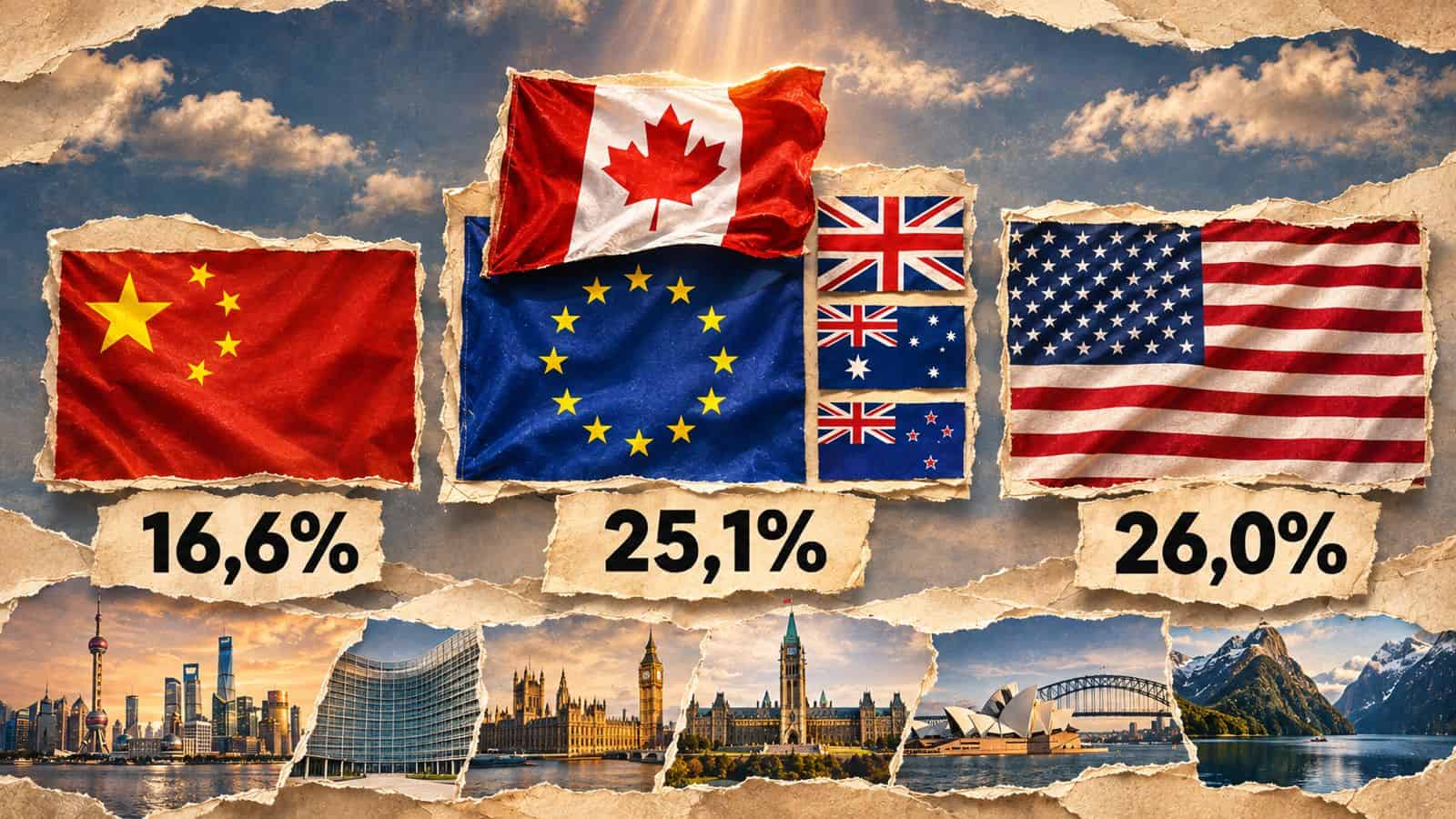
According to the International Monetary Fund, the combined nominal GDP of the EU, the United Kingdom, Canada, Australia, and New Zealand reached $29.7 trillion in 2025, $1.1 trillion less than that of the United States and $10 trillion more than China’s.
In October 2026, Germany, France, Italy, and Greece opposed granting Canada associate membership in the EU. Nevertheless, Ottawa and Brussels proceeded with the launch of an economic and security alliance.
Article 49 of the Treaty on European Union allows only European states to apply for membership. Ottawa’s rapprochement with Brussels is therefore proceeding through joint programs rather than accession.
In February 2026, Canada signed an agreement to participate in the EU’s Security Action for Europe (SAFE) defense financing instrument, which supports joint arms procurement. In June, following approval by the Council of the EU, Canada became the first non-European country to participate.
The EU does not include Australia or New Zealand, so bringing democracies together without the United States requires a framework broader than the Union itself.
The new government of British Prime Minister Andy Burnham has adopted a policy of rapprochement with the EU. A grouping of democracies without the United States offers London a path toward closer cooperation with European partners without rejoining the Union.
Australia already cooperates with Canada on defense. In March 2025, Ottawa reached an agreement with Canberra to develop an over-the-horizon radar system based on Australia’s JORN technology to protect the Arctic.
Alongside Britain, Australia, and New Zealand, Canada is a member of the Comprehensive and Progressive Agreement for Trans-Pacific Partnership (CPTPP), which operates without U.S. participation. In February 2026, Carney proposed that Canada, which already has a trade agreement with the EU, serve as an intermediary in bringing the trans-Pacific partnership closer to the European Union.
After SpaceX restricted some services for Ukraine’s Armed Forces without warning in October 2026, including the operation of terminals on platforms traveling faster than 160 kilometers per hour, European governments began reassessing their dependence on Starlink.
On October 30, 2026, Carney emphasized that no country, including the United States, is self-sufficient. Ottawa is investing in AI and developing shared space assets with Europe to avoid dependence on a single private company.
The alliance with the EU, combined with Canada’s membership alongside Australia and New Zealand in the trans-Pacific partnership, gives Ottawa connections to European and Pacific democracies. Canada is using these relationships to coordinate a framework broader than the EU.
Canada and Other Middle Powers With Effective Institutions Take On Roles Washington Is Stepping Back From
Autocracies and democracies are competing to shape the foreign policy orientation and domestic governance models of countries that have yet to settle on a development path, including Indonesia and Brazil. China offers these countries a model in which an authoritarian state rapidly builds infrastructure and industrial capacity. Russia promises ruling regimes protection from internal threats, while Western countries associate prosperity with democracy and predictable rules.
By combining domestic stability with the development of democratic institutions, Canada serves as a demonstrable example for the Western bloc. Countries still weighing their options can use Canada to assess the effectiveness of the democratic model, while citizens living under undemocratic governments can compare their own leaders against it.
According to the spring 2026 Democracy Perception Index survey conducted across 98 countries, including undemocratic states, Canada and Switzerland topped the list of countries viewed most positively worldwide. The United States, meanwhile, ranked among the five countries with the most negative perceptions.
As the Trump administration reduces support for democratic institutions abroad and redirects resources toward domestic political priorities, responsibility for upholding international trade rules, common technological standards, human rights, and democratic governance is increasingly being shared among the Western bloc’s middle powers.
European democracies, together with Japan, South Korea, Australia, and Canada, have the capacity to sustain the mechanisms underpinning the “rules-based world order.”
AI and Education Set Canada on a Trajectory That Outweighs Its Role in the Resource Economy
Canada has traditionally been viewed as a supplier of lumber, oil, potash, and uranium. In the coming years, however, its global standing will increasingly be determined by AI and education – sectors in which the country invests consistently, rather than shifting priorities from one election to the next.
Canada is already developing AI as a full-fledged industry, with a dedicated government minister, public funding, and state equity stakes in AI companies. Over two years, the share of Canadian businesses using AI to produce goods and services rose from 6.1 percent to 19.2 percent, reaching 40.4 percent in the finance and insurance sector.
In 2017, Canada adopted the world’s first national AI strategy. The Mila institute in Montreal, the Vector Institute in Toronto, and Amii in Edmonton grew out of the research schools established by Yoshua Bengio, Geoffrey Hinton, and Richard Sutton.
The Carney government built on and expanded this approach, appointing Evan Solomon as Canada’s first Minister of Artificial Intelligence and Digital Innovation in May 2025 and unveiling the “AI for All” strategy on June 4, 2026.
According to the Canadian government, the country is home to 0.5 percent of the world’s population but accounts for 10 percent of the world’s leading AI researchers. This concentration of highly skilled AI talent is the result of the systematic development of science, technology, engineering, and mathematics (STEM) programs at Canadian universities and research centers over several decades. As a result, another country cannot quickly assemble a comparable pool of talent, even with substantial investment.
Drawing on this talent, Canada’s AI sector is developing into a major industry. In the year ending March 2026, Ontario saw the creation of 121 new AI companies, while private investment in the province’s AI firms increased to $2.8 billion.
Canadian universities are attracting scholars leaving the United States. In 2025, Timothy Snyder, Marci Shore, and Jason Stanley moved from Yale University to the University of Toronto. The 2025 federal budget allocated $1.2 billion to attract highly qualified international researchers to Canadian universities.
The European Union has capital, data, and an industrial base, but among world-class AI model developers independent of American and Chinese platforms, Europe has only France’s Mistral AI, while Germany’s Aleph Alpha is combining with Canada’s Cohere.
Ottawa is helping to fill this talent gap by combining its large share of leading researchers with a domestic AI model developer, Cohere, which operates under Western law. For Europe, Canada is becoming a source of the component needed to modernize its AI sector – a component Europe cannot purchase or develop domestically within a few years.
On October 29, 2026, Canadian AI laboratory Cohere announced a funding round of up to $5 billion led by Germany’s Schwarz Group, valuing the company at $25.5 billion. That same day, while hosting EU leaders in Montreal, Carney announced that the Canadian government would become a shareholder in Cohere, investing up to $1.14 billion in an equity stake.
In return, Cohere committed to maintaining its Canadian headquarters, creating at least 1,000 technical jobs by 2030, and investing $1.2 billion in new computing infrastructure in Canada. AI Minister Evan Solomon stated that the stake in Cohere would not be the government’s last. The planned Canadian Tech Growth Fund will acquire equity stakes in small and medium-sized technology companies.
In February 2026, Canada and Germany signed a joint declaration on AI and launched the Sovereign Technology Alliance, intended to reduce the two countries’ strategic technological dependence and help establish global standards for emerging technologies. On September 16, 2026, they announced joint funding for LawZero, a Montreal-based AI safety laboratory founded by Yoshua Bengio.
On October 30, 2026, Canada joined the European supercomputing network EuroHPC, giving Canadian researchers and companies the opportunity to apply for access to Germany’s JUPITER supercomputer.
The European Union gains access to researchers, AI models, and computing resources from a country seeking a long-term, predictable, and wide-ranging partnership. Canada, in turn, gains a market for its products and sources of financing to develop its AI sector.
Canada’s Water, Energy, and Mineral Resources Give the Carney Government Influence Over the Terms of Cooperation With Foreign Partners
Global shortages of freshwater, critical minerals, food, and energy are increasing the importance of countries that possess these resources. Canada holds them on a scale disproportionately large relative to the size of its economy.
Canada holds 20 percent of the world’s freshwater reserves and 7 percent of the planet’s renewable freshwater resources. The country also ranks among the three largest suppliers of wheat, canola, and oilseed crops.
Canada is the world’s largest producer of potash, accounting for 31 percent of global production, and the second-largest producer of uranium after Kazakhstan, with a 24 percent share.
Because Alberta is Canada’s most resource-rich province, the results of the October 19, 2026, referendum reduced the risk, from Ottawa’s partners’ perspective, of losing access to these resources. In the referendum, 74.95 percent of participants rejected initiating the process for the province’s separation from Canada.
The value of Canadian minerals to its partners rests on two factors: the country’s resource potential and the independence of its mineral supplies from China.
Because Beijing still controls most of the world’s capacity to process ores into industrial materials, countries within the democratic bloc are developing an end-to-end processing model outside China.
Canada has established itself as the initiator of this model because the G7 adopted the Critical Minerals Action Plan in Kananaskis under Canada’s presidency in June 2025, and Canada established the Critical Minerals Production Alliance in October 2025.
Global warming has contrasting consequences for Canada and Russia. In Canada, it expands the area of land suitable for agriculture, while in Russia, it raises the cost of maintaining northern infrastructure.
Canada’s freshwater resources, low-cost energy, fuel reserves, rare-earth deposits, and Arctic territories give it control over assets that the United States, the EU, and Ottawa’s partners outside the democratic bloc are competing to access. Yet its partners’ interest in Canada’s territorial integrity and political stability extends beyond access to raw materials. The mere possession of mineral deposits does not guarantee that a country can manage them effectively.
Washington’s pressure, intended to force Ottawa back into the role of junior partner, has instead brought the results of the Carney government’s 2025–2026 reforms into focus. These achievements weaken the autocratic axis’s argument that democratic states are becoming dysfunctional.
Clearly defined immigration priorities, the separation of operating and capital expenditures in the federal budget, and the expansion of Canada’s network of trade agreements have restored voter confidence in the Carney government. Such measures are within reach of most middle powers in the Western bloc.
Canada is becoming a significant geopolitical force because it shows the world a different standard of governance. It has secured a seat at the negotiating table without a large military or the other attributes of a superpower. Effective governance makes the Canadian approach itself a geopolitical asset, attracting middle powers dissatisfied with pressure from Washington and Beijing, as well as citizens seeking an alternative model of government.
This publication is the result of a partnership between MILITARNYI and SOLID INFO. An extended version is available on the website of the analytical center.


Big Tech Pushes the White House Toward Global De-escalation: The Stance of Tech Capital Shapes the Terms for a Deal Between Trump, Putin, and Xi Jinping
As of October 14, 2026, political advertising expenditures in the current U.S. election cycle, including reserved airtime, had exceeded $10 billion...

Netanyahu’s Visit to Abu Dhabi: Israel Builds Partnerships from a Position of Strength, but the Middle East Conflict Is Eroding the Edge of Its Weapons
On September 27, 2026, Israeli Prime Minister Benjamin Netanyahu traveled to Abu Dhabi with the head of Mossad and the head of the National Securit...

Japan Rapidly Builds Up Its Defense Capabilities: Personnel Shortages and Low-Cost Weapons Set the Pace of the Self-Defense Forces’ Modernization
On October 13, 2026, lawmakers from Japan’s ruling Liberal Democratic Party, led by former Defense Minister Itsunori Onodera, established a parliam...
