




Popular

Russia has modified the Iskander-M ballistic missile to penetrate missile defense systems and adapt production to sanctions, in particular by incorporating components and technical solutions from the North Korean KN-23.
This was reported by Colonel Oleksandr Zaruba, chief research fellow at the State Scientific Research Institute of Armament and Military Equipment Testing and Certification, during the event “The Russian Federation’s Use of Air Attack Weapons Against Civilian Infrastructure: Technical and Humanitarian Aspects,” which was attended by a correspondent from Militarnyi.
In particular, the missile has been equipped with an updated 9B899 module, which fires decoys, dipole reflectors, and heat traps during the terminal phase of flight.
The onboard systems are adapted to operate in active scanning mode and detect blind spots in the visibility of air defense radar systems. The software is regularly updated.
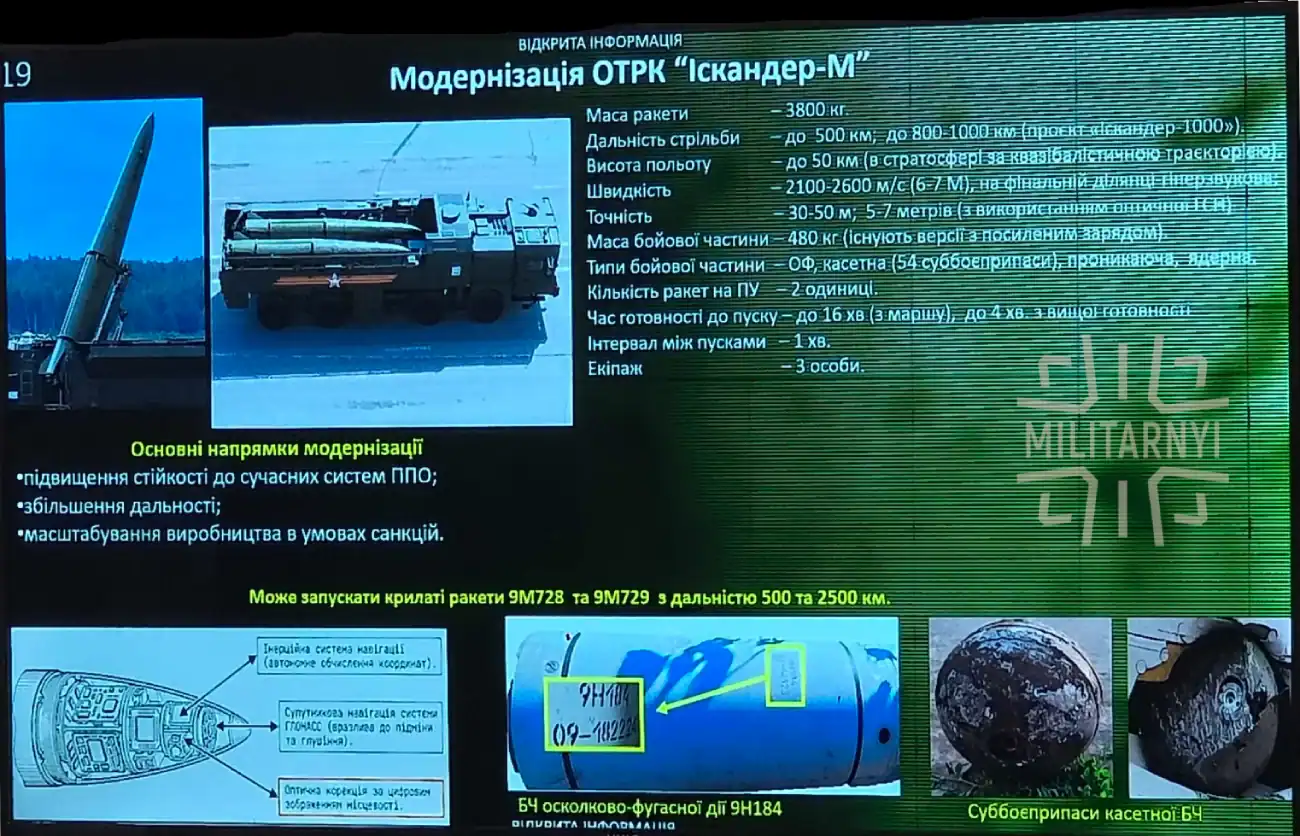
New versions of the missile produced after 2023–2024 use a faster processor to process images received by the optical homing head, which increases the probability of target recognition, detection, and destruction.
To ramp up production, elements and technical solutions used in North Korea’s KN-23 have been integrated into the Iskander-M missile. However, according to the researcher, the use of actual KN-23s transferred by the DPRK “has not been recorded recently.”
“The share of Russian electronic components in this missile has risen to 90%, but Western electronics are also present in it. Seven warhead variants, including penetrating and concrete-piercing versions, and, accordingly, they are used against airfields to destroy our tactical aviation. They are specifically targeting F-16 aircraft,” Oleksandr Zaruba said.
As of spring 2026, the monthly production rate for Iskander-M ballistic missiles stands at 60 units, and for Iskander-K cruise missiles at 10 units.
In addition, researchers have confirmed reports that the Russians are working on a new version of the Iskander-M ballistic missile, tentatively named ‘Iskander-1000,’ which is expected to have a range of up to 1,000 kilometers. This is planned to be achieved through the use of a new, higher-energy fuel and a more powerful engine.
During an analysis of procurement documents for missile systems that came into the possession of the editorial staff, Militarnyi noted an order for missiles with the unusual designation 9M723-2, which may be associated with the Iskander-1000 extended-range missile project.

Production of a small batch of 18 units was scheduled for 2025, and the cost of each unit was estimated at 221 million rubles, or $2.5 million.
Given the absence, as of early June 2026, of any instances of ballistic missiles of this type being used at ranges exceeding 500 km, it can be assumed that this version is still in the development/testing stage.
Підтримати нас можна через:
Приват: 5169 3351 0164 7408 PayPal - [email protected] Стати нашим патроном за лінком ⬇
Subscribe to our newsletter
or on ours Telegram
Thank you!!
You are subscribed to our newsletter