



Popular
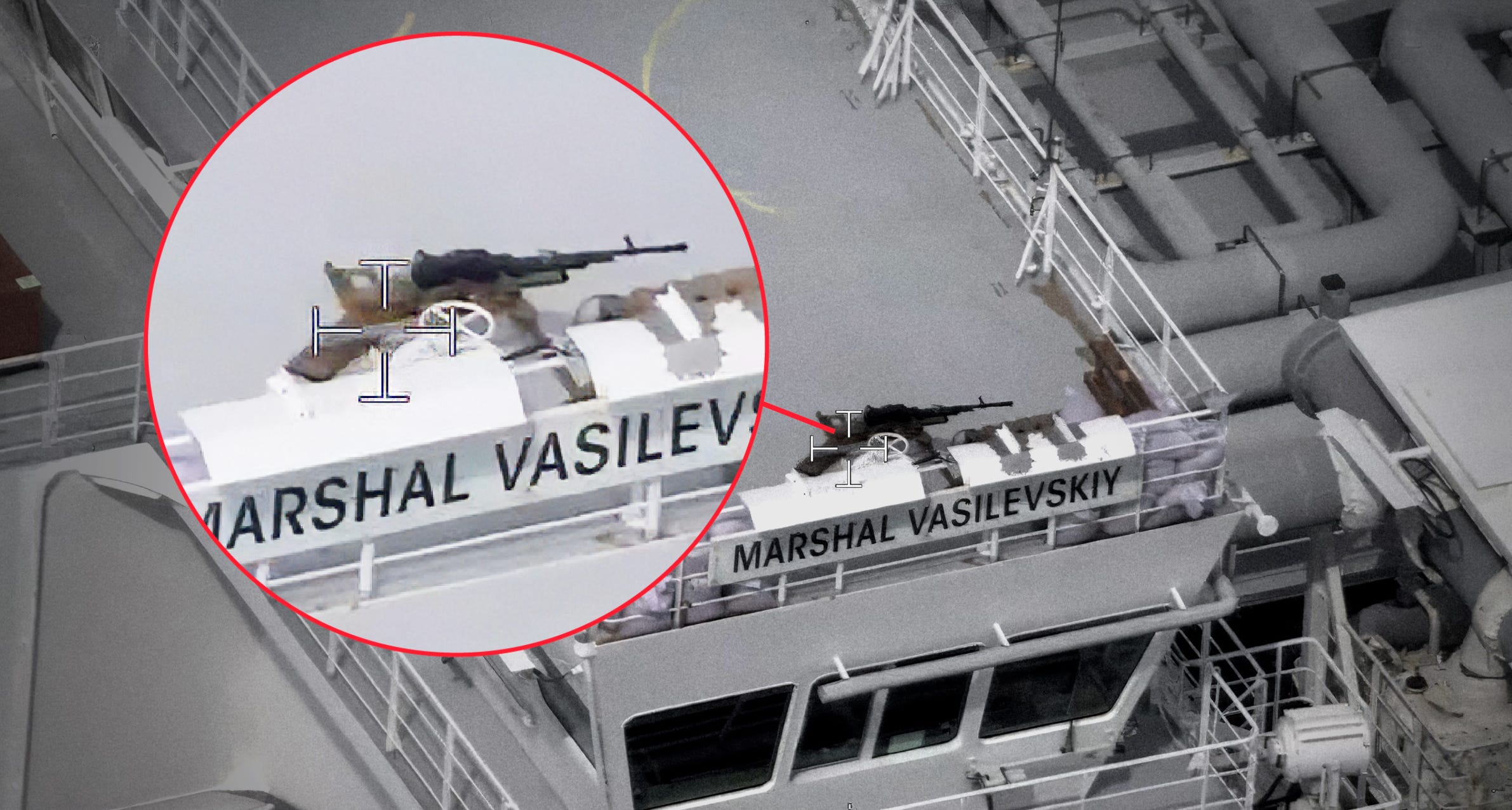
Russia has installed large-caliber machine guns on the civilian gas tanker Marshal Vasilevskiy, which supplies natural gas to the Kaliningrad region.
This was reported by The Baltic Flank, citing photographs taken by a surveillance aircraft of the Estonian Police and Border Guard Board.
This is the first documented case of military weapons being deployed on a civilian vessel.
The images, taken in May as the tanker passed along the Estonian coast en route to the port of Bolshoy Bor in the Gulf of Finland, show two firing positions, reinforced with sandbags, on either side of the gangway.
The Russians had installed 12.7 mm Kord heavy machine guns—which are standard issue for the Russian army—at these positions. A Baltic Sea intelligence officer assesses that the weapons were deployed for two reasons: to protect the vessel from potential attacks by Ukrainian naval drones and to demonstrate strength to Western countries.

However, the source noted that the machine guns are practically ineffective against aerial drones, which have recently been regularly attacking Russian infrastructure in the Baltic Sea. At the same time, the weapons could pose a threat to maritime drones, although Ukraine has not yet deployed them in the Baltic region.
Danish naval commander and independent analyst Jens Wenzel Khristoffersen believes that the armament primarily serves a psychological purpose. According to him, Russia seeks to demonstrate its readiness to use force against any attempts to inspect or detain the vessel.
The publication notes that the Marshal Vasilevsky is not part of the so-called shadow fleet that transports Russian oil in circumvention of sanctions. The vessel serves a different strategic function—it delivers liquefied natural gas to the Kaliningrad region.
Since last August, the tanker has made four voyages between the port of Bolshoy Bor and Kaliningrad. It is Russia’s only FSRU (Floating Storage and Regasification Unit) vessel capable of receiving liquefied natural gas, storing it, regasifying it, and feeding it into the gas transmission system. Given its critical importance to Kaliningrad’s energy supply, Ukraine may view the vessel as a potential target.

Commander of the Estonian Navy, Commodore Ivo Värk, stated that if the tanker’s crew uses weapons against any vessel in Estonian territorial waters, the Estonian Defense Forces will intervene and use force to defend the attacked vessel.
Journalists also analyzed a list of individuals who have been on board the Marshal Vasilevskiy since last August. According to their data, nearly half of the 50 passengers have served in the Russian Army, the Russian National Guard, or the FSB.
One of them, Dmitry Artemenko, according to investigators, is registered at the address of an FSB special forces unit in Balashikha near Moscow and accompanied every voyage of the tanker to Kaliningrad.
Earlier, Militarnyi reported that the French Navy detained the tanker Deliver off the coast of Sicily. The vessel was sailing under the Cameroonian flag from Primorsk.
Підтримати нас можна через:
Приват: 5169 3351 0164 7408 PayPal - [email protected] Стати нашим патроном за лінком ⬇
Subscribe to our newsletter
or on ours Telegram
Thank you!!
You are subscribed to our newsletter