




Popular
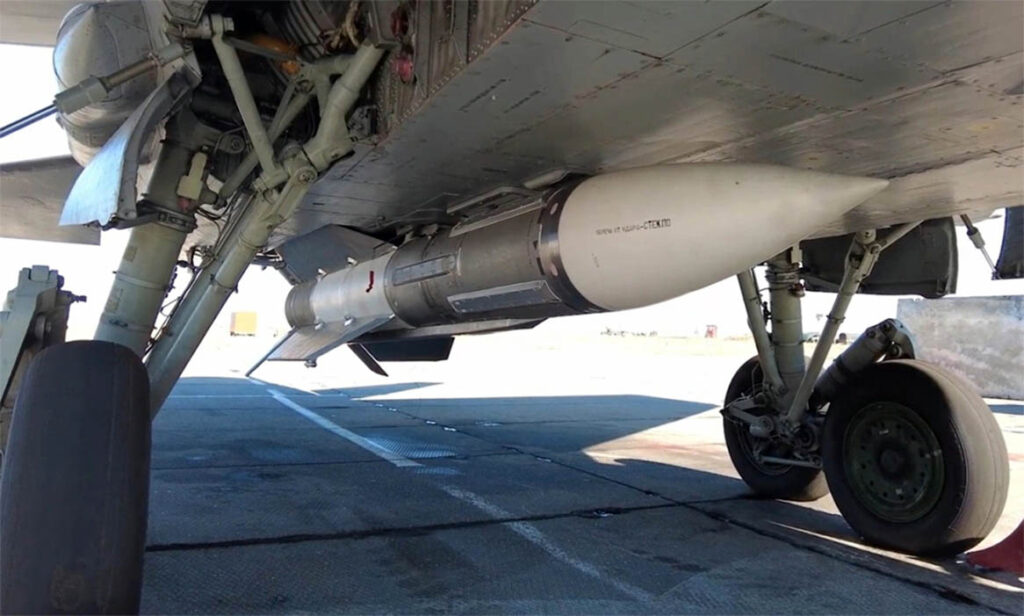
The Russian Aerospace Forces have asked manufacturers to increase production of R-37M long-range air-to-air missiles to 500 missiles per year, starting in 2026.
The request was revealed through leaked documents from the Azov Optical and Mechanical Plant, obtained by analysts at the private intelligence firm Dallas Analytics.
The documents include internal correspondence, government contract data, and production schedules involving the Azov Optical and Mechanical Plant from April 2023 through March 2025.
The documents also revealed that the Azov Optical and Mechanical Plant manufactures several critical electrical components for the R-37M long-range missile, including switching units, power supply and battery activation units, cable harnesses, circuit boards, and housings.

“This list is not a collection of spare parts. It represents the missile’s entire electrical architecture: power distribution, signal routing, and activation of the onboard batteries, without which the R-37M would remain nothing more than an inert object on the aircraft’s hardpoint,” the researchers emphasized.
In March 2025, the company learned that Russia’s Aerospace Forces required an increase, starting in 2026, in deliveries of products incorporating components manufactured by the plant. The company was given 72 hours to respond on whether it could, starting in 2026, supply 500 sets of electronic assemblies and 1,000 missile bodies every year.
The R-37 (K-37) long-range guided air-to-air missile was developed primarily as the main armament of MiG-31 aircraft, replacing the R-33. The aircraft’s main mission was to counter strategic missile carriers, reconnaissance aircraft, and command-and-control aircraft, as well as to intercept cruise missiles equipped with nuclear warheads. These requirements directly influenced the missile’s design: it had a long engagement range and a powerful warhead to destroy large aircraft and cruise missiles, but limited maneuverability.
Testing of the missile continued until 1997. After the Soviet Union dissolved, cooperation with Ukrainian enterprises developing the missile’s guidance systems was disrupted. As a result, a decision was made to develop a guidance system using exclusively Russian-made components. The upgraded missile, built using Russian components, was designated the R-37M (K-37M, Izdelie 610M). Under the export designation RVV-BD (Izdelie 620), it has been repeatedly displayed at military equipment exhibitions.
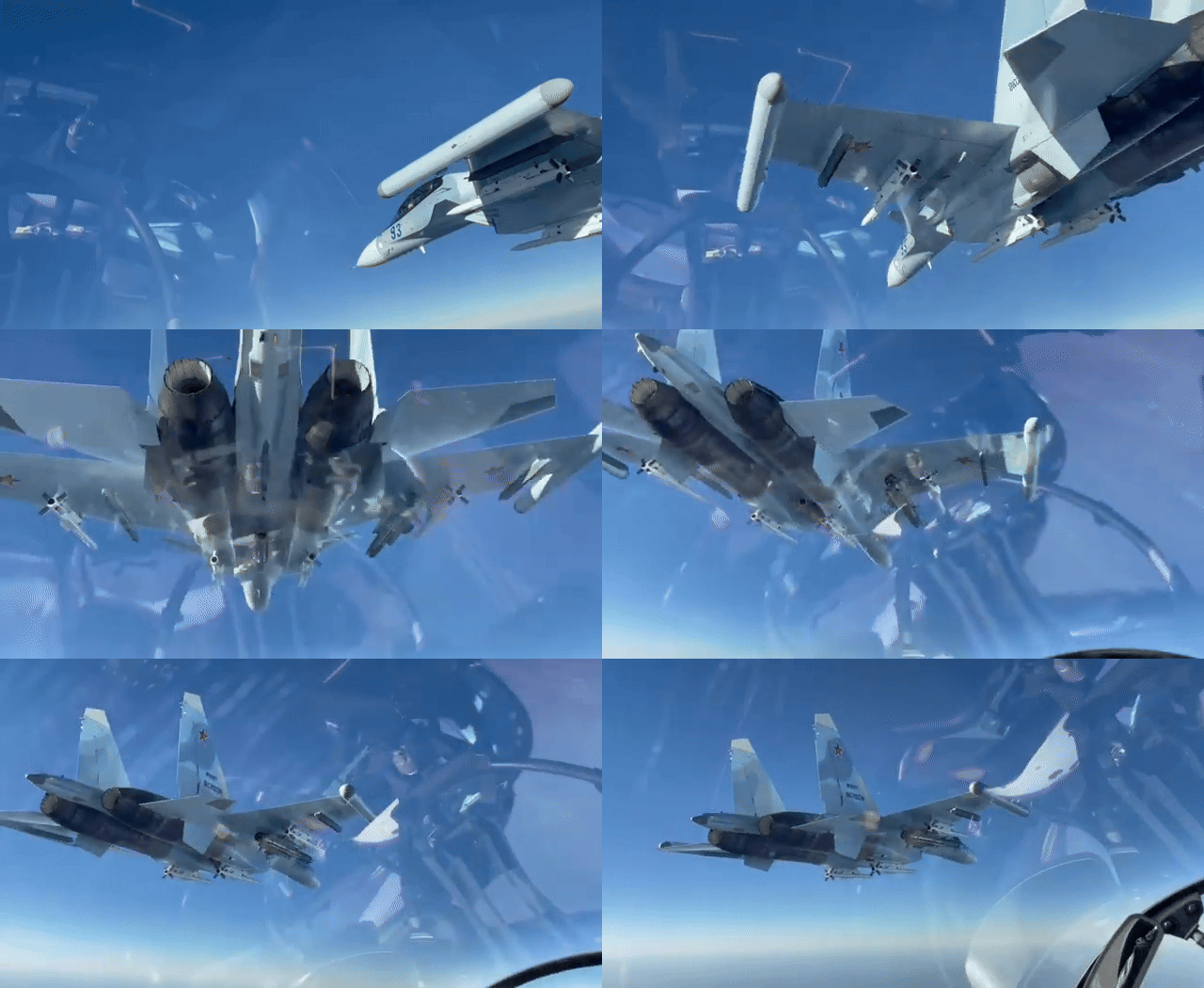
The K-37M guided missile was first launched from a MiG-31 in 2011 and entered service in 2014. The R-37M was later integrated onto the Su-35S, Su-30SM2, and Su-57.
According to promotional materials, the export-version RVV-BD has a maximum launch range of 200 km against “certain types of targets” in the forward hemisphere. The exact range of the R-37M is unknown, although it has been claimed to reach up to 300 km. However, maximum engagement ranges are achieved when the missile is launched from high altitude along a ballistic trajectory against non-maneuvering targets.
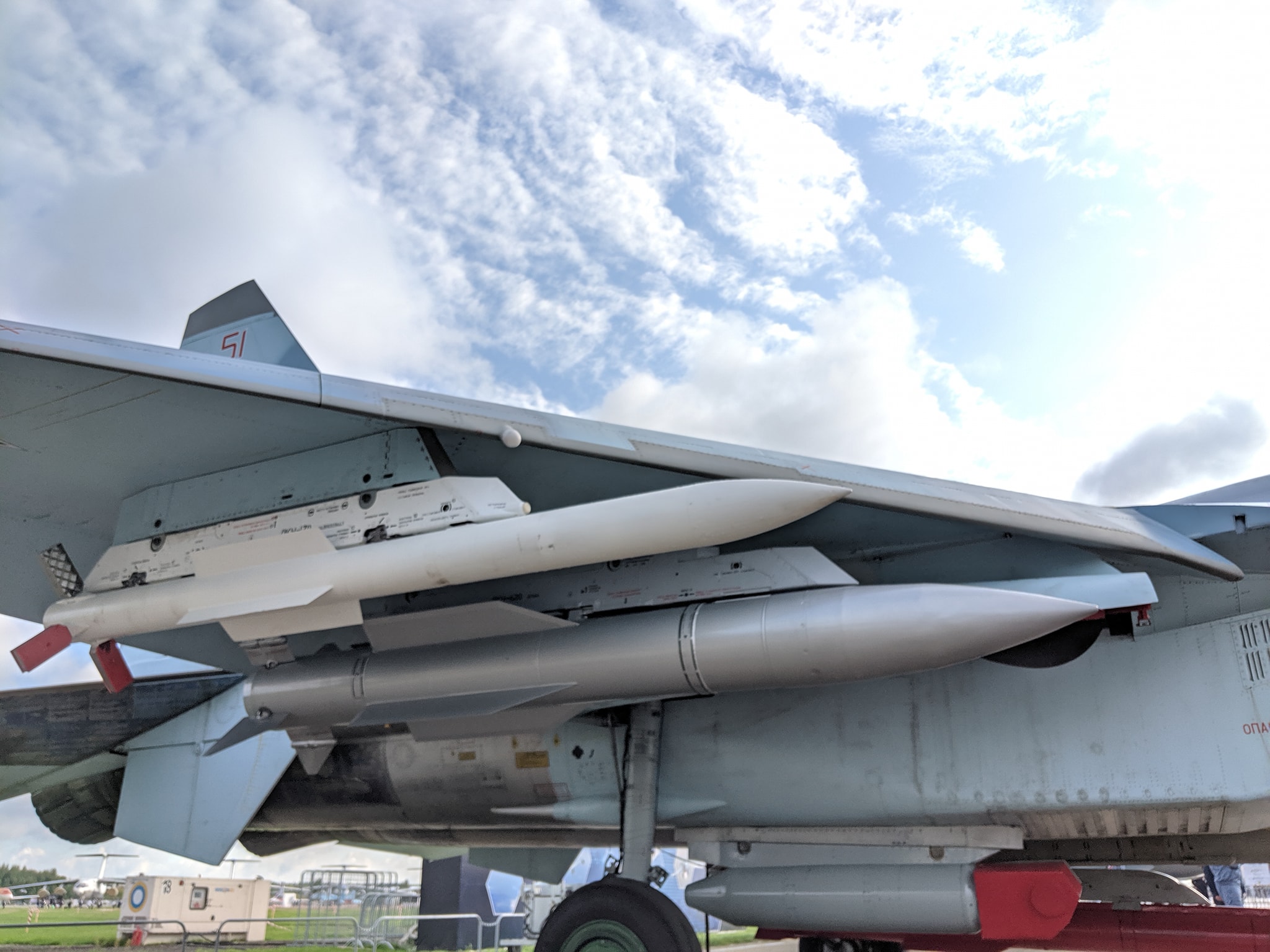
The warhead is a 60 kg high-explosive fragmentation type. The fuze has two target sensors: an active radar proximity sensor and a contact sensor.
The most significant improvement over the previous version was the introduction of a new control system and an upgraded 9B-1103M-350 active radar homing head on the R-37M. The stated target acquisition range against a “fighter-type” target with a radar cross-section (RCS) of 5 m² exceeds 40 km.
In practice, almost every Ukrainian military aviation sortie near the front line is met with at least one Russian missile launch targeting Ukrainian aircraft. These are often air-to-air missiles fired by Su-35S and Su-30SM fighters conducting combat air patrols in designated areas.
Nevertheless, Ukrainian pilots can evade Russian missiles in most cases and complete their missions. This does not mean, however, that these missiles pose only a limited threat to Ukrainian aviation. There have been documented cases of Ukrainian fighter aircraft and helicopters being shot down by R-37 missiles at considerable distances from the front line.
Підтримати нас можна через:
Приват: 5169 3351 0164 7408 PayPal - [email protected] Стати нашим патроном за лінком ⬇
Subscribe to our newsletter
or on ours Telegram
Thank you!!
You are subscribed to our newsletter