



Popular
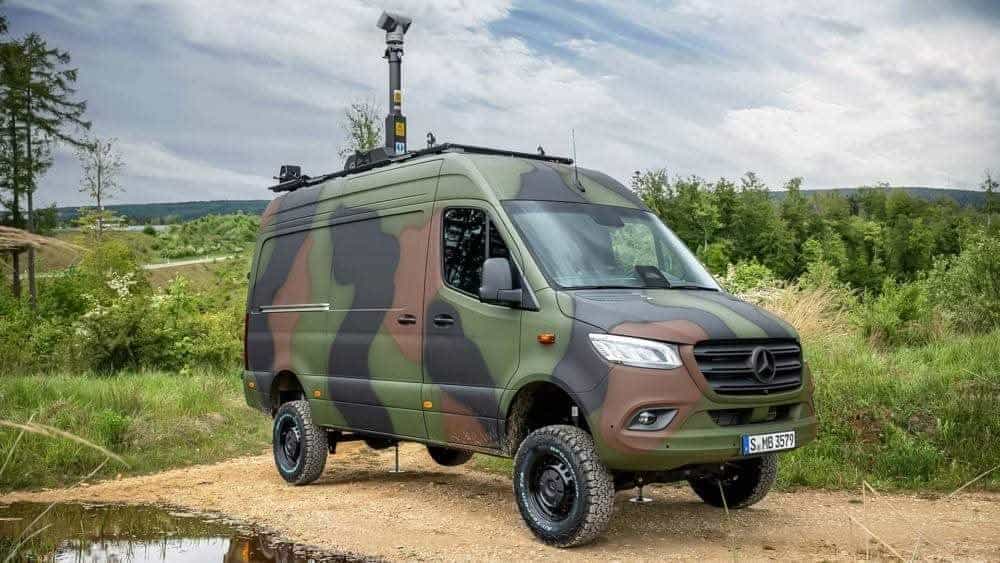
A mobile UAV command post is more than just a van fitted with monitors, antennas, and additional seats.
Its effectiveness depends on a properly selected and modified chassis, reliable power supply, crew ergonomics, rapid deployment, maintainability, and the capacity to operate in real field conditions.
At MSPO 2026 in Kielce, I examined a prototype of such a system based on the Mercedes-Benz Sprinter, jointly developed by TYTAN Technologies and BINZ, and tried to assess it not as an exhibition piece but as a potential operational tool.
I’ve generally always been okay with NATO countries’ experience in supplying off-road vehicles to the military. I’ve cited the experience of France, Spain, the Czech Republic, and even Poland many times, and have mostly given positive feedback.
But this time, we will focus on specialized vehicles. Namely, a mobile command post and carrier for interceptor UAVs based on the Mercedes-Benz Sprinter, developed by Mercedes-Benz together with TYTAN Technologies and coachbuilder BINZ.

…It’s not like I’m some huge Mercedes fan, but I do have a certain loyalty to the brand. After all, my first ‘non-Lanos’ was a W210 E-Class, and over the course of my life I’ve managed to rack up some mileage in almost the entire Mercedes lineup from 1982 to 2022. Well, you get it: I love Mercs. Flexed a bit, proved my brand loyalty… Now let’s move on.
This spring, photos of a handsome green Sprinter briefly made the rounds in the news. Defense publications in Ukraine and abroad covered the concept, with plenty of content about it on LinkedIn and Facebook. It was also displayed at Eurosatory 2026 in Paris, from where a friend of mine shared some detailed photos.
That’s when I started wondering: “Do the Germans actually understand what they’re doing?”
And then, at MSPO 2026 in Kielce, I finally got to see the vehicle in person. Here are my impressions, point by point:
1. Workspace Layout
Materials very similar to MDF are used extensively for the interior. Looks great for an exhibition. For an all-metal van that will be constantly driven on bad roads… questionable. This kind of material is heavy, brittle, and doesn’t handle constant vibration and body flexing very well. I suspect that in real-world use, all this beauty will start rattling loose and falling apart fairly quickly.
2. Crew Seats
The seats are decent, but too basic for a Mercedes and a vehicle designed for such a purpose. In Ukraine, reconnaissance and other UAV operators can spend 8–12 hours at their workstations. So ergonomics here is not a decorative feature but a direct factor in crew performance. I expected more from Mercedes.

3. Practically Unusable Second Sliding Door.
The chosen body has sliding doors on both sides. But the exit on the left is effectively blocked: that’s where the inverter, electrical panel, batteries, and other power system equipment have been installed.
The solution is quite extravagant, but questionable for several reasons:
Why order a body with two sliding doors in the first place? No idea.
4. Ladder.
The roof carries antennas, masts, and other equipment mounted on a roof rack that needs to be quickly accessible. But there is no fixed external ladder.
Instead, they carry a regular folding ladder in the work area. Why not install a proper fixed ladder on the rear door? It would be faster to use when deploying and packing up, wouldn’t take up space inside and require finding a place to prop it up every time.
5. Power Supply.
There is no separate gasoline or diesel generator included. According to the developers, the equipment is supposed to be powered by an auxiliary generator driven by the vehicle’s engine.
It is mounted very low.
The system’s stated output is around 7 kW. Maybe it really does deliver that on a stand (I doubt it). But in real-world conditions, I’d like to see it sustain at least a stable 3 kW continuous load.
Because rated output on a spec sheet and reliable power for the system in field conditions are quite different things.

6. Underbody Protection.
If the all-wheel-drive Sprinter is positioned as a specialized mobile system for field operations in off-road conditions, then where is the protection for the radiator, oil pan, transmission, and the low-mounted auxiliary generator? Pretty much everything is exposed underneath. And that’s especially strange given the location of the power system itself.
7. Transport and Launch of Interceptor UAVs.
The interceptor logistics system and so-called launch pad consist of a metal box with compartments mounted on a retractable platform.
One compartment – one interceptor on a cradle. Looks impressive and neat. But it raises questions about how efficiently the space is used, how quickly the system can be reloaded, and whether such a bulky and heavy structure is really necessary.

8. Outriggers!
Yes, outriggers extend from underneath the body of an all-metal Sprinter and can raise the vehicle slightly off the ground. It looks very impressive. But why? I didn’t see any equipment in this system that would require such precise leveling.
It’s not needed for the operators’ work. It’s not needed for launching the interceptors either. At the same time, the outrigger system is heavy and bulky, takes up space, and reduces the vehicle’s payload capacity.
The only logical explanation I could come up with is that the Sprinter’s body flexes noticeably under torsional loads, the interior fit-out is heavy, and the retractable platform requires stable geometry. Plus, at an exhibition, a vehicle sitting on outriggers looks tall and compelling rather than sagging under the weight of all the equipment installed inside.

The cost of this concept hasn’t been disclosed. But I’ve got a feeling they slapped a ×3 markup on it. That’s just what I managed to notice during my inspection. But even that is enough to draw some conclusions.
European manufacturers are definitely studying photos and videos of Ukrainian specialized military equipment, borrowing individual technical and layout solutions, and trying to replicate them.
But they don’t always grasp why these solutions took the form they did in Ukraine, the conditions they have to operate in, or what crews actually need.
As a result, we see beautiful, complex, and probably very expensive exhibition concepts. But there is still a huge gap between an exhibition concept and a vehicle capable of operating in a war zone day in, day out.
And you know what? Personally, I’m actually glad about it. Because Ukrainian mobile command posts aren’t just innovative. They’re built by people who understand how they’re actually used, get feedback from crews, and improve the equipment not for exhibitions, but for real-world work.
That’s why our solutions continue to stand among the world’s best.
P.S. Too bad those cool Germans who once stuffed a mighty V12 under the hood of a W124 apparently went extinct. They would have definitely done this van right.
Підтримати нас можна через:
Приват: 5169 3351 0164 7408 PayPal - [email protected] Стати нашим патроном за лінком ⬇
Subscribe to our newsletter
or on ours Telegram
Thank you!!
You are subscribed to our newsletter