



Popular
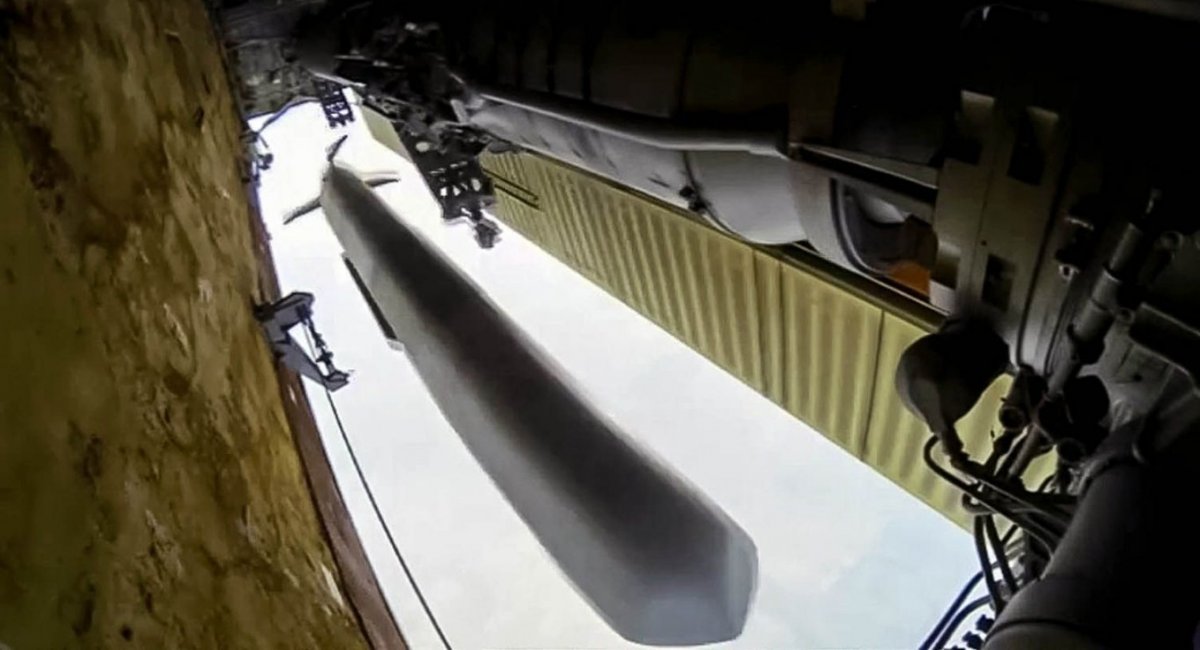
During the full-scale invasion, Russia has significantly modernized the Kh-101 cruise missiles, specifically updating the radar-absorbing coating on the fuselage to reduce their detection range by radar.
This was reported by Colonel Oleksandr Zaruba, chief research fellow at the State Scientific Research Institute of Armament and Military Equipment Testing and Certification, during the event “The Russian Federation’s Use of Air Strike Weapons Against Civilian Infrastructure: Technical and Humanitarian Aspects,” which was attended by a correspondent of Militarnyi.
The researcher noted that the Kh-101 is a fairly old missile that has undergone ‘significant modernization.’ Starting on January 24, 2022, the navigation system, warhead, and fuselage were updated, and a passive jamming unit was added.
“The fuselage has been updated with a radar-absorbing coating to reduce its radar cross section. This means they are detected at a shorter range, and the probability of their destruction decreases. It uses an onboard defense system during flight. It is equipped with modules for launching decoys and dipole reflectors. It activates automatically upon detection of air defense radars or during approach to the target” the researcher described.
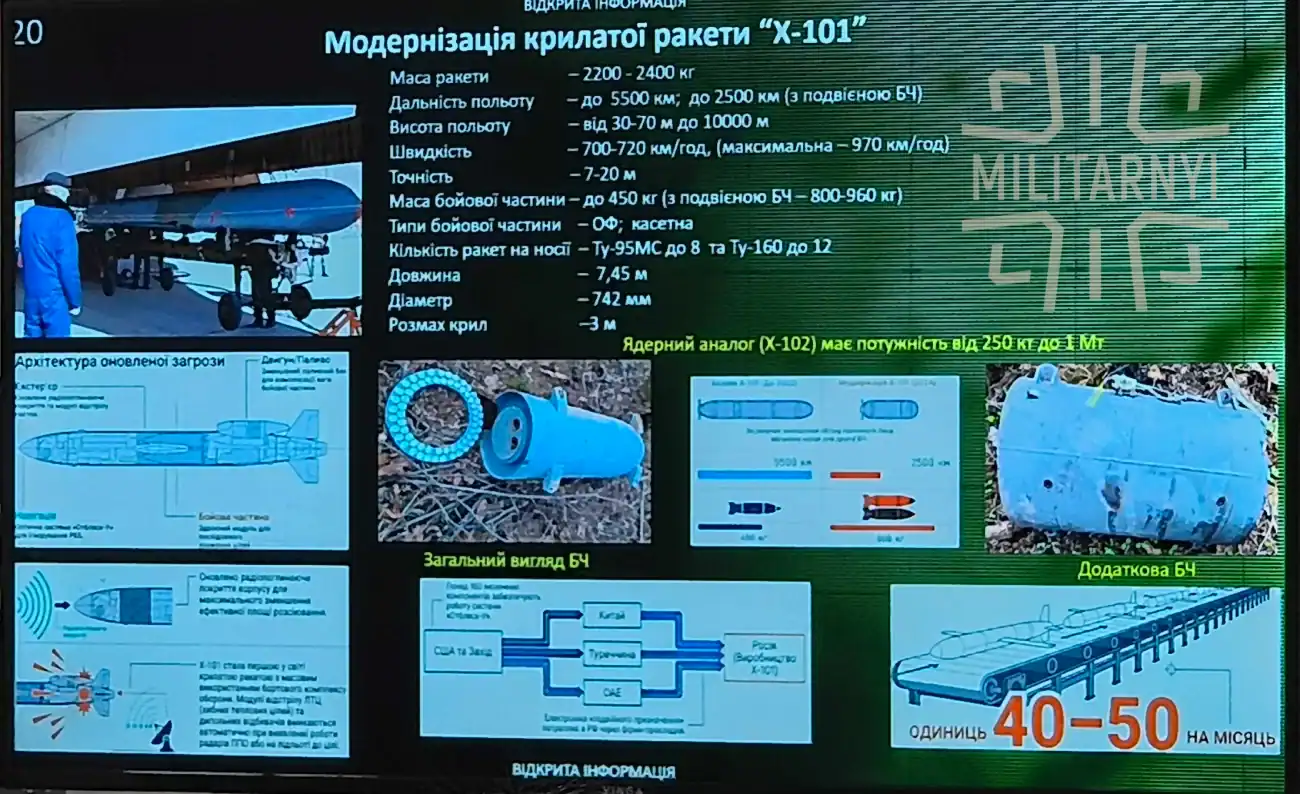
Also, according to him, an analysis of debris from 2024–2025 showed a shift from general-purpose civilian chips to specialized components, which are typically procured through Asian countries.
Starting in the spring of 2024, missiles with dual warheads have been used, which has allowed the total warhead mass to be increased from 450 kilograms to approximately 800 kilograms.

This was achieved by reducing the fuel tank capacity, which resulted in a decrease in flight range from 5,500 kilometers to 2,500 kilometers. However, given the launch distance and the territory of Ukraine, the reduction in range is not critical.
At the same time, the second warhead can be guided, dropped, and detonated at a specified altitude, allowing for the effective use of cluster warheads.
Production is estimated at 40–50 units per month; however, analysis of the debris shows that the strikes are being carried out ‘on the fly’ with missiles manufactured just a few weeks before the attack.
This information is also confirmed by Vladislav Vlasiuk, the President’s Representative on Sanctions Policy. According to him, the Kh-101 cruise missiles that the Russians used for the massive missile and drone strike on May 14 come from a single batch manufactured in the second quarter of 2026.
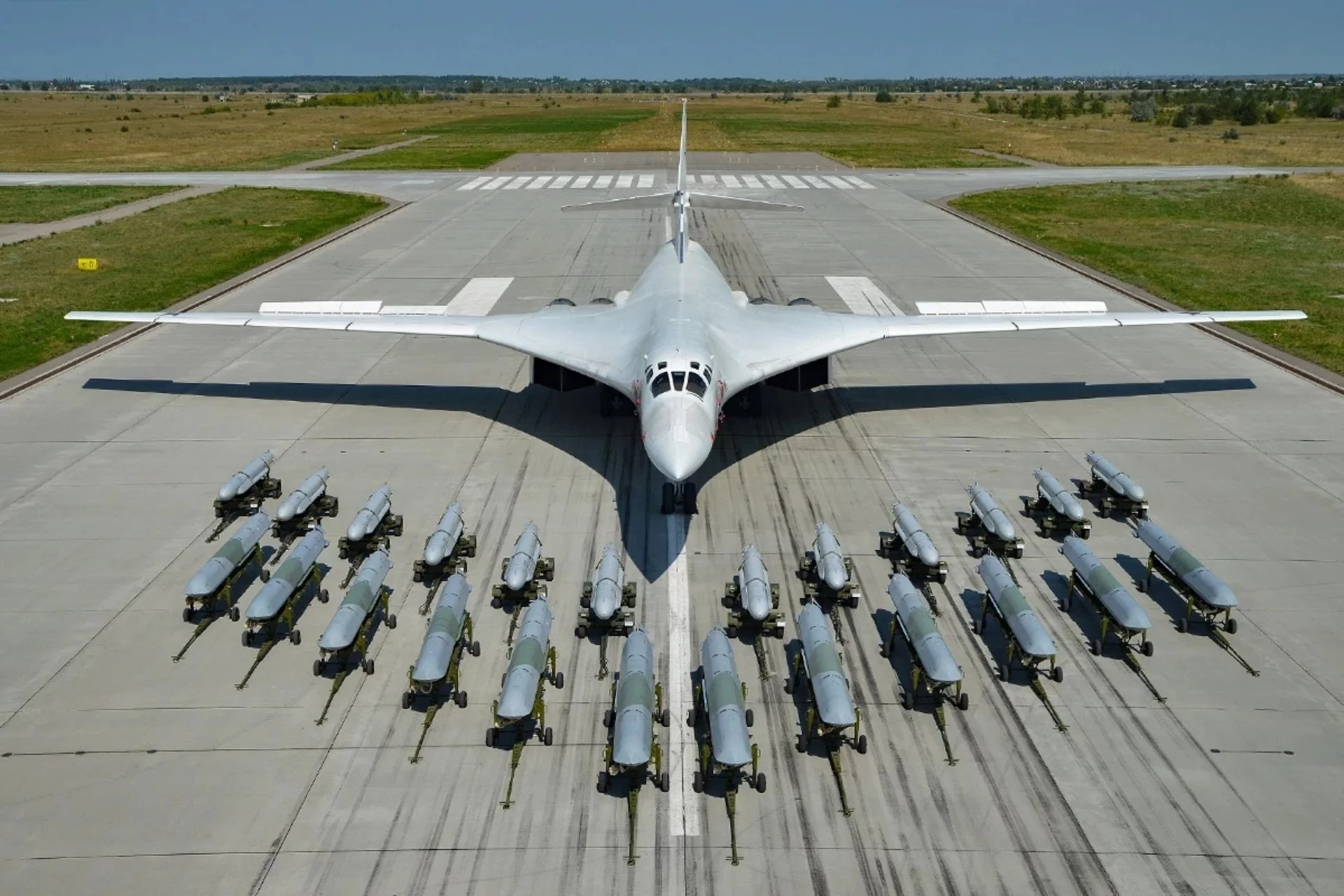
As a reminder, on the night of and morning of May 14, the Russian army also attacked Ukraine with three Kh-47 Kinzhal aeroballistic missiles, 18 Iskander-M/S-400 ballistic missiles, and 35 Kh-101 cruise missiles. Air defense forces managed to shoot down 41 missiles—12 of the 18 ballistic missiles and 29 of the 35 Kh-101 cruise missiles.
The highest number of casualties resulted from the strike in Kyiv: an Kh-101 missile struck a nine-story residential building in the Darnytskyi district of the city, causing the building’s stairwell to collapse. The search and rescue operation lasted over 28 hours. Thirty people were rescued from the rubble, while another 24 were killed.
Підтримати нас можна через:
Приват: 5169 3351 0164 7408 PayPal - [email protected] Стати нашим патроном за лінком ⬇
Subscribe to our newsletter
or on ours Telegram
Thank you!!
You are subscribed to our newsletter