





Popular

Russia has modified its Geran-5 small-sized cruise missiles by relocating the turbojet propulsion system from an external nacelle to an internal fuselage compartment.
Militarnyi reached this assessment after analyzing footage captured by interceptor drones and released by Ukraine’s Security Service and the Wild Hornets group.
The revised propulsion configuration can increase the missile’s flight speed and range, while also simplifying ground testing, access to the propulsion system, and engine replacement.
The externally mounted engine nacelle in the initial Geran-5 configuration likely simplified development and integration of the missile’s propulsion system.
STING S takes down a Geran-5 jet-powered drone-missile ❗️💥
The crew from the 1020th Anti-Aircraft Missile Regiment took down a Russian Geran-5 using the new STING S. This drone is faster and carries a larger explosive payload than other Geran variants.
Big thanks to the… pic.twitter.com/Eg0rQgd1tL
— Wild Hornets (@wilendhornets) September 19, 2026
The primary drawback of an externally mounted engine is the additional aerodynamic drag it generates. The nacelle, its mounting structure, and the junction between the nacelle and fuselage increase the frontal area and the wetted surface exposed to the airflow, while also producing localized flow separation and vortices.
Because aerodynamic drag increases approximately with the square of velocity, these losses become significantly more pronounced at the reported Geran-5 speed of 450–600 km/h than they are on slower UAVs.

Relocating the engine inside the fuselage allows for a smoother external aerodynamic profile and reduces parasitic drag. The resulting performance margin can extend range, reduce fuel consumption, or maintain a higher cruise speed.
In addition, in the externally mounted nacelle configuration, the engine mass and the Geran-5’s thrust line are displaced upward relative to the longitudinal axis. This creates an additional pitching moment that the flight-control system must continuously compensate for through control-surface deflection, which in turn increases drag.


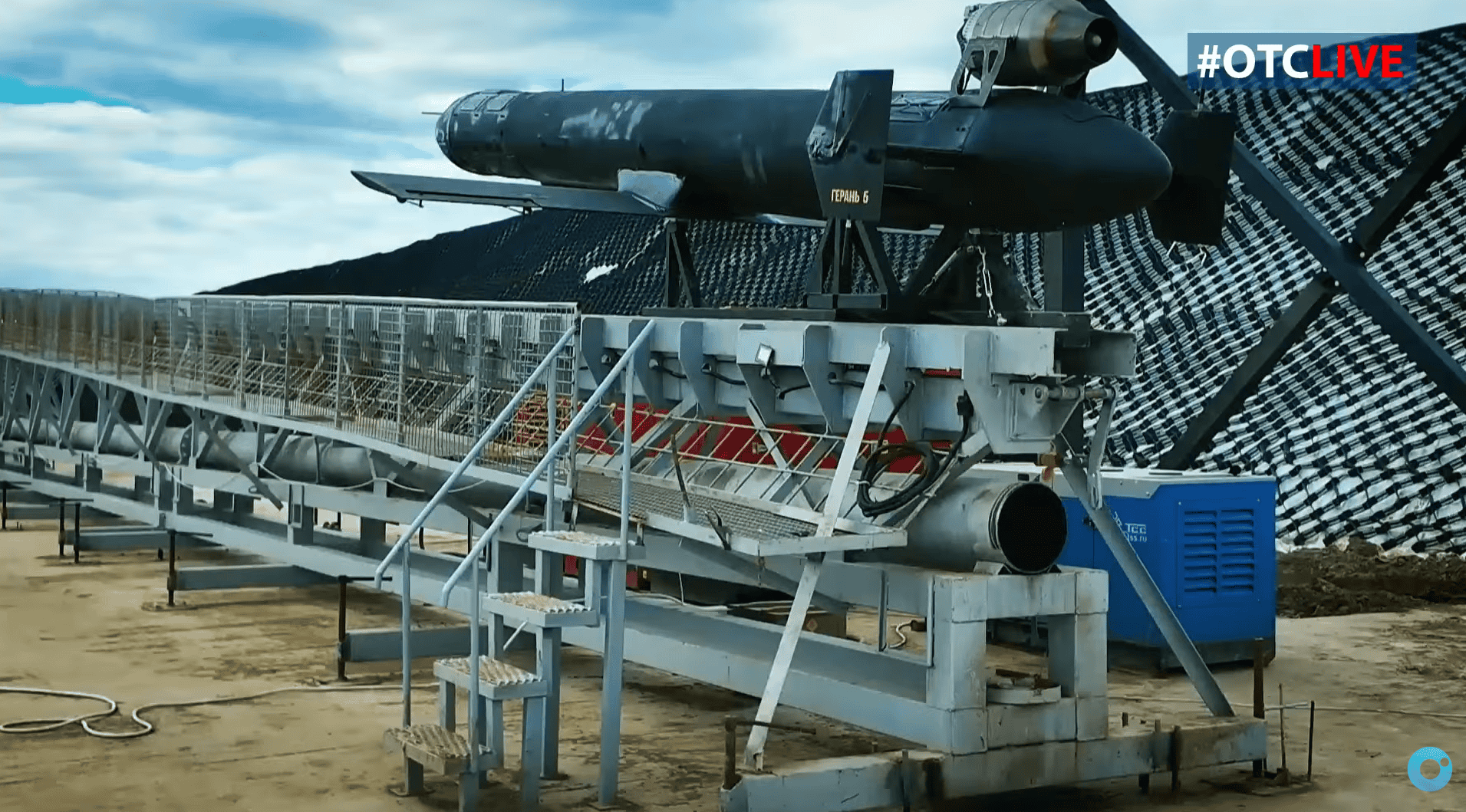
The top-mounted air intake was likely selected to shorten the intake duct while keeping the lower portion of the fuselage unobstructed. This configuration also reduces the risk of ingesting dust and foreign objects during a ground launch.
Locating the propulsion system within the fuselage may also partially reduce the vehicle’s thermal signature in the forward and lateral aspects. The fuselage skin shields the heated engine casing and part of the hot-gas path, reducing their infrared contrast.
However, the exhaust nozzle and exhaust plume remain the primary sources of infrared radiation.
Meanwhile, these aerodynamic benefits come at the cost of a more complex internal design. The engine, mounting structure, thermal insulation, and intake duct occupy internal volume that could otherwise be allocated to additional fuel or other payload.
The vehicle is approximately 6 meters long, with a wingspan of up to 5.5 meters. The Geran-5 can be launched from airborne platforms, including Su-25 attack aircraft, as well as from a ground-based launcher.
The missile is powered by a Chinese TELEFLY TF-TJ2000A turbojet engine rated at 200 kgf of thrust, enabling a reported cruise speed of 450–600 km/h. Its estimated maximum operating altitude is approximately 6 kilometers.

The Geran-5 carries a 90-kilogram warhead, while its stated strike range is approximately 1,000 kilometers.
For target guidance, the missile reportedly uses a 12-channel, jamming-resistant Kometa satellite-navigation antenna, a Raspberry Pi–based tracker, and 3G/4G modems.
Підтримати нас можна через:
Приват: 5169 3351 0164 7408 PayPal - [email protected] Стати нашим патроном за лінком ⬇
Subscribe to our newsletter
or on ours Telegram
Thank you!!
You are subscribed to our newsletter