



Popular

On October 31, North Korea tested a Hwasong-11D tactical ballistic missile equipped with a conventional cluster warhead.
North Korea’s state news agency KCNA reported the test.
According to the agency, the Missile Administration conducted the test to assess the combat capabilities and destructive power of the cluster warhead fitted to an unnamed tactical ballistic missile.
The test reportedly confirmed that a standard Type 2 cluster warhead could “turn an area of 12–13 hectares with an extremely high density of strikes into scorched earth.”

The head of the Missile Administration said special-purpose and standard-type cluster warheads were divided into four categories and that, this year, every unit could select and use them according to its operational requirements and the characteristics of the targets to be destroyed.
Joseph Dempsey, a research associate for defense and military analysis at the International Institute for Strategic Studies, noted that the released images indicate that the missile used in the test was a Hwasong-11D ballistic missile.
Its relatively short range and the fact that it was fired toward an island off North Korea’s west coast used as a test range (38.720234, 125.114059) explain why Japan and South Korea did not issue prior reports of the launch.
Based on the island’s dimensions, the impact area of the cluster submunitions was approximately 380-390 meters long and 250–260 meters wide, covering 7.5-8 hectares. This is significantly smaller than the claimed 12-13 hectares.

The Hwasong-11D, also known as the Hwasongpho-11Ra, is a North Korean tactical ballistic missile. Experts consider it a scaled-down version of the Hwasong-11A, also known as the KN-23. Its first known test launches took place on April 16, 2022, when North Korea presented the system as a new tactical guided weapon for forward artillery units.
According to estimates by the Korea Defense and Security Forum (KODEF), the missile is approximately 4.5 meters long and 600 mm in diameter.
During tests in April 2022, the missiles traveled approximately 110 km, reached an altitude of about 25 km, and attained speeds of up to Mach 4. In May 2024, the South Korean military recorded a flight range of approximately 300 km.
The initial version of the missile is believed to use an inertial navigation system with satellite correction. In May 2024, North Korea announced a test of a new “autonomous” navigation system but did not disclose further details.
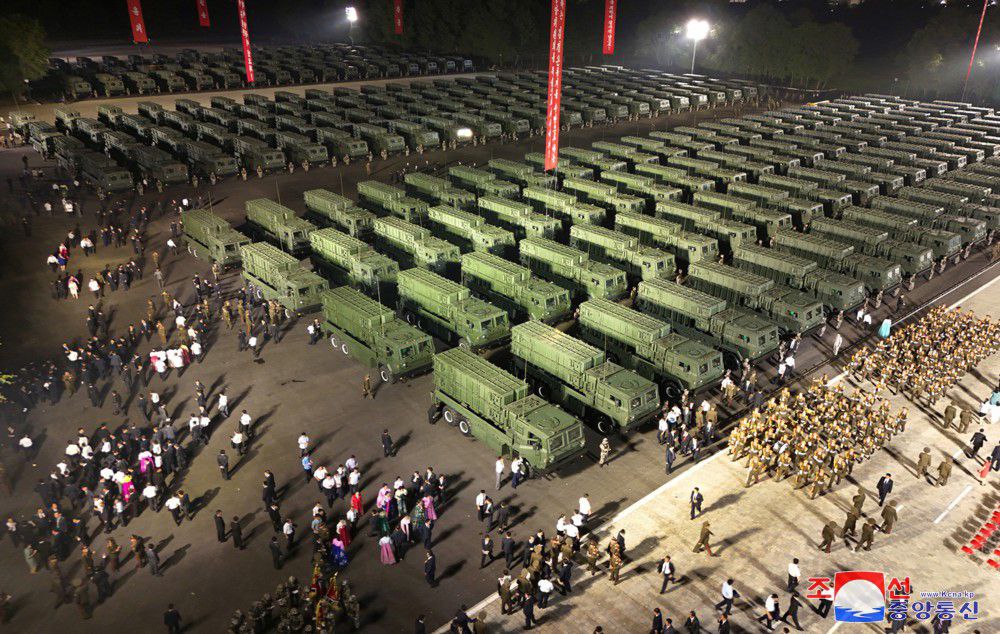
The system’s basic mobile launcher uses a wheeled chassis and carries four missiles in rectangular transport and launch containers. On August 4, 2024, a ceremony in Pyongyang handed over 250 such launchers to the Korean People’s Army.
Підтримати нас можна через:
Приват: 5169 3351 0164 7408 PayPal - [email protected] Стати нашим патроном за лінком ⬇
Subscribe to our newsletter
or on ours Telegram
Thank you!!
You are subscribed to our newsletter