


Popular

An explosion in the Libyan port city of Benghazi destroyed the Russian corvette Mercury, which was escorting a convoy carrying weapons for the Libyan National Army, led by Khalifa Haftar and supported by Russia.
The local news outlet Al Wasat reported the explosion at the port.
Residents woke up to a powerful explosion that, as later emerged, had occurred at the seaport. Videos circulating on social media show flames and smoke rising above the port.
According to the outlet, conflicting accounts emerged about the explosion. Some sources linked the incident to a strike on a Russian vessel carrying weapons, while others reported an explosion at an ammunition depot in the port.
Neither Haftar’s General Command, the Benghazi port administration, nor the government appointed by the House of Representatives issued a statement explaining the circumstances of the incident.
Based on footage recorded by eyewitnesses, Naval News identified the vessel on which the ammunition had detonated as the Mercury, a Project 20380 Steregushchiy-class corvette. The outlet assessed that the explosion had almost certainly destroyed the ship.
The Russian warship had been in the port for several days before the explosion. It formally belongs to the Black Sea Fleet but is currently operating from Northern Fleet bases in the Arctic because of the war in the Black Sea.
The ship was escorting a convoy of Russian vessels used to transport arms shipments for export. The Sparta II, which was struck in the Baltic Sea the previous day, is also used for this purpose.
Several sources whose materials were reviewed by Naval News confirmed the incident. Several satellite images and other corroborating materials obtained by the outlet show the Mercury on fire.
Footage recorded by local residents appears to show an attempt to intercept and shoot down an unidentified aerial target over the city shortly before the explosion aboard the ship.
Project 20380 ships are multi-purpose corvettes equipped with guided missiles. They can operate in the distant maritime zone and are designed to engage enemy surface ships and submarines, as well as provide artillery support for amphibious landings.
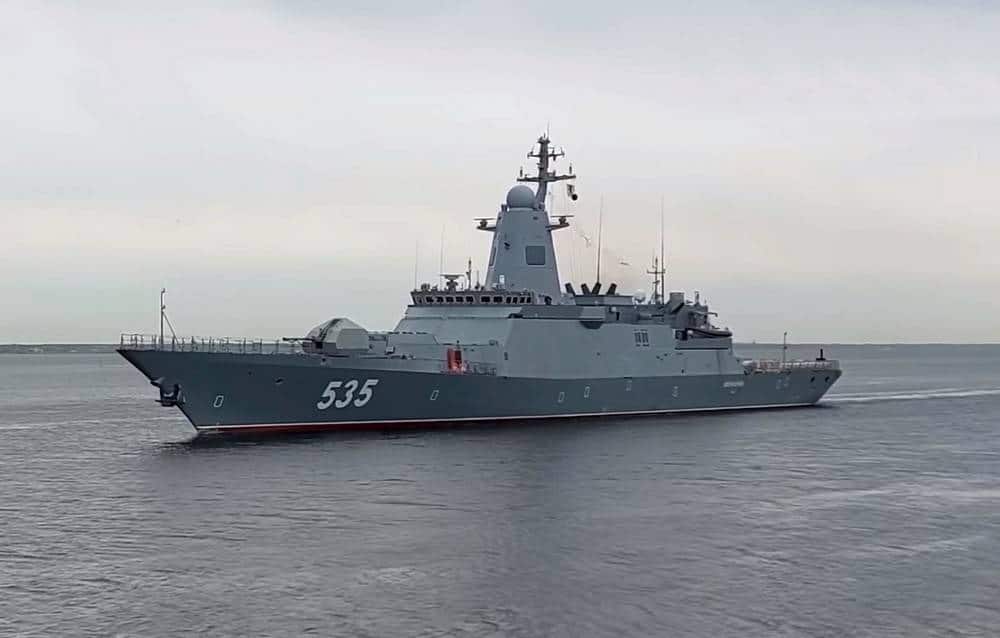
The first ship of the project, the Steregushchiy, was laid down in late 2001 and transferred to the Baltic Fleet in early 2008.
Main specifications of Project 20380 corvettes:
Displacement: 2,200 tons;
Length: 104.5 meters;
Beam: 11.1 meters;
Maximum speed: 27 knots;
Crew: 100.
Armament:
1 × 100 mm A-190 naval gun;
2 × 30 mm AK-630M artillery mounts;
8 × Kh-35 anti-ship missiles;
12 × 9M96M or 9M96E surface-to-air missiles;
8 × 324 mm torpedoes.
Aircraft complement:
Ka-27PL helicopter and Orlan-10 UAV.
The Mercury was laid down on February 20, 2015, at the Severnaya Verf shipyard in St. Petersburg under the original name Retivyy. It was delivered to the fleet on May 11, 2023. On May 13, 2023, a ceremony was held in Baltiysk to formally commission the ship into service with the Russian Navy and raise its flag.
Підтримати нас можна через:
Приват: 5169 3351 0164 7408 PayPal - [email protected] Стати нашим патроном за лінком ⬇
Subscribe to our newsletter
or on ours Telegram
Thank you!!
You are subscribed to our newsletter