





Popular

Russia has begun deploying two new small-sized cruise missiles, which are likely derivatives of the Geran-5 missile; developers aim to accelerate one of them to 900 km/h. This corresponds to the speeds of classic cruise missiles such as the Kh-101.
This was reported by Militarnyi citing its own sources in the Ukrainian Defense Forces and a post by Serhii “Flash” Beskrestnov, an advisor to the President of Ukraine on the development of defense technologies.
News of the deployment of the new Geran-5 variant first emerged in late September, though the use of the new missile remains sporadic for now.
Key changes include a modified fuselage and improvements to the navigation system. Specifically, the tail section of the new variant lacks wingtips (vertical elements), it has a smaller wingspan, the wings have taken on a swept-back shape, and the engine is housed inside the fuselage.

According to estimates by Ukrainian military officials interviewed by Militarnyi, these design changes are primarily intended to increase the speed of the Geran-5 K5-K missile to 900 km/h. This will make it virtually out of reach for interceptor drones.
“First and foremost — speed. As for range — that’s doubtful. Higher speed means higher fuel consumption. They plan to reach speeds of up to 900 km/h. There are no actual measurement data available yet,” the military officials said.
In addition, the new variant features an autonomous optical navigation system that allows the missile to navigate using images of the Earth’s surface. This enables route corrections without relying on satellite navigation and renders electronic warfare systems largely ineffective.
Some of these modernization elements were tested on earlier versions of the Geran-5, which indicates an iterative approach to modernization.
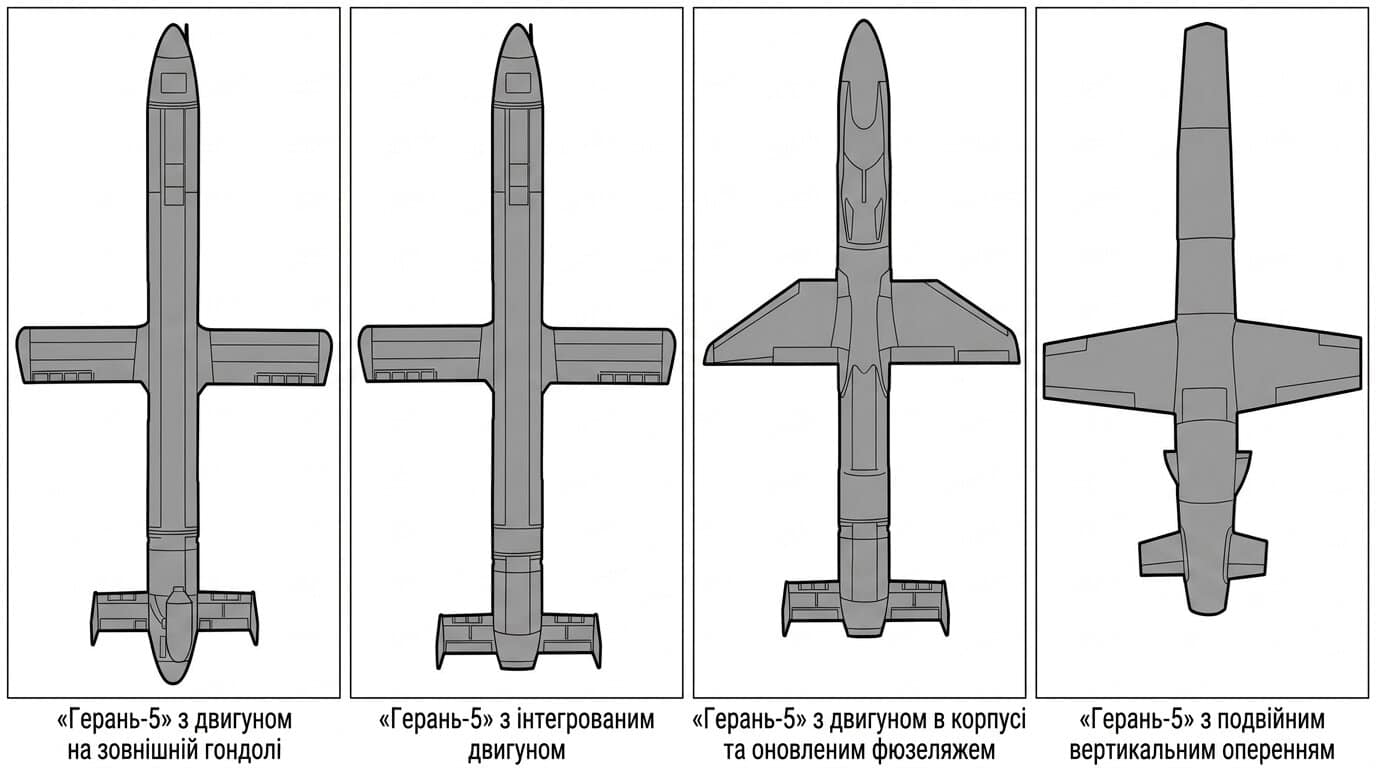
In mid-September, an interceptor drone captured footage of a small-sized cruise missile in which the turbojet engine had been moved from an external nacelle to an internal compartment.
This design change allows for increased speed and, likely, flight range, whereas placing the engine in a separate nacelle likely simplified the development of the first version of the Geran-5.
Serhii “Flash” Beskrestnov published a photo of the new missile on October 22. Although he also refers to the new missile as the Geran-5 K5-K, its exterior differs significantly from the already known Geran-5 K5-K version.

“The missile’s distinctive features include an optical navigation system, increased range, speed, and flight altitude,” he said.
Not much is known about this version of the missile, but by analyzing the fuselage’s appearance, it is possible to make a number of assumptions.
For instance, the missile features a box-shaped fuselage with flat sides instead of a rounded body. The new contours are likely intended to simplify production and the layout of internal compartments. They may also be part of measures to reduce the rocket’s radar cross-section.
In addition, the new rocket has a diamond-shaped wing instead of the straight wing on the Geran-5 and the triangular wing on the Geran-5 K5-K, as well as a V-shaped tail. These shapes were likely also part of measures to reduce radar visibility.
The jet engine’s air intake was moved from the top of the fuselage to the side so as not to obscure the new tail unit and to ensure normal airflow around the combined elevator and rudder.
Russia first deployed the small-sized Geran-5 cruise missile against Ukraine in early January 2026. It has a conventional aerodynamic configuration with separate wings and tail surfaces.
According to the Defense Intelligence of Ukraine (DIU), it bears significant structural and technological similarities to the Iranian Karrar UAV, and most of its key components have been standardized with other Geran models. According to the DIU, the base Geran-5 is 6.5 m long, has a wingspan of 3.2 m, and a maximum takeoff weight of up to 850 kg.
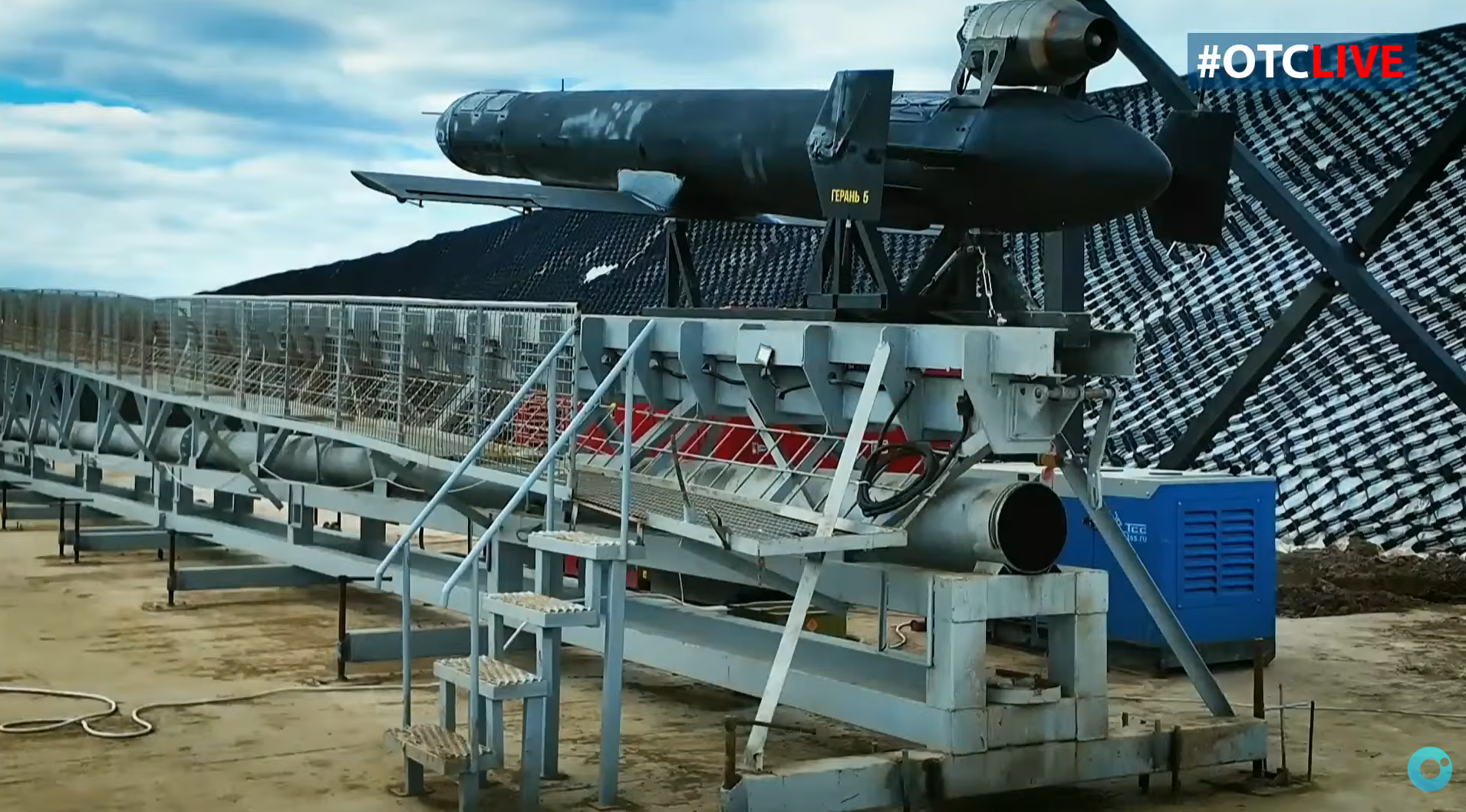
The drone is equipped with a Chinese TELEFLY TF-TJ2000A turbojet engine, which allows it to reach a cruising speed of 450-600 km/h. Its range is up to 950 km, and its flight duration is up to two hours. It can fly at an altitude of up to 6,000 m.
At the same time, these missiles can even be intercepted using interceptor drones based on modified electric quadcopters when the missiles are flying at the lower end of their speed range.
The onboard equipment includes the Kometa-M12 jam-resistant satellite navigation system, a Borshch tracker based on a Raspberry Pi microcomputer with 3G/LTE modems, and an XK-F358 mesh modem from the Chinese company Xingkay Tech.
As of the end of October, Russia had ramped up production of the Geran-4 and Geran-5 attack drones to 4,000 per month, which is twice the production volume of the Geran-2 piston-engine drones. At the same time, the vast majority of this total consists of Geran-4 drones.
Підтримати нас можна через:
Приват: 5169 3351 0164 7408 PayPal - [email protected] Стати нашим патроном за лінком ⬇
Subscribe to our newsletter
or on ours Telegram
Thank you!!
You are subscribed to our newsletter