



Popular
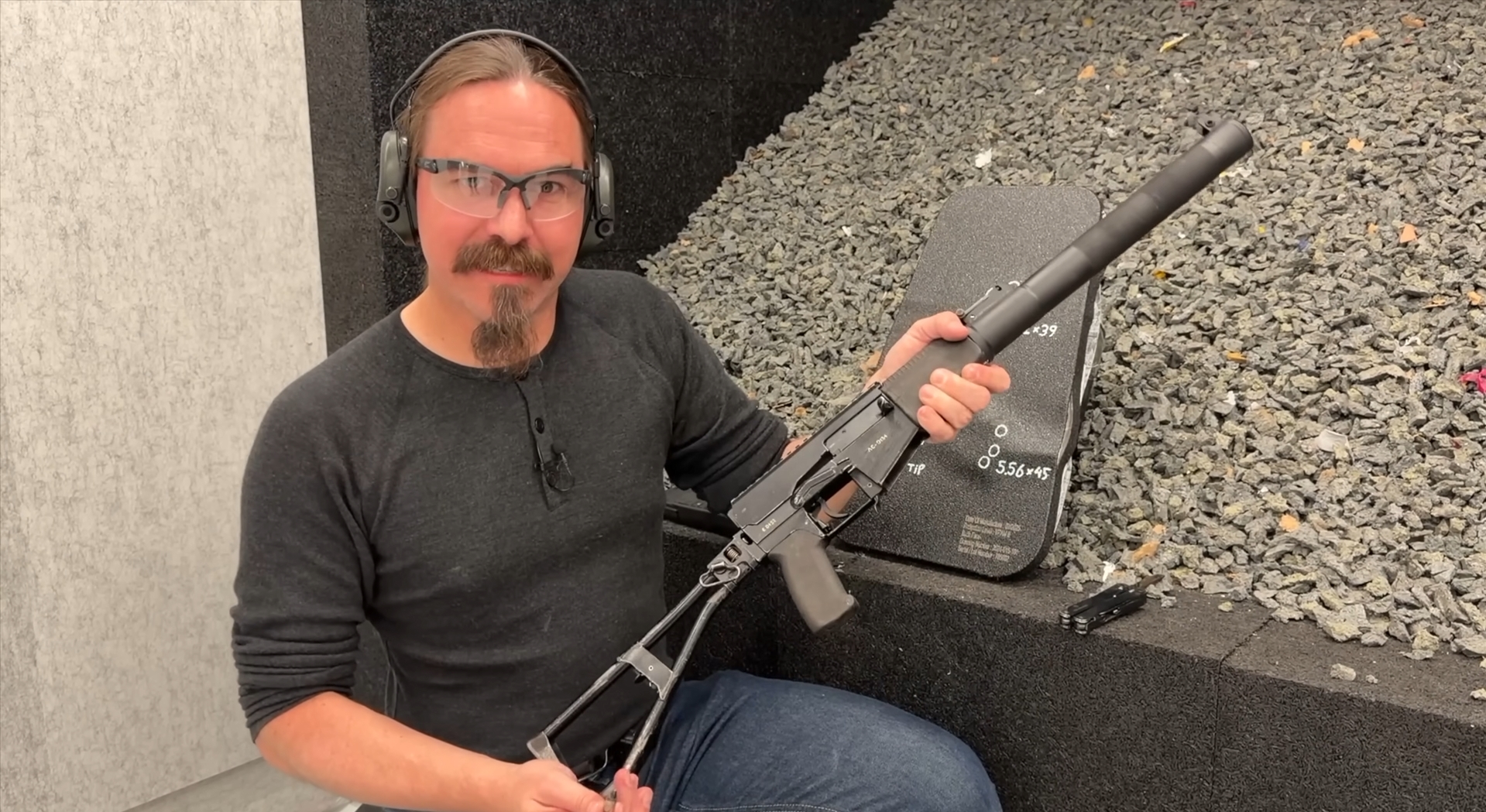
American small-arms researcher and Forgotten Weapons host Ian McCollum tested an AS Val assault rifle captured from Russian forces.
Ian McCollum, who has more than 3 million subscribers, said that the Russian weapon was provided for testing by Ukrainian military personnel.
During the test, he examined how the 9×39 mm SP-6 armor-piercing round fired from an AS Val performed against different types of protection.
The AS Val and VSS Vintorez were developed from similar designs but serve different purposes. The VSS Vintorez was fitted with a wooden detachable stock and was designed as a specialized suppressed sniper rifle, while the AS Val has a folding metal stock and was developed as a specialized assault rifle.
These systems use specialized 9×39 mm subsonic ammunition.

The SP-5 round is primarily intended for the VSS Vintorez because its design provides greater accuracy.
The SP-6 round is more commonly used with the AS Val because of its armor-piercing capability. At the same time, both types of ammunition can be used with both weapons.
The main difference between the SP-6 and SP-5 is the bullet design. It has a hardened metal armor-piercing core designed to improve penetration.
However, there is also a newer 7N12 round, which has 10% greater penetration and even higher accuracy than the SP-6.

The SP-5, in contrast, has a full-metal-jacket bullet with a lead core and is optimized primarily for accuracy. Both rounds are subsonic and are used with the VSS Vintorez and AS Val.
The first test involved Level IIIA soft armor. This type of protection is designed, among other things, to stop .44 Magnum and 9 mm Parabellum rounds. McCollum said he expected the armor-piercing 9×39 mm round to penetrate the armor.
The result confirmed this assumption: the SP-6 bullet passed through the soft body armor.
At the same time, a container filled with ceramic pellets positioned behind the armor stopped the bullet.
Ian said the result was expected and moved on to testing a hard armor plate.
For the second stage, a plate meeting the VPAM 6 standard was used. According to McCollum, it is designed to protect against multiple hits from standard 7.62×39 mm rounds.
The plate itself, however, already showed evidence of previous testing.
It had previously been subjected to fire from 7.62×39 mm armor-piercing rounds, standard 5.56 mm rounds and semi-armor-piercing 5.56 mm rounds. Some of those shots resulted in the plate being penetrated.
That was why McCollum considered it an interesting subject for comparison with the armor-piercing 9×39 mm round.
The first shot from the AS Val hit close to an already damaged area. However, even under those conditions, penetration did not occur.

Ian noted that the plate, already damaged by previous hits, effectively gave the 9×39 mm bullet an additional chance to penetrate the protection, but it still failed to penetrate the protection.
During the second shot, the hit was more precise. After disassembling the armor plate, McCollum found the bullet’s steel core with a copper jacket inside.
Even traces of the barrel’s rifling remained on it, while the jacket itself was barely torn during impact with the armor.

Thus, the test demonstrated that the armor-piercing 9×39 mm SP-6 can penetrate soft armor but failed to penetrate a hard armor plate even after hitting an already damaged area.
McCollum called the result unexpected and said it allowed him to better assess the weapon’s actual capabilities.
Підтримати нас можна через:
Приват: 5169 3351 0164 7408 PayPal - [email protected] Стати нашим патроном за лінком ⬇
Subscribe to our newsletter
or on ours Telegram
Thank you!!
You are subscribed to our newsletter