


Popular
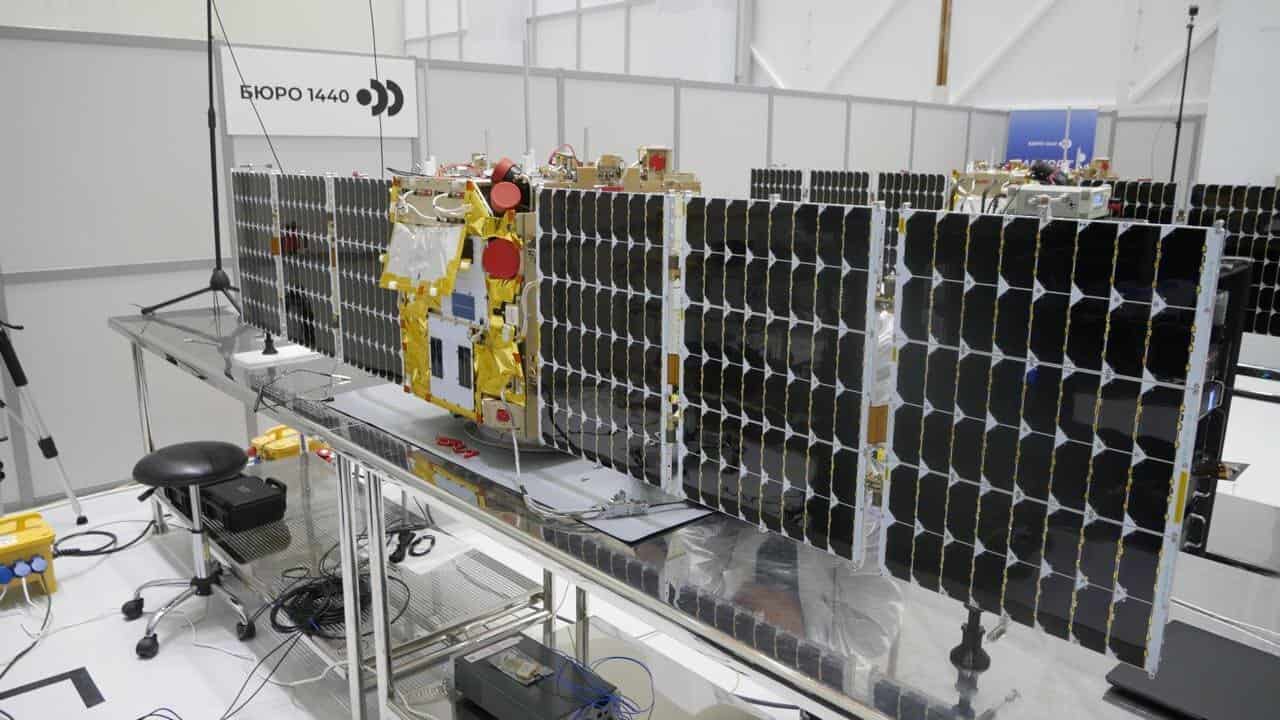
Applications for the registration of the Rassvet-4 satellite network, which involves the deployment of 374 spacecraft, have appeared in the International Telecommunication Union’s database.
This is evidenced by documents from the International Telecommunication Union (ITU).
According to the published data, the applications were entered into the registry on October 29, 2026.
The Russian side submitted two documents: Advance Publication Information regarding the satellite network and a Coordination Request.
The proposed constellation is to consist of 374 satellites placed at an altitude of approximately 800 km. They are planned to be distributed across 17 orbital planes—22 satellites in each.

The documentation also reveals specific characteristics of the communications equipment. In particular, each satellite will have 12 antenna beams: seven for transmitting signals and five for receiving them. Data on operating frequencies and antenna characteristics are also provided.
The Rassvet system’s frequency plan calls for the use of the Ku and Ka bands. Specifically, the 10.7–12.725 GHz and 19.075–20.2 GHz bands are allocated for data transmission from the satellite to ground terminals, while the 14–14.495 GHz and 29.5–30 GHz bands are allocated for signal transmission from ground stations to the satellites. Separate frequency bands are designated for feeder and inter-satellite communications.
These parameters were established by a decision of the Russian State Commission for Radio Frequencies dated November 29, 2021.
The need for modernization arose amid difficulties with the deployment of the previous generation of satellites. In March and July 2026, Russia launched two batches of 16 Rassvet-3 satellites into orbit.
As of early November, two satellites had already fallen out of orbit, and the remaining 30 had not reached the initially stated operational altitude of approximately 800 km.
In particular, 13 satellites from the second batch stabilized at an altitude of approximately 508 km.

It is worth noting that the project documentation from Bureau 1440 previously specified a target orbital altitude of approximately 800 km. Therefore, the satellites’ stabilization at an altitude of 508 km does not mean that the initially stated orbital parameters have been achieved. At the same time, the satellites have already demonstrated their operational capability. During an experiment on September 19, residents of a settlement in the Nenets Autonomous Okrug gained access to a remote electronic voting system via a satellite communication channel.
As a reminder, on October 30, Vladyslav Vlasiuk, the Commissioner of the President of Ukraine for Sanctions Policy, released information about 49 Russian and Belarusian companies involved in the creation of the Rassvet satellite system.
Earlier, Militarnyi reported that as of July 31, 2026, the Russian Rassvet satellites operated by Bureau 1440 were already providing at least two communication channels per day over Ukrainian territory, each lasting more than an hour.
More information on the topic in the article: “Anatomy of ‘Bureau 1440’: Structure and Vulnerabilities of Russia’s Rassvet — the Starlink Analog.”
Підтримати нас можна через:
Приват: 5169 3351 0164 7408 PayPal - [email protected] Стати нашим патроном за лінком ⬇
Subscribe to our newsletter
or on ours Telegram
Thank you!!
You are subscribed to our newsletter