



Popular

The Mexican Air Force has begun a program to replace its F-5E/F Tiger II light fighters, acquired in the 1980s.
Zone Militaire reported this news.
After more than 40 years of operation, only five to six aircraft remain airworthy, now used mainly for airspace patrol missions. The Tiger II remains the only fighter in the Mexican Air Force.
In 2007, Mexico City negotiated with the United States to purchase 12 F-16 fighters, but economic difficulties prevented the deal.
As a result, the Mexican Ministry of Defense signed a contract with the Swiss group Ruag to maintain the existing F-5E/F fleet.
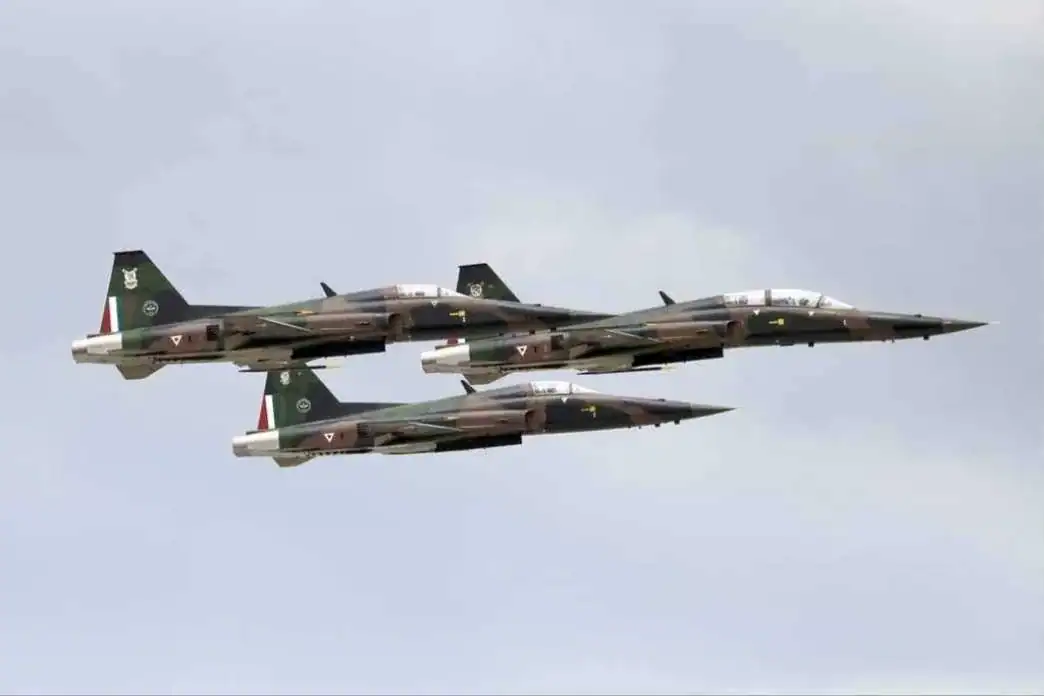
However, the Air Force can no longer delay modernization of its combat aircraft. In late April, during the Tulum airshow, Mexican Air Force Chief of Staff General Roman Carmona Landa announced the launch of a procurement program for at least 12 new combat aircraft, due to enter service in 2028.
Candidates under consideration include the F-16 Block 70/72 Viper from Lockheed Martin, the JAS-39 Gripen E/F from Saab, the FA-50 Fighting Eagle from Korea Aerospace Industries and the M-346FA from Leonardo.
Despite being the most expensive option, the F-16 Viper is considered the leading candidate.
In January, despite strained relations between Mexico and Washington that have worsened since the start of Donald Trump’s second presidential term, Mexico announced the purchase of a C-130J Hercules transport aircraft from Lockheed Martin.
Earlier reports from the Mexican Air Force had also mentioned the European A400M Atlas among potential options.
The F-5E Tiger II is a U.S. light multirole fighter developed by Northrop in the 1970s as an evolution of the F-5 Freedom Fighter family.
The aircraft was designed as a relatively inexpensive, easy-to-maintain and reliable platform for U.S. allies, capable of interception, escort and ground strike missions.
The F-5E variant received more powerful engines, improved avionics, the Emerson AN/APQ-159 radar and increased fuel capacity compared with earlier versions. The two-seat F-5F variant was used for pilot training and could also perform combat missions.

Despite its compact size, the Tiger II was known for good maneuverability and low operating costs, making it popular with dozens of countries. It was widely exported to Latin America, the Middle East and Asia and was also produced under license in some countries.
The aircraft is armed with two 20 mm M39 cannons, AIM-9 Sidewinder air-to-air missiles, unguided rockets, bombs and other external stores.
Its maximum speed exceeds Mach 1.6, and its combat radius allows it to perform tactical aviation missions effectively.
Підтримати нас можна через:
Приват: 5169 3351 0164 7408 PayPal - [email protected] Стати нашим патроном за лінком ⬇
Subscribe to our newsletter
or on ours Telegram
Thank you!!
You are subscribed to our newsletter