







Popular
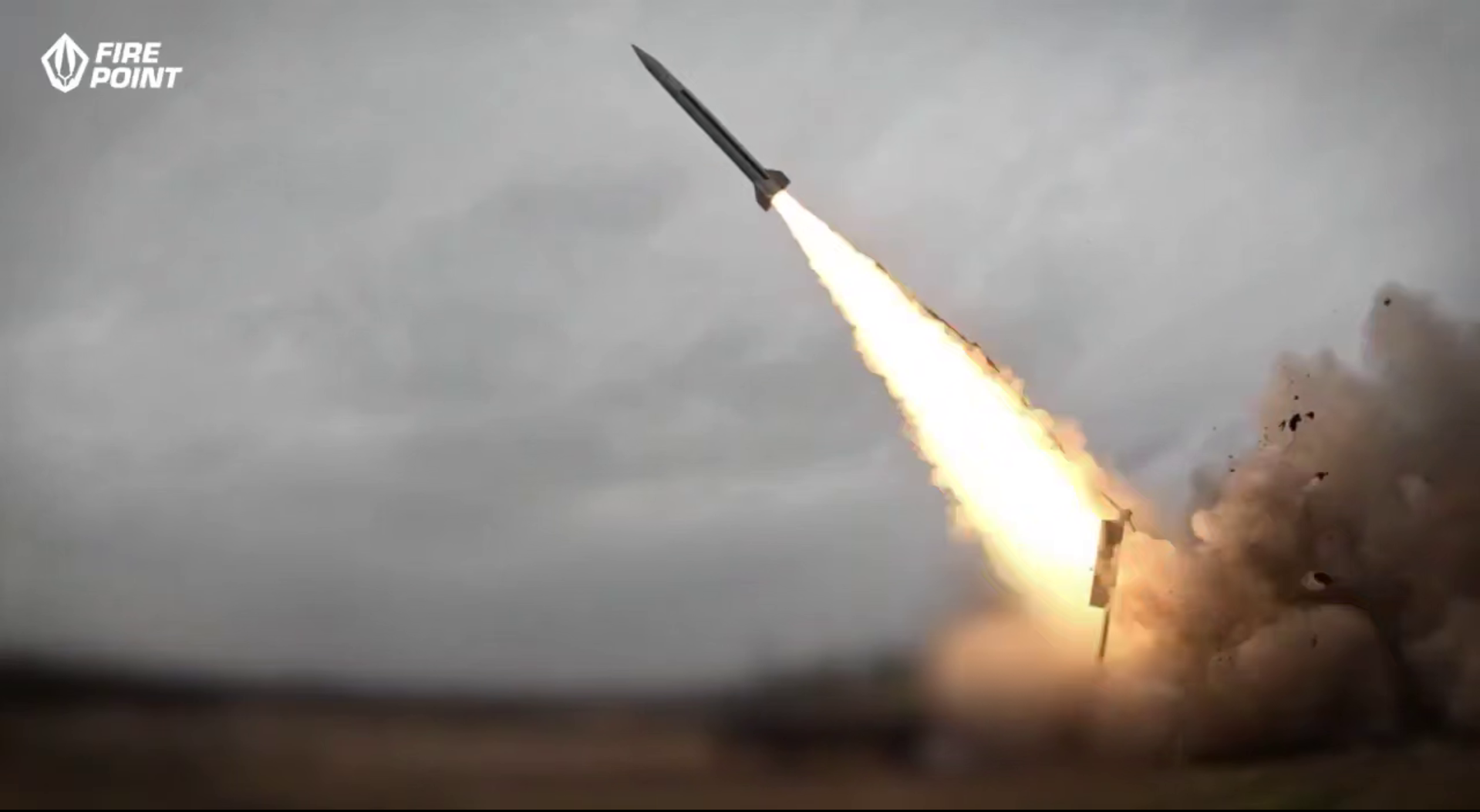
Ukrainian company Fire Point has conducted flight tests of its new FP-7 tactical ballistic missile.
The video of the tests was published by Fire Point co-owner and chief designer Denis Shtillerman on his X page.
The test video shows that during launch, the missile performs a course correction, i.e., the flight is controlled.
In addition, the missiles are launched using a non-specialized launcher based on a multi-axle truck chassis, which is standard for such systems, and, similar to the FP-5 cruise missiles, a conventional rail guide on a trailer.
Fire Point first announced the development of its own FP-7 and FP-9 ballistic missiles at a press conference during the MSPO international exhibition in September 2025 in Poland.
The FP-7 has a declared range of up to 200 km, a maximum speed of 1500 m/s, and a circular error probability (50% of missiles must hit a circle with this radius) of 14 meters. The warhead is to weigh 150 kg, and the maximum flight time is 250 seconds.

The missile is designed for the rapid destruction of targets at medium ranges. It is believed that these missiles will be highly unified with the anti-aircraft missiles currently being developed by the company.
“Until we have the ability to integrate with European radars, we are using it as a cheap short-range ballistic missile,” said Denis Shtillerman in December 2025.
At the end of November 2025, it was reported that the company planned to complete the codification process for the FP-7 tactical ballistic missile at the Ukrainian Ministry of Defense by the end of 2025.
He noted that the missile would have a relatively simple design and, thanks to the preliminary establishment of production and the availability of a financed order, the missiles would “fly like hotcakes.”


In early February 2026, Denis Shtillerman clarified in an interview with DW that, despite expectations that the ballistic missile would be put into service by the end of 2025, a “series of events” had prevented this from happening — “we hope to complete all tests in February.”
According to the developer, the issue of an accurate inertial navigation system remains critical, for which the company is currently forced to purchase laser gyroscopes, so it is building its own gyroscope production facility.
Given the security threat and sensitivity of such production, the new plant is being built abroad, in an unnamed partner country. Also abroad — in Denmark — a plant for the production of solid-fuel engines is being built for similar reasons.
The FP-9 missiles will be significantly more powerful. It is stated that they will have a range of up to 855 km, a speed of 2200 m/s, a warhead of 800 kg, and a circular error probability of 20 meters. According to the plan, this missile is to be codified in 2026.
Підтримати нас можна через:
Приват: 5169 3351 0164 7408 PayPal - [email protected] Стати нашим патроном за лінком ⬇
Subscribe to our newsletter
or on ours Telegram
Thank you!!
You are subscribed to our newsletter