





Popular

The U.S. Navy has canceled the Constellation-class frigate program due to production delays and project failures.
According to Navy Secretary John Falan, only the first two ships, which are in the early stages of construction, will be completed by 2030. All other planned frigates have been canceled.
Falan explained that the move is aimed at ending a budget-heavy program and focusing on developing a new class of ships with realistic timelines.
“We are changing our approach to building the fleet. The first step is a strategic withdrawal from the Constellation-class frigate program,” Falan said.
Currently, the U.S. Navy still needs about 73 more surface combat ships to effectively counter the Chinese threat.

Since the U.S. Navy abandoned the construction of these frigates and freed up funds, the Pentagon plans to allocate them to new programs.
“In the coming weeks, the Navy will work with Congress to reallocate some of the unused funds originally intended for the frigates to other ships that can be produced more quickly in Marinette,” a senior official told USNI News on Tuesday.
Construction of Constellation-class frigates was ordered in 2021. The frigate was intended to be a highly standardized ship based on the European FREMM design, with 85% of its components planned to be unified with those of the European ship. However, the program’s implementation went out of control.
First and foremost, the planned level of standardization dropped to 15%, and the development of the project was never completed on time.
Despite these delays, the Pentagon decided to begin construction of the frigates before the final design was completed, a decision that became one of the main reasons for subsequent problems. As a result, shipbuilders began cutting and preparing steel before the final design was approved, complicating the construction and increasing its weight due to numerous changes.
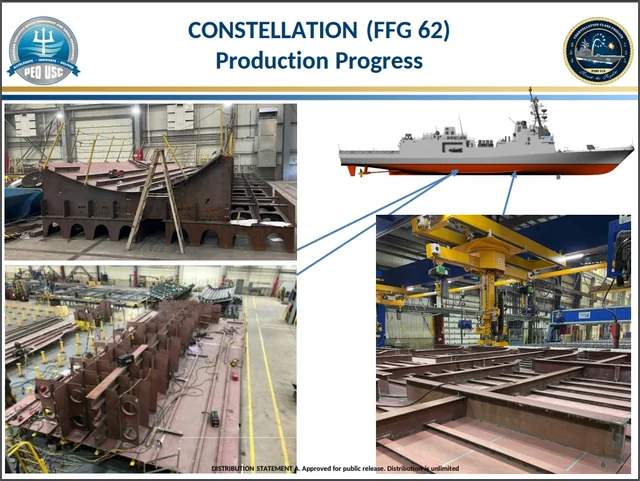
In addition to problems at the shipyards, the Pentagon still cannot decide on the specifications for the new frigate. Earlier reports indicated that the initial target displacement was 7,291 tons.
As of today, the Pentagon has spent over $22 billion on the program, with the cost of a single ship around $1.4 billion, potentially decreasing to $1.1–1.2 billion for subsequent units.
These issues have caused a four-year delay in the frigate’s construction, and actual progress on the laid-down ship over the course of a year did not exceed 12%.
Since the program has ultimately been canceled, the U.S. plans to begin exploring new solutions to maintain its fleet amid the rapid expansion of China’s naval forces, which launches up to five surface combat ships each year. This trend is causing serious concern in Washington.

Currently, the U.S. Navy effectively has no alternative surface ships aside from Arleigh Burke-class destroyers. Despite their high combat effectiveness, their cost has already exceeded $2 billion per unit, making them too expensive for routine tasks, such as maintaining a continuous Fifth Fleet presence in the region.
It is still unknown whether the U.S. Navy will develop a new frigate design or follow a model similar to the previous program – purchasing an existing foreign design and integrating American systems.
As Militarnyi recently reported, the U.S. Navy aims to involve Japan and certain European countries in a cooperative effort to restore American shipbuilding capabilities and address the structural crisis. This includes supporting local shipyards and expanding their capacity to build new combat ships.
Підтримати нас можна через:
Приват: 5169 3351 0164 7408 PayPal - [email protected] Стати нашим патроном за лінком ⬇
Subscribe to our newsletter
or on ours Telegram
Thank you!!
You are subscribed to our newsletter