


Popular

The analytical group of the Center for Human Rights in Armed Conflict has recreated the murder of Ukrainian prisoners in Olenivka and determined the involvement of the Russian military in it.
The details of the investigation were published on the Center for Human Rights in Armed Conflict’s website.
Investigators conducted a detailed analysis of the tragedy in the Olenivka prison, where 40 Ukrainian prisoners of war were killed in July 2022, including many Azov regiment soldiers who had left Azovstal.
Russian propagandists were the first to announce the mass deaths, accusing the Ukrainian side of striking the prison with a HIMARS missile system.
However, CHRC researchers, having analyzed available videos, photos, and testimonies of the prisoners, found that the explosions in the so-called “barracks 200” were the result of a planned Russian operation with cannon artillery shells used by the Russian military.
Four explosions were recorded: first, two outside the barracks, and then two almost simultaneous explosions inside. The survivors described the first explosion as being quite distant from the barracks; it did not leave a visible crater and caused only minor damage to the prison buildings and other structures. A munition with limited explosive power likely caused this explosion. According to the prisoners of war, the second explosion occurred much closer to the barracks. It shattered several windows, and the shrapnel hit the corrugated tin sheets of the barracks.
Although there are various interpretations of the two explosions outside the barracks, only one fully explains all the available evidence: target practice (using low-explosive projectiles), adjusted by UAVs. After the first projectile landed far from the barracks, the second landed much closer, and then two high-explosive fragmentation shells hit the barracks almost simultaneously.
The first shell to hit the barracks pierced the outer roof and inner ceiling and exploded when it hit the concrete column to the right of the entrance gate. 3D modeling helped to identify the trajectories of the shells hitting the barracks.

The angle of impact and trajectory of the shell point to the area of the Russian-occupied village of Liubivka, 2-8 km from the prison, where the artillery units that carried out the attack could have been located.
Investigators concluded that the debris found at the scene most closely resembled cannon artillery ammunition, not HIMARS missiles or other types of shells. Experts estimate that the explosive power of the explosions corresponded to that of 152-155 mm high-explosive fragmentation shells. The explosions threw heavy concrete and metal objects several meters away.
A distinctive feature of the explosions in barracks 200 was the intense thermal impact on the prisoners and the interior of the barracks. The small presence of flammable materials in the barracks indicates that the exploded ammunition had an extremely short-term and high-temperature impact that caused the fire in the barracks. This is typical of thermobaric munitions.
Investigators have ruled out the possibility of improvised explosive devices or incendiary munitions. Of the three types of projectiles that matched the parameters of the shells – thermobaric grenades, anti-tank guided missiles, and artillery ammunition – artillery shells have the most similarities to the available evidence.
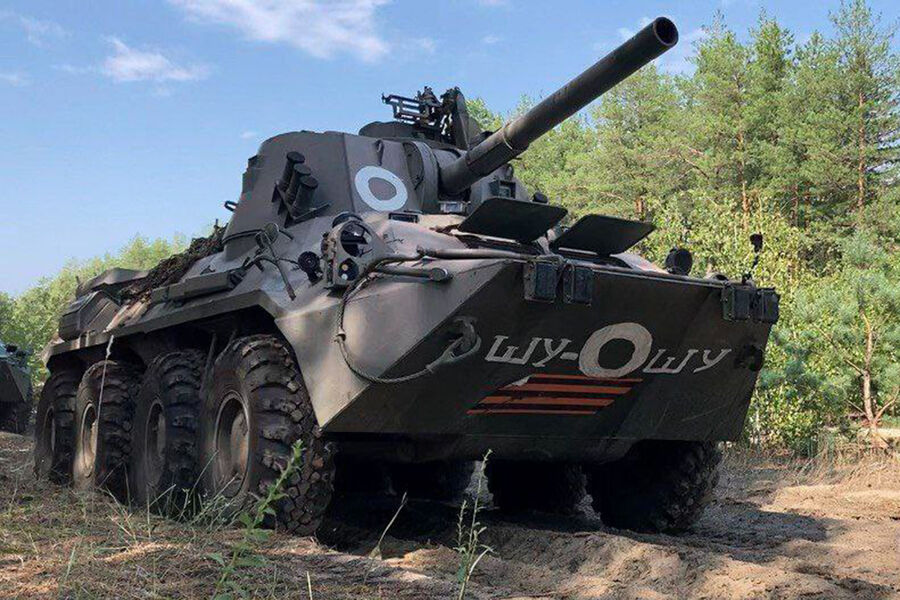
The only other projectile that fits the description of the damage is the 120mm thermobaric high-explosive fragmentation projectile ZOF74, which is used in the Russian Federation. The Russian Federation developed it for the Nona family of rifled mortars.
The analytical group concluded that the direct organizers of the attack were representatives of the Ministry of Defense and the Russian Armed Forces’ command, who coordinated with the Federal Penitentiary Service.
The attack was organized on the spot by a group from the ‘Joint Center for Control and Coordination’ (JCCC), which had visited the prison before the attack and was likely present on July 29 and in the subsequent days.
After the FPS transferred 200 prisoners of war to a hastily constructed “barrack 200”, a group of 10-14 experienced military personnel equipped with 2A51/60/80/80-1 self-propelled artillery systems and a UAV system fired at the barrack. The sound of fire from Grad multiple rocket launchers accompanied the shelling. First, two correctional shells (training or smoke shells) fell, and a minute later, two ZOF74 shells hit the barracks: the first one near the entrance gate, the second one hit the northern wall above the roof.
Most likely, the group belonged to units of the Russian Armed Forces, equipped with appropriate artillery systems, which were stationed nearby. In particular, the 61st and 155th Marine Brigades, as well as the 11th Guards Motorized Rifle Regiment, fit this description.
The cover-up activities involved high-ranking members of Moscow’s military, the Investigative Committee of the Russian Federation, FSIN officers, representatives of the Joint Center for Control and Coordination (JCCC), and officials of the so-called DPR.
In total, at least two dozen people were involved in the planning and execution of the attack, and several dozen were involved in the cover-up activities.
The idea of shelling barracks 200 with cannon artillery probably arose from an order to stage the killing of prisoners by Western weapons. The choice of mortar systems and thermobaric ammunition was made because of their power, accuracy, and availability. The simultaneous impact of two shells was planned to imitate the effect of HIMARS missiles and complicate the assessment of damage. The eastern direction of the attack was chosen because it was safer and more secretive, as well as less clear to external observers.
Підтримати нас можна через:
Приват: 5169 3351 0164 7408 PayPal - [email protected] Стати нашим патроном за лінком ⬇
Subscribe to our newsletter
or on ours Telegram
Thank you!!
You are subscribed to our newsletter