
Popular

Just a few years ago, the idea of calling or sending a message from a remote mountain valley directly via satellite using a regular smartphone seemed like science fiction. Today, these are the first field tests. SpaceX with Starlink, along with mobile operators, show that a phone can “reach” orbit without special antennas or bulky “satellite phones”. In Ukraine, this technology has already been tested by Kyivstar, which launched the Direct-to-Cell beta test in the autumn of 2025.
But it is important to say right away: Direct-to-Cell is not a magic solution that will instantly replace all communication towers. This is only the beginning of a big process. Today, it is about SMS, tomorrow – about basic data, and for calls and stable internet, we will have to wait for years. And even then, communication will depend on a “clear sky”, the smartphone battery will drain faster, and the signal can be detected or jammed.
Therefore, this article is not about loud promises. We will analyze what Direct-to-Cell really is, how it works, which myths should be discarded, and what to realistically expect in the coming years. The material is voluminous and dense—it is not a “two-minute read,” but a detailed breakdown for those who want to understand the technology without rose-tinted glasses. With adaptation specifically to the questions and needs of Ukrainians.
Direct-to-Cell (DTC) is not another marketing trick, but a specific technology: a satellite functions as a mobile communication base station. A regular phone that we carry in our pocket connects to it in the same way as it connects to an operator’s tower in the city. No “satellite phones,” additional antennas, or special applications—only a standard LTE-smartphone and an open sky overhead.
Hence the name: Direct-to-Cell, meaning “directly to the cell”—in the sense of the mobile network cell, which in this case is not a terrestrial mast, but a satellite in low orbit. The formulation Direct-to-Call is sometimes found in the media; this is more a loose interpretation, where the focus is precisely on the possibility of future calls. But in the official documents of SpaceX and its partners, the term is unambiguous: Direct-to-Cell.
To understand the difference:
A key point to remember: this is not a magic wand, but a technical compromise. The phone cannot “shout” powerfully, so the satellite is equipped with large antennas to “hear the whisper”. And it will only work where there is nothing extraneous between the phone and the sky—no roofs, forests, or mountain slopes.
Direct-to-Cell is an attempt to make mobile communication truly global: where today you are without a signal, tomorrow you may have at least the basic ability to send a message or make a call.
The history of Direct-to-Cell did not begin with Elon Musk or Kyivstar. It began the moment a person first brought a mobile phone to their ear—that same heavy 1G “brick-like” device. Back then, communication was expensive, the quality was questionable, but the idea of “talking anywhere” had already amazed the world.
Over several decades, we have moved from analog 1G to digital 2G, from SMS to mobile internet 3G, from smartphones and streaming in 4G to the current 5G with its gigabit speeds. In every network generation, there seemed to be more “magic,” but in reality, it was always engineering: new standards, new antennas, new frequencies, new equipment.
However, no generation solved the main problem of “dead zones.” From 1G to 5G, coverage became denser, but it still depended on where a tower could be placed and where it could not. Seas, mountains, deserts, and the front line remained “white spots.”
It was this problem that was first systematically formulated in a new approach that emerged with 5G: Non-Terrestrial Networks (NTN) — mobile networks that go beyond terrestrial infrastructure. NTN is not only satellites, but also drones, stratostats, any “non-terrestrial” platforms capable of becoming part of the mobile network.
We have already discussed this path in detail in the material «From Analog 1G to NTN: How Mobile Networks Reached Space». It provides more information about each generation and how they step by step prepared the ground for today’s leap. In this article, it is only important for us to see the main line: Direct-to-Cell is the natural continuation of the evolution of mobile networks, where the “tower” has finally ascended to orbit.
To understand how Direct-to-Cell works, it is worth breaking everything down into simple images.
Satellites that provide DTC fly in Low Earth Orbit (LEO) — approximately 500-600 km above the Earth. This is relatively “close”: the signal arrives quickly, delays are small, but they also only “see” a narrow strip of the surface. Therefore, hundreds of such satellites are needed to form a global coverage mosaic.
A phone is not a powerful walkie-talkie. It rather “whispers” toward the sky. To hear this whisper, the satellite has large phased array antennas that simultaneously “listen” to thousands of signals and form narrow beams. It’s like a huge ear that can be aimed at where your smartphone has started talking.
For the satellite and the phone to “understand” each other, a common vocabulary is needed. This vocabulary is the 3GPP NTN standard, adopted within the framework of 5G. It defines how the phone should “greet” the satellite, which frequencies are used, how to correct the signal that disappears due to the movement of the devices in orbit. Without this “vocabulary,” everyone would be speaking their own language.
The main reminder here is: the phone can “reach” the satellite only when it has a clear sky. A house roof, dense trees, or even a wet forest can easily absorb the signal. Unlike a terrestrial tower, which can “punch” through walls, the satellite channel works only in direct line of sight.
So Direct-to-Cell is not magic and not a panacea. It is an engineering solution that allows your smartphone to “call the sky” if you find yourself far from civilization. But it only works under ideal conditions, which means it is demanding on the user.
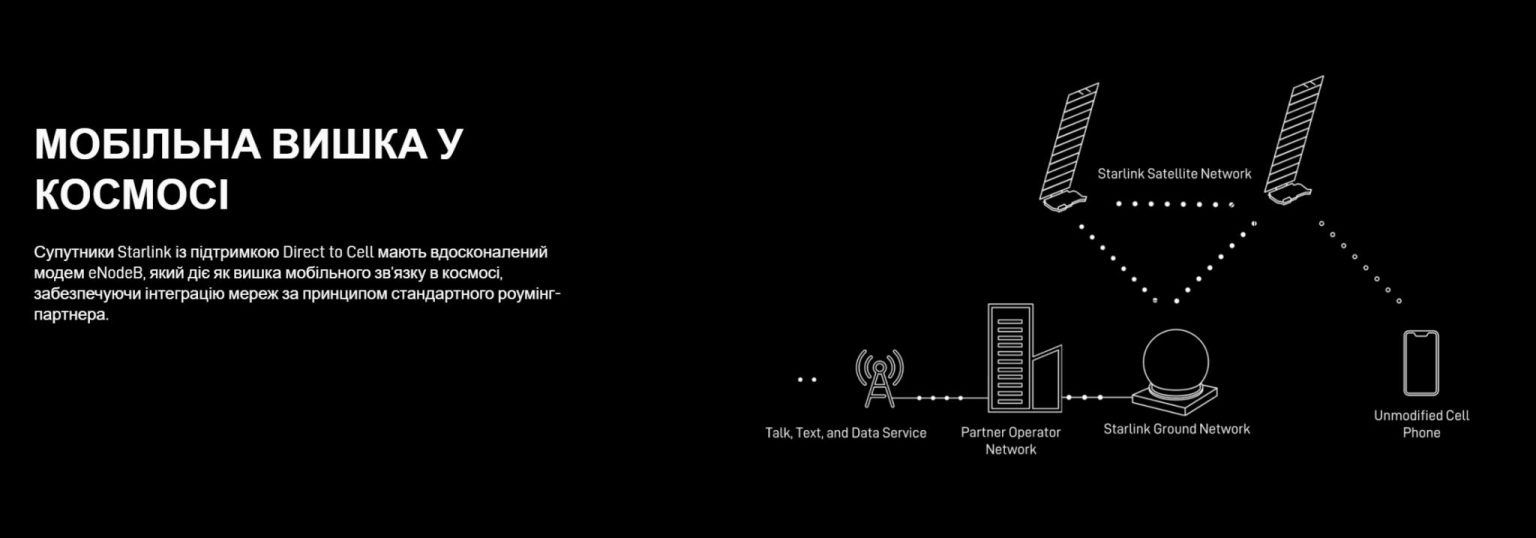
Direct-to-Cell from SpaceX is probably the most discussed project in the world of satellite mobile communication today. The first loud announcement was made back in 2022 when the company reached an agreement with T-Mobile in the US. In Ukraine, this story gained particular relevance in 2025, when Kyivstar conducted the first field tests of DTC together with Starlink. A beta program was launched in the autumn. For the user, this looks like regular roaming: you remain on your operator’s network, only the satellite performs the role of the “mast.”
An important nuance: the DTC function is performed not by all Starlink V2 Mini Optimized satellites, but only by their special versions, equipped with an eNodeB modem and phased array antennas. The rest of the V2 Mini remain “internet satellites” that provide the classic Starlink service. A mixed fleet is being formed in orbit: some satellites for the internet, some for mobile communication.
Currently, the main model is integration with mobile operators, global and national. SpaceX provides “orbital towers,” and the mobile operator remains the contact point for the subscriber. However, after the agreement with EchoStar, the company gained access to the AWS-4 and H-block radio frequency spectrum in the US. This opens the way to becoming an independent DTC mobile operator in the future. Nevertheless, this step will not happen tomorrow: it requires new generations of satellites and years of deployment.
The implementation of DTC is a long process. Today, only short messages are available; next, low-speed internet for IoT and basic data is expected; and only then – voice calls. According to forecasts, the large-scale build-up of the DTC-fleet will begin after 2026, and global coverage may appear closer to 2030. This means that “wow effects” should not be expected quickly. But even the current level—the ability to send an SMS in a “dead zone”—is already critically important, especially for Ukraine.
SpaceX is not alone in this race. The idea of connecting ordinary smartphones to satellites did not emerge yesterday, and there are already several companies working on similar solutions. But if we talk about what is available to the user right now, the picture looks different.
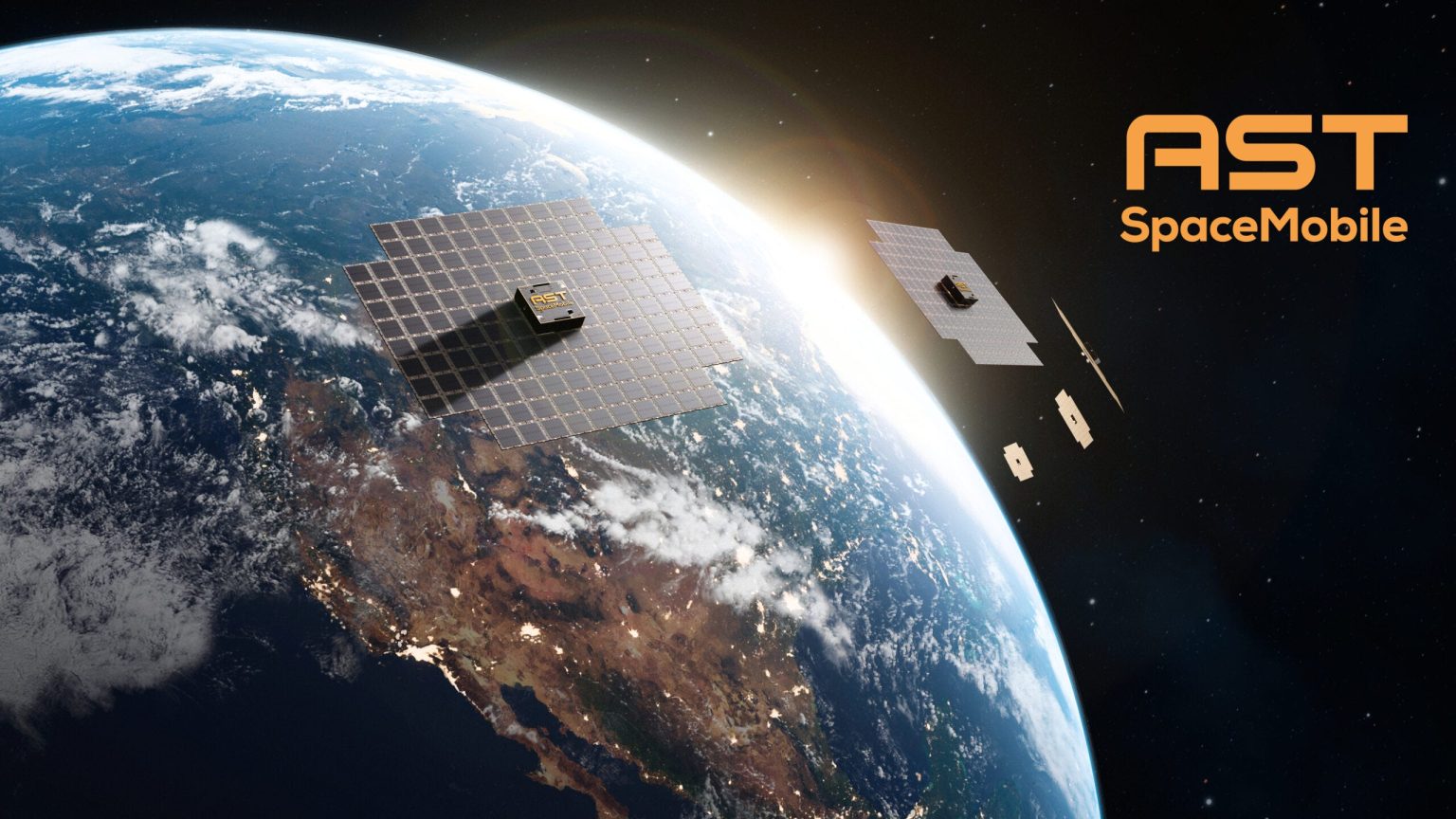
AST SpaceMobile has bet on giant satellites with deployable antennas the size of tens of meters. Their BlueWalker-3 has already demonstrated voice and even video calls from ordinary smartphones on the AT&T and Vodafone networks. Technologically, AST focuses on LTE/5G NR in the frequency bands of partner operators, essentially duplicating the gNodeB base station in orbit. This looks impressive, but for now, it remains demonstrations, not a mass service. AST has no partners in Ukraine.
Lynk Global is moving along a simpler path. Their small satellites already allow sending SMS via operators in several countries in Africa and the Caribbean today. This works based on LTE Release 9/10 and narrow channels in the partners’ spectrum, so the service is limited to text messages. Lynk is not available for Ukraine.
Apple together with Globalstar is the only pair that has provided mass access. Starting with the iPhone 14, the SOS via satellite function is active in many countries. It works in the L-band (1610-1618 MHz), on Globalstar frequencies, and is not integrated into 3GPP NTN, but is based on its own short message transmission protocol. This is not a full-fledged Direct-to-Cell, but a specialized service for emergency situations. And it is not available in Ukraine.
So, if we look soberly: a Ukrainian subscriber has real access to the DTC-service only through Starlink and Kyivstar. All other solutions remain either demonstrations or local services somewhere far away.
When a new technology emerges, the media and politicians often exaggerate its capabilities. Direct-to-Cell is no exception. In publications, you can find statements that “regular calls from a smartphone to a satellite are already working” or that “now communication will be always and everywhere.” This creates inflated expectations, which are dangerous because people start counting on the service in situations where it is not yet capable of helping.
Reality: The first stage is SMS and short data. Voice and high-speed internet require the expansion of the constellation and complex network updates. So, a call from the mountains or the front line directly via satellite is a prospect for several years ahead, not the present.
Reality: The phone “whispers” to the satellite, it does not “shout,” so a clear sky remains a prerequisite. A building, dense forest, or even wet tree crowns easily absorb the signal.
Reality: No. It is a complement, not an alternative. Mobile operators remain key: it is through them that subscribers gain access, and it is their infrastructure that determines the scale of the service.
Reality: Any radio technology has vulnerabilities. DTC can be jammed by EW, fake signals can be created, or operation can be limited due to a lack of gateways. This is critical for the military: one should not count on the “invisibility” of a smartphone in a satellite network.
Reality: In the media, “autumn—and we’re already calling via satellite” is often heard. But even SpaceX officially explains: functions will be added gradually. The ability to send a message this year is a big step, but the rest is a matter of several years.
Reality: This is one of the most common confusions. People often think: if a neighbor has a Starlink terminal on the roof, it is enough to get closer to it with a phone—and that’s Direct-to-Cell. It sounds funny, but such questions are indeed asked. In fact, these are two different services:
Starlink terminals are equipment for broadband internet. They communicate directly with satellites in the Ku/Ka-bands and create Wi-Fi in the home or car.
Direct-to-Cell works completely differently: the smartphone connects directly to the satellite in the mobile operator’s frequencies (LTE). No terminals are needed here. So standing next to a terminal, hoping that it “distributes DTC,” is the same as pressing a phone against a TV to “catch” satellite TV.
Direct-to-Cell looks like a breakthrough, but it has a number of fundamental limitations and vulnerabilities that need to be known.
The main condition for DTC to work is direct line of sight to the satellite, i.e., a clear sky. Roofs, thick walls, dense foliage, mountain ledges, or even heavy rain significantly weaken the signal and can completely block it. Unlike a terrestrial mast, the satellite channel does not “punch through” obstacles.
Communication with the satellite forces the device’s radio module to work more intensively, especially when the signal is weak or during a long connection. Therefore, the battery will drain noticeably faster during long calls or constant data exchange. For short SMS, this is almost imperceptible, but the impact is significant for voice and streaming data—the demand for power banks may well increase.
An active smartphone in the DTC network emits a signal on LTE/NR frequencies, which can be detected by radio electronic intelligence systems and passive locators. Therefore, DTC users are not “radio-invisible”—they can be detected and localized by their emission.
Like any wireless technology, DTC can be jammed or distorted. The low power of the uplink signal from the smartphone makes it especially vulnerable: targeted sources of interference can seriously affect the channel’s operation.
There is a risk that terrestrial or airborne devices imitating DTC network parameters (e.g., similar network names or PLMN) can attract devices that are manually or automatically searching for the DTC network. In this case, the mobile device may try to register with the fake “cell,” which creates risks of intercepting identifiers or collecting signals for geolocation. The key word here is not that the fake imitates a satellite, but that it acts as a “hook” for devices actively searching for the network.
Even when the phone “sees” the satellite, most DTC implementations rely on terrestrial gateways and network elements for traffic routing and interaction with operators. If the gateways are disconnected, damaged, or controlled by third parties, the effectiveness and availability of the service significantly decrease.
Usually no. The idea of DTC is to work with existing LTE/5G-devices without hardware modifications. However, the phone needs to support the bands and profiles used by the operator in the DTC-imitation; some old models or region-locked devices may not work.
Not necessarily. Most often, DTC is integrated as an operator service—your subscriber number and SIM remain. In certain scenarios, the operator may require specific settings or a special profile, but a mass “re-issuance” of SIM cards is not foreseen.
Not yet commercially—mostly SMS and very limited data. Voice and fast data are the stages of the next years. A large-scale build-up of the satellite fleet and network capabilities is needed for mass voice calls.
As a rule—no. DTC requires direct line of sight to the satellite (”clear sky”). Roofs, dense tree crowns, buildings, and other obstacles greatly reduce or completely block the channel.
Power consumption increases, especially during long connections or weak reception. For short SMS, it is almost imperceptible; for long calls or constant data exchange the battery will be consumed significantly faster.
The channel is encrypted according to mobile standards, but DTC has vulnerabilities: the possibility of fake “cells,” jamming/EW, and dependence on terrestrial gateways. DTC cannot be considered “completely safe” or “invulnerable.”
Yes. An active smartphone emits a signal on mobile frequencies—it can be detected by radio electronic intelligence systems and passive locators. DTC does not make the device “invisible.”
“Fake cells” are terrestrial/airborne devices that imitate network parameters (network name, PLMN, etc.). They can attract devices that are automatically searching for or manually configured to DTC networks. Consequences range from collecting identification data to intercepting sessions; therefore, the wave of “manual connections” should be understood as a risk.
Vulnerability to radio electronic influences exists: targeted sources of interference are capable of seriously disrupting the uplink channel from the phone to the satellite. This is one of the main differences from the stability of some military solutions.
Yes. The approaches are different: some use large satellites with powerful antennas (AST), others use a small class and simpler services (Lynk), Apple/Globalstar provide an SOS-channel in the L-band, and SpaceX focuses on 3GPP-compatible integration on a large scale.
For the user, this means: availability and the set of functions depend on the specific operator/partnership.
Yes—Kyivstar is conducting beta testing in partnership with Starlink (September-October 2025 in the form of a beta program; starting with SMS). This is a test phase; a large-scale commercial launch will require additional stages.
Estimates vary, but realistically: the SMS/IoT stages—1-3 years in terms of expansion scale; broader data coverage and voice—3-7 years for significant deployment; full global coverage and stable service may take about 7-10 years, depending on investments, launches, and regulatory agreements.
This is a question of the operator’s business model. In the initial stages, it may look like special roaming or a separate tariff; in the future—various models (SMS packages, IoT plans, voice services). Exact prices depend on the operator and region.
Based on the current state of the technology—no. DTC should be considered an auxiliary or backup channel: useful in “dead zones,” but limited by visibility conditions, energy-intensive, and vulnerable to EW and fake stations.
Yes. Operators must address issues of spectrum, network integration, registration policies, interaction with the satellite provider, and regulatory requirements. DTC raises complex technical and legal issues that operators are working on in partnership with satellite service providers.
What we are seeing now is only the starting phase. There are already several hundred Starlink satellites with Direct-to-Cell support in orbit. They allow demonstrating the basic capabilities of SMS from “dead zones.” But this is not enough for voice calls or stable internet.

SpaceX plans to increase the number of satellites with DTC-modules to tens of thousands. The figure of about 15 thousand “orbital towers” is mentioned in documents, which are expected to appear in the composition of future generations. This means years of gradual launches: dozens of missions every year, building up infrastructure, and integrating new functions.
What will this give users?
But Ukraine is not condemned to remain in the monopoly of one player. In the coming years, other projects that we mentioned above may also enter the market: AST SpaceMobile, Lynk, as well as new initiatives that are only being prepared. If they find local partners and receive regulatory permits, competition will become real—and that is good for users.
Therefore, “what’s next?” is not an instant revolution, but a marathon of gradual changes, where Ukraine will also become a testing ground for new services. Today, we can send an SMS from a place where there is no mast. In a few years, we will be able to make a call from a mountain valley. And closer to the end of the decade, “dead zones” may simply not remain. But the path to this is long, and expectations must be kept realistic.
Підтримати нас можна через:
Приват: 5169 3351 0164 7408 PayPal - [email protected] Стати нашим патроном за лінком ⬇
Subscribe to our newsletter
or on ours Telegram
Thank you!!
You are subscribed to our newsletter