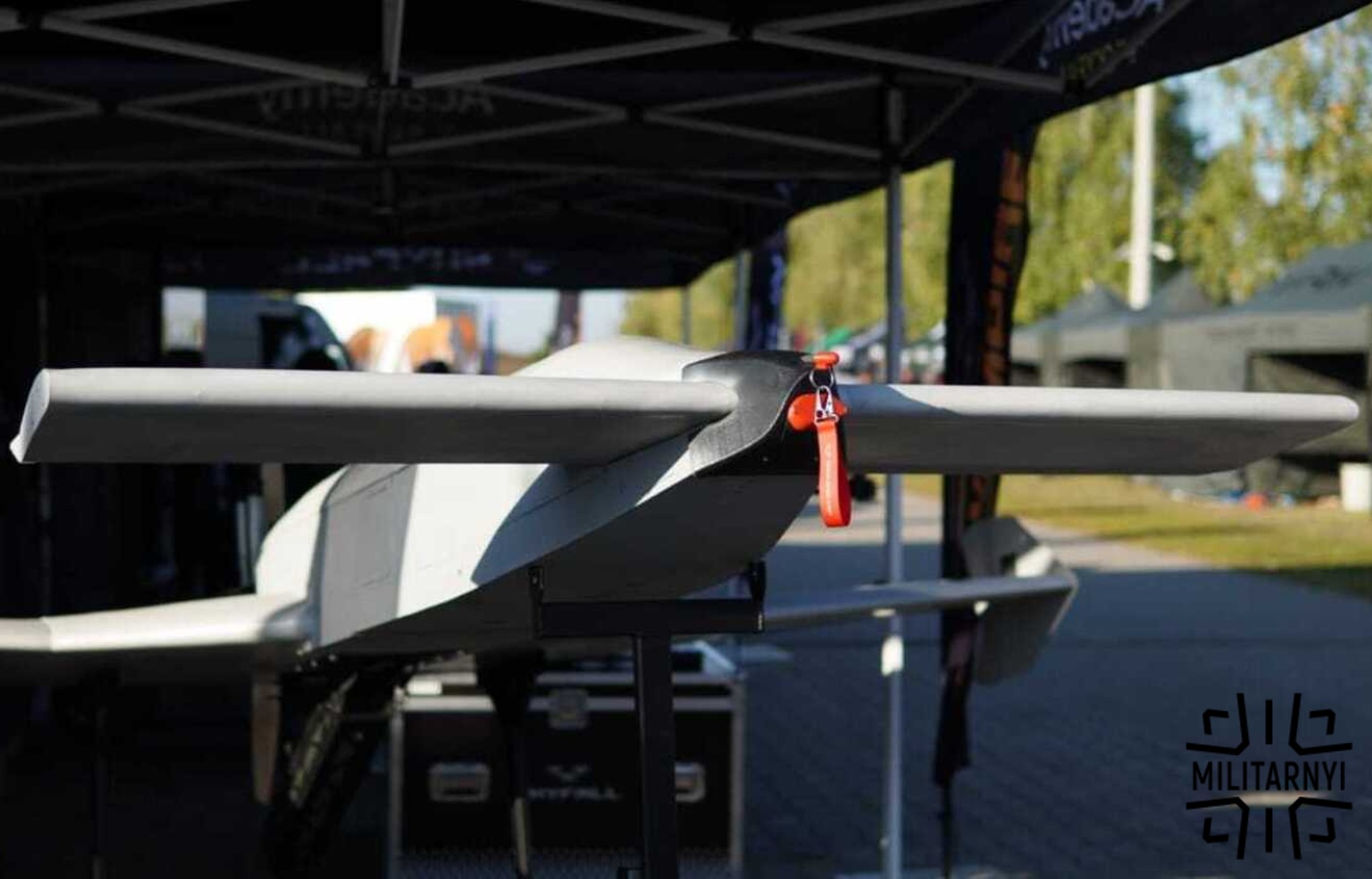



The Turkish company Baykar has moved on to flight testing the third prototype of the Kizilelma drone, equipped with high-precision aviation weapons.
The company’s press service has released footage of the tests.
The reconnaissance-strike drone took flight carrying a 250-kilogram Mk.82 bomb, fitted with the TEBER-82 guidance kit.
At this stage, the developers are recording aerodynamic data and documenting the flight parameters of the drone with suspended weaponry.
Notably, for the flights they chose a solution that suspends the bomb on an external pylon, the SADAK-4T, despite the aircraft being promoted as low-observable and having internal weapon bays.
This is already the fourth test flight of the drone within the testing program, which began at the end of September and aims to explore its capabilities with the new Ukrainian engine.
The integration of the AI-322F engine with an afterburner, replacing the AI-25TLT engines used in the first two prototypes, is evidenced by the second flight, during which Turkish engineers studied the aircraft’s behavior during takeoff with afterburner engaged.
According to the company, with the new, more powerful engine Kizilelma will come closer to the speed of sound. And thanks to aerodynamic improvements, it will be able to perform more complex maneuvers at higher speeds.
During the third flight, the aerodynamics were studied and the propulsion system’s performance was checked at a mid‑subsonic speed of Mach 0.6.
It is worth noting that the drone has flown not only with conventional large‑caliber aerial bombs but also with smaller munitions, TOLUN, which are analogous to the American GBU‑39/B Small Diameter Bomb.
In 2021, the Turkish company BAYKAR ordered AI-322F and AI-25TLT jet engines from the Ukrainian state enterprise Ivchenko-Progress to be installed on the prospective Turkish combat drone. Engine deliveries continued into 2024.
The Kizilelma has a maximum flight altitude of 13,700 meters, with a service ceiling of 7,600 meters. It is capable of staying in the air for over 3 hours. The drone is expected to be developed in several versions: subsonic, transonic, and supersonic. The subsonic cruising speed is 0.6 Mach, with a maximum speed of 0.9 Mach. Its wingspan is 10 meters, length is 14.5 meters, and height is 3.5 meters.
The maximum takeoff weight is 8,500 kg, and the payload capacity is 1,500 kg. All phases of flight – including takeoff, landing, cruise and taxiing – are performed autonomously.
The production model is expected to be equipped with an electro‑optical targeting suite, an infrared optical system, and a multi‑mode radar with an AESA (active electronically scanned array).
Підтримати нас можна через:
Приват: 5169 3351 0164 7408 PayPal - [email protected] Стати нашим патроном за лінком ⬇
Subscribe to our newsletter
or on ours Telegram
Thank you!!
You are subscribed to our newsletter