



Popular
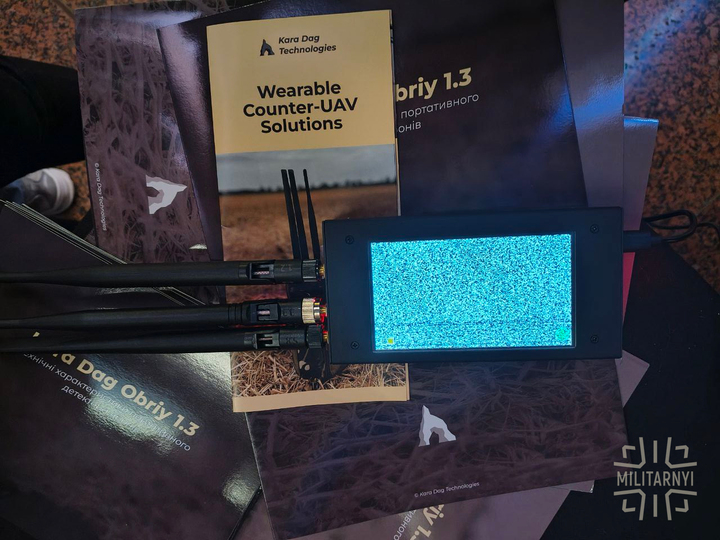
The Ukrainian company Kara Dag Technologies has updated its Obriy drone detector to the 1.3 version. It is designed for personal use by soldiers on the battlefield.
The detector in this version was showcased at the Brave1 Components exhibition, which took place recently.
According to the company, the device reduces casualties by alerting users to approaching enemy FPV drones and quadcopters (DJI Mavic), which it can reliably detect at a distance of 2–5 km.
Drone detection is carried out based on their video signals.
The corresponding app can be installed on a smartphone, allowing users to detect and display the frequencies used to control nearby enemy FPV drones.
In addition, thanks to integration with electronic warfare systems, Obriy 1.3 can automatically activate jamming to disable a drone.
The detectors have been tested in combat conditions during the Russian-Ukrainian war.

The new model features improved characteristics compared to its predecessor, Obriy 1.2 version, which is no longer produced.
The system is fully autonomous and requires minimal training to operate. Its weight with antennas installed is about 380 grams, and it can operate for up to 8 hours. There is also a version of the detector with a built-in video screen.
The Obriy 1.3 detects enemy FPV drones using frequencies of 1080–1360 MHz (40 MHz step), 2370–2510 MHz (5 MHz step), and 4900–6050 MHz (5 MHz step). The commonly used bands are 1.2, 2.4/3.3, and 4.9–6.0 GHz.

The alarm is triggered when the signal level (RSSI) exceeds a certain threshold or when a specific signal fingerprint is detected. To filter noise, RF signal-fingerprint checks, signal-level smoothing, and filtering of short signals as well as WiFi and Bluetooth channels are applied.
This ensures stable operation with a minimal number of false alarms.
Declared reaction time:
At the MSPO exhibition held in September in Poland, the company reported that it is working on the 1.5 version, which will detect enemy drones using frequencies from 0.3 to 7 GHz.
Підтримати нас можна через:
Приват: 5169 3351 0164 7408 PayPal - [email protected] Стати нашим патроном за лінком ⬇
Subscribe to our newsletter
or on ours Telegram
Thank you!!
You are subscribed to our newsletter