









Popular
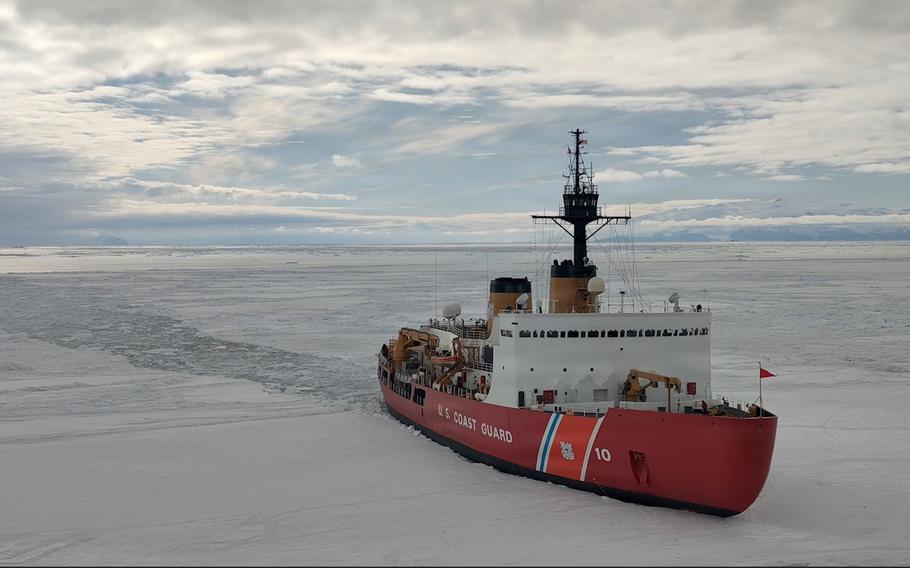
USCGC Polar Star, the U.S. Coast Guard’s only heavy icebreaker, turns 50. All U.S. military icebreakers are part of the Coast Guard; the Navy does not operate any vessels of this type.
American military media Stars and Stripes reported on this.
As noted, the oldest ship in the Coast Guard fleet is marking its 50th anniversary by doing what it does best — breaking ice. Polar Star has arrived in McMurdo Sound in Antarctica for its annual Operation Deep Freeze mission, clearing channels for supply ships servicing scientific stations.
According to the Coast Guard, Polar Star can navigate ice up to 6 feet thick at 3 knots. Using a continuous ramming process, drive, strike, retreat, and strike again, it can penetrate ice up to 21 feet thick.

Commissioned on January 17, 1976, Polar Star is one of only three fully operational U.S. military ships over 50 years old. The list also includes the amphibious assault ship USS Blue Ridge, based in Japan and commissioned in November 1970, and the aircraft carrier USS Nimitz, based at Naval Base Kitsap, Washington, commissioned in April 1975.
Polar Star is one of three ocean-going icebreakers operated by the U.S. government. The Coast Guard also operates two medium icebreakers, USCGC Healy and USCGC Storis, capable of navigating ice up to 8 feet thick.
By comparison, Russia has a fleet of 42 icebreakers, eight of which are nuclear-powered. China’s icebreaking fleet is smaller than Russia’s but larger than the U.S.’s, with five scientific icebreakers.
To address the gap and replace aging vessels, the United States ordered three heavy icebreakers in 2025 and signed a memorandum of understanding to construct 11 medium icebreakers.
Bollinger Shipyards, based in Seattle, Washington, has been selected to build the heavy vessels, with the first expected to be delivered after 2030.
The medium icebreakers will be built in cooperation with Finland. Finnish shipbuilders will construct the first four at domestic shipyards, after which U.S. companies will build up to seven more using the experience gained.

The 11 medium icebreakers are projected to cost around $6.1 billion. The search for foreign contractors reflects the decline of the U.S. shipbuilding industry; the last American company to build icebreakers launched one in 2014.
Meanwhile, Polar Star is undergoing a five-year repair and modernization program, allowing it to continue service into the 2030s. Work is carried out in stages, with the ship returning to active duty between phases to support U.S. Antarctic missions.
Підтримати нас можна через:
Приват: 5169 3351 0164 7408 PayPal - [email protected] Стати нашим патроном за лінком ⬇
Subscribe to our newsletter
or on ours Telegram
Thank you!!
You are subscribed to our newsletter