





Popular

Taiwan’s Ministry of National Defense has launched a large-scale program to build a series of 10 new-generation light frigates.
USNI News reported on this.
The Ministry plans to introduce the ships into naval service between 2028 and 2040.
The primary mission of the new vessels will be air defense and anti-submarine warfare amid sustained pressure from the People’s Republic of China.
The government is allocating $7.8 billion for the project as part of a broader shipbuilding budget request totaling nearly $10 billion.

The navy has divided the order evenly: five frigates will be configured for air defense (AAW), while the remaining five will focus on anti-submarine warfare (ASW).
The series continues a program launched in 2023-2024, when construction began on the first two prototype ships. Taiwan is also studying the construction of new multi-purpose frigates.
The design is based on an adapted concept from U.S. Gibbs & Cox.
The requirements call for ships with a displacement of approximately 2,500 tons to replace the aging Knox-class frigates, which date back to the Cold War.
The Taiwanese Navy still uses these older vessels for intensive monitoring of Chinese ships operating in the “gray zone.”
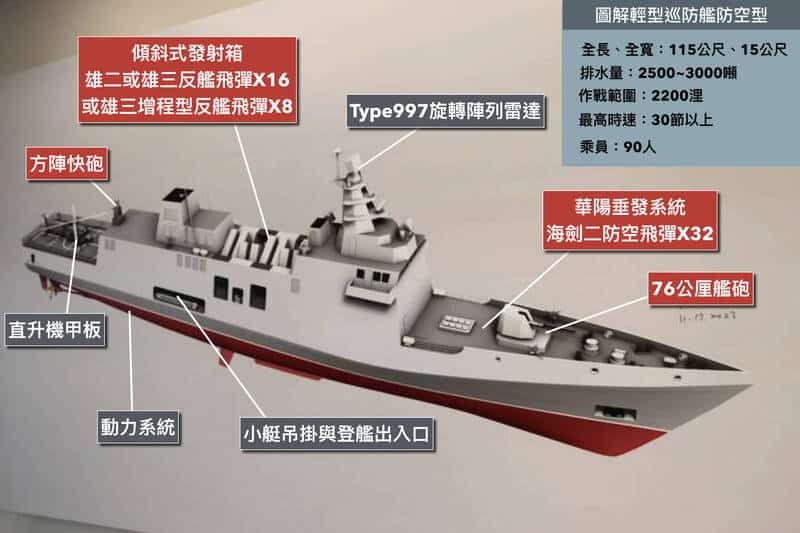
According to the design, the hull is 115 meters long and 12.6 meters wide, with a draft of 3.9 meters.
Extensive automation has reduced the crew to 85 personnel, a significant reduction compared with Knox-class ships, which require more than 200 sailors.
The propulsion system uses a combined diesel-electric and gas turbine configuration (CODLAG). The main engine is a General Electric LM2500+G4 gas turbine, supported by diesel generators. This setup gives the frigate a top speed of more than 30 knots and a range of 4,800 nautical miles at an economical speed of 12 knots.
Armament varies by configuration. The air defense version is equipped with a 32-cell vertical launch system (VLS) for TC-2N (Sea Sword II) medium-range surface-to-air missiles.
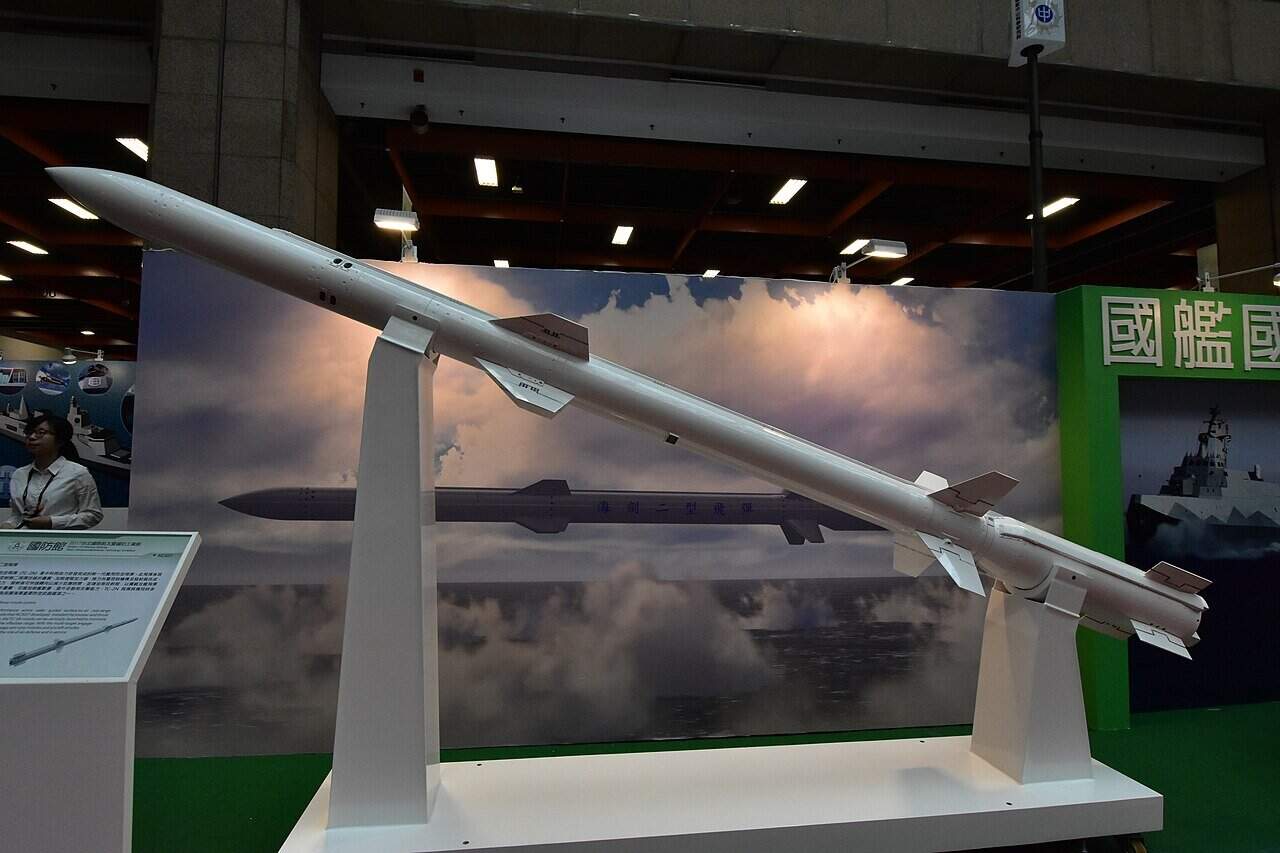
The anti-submarine version replaces the VLS with a towed variable-depth sonar and torpedo tubes.
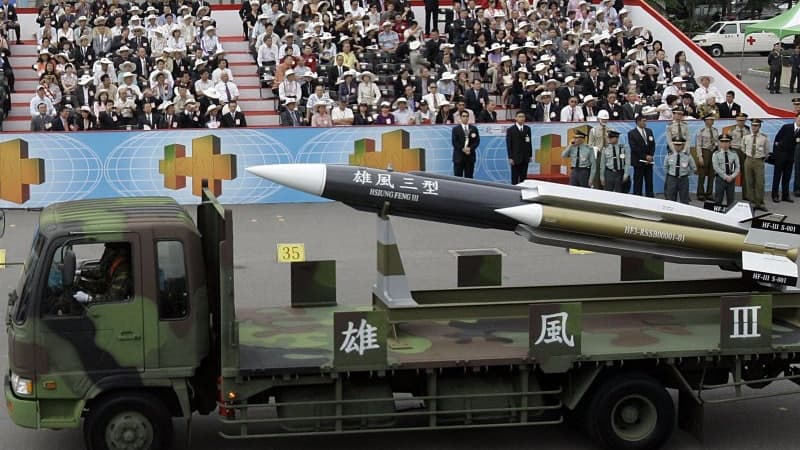
Both versions share a common strike package, including up to 16 Hsiung Feng III supersonic anti-ship missiles or Hsiung Feng II subsonic missiles, mounted in launchers amidships.
Gun armament includes a 76 mm OTO Melara Super Rapid gun at the bow and a Phalanx close-in weapon system at the stern for missile defense.
Target detection is handled by a 3D rotating active electronically scanned array radar (BAE Systems Artisan Mk.), integrated with the CMS-330 combat management system from Lockheed Martin Canada.
A flight deck and hangar for an S-70C Thunderhawk helicopter are located at the stern of the frigate.
Підтримати нас можна через:
Приват: 5169 3351 0164 7408 PayPal - [email protected] Стати нашим патроном за лінком ⬇
Subscribe to our newsletter
or on ours Telegram
Thank you!!
You are subscribed to our newsletter