






Popular

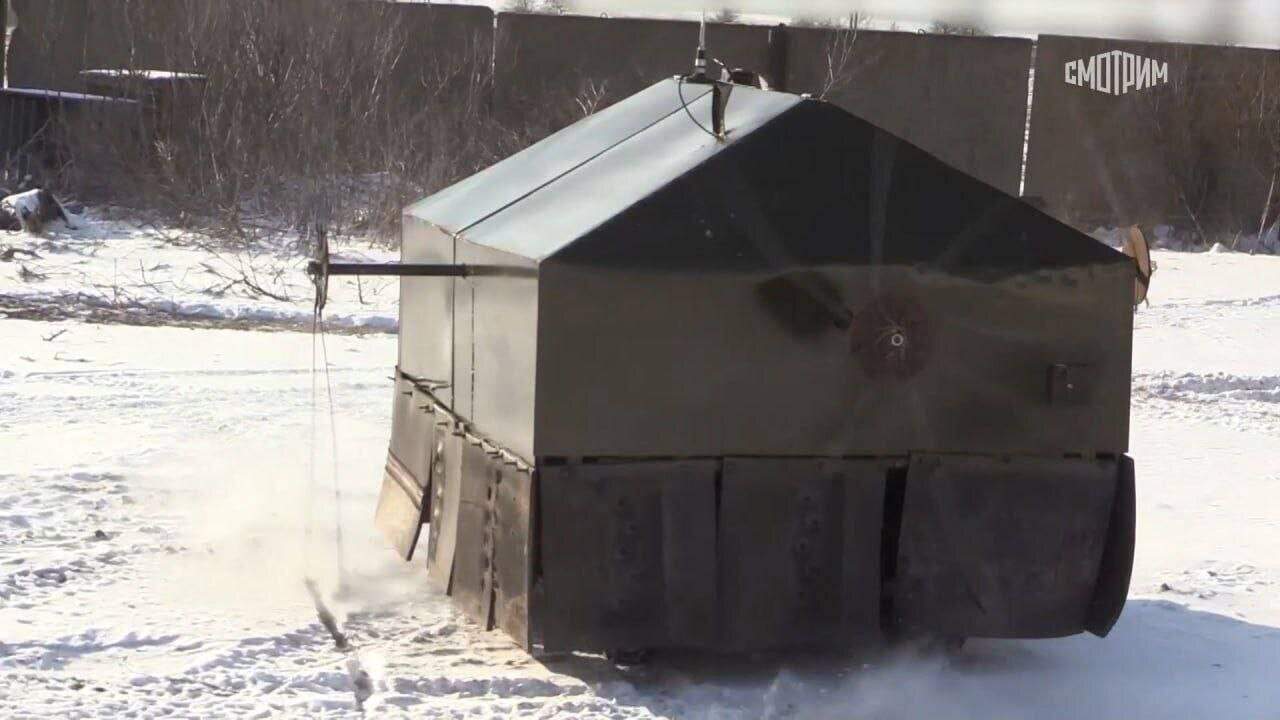
The Russian military has installed “fans” on a ground robotic system to counter Ukrainian drones.
Armored vehicle researcher Andrii Tarasenko shared the video on his Telegram channel.
As part of the experiment, Russian forces equipped the ground robotic system with a protective “shed-like” structure, featuring rotating mechanisms on the sides and at the front and rear.
Ropes are attached to these mechanisms. As the vehicle moves, individual motors begin rotating the “fans.” According to the developers’ plan, the ropes are meant to knock down or damage Ukrainian drones approaching the protected equipment.
In the released footage, the elements of this defense hit the ground, significantly reducing the mobility of the ground robotic system.
Additionally, it remains unclear how this design will function during active movement; the ropes are likely to strike the vehicle’s body.
There are also questions about the system’s mobility in overgrown areas, open fields, and urban environments.
Such “fans” will inevitably catch on vegetation and structures and kick up significant dust.
It is worth noting that the Russians have patented at least two similar devices, including one based on the UAZ-452 Bukhanka.
The design consists of a frame that mounts to the vehicle’s body. On this frame, at least one electric motor with a shaft-mounted blade is installed; these motors can be directly connected to the vehicle’s electrical system.
In this case, the mechanical impact on FPV drones is made not by ropes, but by the rotating blades.
According to the developers’ plan, during an attack on the protected vehicle, the drone is highly likely to enter the blade rotation zone.

The gap between the vehicle’s body and the rotating blades is designed to cause the cumulative grenade to rotate upon contact with either the body or the blades.
This gap is also designed to weaken the cumulative jet if the drone’s warhead detonates upon contact with the blades.
Additionally, a version with an electric motor and ropes mounted on the combat vehicle’s roof has been patented. According to the developers’ idea, this design is intended to protect the vehicle from ammunition drops and attacks from above.
Підтримати нас можна через:
Приват: 5169 3351 0164 7408 PayPal - [email protected] Стати нашим патроном за лінком ⬇
Subscribe to our newsletter
or on ours Telegram
Thank you!!
You are subscribed to our newsletter