

Popular

An RUSI analysis dated November 1, 2025, titled Vulnerabilities in Sukhoi Production: Clipping Russia’s Wings, examined the state of Russia’s aircraft manufacturing industry amid its full-scale invasion of Ukraine. The study identified key “bottlenecks” in Sukhoi aircraft production that are vulnerable to international sanctions and Ukrainian strikes.
According to the analysts, while primary aircraft manufacturing plants in Komsomolsk-on-Amur, Novosibirsk, and Irkutsk are already under sanctions, a number of their suppliers have managed to avoid restrictions.
In November, the international intelligence community InformNapalm, in cooperation with the Fenix cyber center, published classified documents obtained through a multi-stage operation targeting the Russian company OKBM. OKBM specializes in producing components for strategic aviation and spacecraft. The leaked materials confirmed the Russian aviation industry’s heavy dependence on imported components.
The documents specifically highlighted reliance on imported CNC machine tools, the procurement of which has been significantly hindered by sanctions.
According to RUSI’s mapping, the most critical suppliers involved in the production of Sukhoi (“Su”) aircraft are located in the European part of Russia, placing them within range of Ukrainian long-range strike capabilities.
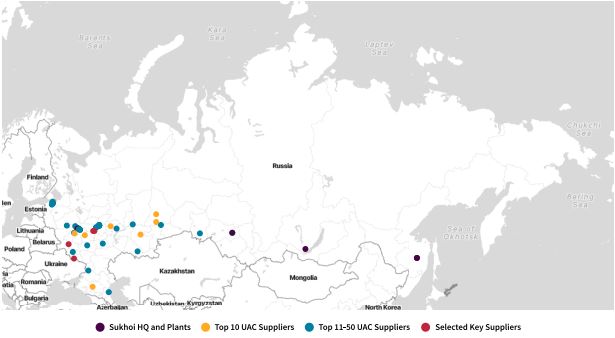
Among them are:
A more general analysis of the leading avionics suppliers to the United Aircraft Corporation shows that most of the 12 leading design bureaus and suppliers are heavily dependent on imports of critical equipment and components, sourced through opaque supply channels involving little-known private importers.
Throughout 2024, this group of unsanctioned Russian importers supplying the 12 leading avionics vendors received shipments containing integrated circuits and capacitors worth more than USD 25 million. These shipments included products from brands such as Texas Instruments and Murata. The supplies often originated in China and were routed through small distributors in Belarus and Kyrgyzstan. Most of these components can be identified within the supply chains of Sukhoi-branded aircraft.
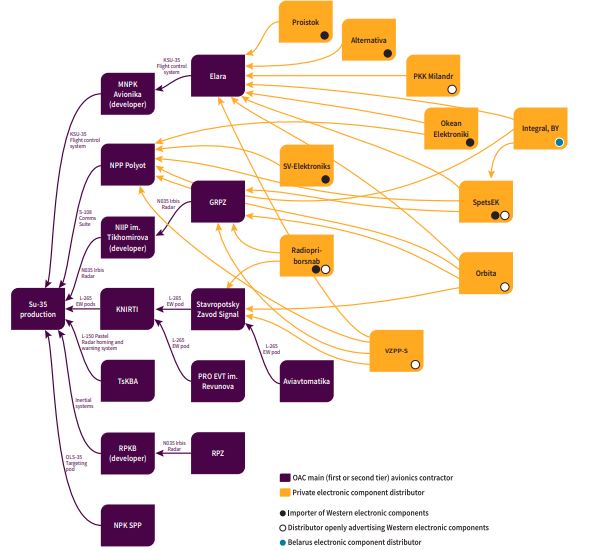
Sukhoi components that depend on these import channels include critical equipment such as the communications system (NPP Polet), the flight control system (Elara), the engine control module, radar guidance and control systems, and, of course, the Khibiny electronic countermeasures system, developed and manufactured by KNIRTI.
“Expanding the sanctions regime to include second- and third-tier suppliers in Sukhoi’s supply chain could help disrupt Russian aircraft production today and highlight to potential Russian export customers the risks of relying on Russia for aircraft maintenance and supply in the future,” the RUSI study states.
Coordinating these sanctions with an expanded Ukrainian deep-strike campaign, which could further disrupt Russian metallurgical and defense-industrial facilities over the next 12 months, could compound the effect, leaving Russia struggling to replace damaged equipment.
Підтримати нас можна через:
Приват: 5169 3351 0164 7408 PayPal - [email protected] Стати нашим патроном за лінком ⬇
Subscribe to our newsletter
or on ours Telegram
Thank you!!
You are subscribed to our newsletter