
Popular

According to a recent study by the Peterson Institute for International Economics (PIIE), Denmark ranks first globally in the share of its gross domestic product (GDP) allocated to direct military aid to Ukraine.
The study covers the period between January 2022 and October 2025 and highlights a wide gap between the countries providing the most support and the largest Western economies.
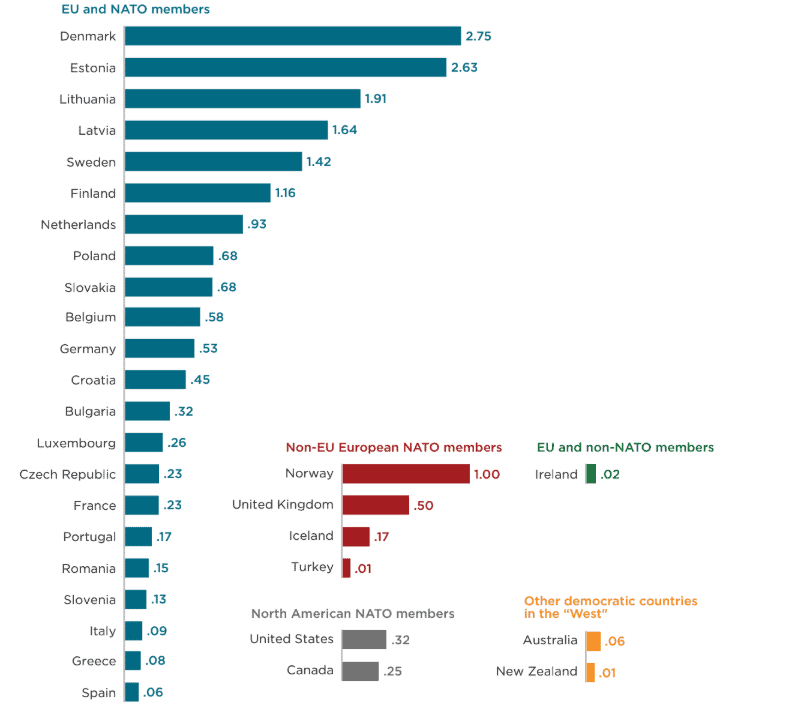
Denmark allocated 2.75% of its GDP to Ukraine’s defense – the highest level among all EU and NATO members. This makes Denmark the most intensive supporter of Ukraine, ahead of countries traditionally seen as Europe’s main security donors.
Other high-ranking countries include the Baltic and Nordic states. Estonia devoted 2.63% of its GDP to aid Ukraine, Lithuania 1.91%, Latvia 1.64%, and Sweden 1.42%. These figures indicate that NATO’s northeastern members regard Russia’s defeat as critical to their national security.
PIIE experts conclude that geography plays a major role in determining support levels. Countries closer to Russia tend to provide more assistance, and geographical distance accounts for nearly half of the differences in aid levels among EU states.
An important factor behind Denmark’s leadership was its strong fiscal position at the start of Russia’s full-scale invasion. Countries with low public debt had significantly more “fiscal space” to rapidly increase military spending. A stable economy allowed Copenhagen and Tallinn to finance Ukraine’s Armed Forces without placing a critical strain on their national budgets.
By contrast, large EU economies with high levels of public debt showed much more modest relative results. Germany’s military assistance amounted to just 0.53% of GDP, while France provided 0.23%. Even the United States, despite its enormous absolute level of aid, lags far behind Northern European countries when measured as a share of GDP (0.32%).
Contrary to expectations, the war did not lead to deeper integration in the field of common defense. Instead of a unified approach, the EU’s response remained fragmented, with each member state acting according to its own financial capacity and national interests.
Analysts are particularly concerned about the stance of neutral EU countries such as Ireland, Cyprus, and Malta. Their assistance to Ukraine was minimal (less than 0.02% of GDP), and their own defense spending even declined.
Analyst Jakob Funk Kirkegaard emphasizes that Denmark, Finland, and Slovakia were able to provide substantial assistance (more than 0.5% of GDP) despite their existing levels of public debt. This demonstrates that when a clear strategic objective is in place, economic constraints do not become an insurmountable barrier to providing military aid.
At this stage, the EU has effectively assumed the role of a financial donor, thereby ensuring Ukraine’s budgetary stability. However, direct military assistance – particularly the procurement of weapons – remains the responsibility of individual leading countries. Denmark plays a key role in this process, often acting as an initiator of new coalitions and supply programs.
Read more on Denmark’s military assistance during 2022–2025 in the Militarnyi’s article.
Підтримати нас можна через:
Приват: 5169 3351 0164 7408 PayPal - [email protected] Стати нашим патроном за лінком ⬇
Subscribe to our newsletter
or on ours Telegram
Thank you!!
You are subscribed to our newsletter