Popular

Russian tank crews share that improvised overhead cages — known as “tsar-mangals” — overload the transmission and cause failures. They also report a severe shortage of explosive reactive armor (ERA).
Units are forced to replace missing blocks with improvised substitutes.
Tank historian Andriy Tarasenko published fragments of an interview with a member of a Russian tank crew.
According to the tanker, the “tsar-mangals” damage transmissions, sometimes after just a few kilometers of driving.

Even more problems arise when crews mount cages directly on the turret — in those cases, turret rotation drives fail and backup manual rotation becomes impossible.
“The chassis survives, but the transmission and side gearboxes don’t. In another company, they made a ‘tsar-mangal’ out of cables. It didn’t even make it 10 km before one of the side gearboxes failed. The load on the components is very high, and they fail much faster. And if you mount the mangal on the turret instead of the hull, the turret drives burn out — you can forget about manual rotation,” he said.
He also notes a major shortage of reactive armor blocks, especially the modern Relikt system, which units replace with improvised versions.
“Oh… with the reactive armor — a complete mess. On older vehicles, it was a bit easier, although there was already a shortage of blocks, then of plastic explosives. That didn’t stop me: we reinforced the gunner’s side with two layers, welded a second layer onto the turret, and installed the screens. But on the BVMs… all those Relikts they show apparently exist only in Kremlin cartoons. On the turret cheeks, there’s a homemade version from garage workshops — sheet metal shaped like factory plating with an explosive insert from the UR-77 mine-clearing line charge. It works about 50/50 at a 45° angle,” the tanker complained.
In addition, he shared that while tanks arrive from the factory with a “good configuration,” repair battalions have to buy spare parts with their own funds when components fail.
In June 2024, Russian forces started producing improvised reactive armor blocks in field workshops.
In garage conditions, they pack explosives from the UR-77 mine-clearing charge into homemade containers.
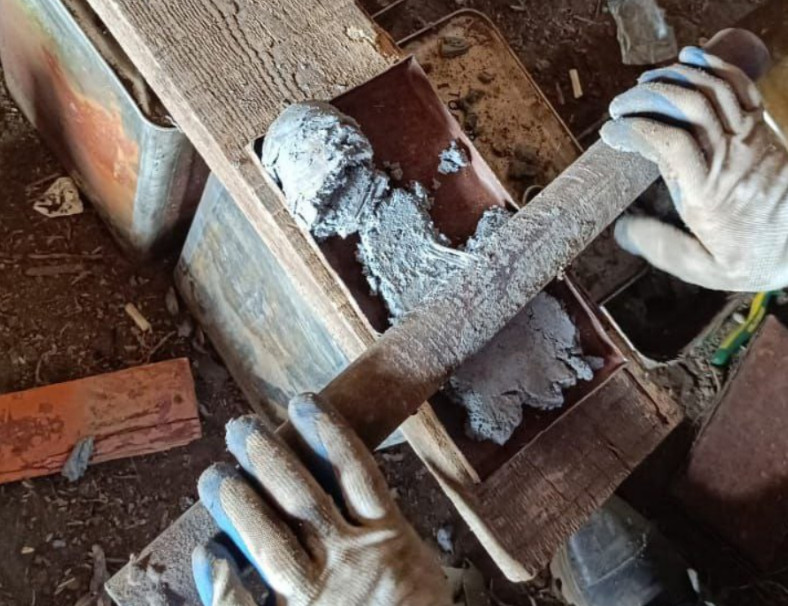
These containers are similar in dimensions to the 4S20 blocks used in the Kontakt-1 reactive armor system.
The explosive mixture extracted from the mine-clearing charge is similar to what is used in Kontakt-1. However, for reactive armor, precise matching is critical, as it determines activation on impact. As a result, improvised blocks often fail to activate, according to the Russian tanker.
Підтримати нас можна через:
Приват: 5169 3351 0164 7408 PayPal - [email protected] Стати нашим патроном за лінком ⬇
Subscribe to our newsletter
or on ours Telegram
Thank you!!
You are subscribed to our newsletter