



Popular

The Pentagon has launched a major policy shift aimed at expanding the use of small drones across all branches of the U.S. Armed Forces, designating many of them as ‘expendables’ rather than full-fledged aircraft.
The new policy, outlined in a memo titled Unleashing U.S. Military Drone Dominance, reflects the priorities of Defense Secretary Pete Hegseth, who emphasized the need to scale up drone production and cut through bureaucracy.
Under the changes, lower-level commanders will be authorized to purchase small drones independently, and many systems will be treated like ammunition — such as hand grenades — rather than durable goods.
Hegseth said the U.S. must’ve rapidly expanded its domestic drone manufacturing capacity, focusing on mass production of inexpensive drones under the ‘Buy American’ initiative, with contributions from engineers and AI experts.
“Senior officers must overcome the bureaucratic tendency to avoid risk — in budgeting, armaments, planning the use of weapons, and training,” he said.
The secretary called drones the most significant battlefield innovation of this generation, citing their widespread use in Ukraine, where they account for the majority of this year’s combat losses.
Despite the global growth of drone manufacturing, he said, the U.S. military had fallen behind due to excessive regulation under the previous administration.
According to the memorandum, Group 1 and Group 2 drones will now be considered “consumer goods” rather than durable military equipment.
The Group 1 drones are defined as weighing up to 20 pounds (9 kg), flying at altitudes up to 1,200 feet (365 meters), and reaching speeds of 100 knots. The Group 2 drones can weigh up to 55 pounds (25 kg), reach altitudes of 3,300 feet (1,000 meters), and fly at speeds of up to 250 knots.

The Pentagon is also exploring whether to apply similar classifications to Group 3 drones, which weigh up to 1,320 pounds (600 kg) and can fly at altitudes up to 5,500 meters.
The reclassification will allow the military to bypass certain interoperability standards such as NATO’s STANAG 4856, which increase the cost and complexity of drone design. The Pentagon now states that such requirements should only apply to larger drones.
“The Secretaries of the Departments of Defense will establish airworthiness and material release requirements for UAVs, excluding Group 1 and Group 2 aircraft, except in exceptional circumstances,” the memorandum states.
Treating small drones as consumables also changes the way they are supplied and maintained, potentially enabling even small units to procure and operate them independently.
Under the revised framework, unit commanders will determine who is authorized to operate small drones and will be allowed to test and procure UAVs that meet current standards — including commercial models and those developed internally by military personnel using approved components.
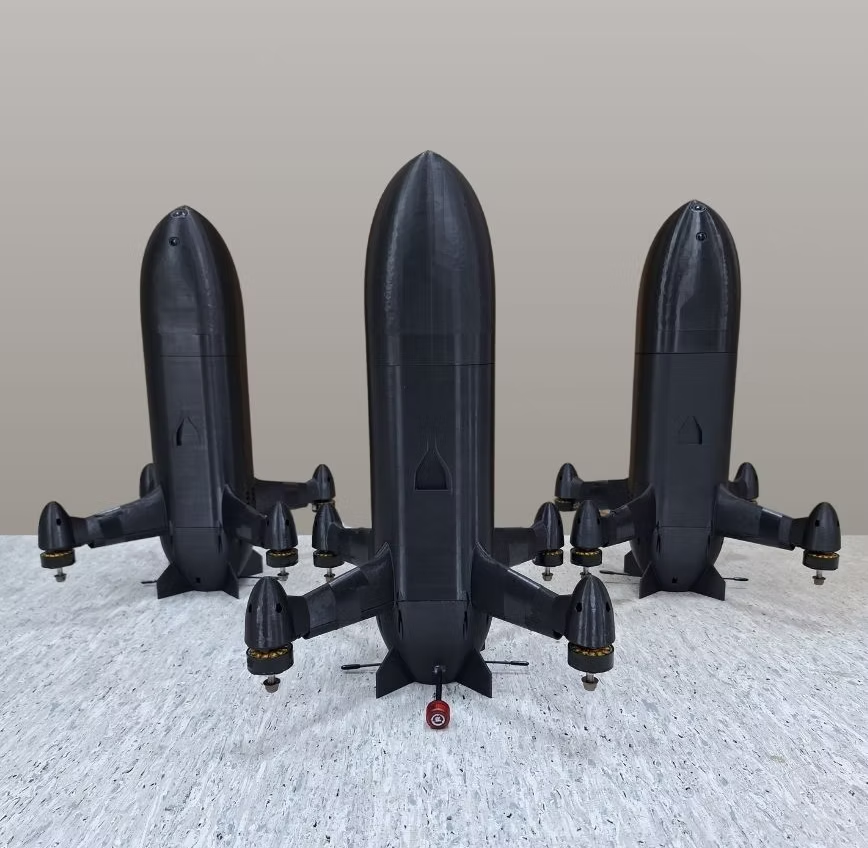
The Pentagon also plans to streamline development and procurement processes, placing special emphasis on units using 3D printing and rapid prototyping.
The reform includes an overhaul of the Pentagon’s Blue List — the catalog of drones and subcomponents approved for use by the U.S. military. Under the new policy, lower-level commands will be allowed to submit additions to the list.

The memorandum also calls for the creation of dedicated UAV training grounds and greater integration of drone systems into standard combat training programs.
By the end of 2026, each U.S. military unit is expected to be equipped with low-cost disposable drones, with priority given to units stationed in the Indo-Pacific region.
The announcement comes as U.S. drone makers prepare to ramp up production. Neros Technologies, which manufactures Archer FPV drones, recently states it could produce up to one million units annually if it receives sufficient Pentagon orders.
Підтримати нас можна через:
Приват: 5169 3351 0164 7408 PayPal - [email protected] Стати нашим патроном за лінком ⬇
Subscribe to our newsletter
or on ours Telegram
Thank you!!
You are subscribed to our newsletter