



Popular

Twice in recent weeks, China has mobilized thousands of fishing boats to practice forming massive “floating barriers” stretching roughly 460 kilometers.
The New York Times identified the unusual maneuvers through an analysis of ship-tracking data.
On Christmas Day 2025, about 2,000 Chinese fishing vessels abruptly halted routine fishing activity or departed their home ports and assembled into two long, parallel formations in the East China Sea. Each formation extended for about 460 kilometers and took the shape of an inverted L.
A similar formation was observed again on January 11, 2026, when about 1,400 Chinese vessels gathered in a rectangular formation stretching more than 320 kilometers.
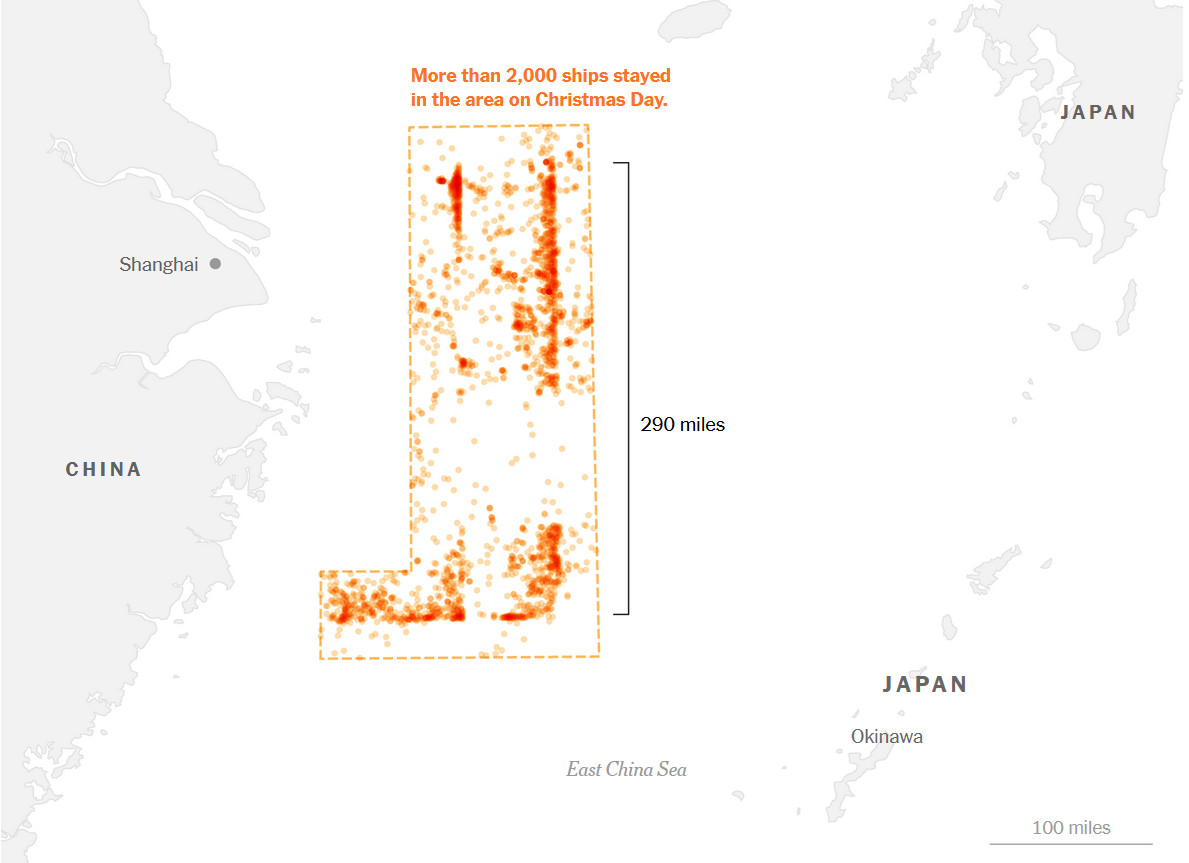
The density of the formation was so high that some approaching cargo ships were forced to divert around it or navigate in zigzags, according to tracking data.
The unusual patterns were first noticed by Jason Wang, chief operating officer of the analytics firm ingeniSPACE, and independently confirmed by The Times using vessel-location data from Starboard Maritime Intelligence.

“My best guess is that these were exercises to test how civilian vessels would respond if ordered to assemble on a large scale in a future crisis, perhaps in support of a quarantine, blockade, or other forms of pressure on Taiwan,” Gregory Pauling, director of the Asia Maritime Transparency Initiative, wrote in a commentary for The New York Times.
The People’s Liberation Army Navy (PLA) operates a maritime militia that conducts so-called “gray zone” activities aimed at establishing de facto control over disputed waters near China.
These activities include providing armed escorts for Chinese fishing vessels, intimidating foreign commercial shipping in contested areas, and deterring other countries’ coast guards and navies from patrolling waters they claim, due to the risk of escalation with Beijing.
The maritime militia is primarily composed of personnel from state-run fishing fleets who receive military training similar to reservists or national guard units, while its core leadership consists of active-duty military personnel.
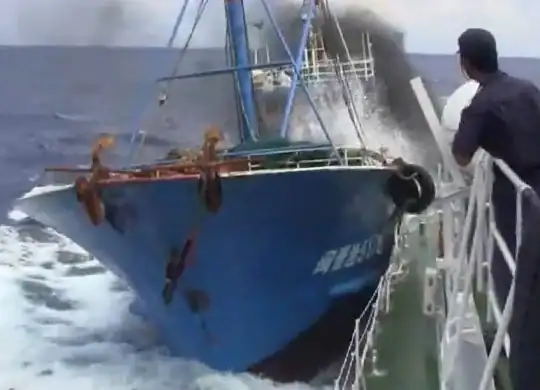
Given that China operates one of the world’s largest fishing industries — with a fleet of about 564,000 vessels as of 2020, all under state control — the potential scale of such a militia is significant.
For regular navies, a key challenge in responding to such activity lies in the legal constraints on the use of force. Fishing vessels present a civilian profile and, under international law, are generally protected from attack during military operations.
At the same time, these vessels can display coordinated, military-style behavior in support of China’s maritime objectives and then quickly revert to civilian operations at the same ports. This hybrid posture complicates the development of clear rules of engagement for naval and coast guard commanders.
For a detailed assessment of China’s military strategy in a potential large-scale conflict, see Militarnyi’s article “US Army Report: How China Fights in Large-Scale Combat Operations.”
Підтримати нас можна через:
Приват: 5169 3351 0164 7408 PayPal - [email protected] Стати нашим патроном за лінком ⬇
Subscribe to our newsletter
or on ours Telegram
Thank you!!
You are subscribed to our newsletter