


Popular

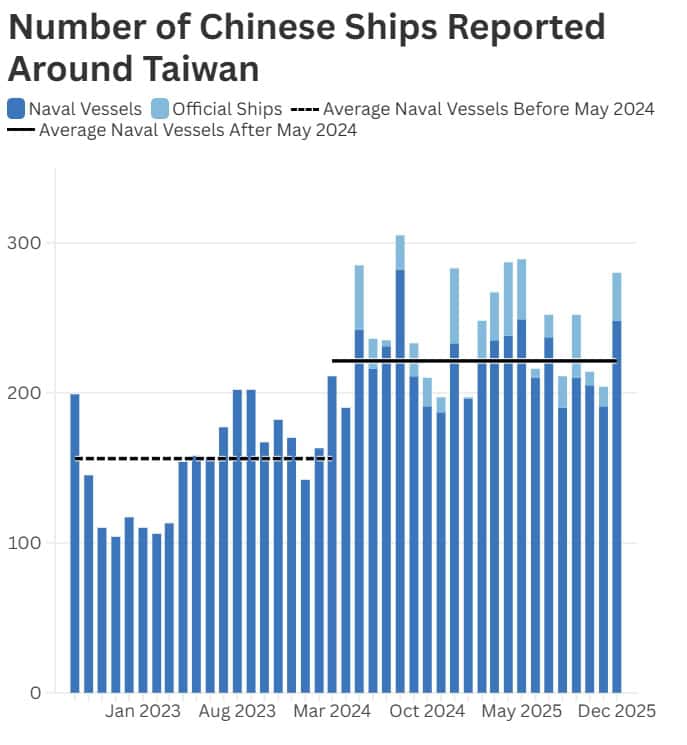
In 2025, China demonstrated unprecedented growth in operational tempo and expanded its geographical presence in the Indo-Pacific region.
This was reported by the Center for Strategic and International Studies (CSIS) China Power Project.
The report records a record number of air incursions into Taiwan’s air defense zone. Analysts also note the first-ever simultaneous operations of two aircraft carrier groups in the Pacific Ocean and a shift in the focus of aggression to the South China Sea.
After the inauguration of Taiwanese President Lai Ching-te (William Lai) in May 2024, the Chinese command set a significantly higher baseline level of monthly activity. The PLA maintained this pace throughout 2025.
The total number of Chinese aircraft incursions into Taiwan’s Air Defense Identification Zone (ADIZ) reached 3,764, which is 22.4% higher than the previous year.

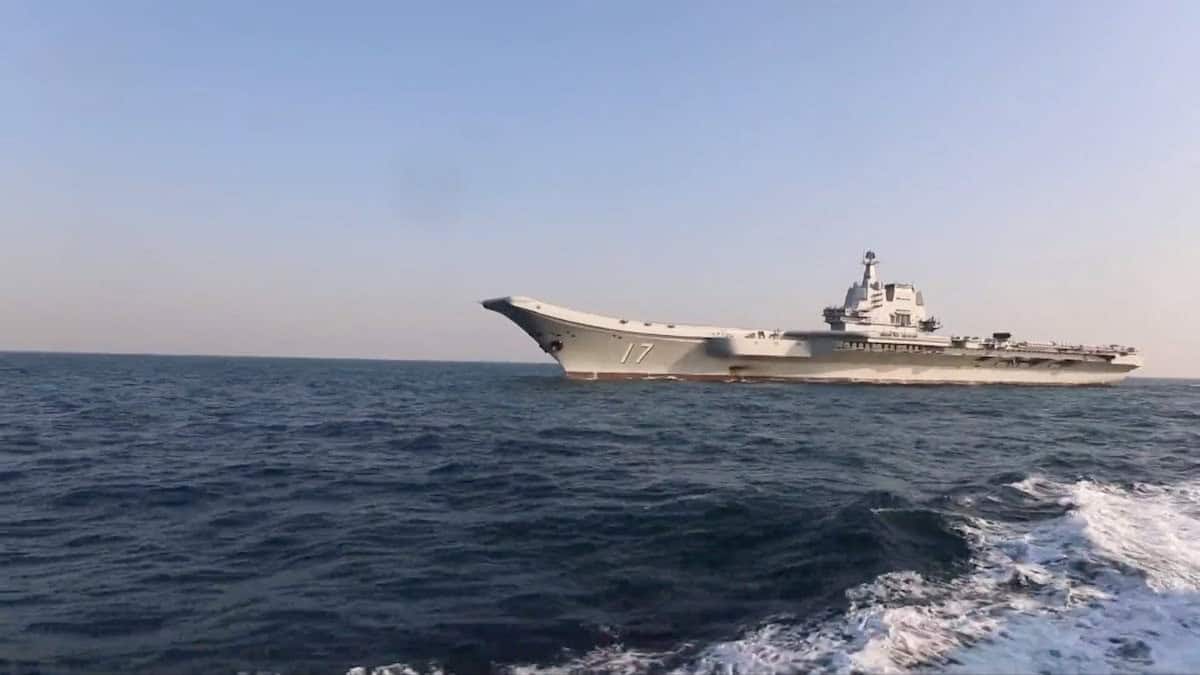
Beijing chose large-scale exercises Strait Thunder-2025A in April and Justice Mission 2025 as key elements of pressure. During the April maneuvers, the PLA Navy practiced a scenario of a complete blockade of the island with the participation of the Liaoning aircraft carrier group.
Chinese missile forces simulated strikes on ground targets, including the Yong’an liquefied natural gas (LNG) terminals in Gaoxiong. These actions indicate Beijing’s preparations to destroy the island’s energy infrastructure.
For the first time, the Chinese navy demonstrated its ability to project power far beyond the First Island Chain. In 2025, both combat-ready aircraft carriers, Liaoning and Shandong, simultaneously performed tasks in the open waters of the Pacific Ocean.
NAVY ship groups conducted firing and maneuvers near the coasts of Australia and New Zealand. Experts see this as a signal of Beijing’s readiness to act on a global scale.
In the South China Sea, Beijing has shifted the vector of tension. Previously, the epicenter of the confrontation was Thomas Shoal, but in 2025, the Chinese Coast Guard (CCG) focused its efforts on blocking Scarborough Shoal.
The number of operations in this area doubled compared to 2024. In total, the PRC forces conducted 163 operations in the region, setting a new historical high.
The situation around Japan also escalated. In November and December 2025, observers noted a sharp surge in PLA activity. China increased the number of patrols in the area surrounding the disputed Senkaku Islands.
Beijing is using “gray zone” tactics to wear down the Japanese Self-Defense Forces and demonstrate its own claims to the archipelago.
Despite the overall increase in activity, military cooperation with Russia has undergone quantitative changes. In 2025, Beijing and Moscow conducted only six joint exercises — the lowest number since 2020.
However, the parties have moved to a qualitatively new level of interaction: the fleets of both countries conducted their first joint underwater patrol. This indicates a deepening of integration at the level of strategic nuclear forces and the submarine fleet.
CSIS experts note a slight decrease in the intensity of PLA activities in the second half of 2025. This lull may indicate a temporary tactical regrouping or the influence of internal purges in China’s senior military leadership.
At the same time, the overall trend remains unchanged: Beijing is systematically building up its military capabilities in order to change the status quo in the Indo-Pacific region by force.
It is worth noting that during the first three quarters of fiscal year 2025, foreign military aircraft forced the Japanese Self-Defense Forces to scramble 448 times.
Although this figure is slightly lower than the same period last year, when 521 sorties were recorded, the intensity of operations near Japanese airspace remains high.
China has traditionally been the most active, accounting for 68% of all incidents (304 cases), while Russian aircraft were the cause of interceptions in 29% of cases (130 sorties).
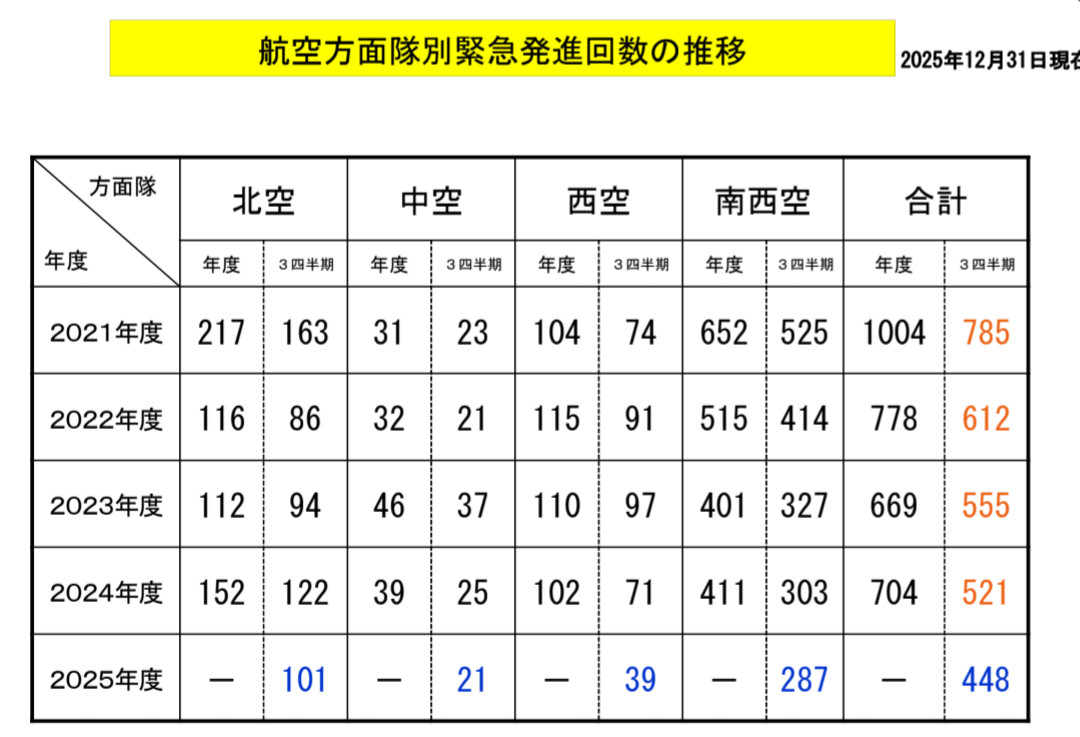
The main tension is concentrated in the southwestern sector, where Japanese fighters took off to intercept 287 times. The main challenges to regional security were the maneuvers of Russian Tu-95 strategic bombers accompanied by fighters in the waters of the Sea of Japan.
The Japanese Joint Staff pays particular attention to the actions of Chinese carrier-based aircraft — during the reporting period alone, approximately 260 takeoffs and landings of J-15 fighters from aircraft carriers in the Pacific Ocean were recorded. In addition, Moscow and Beijing continue to conduct joint long-range flights of H-6 and Tu-95 bombers.
It should be noted that Tokyo responds to such actions with countermeasures to demonstrate its own capabilities.
In particular, Japan launched 16 F-2 fighters equipped with 64 anti-ship missiles in response to the Chinese fleet’s activity in the region.
Підтримати нас можна через:
Приват: 5169 3351 0164 7408 PayPal - [email protected] Стати нашим патроном за лінком ⬇
Subscribe to our newsletter
or on ours Telegram
Thank you!!
You are subscribed to our newsletter