

Popular

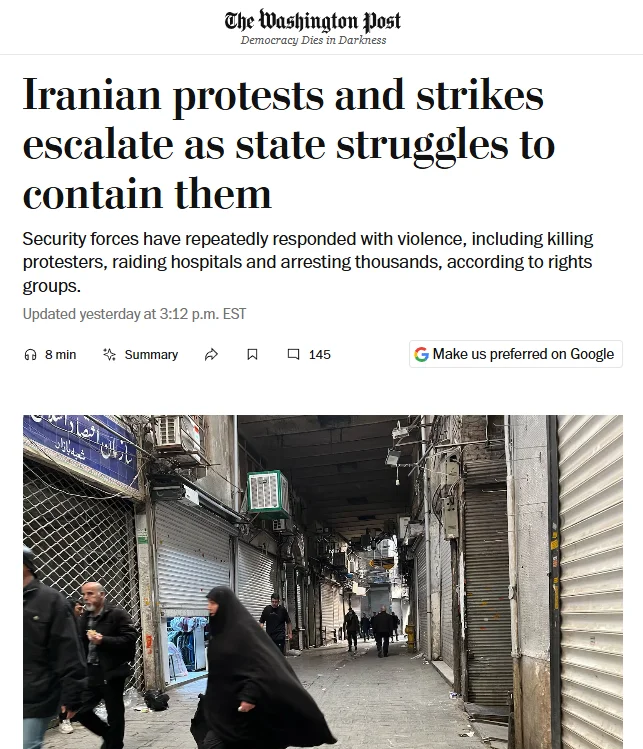
The Iranian government is trying to contain the protests that began late last month with traders in Tehran and have now escalated into mass demonstrations and prolonged strikes in cities and towns across the country, The Washington Post reports.
On Thursday evening, masses of Iranians took to the streets at the call of Reza Pahlavi, the former crown prince of Iran and now the de facto leader of the Iranian opposition. Pahlavi wrote in an article for The Washington Post on Tuesday that he sees himself as a unifying figure to help Iran transition to democracy, not a ‘future ruler.’
Security forces have responded with violence in many cases, including killing protesters, raiding hospitals and arresting thousands of people, according to human rights organizations. Estimates of the death toll range from at least 27 to 36 people, according to human rights organizations. The Center for Human Rights in Iran reported on Tuesday that six children were killed by security forces.
Some videos posted online show that security forces were at times unable to cope with the scale of the protests. And, despite the crackdown and official announcements of moderate economic changes, including a $7 monthly supplemental payment to households to buy basic food, the protests appear to be gaining momentum.
Large crowds took to the streets on Thursday evening in the country’s largest cities, including Tehran, Mashhad, and Isfahan, as well as in other cities ranging from large to small. The protests spread and reportedly covered more than 280 locations in 27 of Iran’s 31 provinces.
The number of protesters on Thursday evening reminded some participants and observers of the Green Movement of 2009, when an estimated 3 million Iranians took to the streets in one day in Tehran. Since then, Iranian demonstrations have seen smaller and more dispersed turnouts, in part due to tight security measures. But not on Thursday night.
Internet monitoring group NetBlocks said on Thursday that Iran “is now in the midst of a nationwide internet lockdown.” The government has restricted the Internet in previous rounds of unrest in an attempt to block the spread of information about the events.
People in Tehran, Rasht, and Mashhad – major Iranian cities in different parts of the country – said in interviews that most stores in their neighborhoods were closed. Among the stores that were open were supermarkets, where Iranians had difficulty finding basic goods.
If the suspension of economic activity continues, this could be significant. Large-scale business closures were almost never observed during previous protests in Iran in recent decades.
The Iranian government has repeatedly faced street protests, especially since 2017, with an average of one mass protest movement every two years. Each time, the authorities have suppressed the demonstrations with force, including mass arrests and killings.
Several Iranians interviewed by The Washington Post pointed to President Donald Trump’s public support for the protesters as a factor in increasing people’s motivation to resist. Trump has said that the United States will intervene if the Iranian authorities kill protesters, although it is unclear what that intervention will look like.
In text messages, the government told some Iranians that they had been ‘observed’ to be near an ‘illegal assembly’ and warned them not to do so again, according to screenshots of the messages sent to The Washington Post. Authorities have also been calling and threatening people who post messages in support of the protests on their social media.
Today is expected to be the second day of mass protest movements across the country, and Iran’s supreme leader is preparing a video address to the people.
Підтримати нас можна через:
Приват: 5169 3351 0164 7408 PayPal - [email protected] Стати нашим патроном за лінком ⬇
Subscribe to our newsletter
or on ours Telegram
Thank you!!
You are subscribed to our newsletter