



Popular
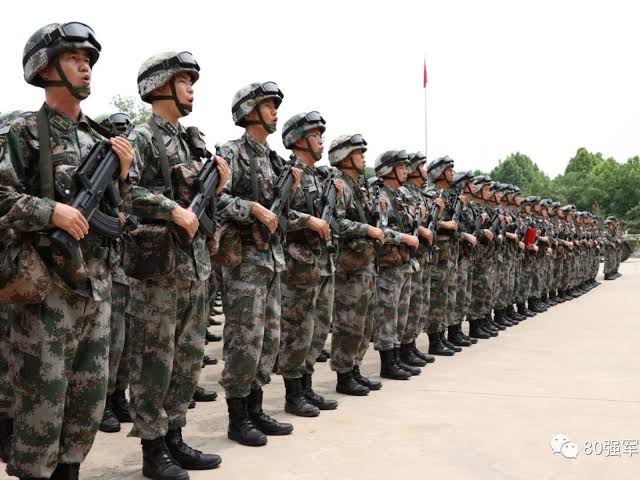

The report “How China Fights in Large-Scale Combat Operations” contains a detailed assessment of China’s military strategy, operational concepts, and the expected characteristics of the People’s Liberation Army Ground Forces (PLAGF), conducted by the U.S. Army Training and Doctrine Command. We will try to provide a brief summary of this report. You can find the original version in our Library.
The Chinese leadership perceives the global security environment as increasingly complex and perilous, identifying the United States as its principal strategic competitor.
Although not explicitly defined, China’s primary interests center on economic development, domestic stability, national sovereignty, and territorial integrity.
In order to safeguard these key interests, China has expanded the scope of its focus to include overseas interests. This expansion was documented in China’s 2013 Defense White Paper and is reflected in its efforts to establish global military influence.

China’s interpretation of its territorial sovereignty is quite broad and has resulted in territorial disputes with 17 countries. Among these, Taiwan and its disputed status are of particular concern to the Communist Party of China. Chinese leaders reject foreign interference in the Taiwan issue, democracy, and human rights, prioritizing their ambition to establish China as a global economic and geopolitical power.
China’s approach to conflict varies from diplomatic engagement to full-scale warfare employing all available means to gain advantage. This comprehensive national approach encompasses a wide range of activities, including the work of China’s United Front — a combination of influence operations, interference, and intelligence activities — and the “three warfares” (psychological, informational, and legal), which are applied to advance national interests without direct armed conflict, as well as the military concept of “active defense.”
The concept of active defense establishes the foundation of China’s military strategy and involves a strategically defensive posture with the capability to conduct offensive operations both at the operational and tactical levels. This enables China to fully leverage three factors: numerical strength, large reserves of military equipment, and internal communications.
Additionally, the scope of active defense has expanded over the past 15 years, shifting from a purely defensive stance to one capable of projecting power beyond China’s immediate borders. This evolution includes developing antiaccess capabilities, emphasizing maritime military struggle, and preparing for ‘informationized’ and ‘intelligentized’ warfare. The strategy integrates the concept of ‘Modern People’s War,’ which the CCP defines as the mass mobilization of society to confront foreign aggression or protect national unity.
A key tenet of China’s active defense strategy is ‘war control’ or ‘effective control,’ that is, how China manages activities during competition, crisis, and conflict. War control emphasizes the management and containment of conflicts to achieve specific objectives while minimizing risks.
It can be understood as having three main components:
China views ‘military-civil fusion,’ the concept of a national integrated strategic system and capabilities, as a critical enabler in strategic competition and conflict. Chinese military power integrates and depends upon whole-of-nation support for rapid deployment and protracted sustainment.
In 2015, Xi introduced the concept of military-civil fusion, which is a further refinement of CCP concepts of civilian support to the military. In 2017, the CCP established the Central Commission for Integrated Military and Civilian Development to oversee its integration. Later renamed the “national integrated strategic system and capabilities,” this system was adopted to help China make optimal use of its significant civilian economic power, science and technology sector, and civilian infrastructure to support military development and, symbiotically, to use military research, development, and capabilities for social benefit.
China has developed initiatives across all segments of society in the frameworks of military-civil fusion, which have important implications for its strategic and operational capabilities. Examples of this can be seen across all segments of society:
China conceptualizes modern warfare against the United States and its allies as a ‘systems confrontation’ rather than traditional force-on-force or platform-on-platform battles. By Chinese idea, “systems confrontation” is the act of pitting opposing states’ defense strategies, systems, and civil-military synergy against each other.
China believes that targeting and disrupting its enemy’s interconnected systems can neutralize the enemy’s ability to function effectively, project power, and wage war.
In 2021, to enable China’s systems approach, the PLA adopted Multidomain Precision Warfare (MDPW) as its core operational concept. This concept enables systems confrontation and supports the integration of operations across all domains.
It is based on the new domains identified in Chinese military writings, which elevated the cognitive dimension and electromagnetic spectrum to be coequal with the more established land, sea, air, space, and cyber domains.
MDPW aims to fuse information across services and domains to launch strikes against identified enemy vulnerabilities.
Future conflicts involving the PLA under the MDPW operational concept will likely feature the following key characteristics:
Historically, PLA operations have relied heavily on the PLA Army, its ground force. The PLA Army is large, comprising approximately 51% of the PLA’s active-duty force. However, the rapid growth and modernization of China’s other services, including the PLA Navy, PLA Air Force, and PLA Rocket Force, have significantly enhanced China’s joint combat power. The PLA Navy is further augmented by China’s coast guard which operate more than 1,200 vessels.
China has made significant investments in space capabilities over several decades, developing a robust and multifaceted space program. The PLA uses space assets for various purposes, including intelligence collection, communications, and navigation support. Additionally, the PLA has developed and employs counterspace capabilities to disrupt space-based communications, radar, and navigation systems – all vital for military operations.
In the cyber domain, Chinese state-affiliated groups conduct large-scale and sophisticated cyber espionage campaigns against the United States and its allies.
The branches of the armed forces generate combat power and are supported by other elements — the Cyberspace Forces, Information Support Forces, Military Aerospace Forces, and the Joint Logistics Support Forces.
China has established five joint theater commands, each operating in a separate strategic region:

In a joint operation, the PLA would employ a variety of maneuver forces from different branches and services, notably from the PLA Army, PLA Navy Marine Corps, and PLA Air Force Airborne Corps. Each of the five joint theater commands have 2-3 PLA Army group armies, with joint components present under multiple PLA Air Force air bases, a navy fleet, and Joint Logistics Support Force units assigned as required.

Each theater command army also has a long-range rocket brigade, intelligence and reconnaissance brigade, pontoon bridge brigade, information support brigade, and electronic countermeasure brigade. The Southern and Eastern Theater Commands oversee seven and four coastal defense brigades, respectively.
In wartime, these forces might include attached units from the PLA Navy Marine Corps, PLA Air Force Airborne Corps, and PLA Rocket Force. These forces might be further enabled by the Joint Logistics, Cyber, Aerospace, and Information Support Forces, as well as by reserves, People’s Armed Police (including Coast Guard), and militia units (including maritime militia forces) to execute an operation.
Most PLA land maneuver forces, including those from the Marine Corps and Airborne Corps, use a brigade-battalion structure. Each brigade typically consists of four maneuver battalions, as well as support battalions for functions such as artillery, air defense, reconnaissance, combat support, and sustainment.
The PLA has developed a strategy to prevent intervention by the United States and its allies, aimed at delaying, weakening, or destroying enemy forces before their full deployment. China seeks to neutralize American reinforcements while they are still en route by targeting command systems, logistics, bases, and infrastructure. This approach limits maneuverability and delays the enemy’s deployment.
Counter-intervention strategy will be divided into three major phases:

Information dominance is a critical component of the strategy. China seeks to influence the adversary’s decision-making even before a conflict begins, using propaganda, disinformation, cyber strikes, and intelligence.
Through sophisticated AI-driven propaganda and targeted disinformation, China aims to manipulate military and civilian leaders’ perceptions through the cognitive domain to cause hesitation or paralysis in critical decision making processes. These operations are supported by China’s global intelligence apparatus that will collect on the intervening enemy’s military and civil activities to gain information and provide early warning. China’s expansive intelligence collection capabilities include satellites, high-altitude balloons, unmanned aircraft systems, human intelligence assets, and open-source intelligence operations.
Military and civilian cyber structures will operate in parallel, targeting command networks, transportation hubs, and critical infrastructure to destabilize control and complicate the deployment of foreign forces.
The PLA’s concept of air dominance differs from the U.S. concept of air superiority. The PLA focuses on denying air superiority to the enemy rather than securing it for themselves. Aircraft from all of China’s military services will target early warning aircraft, electronic warfare aircraft, stealth aircraft, cruise missiles, and refueling tankers — in that order of priority — to deny enemy forces sanctuary in the area of responsibility and the ability to mass air power. The integrated defense network includes long-range strategic HQ-9 systems, medium-range systems, missile defense systems, and short-range systems that provide protection against drones and low-flying targets.
Fortified islands play an important role as staging airfields in the air campaign. They are capable of temporarily hosting fighter squadrons, allowing for an extended operational range of aircraft without the need for permanent basing.
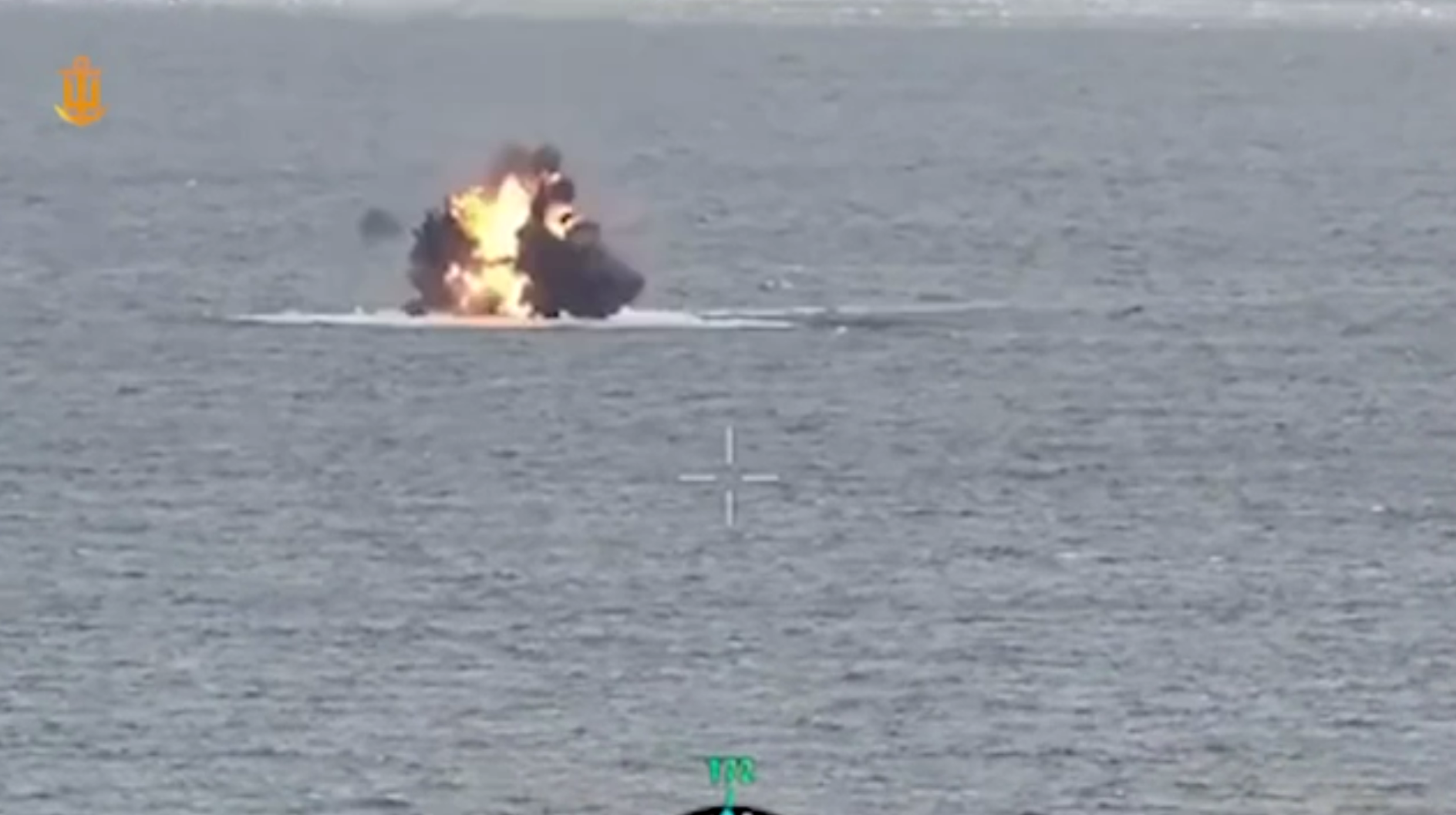
Similarly, the PLA aims to deny the seas to the enemy. PLA naval and rocket forces will target key enemy ports and vulnerable maritime nodes to preclude movement of forces into the theater.
Chinese aircraft carrier and missile platforms will be used to conduct long-range strikes, including through the use of long-range aviation and precision-guided weapons.
The submarine fleet is primarily focused on destroying enemy vessels in the area of the First Island Chain and the western Pacific Ocean. In coordination with aviation, submarines carry out reconnaissance and use external information to target enemies beyond the range of their own sensors.
This campaign involves coordinated strikes by all branches of the military against key and stationary targets in order to demoralize the enemy and disrupt their operations.
The core of the firepower component consists of artillery, missile systems, and long-range ballistic missiles, which are likely to be launched from mainland positions.
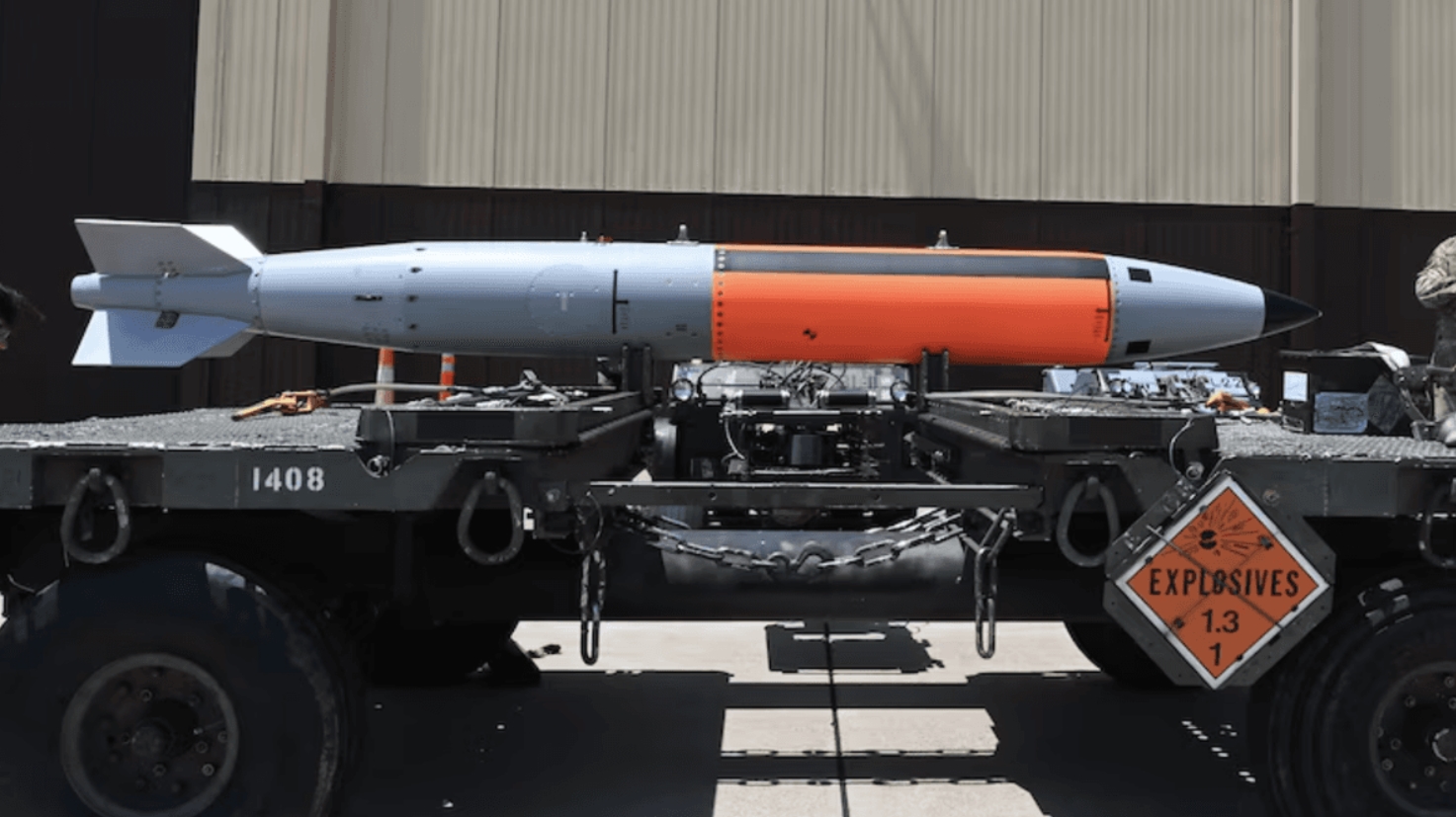
Although the use of weapons of mass destruction is not formalized in China as a separate doctrine, it is considered a possible tool within a broader strategy of countering external intervention. China views it as an important asymmetric advantage that could seriously affect the U.S. ability to conduct military operations in the western Pacific.
China’s approach to nuclear policy is also undergoing significant changes.
Moving away from the historical doctrine of “no first use” of nuclear weapons, China is now shifting toward a “launch-on-warning” concept — that is, launching a retaliatory strike in response to signs of an incoming enemy nuclear attack.
In addition to nuclear weapons, chemical and biological weapons could potentially be used within the counter-intervention strategy. According to the 2025 Annual Threat Assessment of the U.S. Intelligence Community, China most likely possesses chemical and biological warfare capabilities that pose risks not only to U.S. military personnel but also to their allies and civilian populations.

At the initial stage of the landing campaign, the Chinese military will focus on capturing remote islands. The primary goal of this phase will be to secure control over the maritime and air routes leading to the main objective. The campaign will begin with large-scale fire strikes on critically important military and infrastructure targets, including headquarters, barracks, long-range artillery, air defense systems, as well as communication and energy facilities.
Simultaneously with the fire strikes, the PLA will launch amphibious and airborne operations. Landing forces will attack the coasts, landing from military landing craft, the navy, and adapted civilian vessels. At the same time, airborne troops and PLA special forces will conduct air assaults, seizing strategically important targets within the interior of the islands.
Special forces operations will be particularly important at this stage. They will infiltrate the main island by air and sea to conduct reconnaissance and sabotage.
Before the main phase of the invasion, China will conduct a large-scale firepower campaign that will include both lethal and non-lethal means. The lethal component involves massive strikes from land, sea, and air using cruise and ballistic missiles, rocket artillery, and aviation munitions. According to Chinese military doctrine, a preliminary artillery bombardment and coordinated fire destruction of enemy defensive positions are mandatory before deploying landing forces.
Simultaneously, cyberattacks will be carried out, electronic warfare conducted, and psychological operations launched — all aimed at destabilizing digital infrastructure, disabling communications, and lowering the enemy’s morale.
The main assault will begin with synchronized actions by ground, air, and naval forces. In the first hours, the PLA will attempt to destroy the government and military command system, including communications and transportation hubs. This aims to prevent the rapid mobilization of reserves and troop movements.
Strike forces will simultaneously land on multiple beaches of the main island, with particular focus on areas near the capital and other centers of power. In addition to military vessels, modernized civilian ferries capable of transporting combat equipment will be actively used to deliver units. Airborne landings will also take place in several areas alongside the naval assault.
During ground combat operations, the navy will act as mobile platforms for deploying air defense and anti-ship missiles, quickly responding to threats and reinforcing weak points in the offensive.
Following a successful breakthrough of enemy defenses, the PLA will focus on securing beachheads, advancing deeper inland, and uniting scattered units. Their primary objectives will be to hold and stabilize the newly captured territories, safeguard key ports and airfields, and effectively isolate the island from any external support.
To achieve this, the PLA will deploy both surface and submarine forces along critical sea lanes, establishing a multi-layered blockade designed to prevent any reinforcements from reaching the island.
China holds a number of strategic advantages that markedly enhance the effectiveness of its military operations. Foremost among these is its numerical superiority: the total strength of the People’s Liberation Army (PLA) exceeds 3 million personnel, with nearly one million serving in the ground forces. In contrast, Taiwan’s armed forces number approximately 1.8 million, including reserves, of which 80% are reserve brigades — posing challenges for rapid mobilization and deployment.
Another critical advantage lies in China’s capacity for disinformation and disruption of enemy mobilization efforts. Beijing is expected to execute an extensive disinformation campaign, employing strikes on decoy landing sites, deceptive electronic signals, and simulated exercises aimed at misleading adversaries regarding actual landing zones.
Operational tempo will also be a decisive factor. China intends to conduct a rapid, high-intensity operation designed to quickly secure and consolidate beachheads.
Nonetheless, despite these advantages, significant challenges remain. Limited maritime transport capabilities will constrain the mass movement of forces. Frontline logistics, particularly under conditions of intense combat, will be vulnerable —“last mile” resupply efforts may be compromised by enemy fire and challenging terrain. Additionally, unpredictable environmental factors such as tides and storms may disrupt planned landing schedules. Well-prepared defensive positions, including minefields and fortified strongholds, have the potential to inflict substantial casualties.
Finally, China’s relative lack of experience in conducting integrated joint operations across multiple service branches presents a notable obstacle. Coordinating complex actions among the army, navy, air force, and special operations forces in a dynamic, large-scale conflict environment will be a considerable challenge.
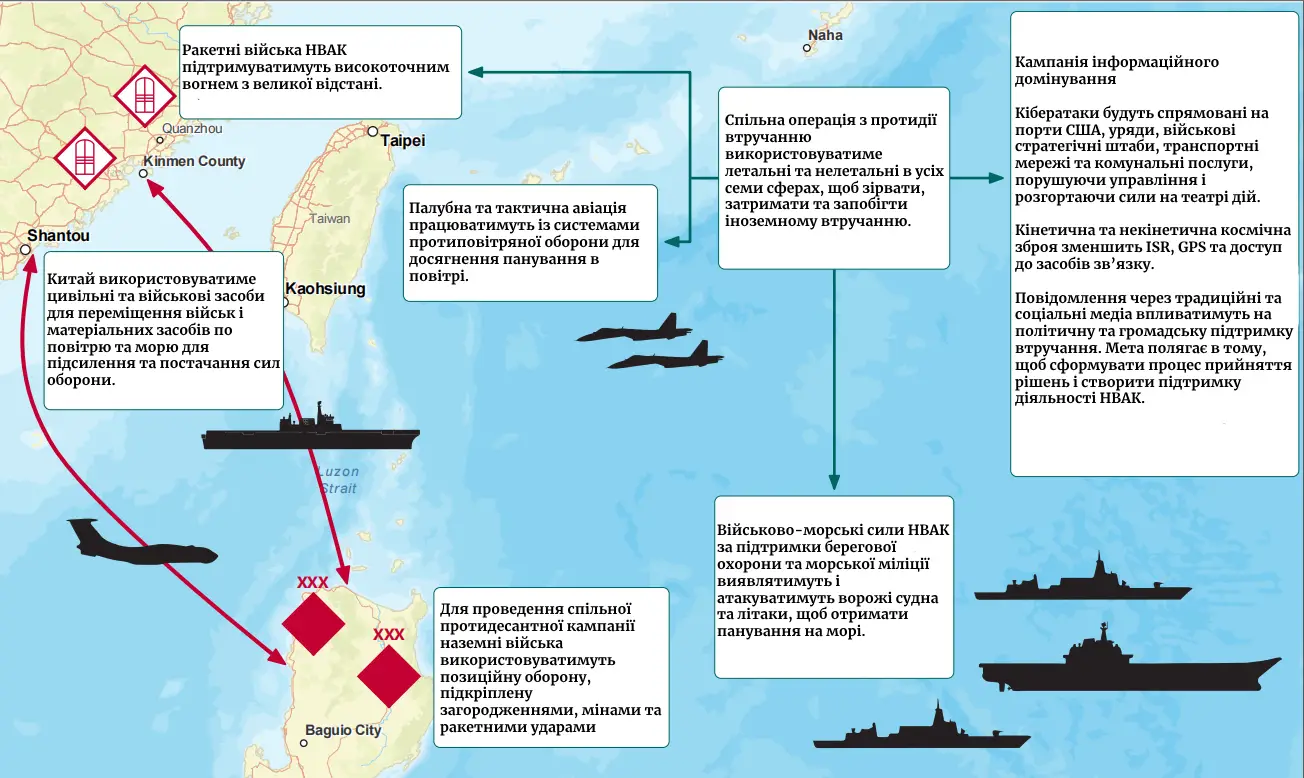
The joint antilanding campaign encompasses China’s strategy to secure and defend an island or coastal area against an attacking enemy. For this type of operation, ground units will be organized into groupings designed for specific tasks.
Likely groupings and tasks will include:
At the initial stage, the PLA will seek to prevent the enemy from reaching the coastline by exhausting them as much as possible before the landing. The focus will be on reconnaissance, strike aviation, coastal missile systems, and the submarine fleet.
During the positional defense phase, the key objective will be to contain the enemy immediately after the landing, while their combat formations are still disorganized. The PLA aims to target landing craft at sea or immediately after they reach the shore. Light infantry will be deployed in forward positions, while armored units will be held in reserve for counterattacks.
The counterattack will begin once the enemy’s landing is disrupted. A mobile task force will strike weakened enemy forces, conduct clearance operations, and create favorable conditions for subsequent operations. Coordination of fire strikes against critical targets will continue to support the maneuvers of mobile units.
The final phase of the campaign involves consolidating gains, which includes deploying reinforcements, replenishing resources, and preparing for potential offensives or repelling new attacks. Engineering and logistical units will be actively engaged to strengthen defensive positions.
China holds several advantages in conducting such operations. First, its geographic proximity to likely theaters of conflict, such as the First Island Chain, allows the PLA to shorten logistical routes. Second, China possesses the world’s largest naval fleet, which can significantly complicate enemy approaches to the coastline, while numerous coast guard vessels provide additional defensive capabilities. Air support from the air force and robust air defense further enhance the effectiveness of this concept.
Meanwhile, China faces serious challenges. In particular, rapid developments could leave little time to establish a full defense before third-party intervention.
Maintaining open maritime and air routes in a region where potential adversaries operate may prove extremely difficult.
This analysis is consistent with the findings outlined in TRADOC Pamphlet 525-92 and underscores the complexity of the contemporary multidomain operational environment in which the U.S. Army must operate. China exhibits a sophisticated level of integration across all military domains, including the information domain, and adopts a comprehensive approach to degrading critical enemy systems. Such dynamics necessitate a thorough understanding of China’s strategic objectives by the U.S. Army, as military operations in the Indo-Pacific region can no longer be effectively conceptualized solely through maritime or aerial frameworks.
Consequently, U.S. ground forces must be prepared to conduct operations in environments where dominance in a single domain does not guarantee success. Their role in shaping the regional security architecture and their capacity to execute large-scale joint operations remain indispensable both for deterrence and, if required, for decisive engagement in armed conflict.
Підтримати нас можна через:
Приват: 5169 3351 0164 7408 PayPal - [email protected] Стати нашим патроном за лінком ⬇
Subscribe to our newsletter
or on ours Telegram
Thank you!!
You are subscribed to our newsletter