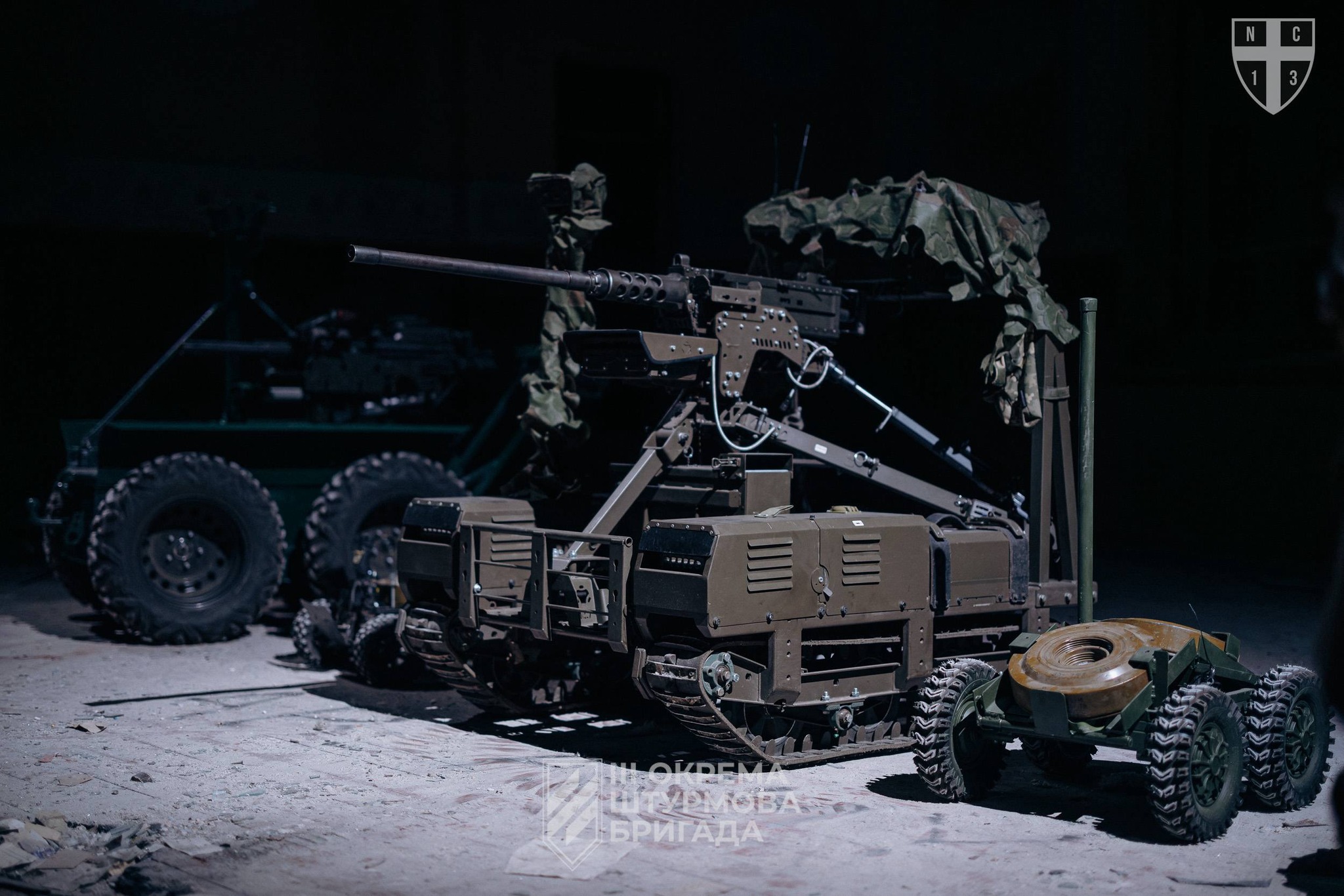

The battlefield is increasingly saturated with ground robotic systems, and over the past year they have actively taken over the logistics of the front line. But these are not all their possible niches, and we talked to the commander of the NC13 UGV company of the 3rd Assault Brigade, who goes by the callsign Makar.
In your previous interview with Militarnyi, you mentioned that not all manufacturers hear the frontline, hear feedback and process it. Has anything changed? Have new manufacturers emerged, those that are more, let’s say, based on military needs rather than building “something of their own”?
Let’s put it this way, the market for UGVs is growing significantly all the time. That is, every six months we see that from several to dozens of new UGVs appear on the market. These are new manufacturers who produce their own equipment for the front line. And we have to develop a certain interaction with each manufacturer, because not all manufacturers immediately realized that they need to communicate with the military first.
What I mean by the military is the crews that use ground robotic systems at the front. Yes, many people communicate with the General Staff there or with the command of individual brigades, with the command of individual battalions, but in fact, manufacturers need to communicate not even with platoon commanders of the UGVs, but with combat crews who use the equipment on the battlefield directly. Because they are the ones who will give the most accurate and honest feedback on the equipment.
At a certain period, there was such a gap between us and the manufacturers in this regard, and we decided to start building a direct line of communication.
We tried to do this separately with each manufacturer, it gave results, but not the results we wanted, so we decided to start organizing a number of public events. What we mean by public events is to gather UGV units from different brigades that use robots on the battlefield and bring together the manufacturers who produce them. And at such meetings, to build direct interaction and communication between all of us.
First and foremost, honest interaction, as each manufacturer will praise its product and talk about its advantages. In fact, combat units are more interested in the disadvantages and shortcomings of drones so that we can take them into account when performing certain combat missions. And when we know the shortcomings in advance, we can already think and focus on how to change them.
Notably, direct communication between us and the manufacturers makes it possible to quickly produce a much better, higher-quality product for the frontline. The manufacturer receives the right feedback, modernizes their product and, accordingly, in return, they get its active use at the front, and everyone benefits from this. The combat units benefit because their equipment breaks down less and is of higher quality, and the manufacturer receives more demand from the combat units.
This used to be more problematic. After certain events and public events like this, this communication has become much easier. Manufacturers are more willing to come to us for feedback, supply some of their products for free, especially some new developments for testing, development, and so on.
On our podcast, Oleksandr Yabchanka, head of the Robotic Systems Service of the Da Vinci Wolves battalion, and Maksym Vasylchenko, CEO of Tensor and head of the Ukrainian Association of Robotic Forces, discussed the big problem between when an order for a UGV is placed and when the drone reaches the unit directly. Does the communication between manufacturers and crews you mentioned reduce delivery time?
I can confirm that the current procedure slows down the processes, as in most cases the robot shipped by the manufacturer to the warehouse gets to the combat unit in four, five, six, seven, eight months. And our frontline is changing dynamically. The need for distances, capabilities, carrying capacity, and so on changes every two months. So this is a direct problem.
Is it possible to predict the need for UGV in advance?
We, as a combat unit, set certain requirements for the manufacturer, and I’ll give conditional rather than exact figures. For example, we need a UGV with a 100-km range, 400 kg of load capacity, a speed of 15-20 km/h and, for example, removable batteries. And the General Staff or whoever forms the need and tactical and technical characteristics for the manufacturers tells the manufacturer: “We need 15 km of range, 7 km of speed and, I don’t know, 200 kg of load capacity.”
When we set out the requirements for a manufacturer and give them tactical and technical specifications, we always give them a margin, i.e., looking ahead.
And when formulating the needs from the state, in most cases, tactical and technical characteristics are outdated even for the current format of the front, because, no matter how offensive or harsh it may sound, the top brass is far from the realities at the front.
And if the manufacturer listens to such requests, then they will make a robot with lowered performance for today’s needs and then deliver it to the warehouse, and by the time this robot reaches us, it is no longer relevant at all.
If the manufacturer listens to us and produces a vehicle with the tactical and technical characteristics we told him with a margin, then perhaps when it reaches us through all the supply chains, it will still be relevant, or will require minor upgrades.
But now we are actively trying to simplify all these mechanisms, to get the funds and supply them to the units. I think that in 2026 this problem will be, perhaps, not 100% solved, but up to 50% for sure.
This is if we talk about procurement by the state, by the Ministry of Defense of Ukraine.
If we talk about other types of procurement, such as volunteer funds or state administrations. Do they deliver faster?
Personally, I consider interaction with foundations or procurement of brigades or other types of procurement to be direct action.
But there are also many difficulties here, because in order for a foundation to buy for a brigade, the brigade has to find this foundation and negotiate with it. Or we, as a unit, have to find these volunteers ourselves and reach an agreement with them. This is more of an interaction to supply the unit directly.
But we have to make sure that the state provides us with at least 70% of the equipment we use.
Manual efforts are an extreme case, when we need to do something for yesterday, but we have nothing to do it with.
As for the lack of funds and many different manufacturers, what is the general understanding of the need for some unification of products, whether batteries, as you said, are replaceable or, for example, engines of the same model, communications, etc. Is unification possible for UGVs at all, or is there such a ‘zoo’ now that it is out of the question?
There is a ‘zoo.’ It is a fairly large one, because there are robots that are better suited for dry weather, some for rainy weather, some that drive in warm weather in summer, some that drive in cold weather in winter, in frost. There is a different purpose: logistics, strike, mining, demining, engineering. These are all different areas of the UGV, and it’s basically a ‘zoo’ that the units have to deal with, because one UGV unit has to work in several areas.
But little by little, steps are being taken towards some kind of unification. I think the closest unification will be in communications, as there are not many types of communications on the market that use ground-based robotic systems. And this is probably the easiest thing to unify at the moment, and, in principle, a certain number of manufacturers are already doing so.
I think the next step will be to unify some software and hardware.
After that, it will be about components: battery connectors, types of batteries, types of engines, I don’t know, types of wheels, hubs, chain systems. But I think this will be the most difficult process, because there are many manufacturers, their number is constantly increasing, and the more manufacturers there are, the more difficult it is to unify.
But if the state analyzes and communicates with combat units, takes into account their criteria, it will be easier to introduce this unification at the expense of the state, because it can all be standardized at the level of codification of means.
How complicated is the planning and implementation of certain of your operations on the UGV, for example, the previously mentioned POW capture by robot or the piloting of a ground drone with a machine gun? If we take a logistics task, it is one task for a UGV operator, but if, for example, a Mk.19, AGS-17 or Browning M2 carrier, you need to have the skills of a grenade launcher or machine gunner to use them effectively. How is this problem solved – at the level of software or additional training?
You’re right, in fact, the UGV has long since moved from a general concept to a direction. Earlier, when we talked about UGV, everyone thought about logistics exclusively, but now UGV is like the concept of UAVs. We have UAVs for reconnaissance, we have UAVs for strikes, we have UAVs for long-range strikes, and the issue of unmanned aerial vehicles is already a general area that is divided into types. Now, in the UGV, it all looks the same. UGV is already a direction and it is divided into types. And each type requires its own training and personnel training, depending on what it does. Logistics and evacuation is one thing. If we are talking about the striking direction, it is all different, because all the tasks in the striking UGV are absolutely unique. They are unique in terms of planning, application, and execution. If logistics means established routes, specific positions, steel, and so on, then strike missions are always different. Today we are working to eliminate a hiding place, tomorrow we are working on an ambush in the enemy’s rear to destroy their logistics, the day after tomorrow we are supporting assault operations, and a week later we are helping the infantry to defend their positions. These are all unique missions, unique tasks.
The tasks you listed are probably 1% of everything we have already implemented. We have a large number of successful tasks to support assault operations, to accompany assault groups, to provide support in defense, to destroy enemy shelters, to work on enemy logistics, and so on.
That is, we bring everything we try to apply to the system level. Is it difficult? Of course it is, any process in the military is not easy. And if we are talking about processes related to technology, they are even more difficult, because it is not easy to train a machine gunner, and it is even more difficult to train a machine gunner to work remotely on a turret that is filled with software that has its own nuances, pros and cons.
And when we talk about such things at the end of the fourth year of the war, let’s be honest, there is a problem with motivated people. Also, if we compare it with 2022 and 2023 years, it takes more time to train personnel, more extensive programs, but everything is possible and is being implemented.
It is important to understand that an operator of any direction, of any type, is a specialist in his or her own right. For example, at one panel discussion, an interesting phrase was heard that a UAV operator will never reach some extreme level. He will always grow and grow, because there is no end to professionalism. It’s the same in the UGV industry. Each operator is a specialist and a professional in his own right. And he needs to be developed, taught, trained and constantly acquire and increase his skills. War is constantly changing and we need to improve ourselves.
That is why the UGV does not replace people, because we still need people to manage them, maintain them, modernize them, and so on. But with the help of the UGV, we take people directly from the battlefield when performing certain tasks.
I believe that we can take up to 80% of the tasks away from an infantryman with the help of ground robotic systems. Many of them have already been taken away – logistics, evacuation, partly mining, demining. Now the task of my unit is to actively develop the area of strike UGVs in order to increase the ability to support infantry with fire on the battlefield and prevent them from engaging in fire fights, and send robots instead. Accordingly, by using the UGVs, we will save the lives of Ukrainian infantrymen and reduce the number of losses on the battlefield. I won’t say it’s easy, because it’s always hard to be the first to do something.
What is possible in the near future?
In 2026, we want to start with active offensive actions with the combined use of strike UGVs. And by saying this now, I’m probably setting myself some kind of starting point, because when you talk about it in public, you need to execute and show it. That is why we want to consolidate this systematically when we scale up.
In order to prove and show that robots can and should perform more tasks. And this will be an impetus for development at the state level, at the level of manufacturers, and for scaling up the use of strike UGVs in the Armed Forces of Ukraine.
You said system and scaling, and the question arises about this at the level of the brigade and corps itself, for example, the 125th Heavy Mechanized Brigade, where, in the recently published list of changes upon the arrival of the new command in the military unit, there is mention of the creation of a platoon of UGV.
If we are talking about scaling up the experience of using various UGVs within the 3rd Assault Brigade, then we already have our own UGV platoons in each of the battalions. These are mostly logistics evacuation platoons.
At the brigade level, we have two UGV companies. This is a logistics evacuation company called ‘Nova’ and a UGV strike company called ‘NC13,’ which I am currently leading.
All these processes would not have been possible if not for the active support of the brigade command and the commander of the 3rd Army Corps, Andrii Biletskyi. They actively help us, give us the opportunity to develop this as we see it and fully support our initiatives, realizing the importance of this area.
In general, the UGV in the brigade was Andrii Biletskyi’s initiative, which we have been actively developing and scaling up.
From the moment the corps was formed, we began to actively train units that will perform UGV tasks in corps brigades. In particular, you mentioned the 125th Heavy Mechanized Brigade. It’s no secret that the brigade’s command, the command of the former 1st Assault Battalion, the 3rd Assault Brigade, came there. And accordingly, the platoon commander of the UGV is currently a man, a fighter who has extensive infantry experience and extensive experience in the use of ground robotic systems in the 1st Assault Battalion of the 3rd Assault Brigade. That is, the commander of the UGV section is now a person who has a lot of knowledge and experience in the field of UGVs. And I think the platoon format is temporary, and later it will be scaled up to a company within the 125th Heavy Mechanized Brigade.
That is, we can say that the processes are scaled up by transferring fighters with experience from the 3rd Assault Brigade to command levels in the corps brigades to develop and build a system there that is similar to the one in the 3rd Assault Brigade.
The same can be said about the 53rd Mechanized Brigade named after Volodymyr Monomakh, which is part of the 3rd Army Corps. A commander who used to be in my command is now the commander of the UGV company at the brigade level. He is a young, talented guy who used to be a very effective assault pilot, and later was a good leader and commander in the field of UGV. And now he is building a brigade to scale up the experience he gained in our brigade. And we are actively helping with this.
We actively support and help the corps brigades in all matters related to the UGV. That is, we are trying to build a common ecosystem of ground robotic systems in the format of a corps.
Do you cooperate with units outside the corps?
Of course we do. Just recently, the 67th Mechanized Brigade was undergoing a training course with us. We have a company-level UGV institute where we conduct training lasting a month and a half to prepare personnel and train them in UGV areas.
And so many brigades are turning to us, sending their people, groups of their fighters who will be engaged in the field of UGVs.
We train them completely from scratch and later they return to their brigades as specialists who can build a quality unit there, and we provide constant assistance and support in this.
You mentioned active offensive operations in 2026 with the help of the UGV, does this mean that they are already taking place or have taken place?
We have already conducted the first offensive operations. This is not something new for us. Our goal is to scale it up. We want it to become a system involving one, two, or three robots rather than an isolated incident. We have already taken offensive actions using up to five robots acting simultaneously. But we want to bring this to a systemic level.
That is, when battalion commanders plan offensive operations, they should think not about how to accomplish these tasks with infantry, but rather from the perspective of: “We have a company of strike UGVs that can act and carry out offensive operations. Let them plan the actions of the robots that will go first before the infantry. And based on the results of the robots’ work, we will think about how we should proceed with the infantry after them.”
Because, as practice shows, in the task you mentioned with taking prisoners, our task was to prepare the area for further infantry offensive. That is, the task was to move in with robots and eliminate the hideouts. However, it turned out that we moved in, captured the enemy, and the infantry then took up positions within 15 minutes without a single shot being fired by the infantry or any losses on their part.
This shows that robots can change the course of events if they are used. And our goal is to use them in this format – metal goes first. And we cannot afford to act like the enemy, throwing people into meat assaults, whole platoons. We have to act reasonably, and the only thing that can save the frontline now is technology. This is, in fact, what we have been fighting with as much as possible over the past year.
And the winner is not the one who invented these technologies or figured out how to apply them, but the one who thinks about how to scale them and applies them on a large scale for long, so to speak, races.
Підтримати нас можна через:
Приват: 5169 3351 0164 7408 PayPal - [email protected] Стати нашим патроном за лінком ⬇
Subscribe to our newsletter
or on ours Telegram
Thank you!!
You are subscribed to our newsletter