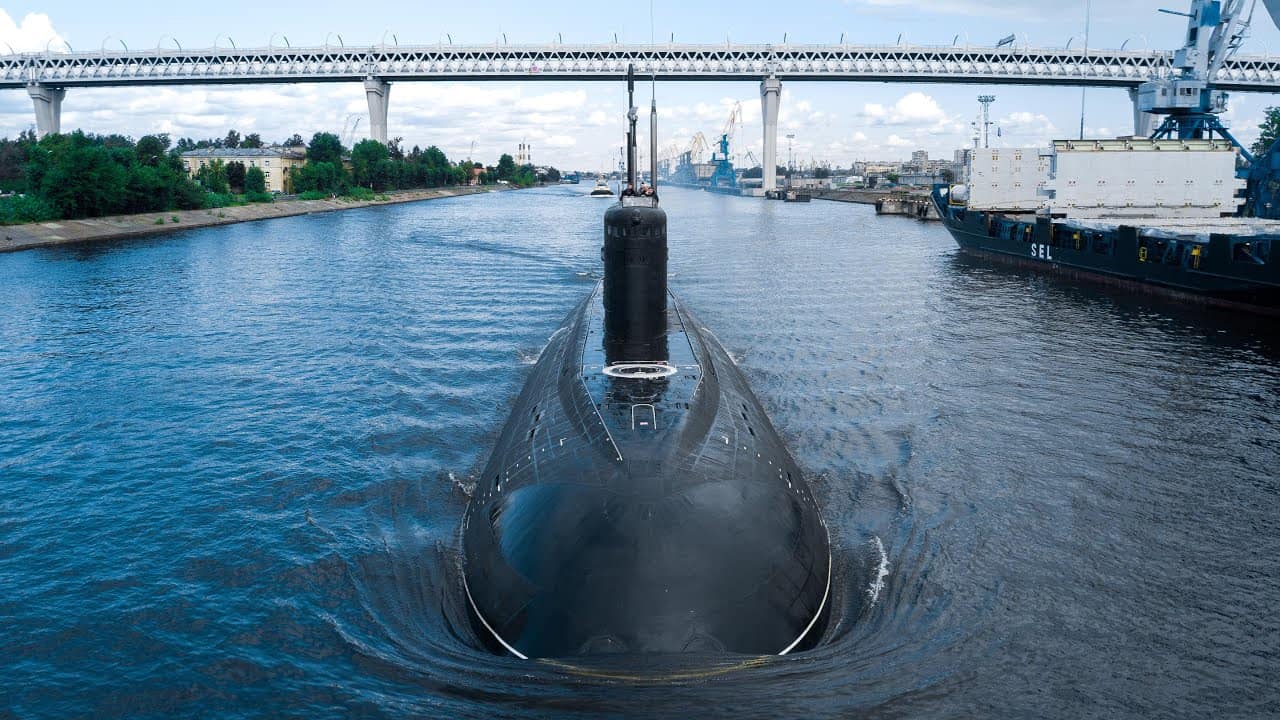


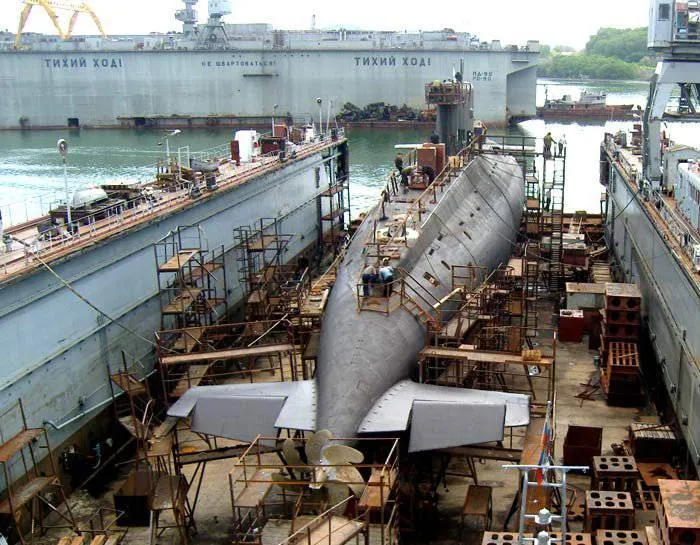
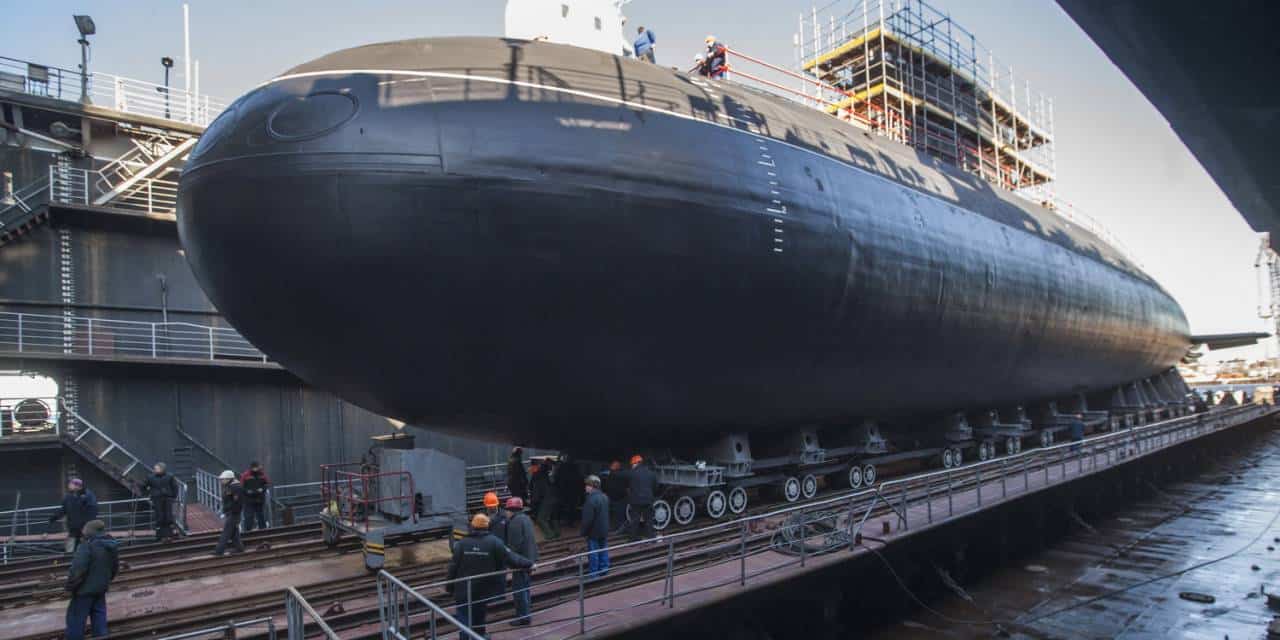

The Project 636 Varshavyanka (NATO classification: Improved Kilo-class) submarines are an export variant of the Project 877 Paltus (NATO classification: Kilo-class) submarines. The name “Varshavyanka” appeared in the 1970s, when it was planned to supply Kilo-class submarines to the Warsaw Pact countries, and later the Improved Kilo-class was also called that. It is designed to destroy surface ships and vessels, enemy submarines, patrol, watch, reconnaissance, and communications security in the “near” maritime zone.
Although the Varshavyanka started out as a simplified export submarine, due to constant delays and problems with the development of the next generation of Project 677 Lada (NATO classification: Lada-class) submarines, it has become the backbone of the Russian Federation’s fleet of diesel-electric submarines.
In the early 70s of the twentieth century, the design of diesel-electric submarines of the third postwar generation began, which were to significantly outperform and subsequently replace the large submarines of the 611, 641, and 641B projects. To increase the time spent underwater by such submarines in those years, work was carried out to equip them with air-independent power plants.
In 1971, the Sudoproekt Design Bureau (today OJSC TsKL Lazurit) designed the Project 947, a promising multipurpose submarine. It was supposed to be equipped with a combined power plant (CPP) consisting of a diesel-electric part and a hydrogen-oxygen electrochemical generator (ECHG). The work on the creation of the ECHG was severely delayed, so the submarine project was shut down.
Almost in parallel, the same organization was developing another project – in 1972, the MOZ advance project with a displacement of 1700-1800 tons was completed. Soon after, the Rubin shipyard was entrusted with the further development of the boat, whose project was assigned the number 877 and the code name “Varshavyanka”. On May 21, 1974, the tactical and technical specifications were approved. In January of the following year, Yuri Kormilitsyn was appointed chief designer of Project 877 (Kilo-class).
The technical design of the Kilo-class was approved on December 20, 1976. The ship’s displacement increased to 2300 tons. Construction was carried out at the Leninsky Komsomol shipyards in Komsomolsk-on-Amur and Krasnoe Sormovo in Gorky.
The main diesel-electric submarine (serial number 451) was launched at the Leninsky Komsomol shipyard on September 15, 1980. The boat entered the USSR Navy in December 1980, and was codenamed Kilo in NATO.
Based on Project 877, the Rubin Design Bureau developed several export variants: 877E, 877EK (“Export Capitalist”), which did not go into production, 877EKM (“Export Capitalist Modernized”), and 636. The first export boats of the Project 877E, built at the Krasnoe Sormovo shipyard, successfully passed state tests in 1985 and were handed over to the Polish (Orel) and Romanian (Dolphin) navies in 1986.
The Sindugosh (B-888) lead submarine of the Project 877EKM was built at the Leningrad Admiralty Association (LAO, now Admiralty Shipyards) and handed over to the Indian Navy in November 1985.
A total of 23 submarines of this type were built for the USSR and Russian navies and 20 for the ex-port.
The Project 636 submarine was codenamed Improved Kilo in NATO. Compared to the 877EKM, they have higher-powered diesel generators, a higher full underwater speed of up to 20 knots, and a significantly longer range in the mode using a device for operating the diesel engine underwater – an increase from 6,000 to 7,500 miles.
In addition, the installation of new equipment and improved depreciation systems made it possible to ensure a significantly lower level of internal noise of the modernized submarine.
Considerable attention was paid to creating special conditions for the commander and the submarine’s control service: all weapons and shipboard control equipment was concentrated in the main command post, isolated from other submarine offices and without through passages along the ship and vertically.
Other areas of modernization of the Improved Kilo-class submarine include equipping it with a newer and more powerful hydroacoustic complex, a combat information and control system (CICS), an inertial navigation complex, and installing a modern periscope with a night vision channel, TV channel and laser rangefinder, improvement of communications equipment with the installation of a towed VHF and microwave antenna, further improvement of the main power plant and the inclusion of a new battery with a 2.5 times longer service life while maintaining the same power.
An important advantage of the new submarine was the virtual absence of restrictions on operation due to physical and geographical conditions: the submarine is able to operate with high efficiency in all weather conditions in all areas of the world ocean – in Arctic and tropical waters, in shallow and deep waters, in coastal and far offshore areas.
At the same time, the submarine’s armament remained generally the same: six 533-mm bow torpedo tubes with a total of 18 torpedoes.
The developers also included a significant modernization reserve in the project, which subsequently allowed for the implementation of measures to improve tactical and technical characteristics and equipping with modernized or fundamentally new weapon systems or equipment, primarily the Kalibr integrated multipurpose missile system (Projects 636M and 636.3), during scheduled repairs or as part of modernization programs.
The first customer of Improved Kilo-class submarines was China: under the first contract in 1997-1998, the Chinese Navy received two large diesel-electric Improved Kilo-class submarines built at the St. Petersburg Admiralty Shipyards. The lead boat of Improved Kilo-class, B-466 (now Yuan Zhend 66 Hao of the Chinese Navy), was laid down under the factory number 01616 on June 16, 1996 and launched on April 26, 1997.
On May 3, 2002, Moscow and Beijing signed a contract for the construction of eight more submarines of the modernized Improved Kilo-class, which resulted in the Chinese submariners receiving eight boats of this type in 2004-2006. All submarines of the second Chinese order were initially equipped with the Kalibr missile system (export name Club-S).
After the completion of the Chinese contract, Russia signed an agreement with Algeria for the supply of two Improved Kilo-class diesel-electric submarines built at Admiralty Shipyards and handed over to the Algerian Navy in 2009-2010. On December 15, 2009, Russia and Vietnam signed a contract for the construction of six large diesel-electric submarines, codenamed Project 636.1.
The lead ship of this contract, HQ-182 Hanoi, was laid down on August 24, 2010, launched on August 28, 2012, and delivered to the customer country at the end of 2013; it officially entered the Vietnamese Navy on January 15, 2014. The last of the six boats of the Vietnamese order was delivered to Vietnam on January 20, 2017, and was commissioned on February 28, 2017.
In 2014, Russia and Algeria signed a new contract for the supply of two more Improved Kilo-class submarines with newer shipboard life support and fire and explosion protection systems (compartment pressure relief and nitrogen fire extinguishing systems) and higher computerization.
The lead ship under this order, number 01346, was laid down on March 14, 2017; it was named 031 Ouarsenis and entered the Algerian Navy in 2019. The second submarine of this order, laid down in 2016, was named 032 Hoggar and entered the customer’s fleet on the same day as the first.
In total, 20 submarines of this type of submarine of various modifications (636, 636M, and 636.1) were built for export.
The Russian Navy initially planned to replace its Kilo-class submarines built in the 1980s with Lada-class submarines. However, due to numerous problems with their design, construction, and testing, it was decided to build a series of submarines for the Russian fleet based on the Project 636, the production of which had already been mastered by Russian shipyards through export contracts.
The first produced Lada, the Kronstadt, officially joined the Russian Navy only in January 2024, 19 years after the start of construction.
The Improved Kilo II-class (Project 636.3) was developed at the Rubin Central Design Bureau of Marine Engineering (St. Petersburg) by a team led by Chief Designer Igor Molchanov. The submarines are being built at the St. Petersburg shipyard Admiralty Shipyards.
The Russian Ministry of Defense signed the contract for the construction of the Improved Kilo II-class lead submarine with the United Shipbuilding Corporation in August 2010. In September 2011, a contract was signed for the construction of the remaining five submarines; all six ships were intended for the Black Sea Fleet (B-261 Novorossiysk, B-237 Rostov-on-Don, B-262 Stary Oskol, B-265 Krasnodar, B-268 Veliky Novgorod, B-271 Kolpino).
On January 16, 2016, the head of the Russian Navy’s shipbuilding department, Captain 1st Class Vladimir Tryapichnikov, said on the air of the Russian News Service that six more submarines of the Improved Kilo II-class would be built for the Pacific Fleet (B-274 Petropavlovsk-Kamchatsky, B-603 Volkhov, B-602 Magadan, B-588 Ufa, B-608 Mozhaisk, B-610 Yakutsk).
The contract was signed on September 7, 2016, as part of the Army-2016 forum. The first ship was scheduled to be laid down in the fall of 2017, and the completion of this batch was expected in 2021. In fact, the last submarine (B-610 Yakutsk) under this contract was launched in the fall of 2024.
There are also plans to lay down four more submarines of this type – Petrozavodsk, Mariupol, Kemerovo, and Lipetsk.
Brief technical specifications
Technical capabilities of Improved Kilo II-class
Submarines of this type being built for the Russian Navy have been modernized compared to the Improved Kilo-class: they have received modern missile and torpedo weapons, radio electronics, and hydroacoustics systems.
The Improved Kilo II-class (Project 636.3) has a double-hulled, single-shafted and single-rotor design and is designed to destroy enemy surface vessels, submarines, patrol, watch, reconnaissance and communications protection in the “near” maritime zone.
The inner hull, made of AK-25 steel, is divided into six watertight compartments, which provides the ship with increased survivability – the boat is able to stay afloat in case one of the compartments is flooded. The thickness of the inner strong hull reaches 24-27 mm, and in some reinforced areas – 30-35 mm.
The outer lightweight hull has a streamlined shape adapted to reduce hydrodynamic drag and noise. The horizontal bow rudders are designed to be retractable into the hull. A special anti-hydroacoustic coating is applied to the hull, and shock-absorbing platforms and other sound-absorbing technologies are widely used in the mechanisms, which ensures high acoustic concealment. Externally, the Improved Kilo-class boats differ from the previous Kilo-class submarines in the shape of the aft superstructure.
The submarine’s power plant operates on the principle of full electric propulsion. It consists of two 30DG diesel generators with a capacity of 1500 kW each, which can operate in the diesel underwater mode, a main propulsion motor PG165 with a capacity of 5500 hp, a 190 hp economical running motor PG166 and two reserve electric motors PG168 with a capacity of 102 hp each.
The propeller shaft rotates on wooden guides made of pockholz wood. The natural lubricant released by pockholz wood allows this technology to ensure the service life of the main shaft is up to 20 years.
The modernization of the power unit, including the installation of more powerful diesel generators and larger batteries, made it possible to reduce the battery charging time and increase the range of submarine operations.
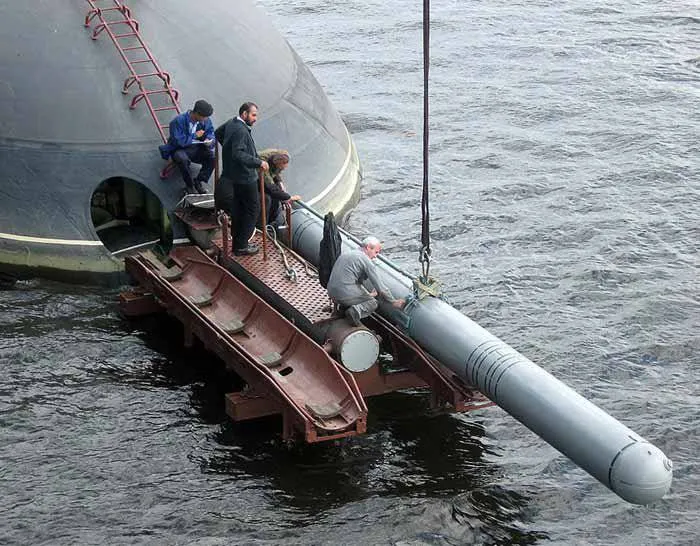
The Improved Kilo-class submarines are armed with six 533-mm torpedo tubes with a munition capacity of 18 torpedoes (heavy torpedoes of the UGST, 53-65, and USET-80K types) or 24 mines (AM-1 mines, deployable at a depth of 50 m) with automatic reloading.
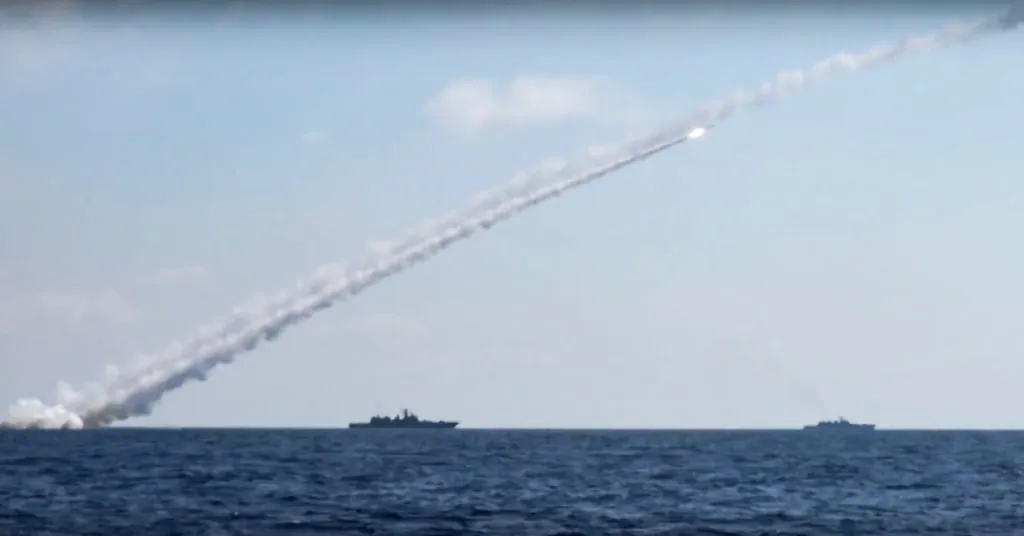
Submarines of the modernized Improved Kilo II-class for the Russian Navy are equipped with a complex of Kalibr-PL cruise missiles capable of hitting targets at a range of over 2000 km. The weight of the 3M14 missile warhead is 500 kg. The export version of the missile system has a range of up to 300 km.
It is believed that the Improved Kilo II-class submarine is capable of firing up to four 3M14 cruise missiles in a single salvo, at short intervals. In addition, it is also armed with 3M54 anti-ship missiles, and the total ammunition can be up to eight missiles.
It is possible to use Igla-1 and Verba man-portable air defense systems, with an ammunition capacity of 8 SAMs.
As part of the modernization to the Improved Kilo II-class, the boats received updated systems: instead of the PZNG-8M periscope, the Parus-98KP optoelectronic mast was installed, the MGK-400 Rubicon hydroacoustic complex was replaced by the newer MGK-400V1, the Andoga navigation system was replaced by the Apasionata-KM, and the MVU-110 Uzel combat information and control system was replaced by the Lama-KM. Other innovations include lead-acid batteries, sound-absorbing coating of the outer hull, and the Paladi-M shipboard systems control panel.
The submarine’s sensor system provides detection of submarines and surface targets in passive listening mode, active echolocation detection in the sector of ±30° relative to the target bearing, telephone and telegraph communication in long-range and short-range modes, as well as detection of underwater sound signals and determination of their direction.
The MRK-50 Albatross radar station operates in periscope and surface modes and provides information on the underwater and air situation, radar identification and navigation safety.
The boats were also equipped with new computerized systems and life support systems, including a compartmental pressure relief system and a nitrogen fire extinguishing system.
In terms of the duration of submersion without the use of a snorkel, which does not exceed three days, the Improved Kilo-class diesel-electric submarines are significantly inferior to modern non-nuclear submarines with air-independent main propulsion systems in service with the navies of Germany, France, Spain, Sweden, and Japan.
On December 8, 2015, during the Russian Armed Forces’ operation in Syria, the B-237 Rostov-on-Don submarine, which was in the eastern part of the Mediterranean Sea, launched Kalibr-PL missiles at targets in the Syrian province of Raqqa. This was the first time in the history of the Russian Navy’s submarine fleet that a missile strike was launched against a real enemy.
Thereafter, Russia regularly launched missile strikes against Syrian rebels, ISIS, and Kurdish forces until September 2017, using both surface ships and submarines from the Mediterranean and Caspian Seas.
During Russia’s full-scale invasion of Ukraine in early 2022, submarines of this type were regularly used to strike Ukraine. Until September 2023, they, like the rest of the Russian Black Sea Fleet, were based mainly in Crimea, from where they went to sea to launch missile strikes.
But after a successful Ukrainian campaign to strike the Russian fleet in Crimea with surface drones, UAVs, and cruise missiles, they were forced to relocate to Novorossiysk. However, as of 2025, even there, Russian ships can no longer feel safe.
In the course of the Russian-Ukrainian war, Russia has lost two submarines of this type. The first, the B-237 Rostov-on-Don, was struck by the Ukrainian Defense Forces with several direct hits from Storm Shadow cruise missiles in September 2023 in Sevastopol.
Despite Russian statements about their intentions to “restore the damaged submarine,” the nature of the damage indicates, if not the complete destruction of this submarine, then the need for major repairs, the cost of which will be comparable to building a new one.
The second submarine, the B-271 Kolpino, was hit by the SSU in December 2025 in the port of Novorossiysk using a Sub Sea Baby underwater drone. The drone hit near the stern of the submarine, where the rudder and vertical rudders, the stern horizontal rudder, and the propeller are located.
The exact extent of the damage to the second submarine remains unknown, but the fact that it was the only one that was not redeployed after the attack refutes the Russian Ministry of Defense’s claims that the submarine was not damaged.
Підтримати нас можна через:
Приват: 5169 3351 0164 7408 PayPal - [email protected] Стати нашим патроном за лінком ⬇
Subscribe to our newsletter
or on ours Telegram
Thank you!!
You are subscribed to our newsletter