AI Assistant for the Military: Interview with the NeoLens Team – Ostap Korkuna and Volodymyr Hera

AI Assistant for the Military: Interview with the NeoLens Team – Ostap Korkuna and Volodymyr Hera

Mykhailo Liuksikov

Mykhailo Liuksikov

April 1, 2026
16:17
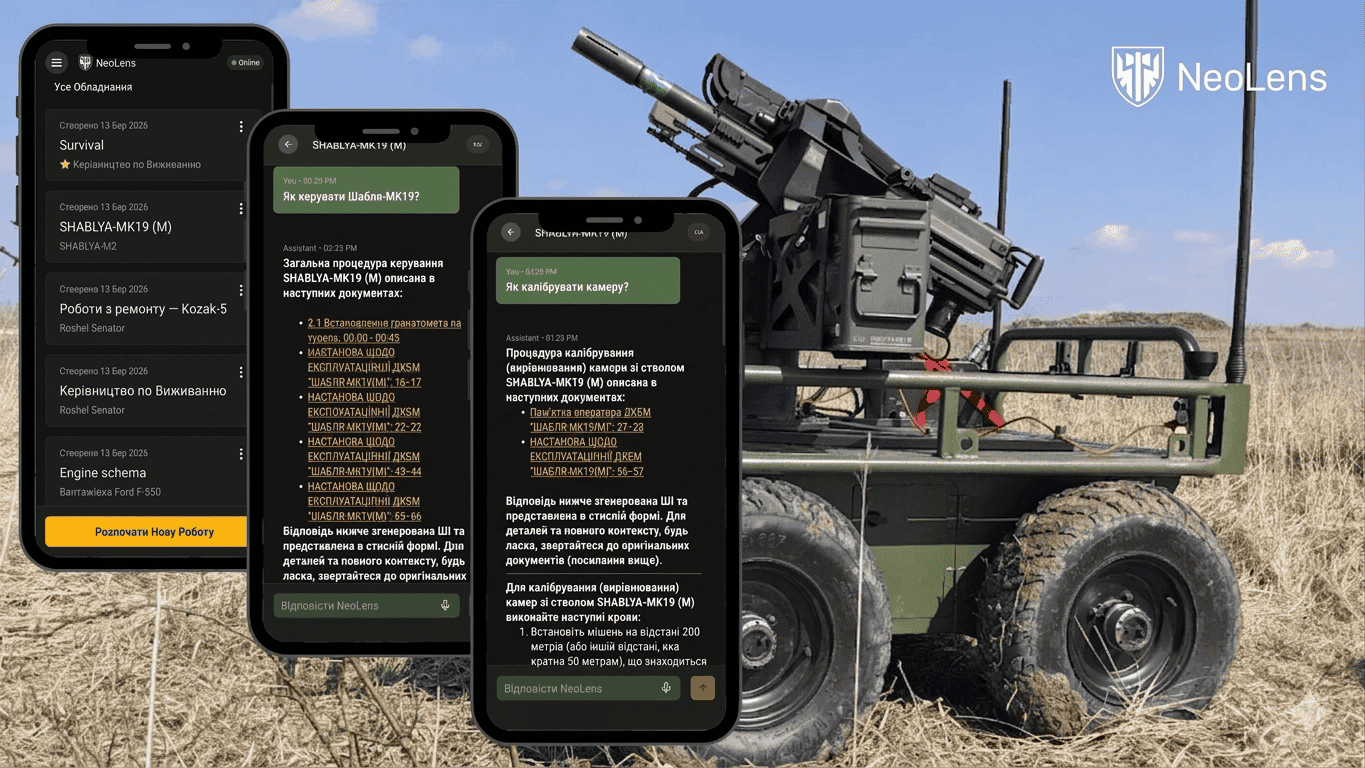
NeoLens working with "Shablya" modules for UGV Collage from the service's LinkedIn page (translated into English by Gemini)

AI Assistant for the Military: Interview with the NeoLens Team – Ostap Korkuna and Volodymyr Hera

Mykhailo Liuksikov

Mykhailo Liuksikov

April 1, 2026
16:17
NeoLens working with "Shablya" modules for UGV Collage from the service's LinkedIn page (translated into English by Gemini)

Technological advancement in warfare has always gone hand in hand with overall progress. Today, as drones play an increasingly important role on the battlefield, artificial intelligence is also becoming a key factor.

In Ukraine, one of the ways AI is being applied is to support the maintenance and servicing of military equipment and weapons through the NeoLens app. The app already offers additional features beyond this. Ukrainian military personnel can access it for free at: https://ukraine.neolens.ai/

Militarnyi spoke with the app’s founders, who provided more detailed insights into how this AI assistant works.

What motivated you to work on this, and how did the development begin?

Ostap Korkuna (O.K.): I’m one of the co-founders of NeoLens. We started the project together with James Liao, whom I met at Stanford when I was studying at the business school there last year.

James is a former U.S. military serviceman. During his career, he gained extensive experience with various types of equipment. In particular, he served in one of the first Stryker brigades in Iraq and had firsthand experience with the challenges of equipment breaking down in harsh conditions.

When we met at Stanford, James was thinking a lot about what is happening in Ukraine with all the equipment supplied by the United States and other countries. Since much of it is not new, it inevitably breaks down. The key question was whether Ukraine has the necessary expertise, and whether there is enough time to train people to repair it.

We starte researching this issue back in 2025 while studying at Stanford, speaking with both Ukrainian and American military personnel, including those who supported Ukrainians at assistance and coordination centers in Poland. It quickly became clear that the problem was real: there is a shortage of expertise specifically in repairing foreign-made equipment, and there is virtually no time for training. That’s when we started developing a solution to help operators and mechanics diagnose and repair heavy equipment, primarily of foreign origin.

As a company, we officially launched in the summer of 2025. Our first product was an assistant for the Humvee, which was well received by operators and mechanics. We were supported by well-known experts in the field of logistics, which helped us launch the product and continue growing.

Later, we added support for the M113, followed by the M109 self-propelled howitzer. More recently, we have been diving deeper into the complexities of maintaining various robotic ground systems and turrets, and began working with the company ROBONEERS, which manufactures them.

We have also taken on drones that require maintenance – both bomber and reconnaissance UAVs demand specific skills in operation, handling, and repair.

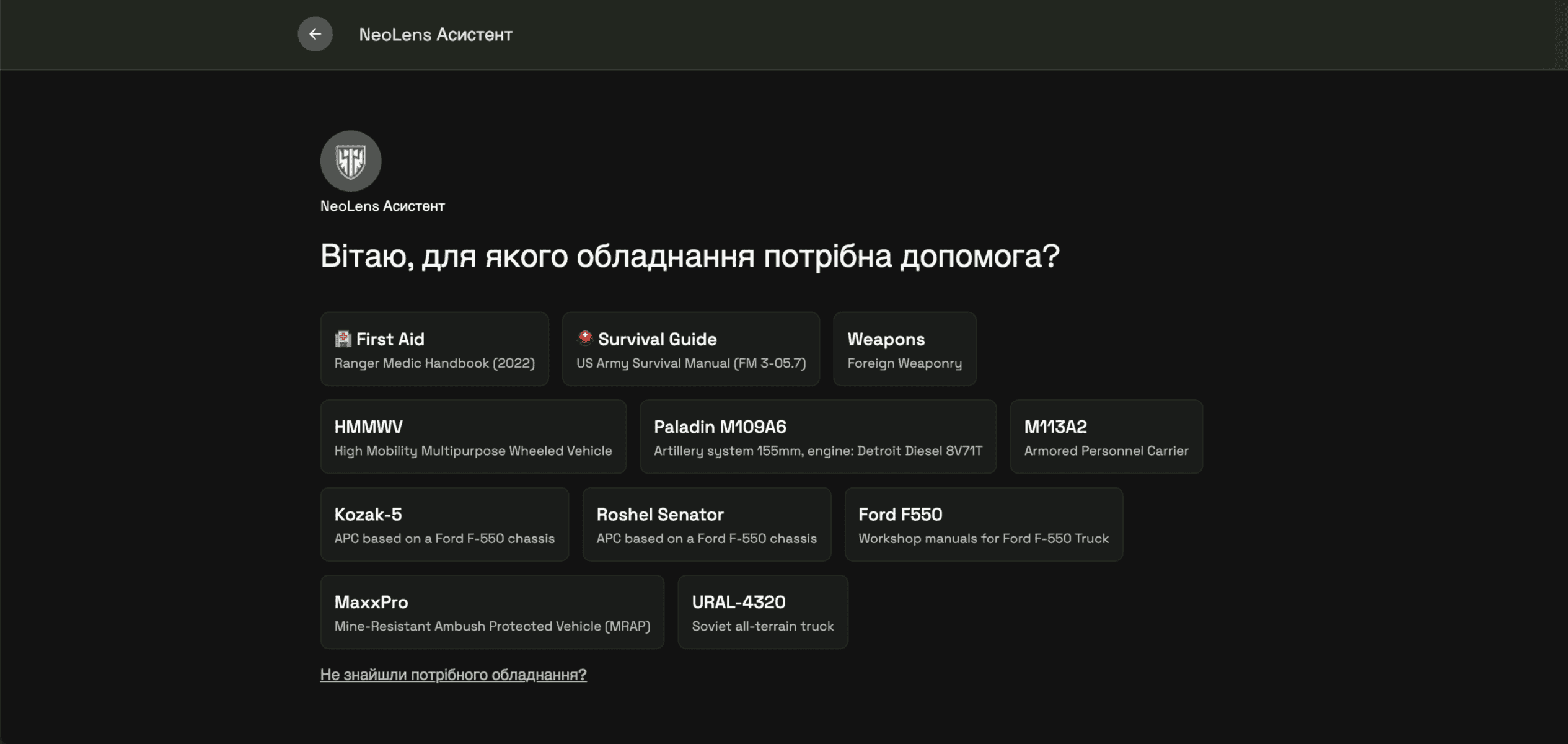
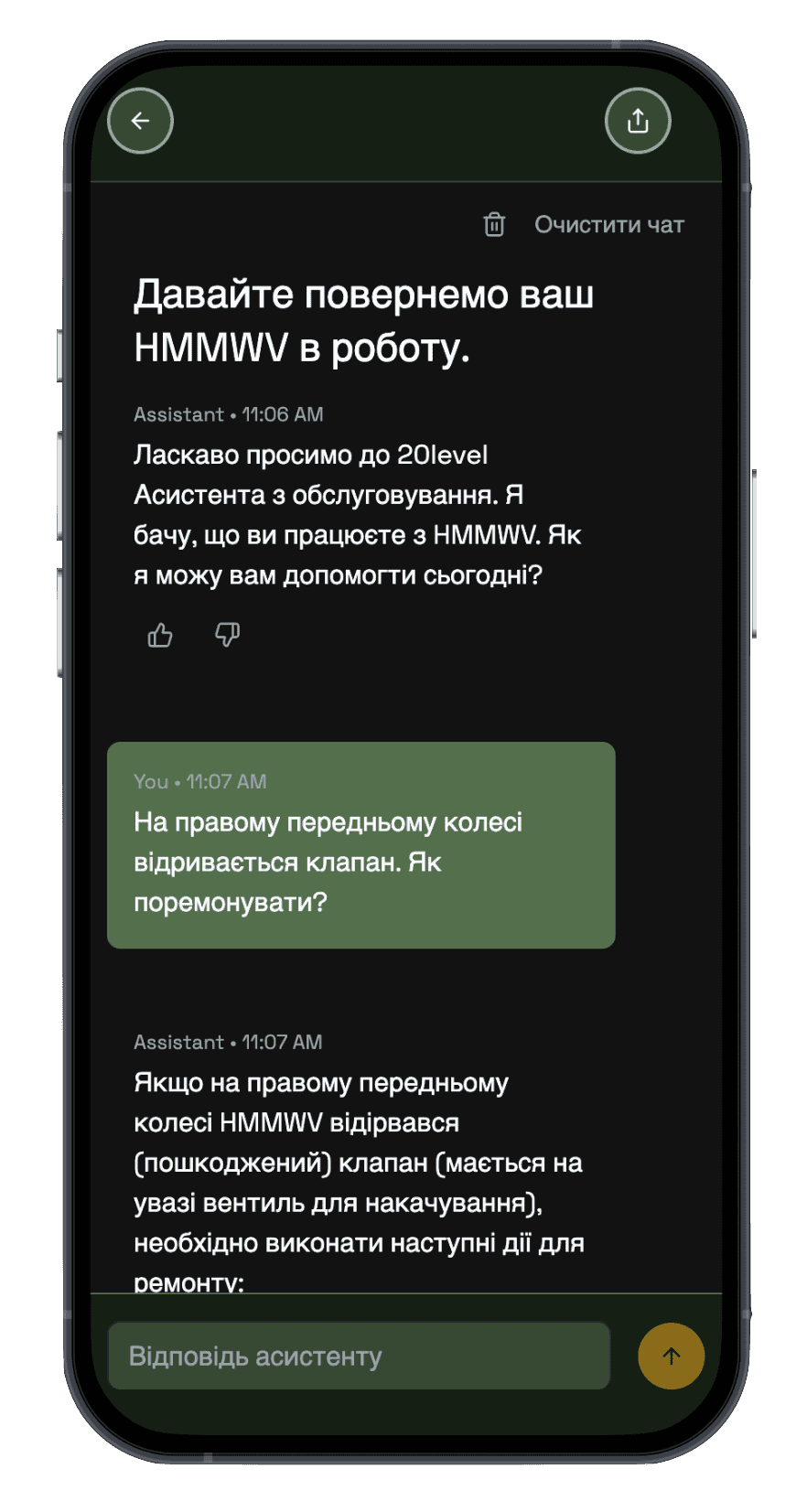
Базова сторінка сервісу NeoLens

Volodymyr Hera (V.H.): Let me highlight an important point – NeoLens also helps overcome the language barrier. These manuals are highly technical and difficult to read. Even someone with an intermediate level of English can struggle, especially given their size – not 20 pages, but 300 or more. For example, the M109 self-propelled howitzer has four to five volumes, each about 1,000 pages long.

On top of that, American manuals rely heavily on abbreviations and acronyms. They’re explained at the beginning, but later entire sentences can be made up almost entirely of them. If you try to translate a term like “crankshaft journal” using Google Translate, you could end up with something completely incorrect, like “cervix.”

You mentioned that you already have an assistant for servicing ROBONEERS products – could you elaborate?

V.H.: We connected with ROBONEERS at a conference organized by Brave1 in Lviv. For them, NeoLens saves a significant amount of time on simple support requests. For example, a user might miss a button or enter data incorrectly. The issue is minor and can be resolved in seconds, but without NeoLens it would require a phone call and involvement of a specialist.

Another key advantage is that the AI can handle imperfect questions. Even if a question is only partially correct or uses the wrong terms, the system still understands the context and provides an accurate answer. A user doesn’t need to know the exact technical terminology – the assistant can interpret the intent and respond correctly.

Ostap Korkuna (O.K.): Another important point is why we chose to work on this problem and how we see the future of the app. When we spoke with American military personnel, we realized that in the future, the amount of equipment assigned to a single operator will increase. One service member will need to manage a large number of drones, robots, and other systems.

The traditional model, where a soldier operates one vehicle and one weapon, is becoming outdated. Processing all this information and incorporating it into training creates a heavy burden for one person. Artificial intelligence can solve this problem by reducing the imbalance between the number of personnel and the amount of equipment they have to manage.

You refer to it as an “app,” although the demo version is a web interface. Is there a smartphone version?

O.K.: We sometimes call it an app because it’s a web application. All users in Ukraine currently work with the web version – that’s where we started, as it allowed us to deliver a solution quickly. You simply open it in a browser, log in, and immediately get access to the chatbot. Installing a separate app can slow things down and make access more complicated.

We’ve always had a mobile app, but it remained in demo mode because we focused on adding new equipment and improving the web experience. Right now, about 1,700 users in Ukraine are using the platform.

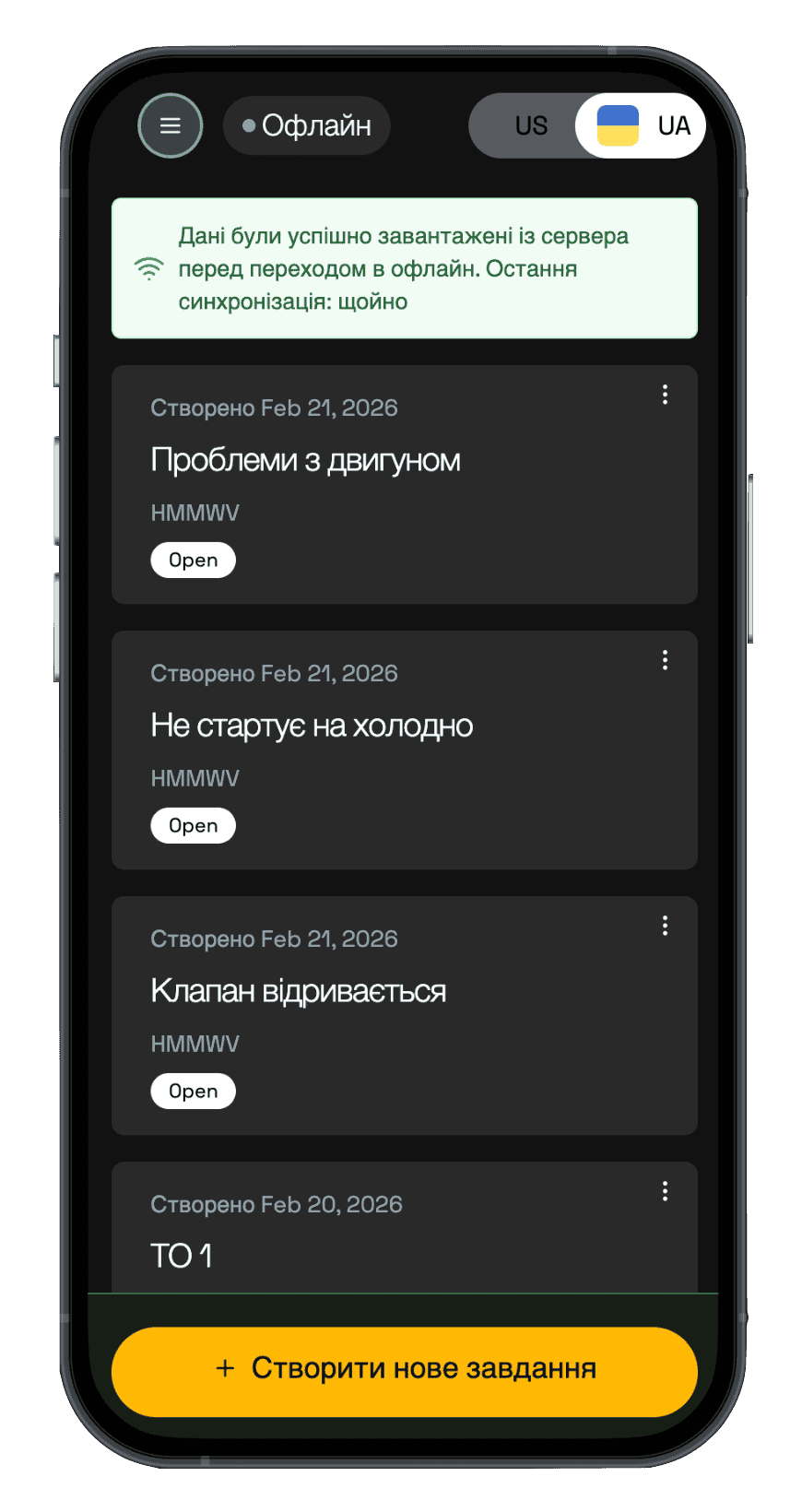
That said, we do plan to release the mobile app soon, as it is essential for offline functionality. This is one of NeoLens’s key advantages – the system can work offline, but that requires installing the app. A demo version already exists; we just prioritized development and held off on releasing it until it’s fully ready for everyday use.

What is needed to access the full version? I’ve explored the functionality and see a version with a limited set of equipment.

Ostap Korkuna (O.K.): I wouldn’t call it a “demo” – it’s more accurate to say there are public and restricted versions. The app has access control, so only verified users can access certain assistants and documentation.

When you register, you immediately get full access to the AI assistant, but only for the equipment whose documentation is publicly available: Humvee, M113, Kozak, Roshel. Additionally, the weaponry assistant and the survival assistant are available right away.

Access to artillery systems – like the M109 -or to the ground robotic systems from Roboneers is not available immediately.

V.H.: Access to Roboneers’ ground robotic systems is managed directly through the company. They have a separate registration process for their users and even attach aluminum plates with QR codes to their robots that link straight to the NeoLens app.

For the M109 self-propelled howitzer, verification is handled through me and my military contacts. Within two or three connections, you can reach someone and confirm that they actually serve in the division equipped with these artillery systems.

We also tried to partner with “Armiya+,” but they are currently overloaded. Integration with them would make access much easier for users. U.S. manuals explicitly state that the documents are only available to Ukrainian military personnel on Ukrainian soil, so we must verify users manually to comply with both U.S. and Ukrainian laws.

Question: The AI assistant is trained on manuals. Can it continue learning from user queries? And how do you prevent hallucinations?

O.K.: That’s an excellent question. We worked very closely with Ihor Simutin, one of the top Humvee specialists in Ukraine, if not worldwide. The first version of the assistant was based entirely on U.S. manuals, structured into three levels: operator, mechanic, and repair depot. But we quickly realized that some information in the original manuals was not only incomplete but sometimes inaccurate.

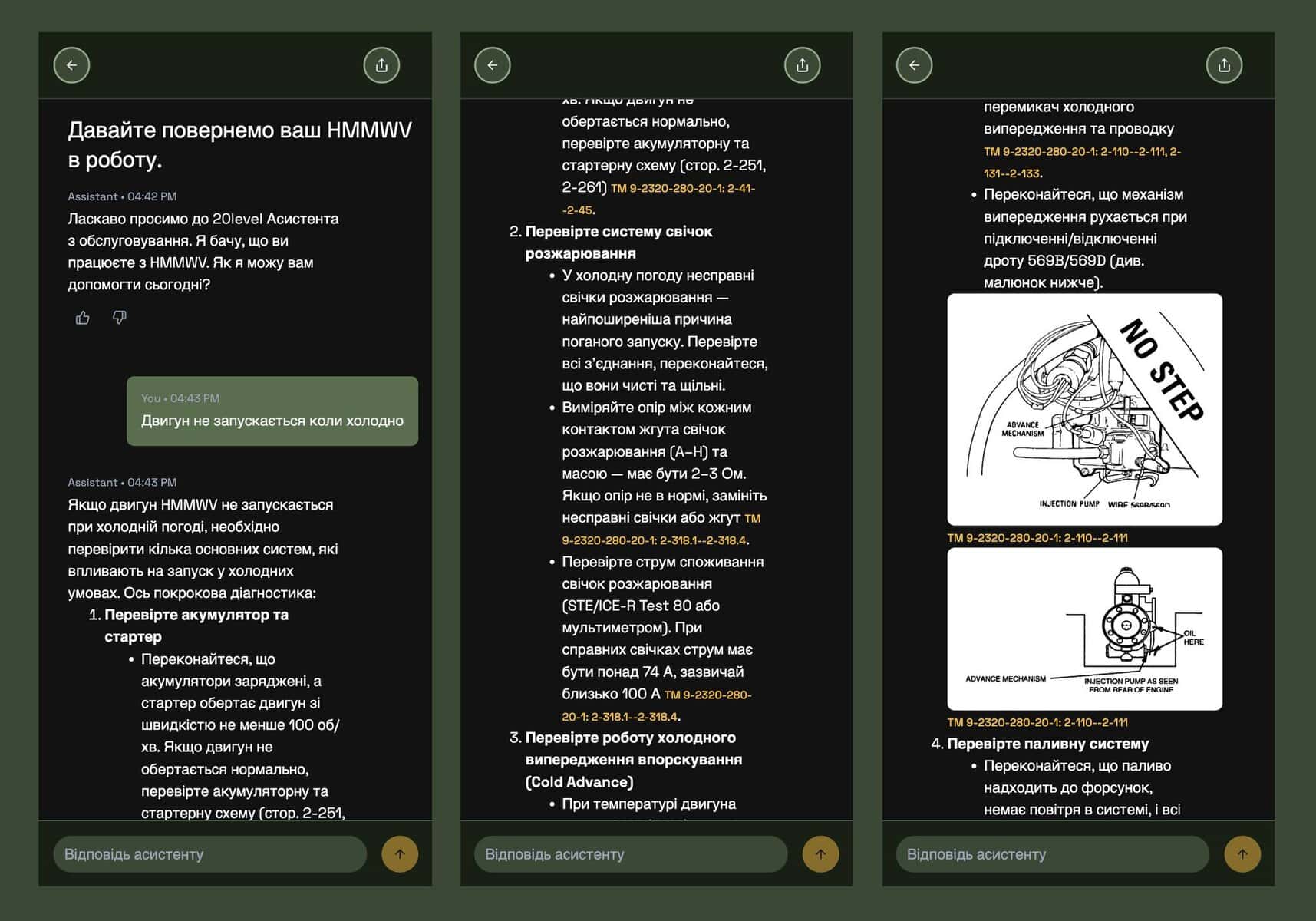
Додаток NeoLens в роботі

Regarding the architecture: the assistant draws information exclusively from a knowledge base composed only of approved documents. This prevents “hallucinations,” so when the assistant doesn’t have information about a particular malfunction, it honestly responds: “I don’t know, I don’t have this information.” It won’t make anything up.

To fill in gaps, in addition to official documentation, we added all the videos that Mr. Ihor published on his channel. These cover the specifics of using the Humvee in Ukrainian combat conditions that are not included in official manuals. Now the assistant can answer more questions than a regular manual. Moreover, it can process not just documents but videos as well.

V.H.: There’s a great example – one user deliberately asked the Kozak thread how to repair a Volkswagen Passat, trying to “trick” the assistant. The conversation ended quickly with: “I don’t have instructions for a Volkswagen Passat.” The system didn’t crash.

O.K.: As for learning from user input, we need to be very careful. We don’t want incorrect information entering the system, whether by accident or intentionally. We can analyze interactions with the app to improve response quality, but training on incorrect data is strictly prohibited.

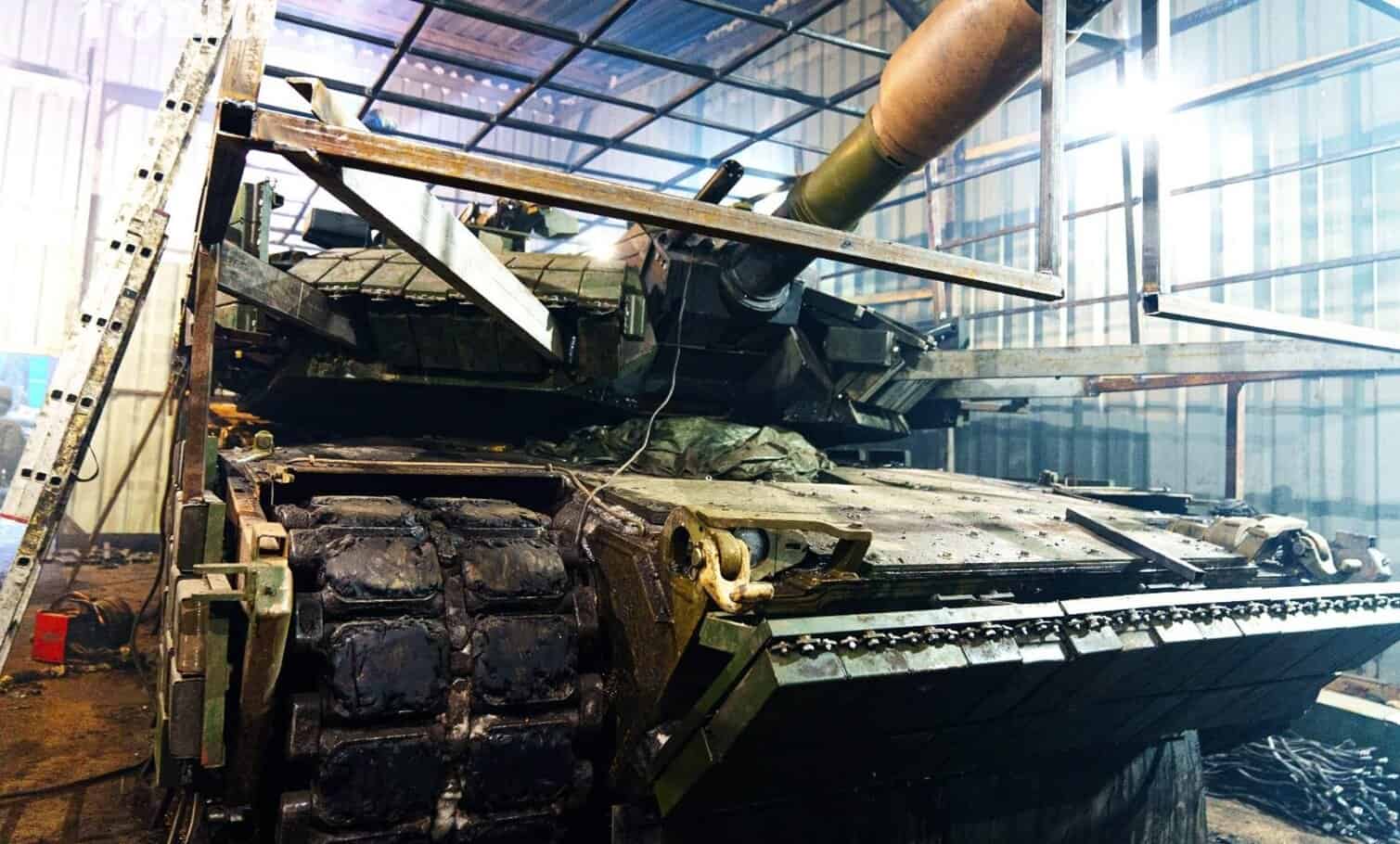
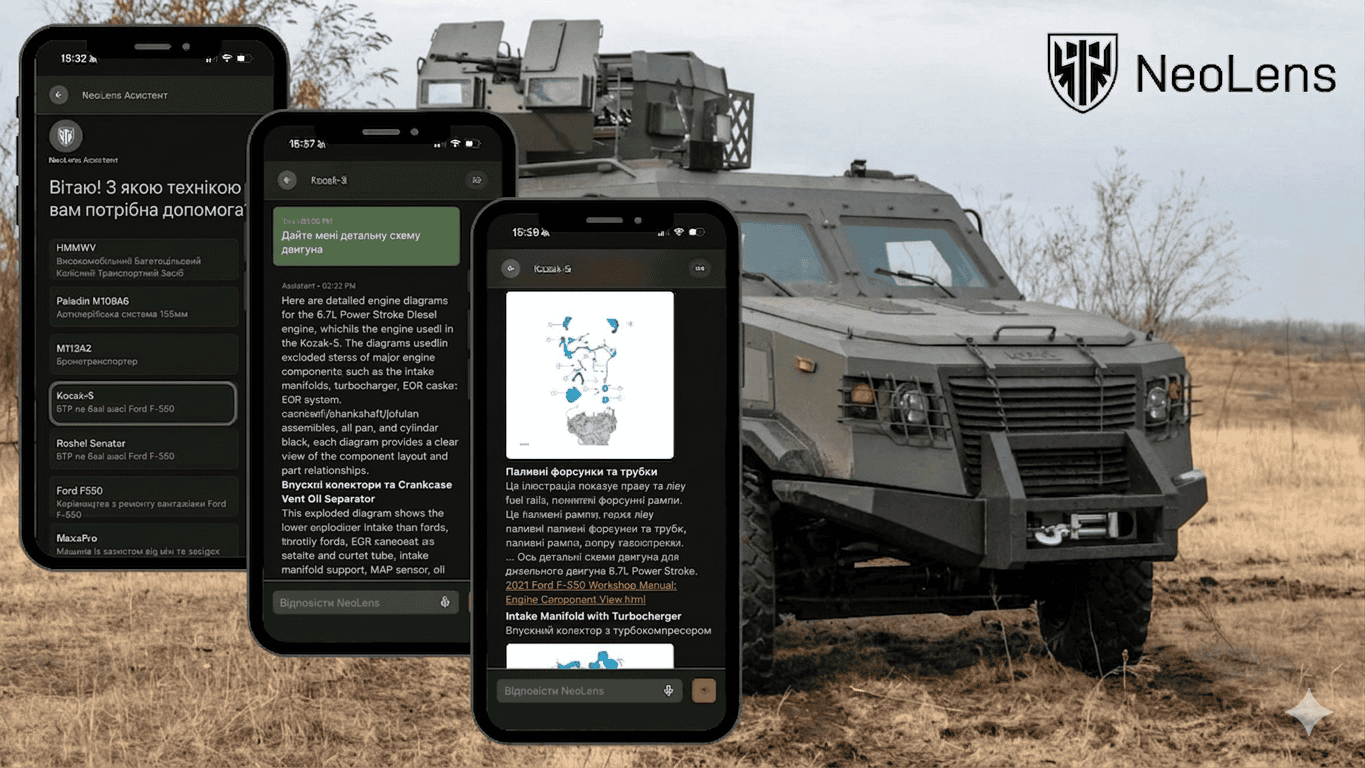
NeoLens в роботі з бронемашиною Козак-5

Question: Do you plan to expand partnerships with manufacturers of robotic systems and UAVs?

O.K.: We are in talks with most of the major drone and robotic ground system manufacturers. Ideally, a service member should have a single solution for all maintenance and repair tasks. They could open NeoLens and find instructions for any piece of equipment. All the manufacturers we’ve spoken to, those with hundreds or thousands of units already at the front, confirm that answering questions, training, and technical support is a major pain point. It consumes a huge amount of resources for relatively simple queries. We can help free up that time so they can focus on production.

We won’t replace live support 100%, but a very large number of questions don’t require human involvement at all, and even less so an internet connection. Our aim is to provide answers within 5–10 seconds, without calls and without needing the internet.

V.H.: Meanwhile, we already have a survival assistant trained on ranger manuals – James is very proud of this. There’s also a weapons assistant. It’s important to emphasize the psychological aspect: an experienced soldier doesn’t need to ask how to use a Browning. But there are people who have just been mobilized, and they may feel embarrassed to ask simple questions for fear of judgment, for example, how to remove a safety. With the assistant, they can ask “as if in confession” – nobody else will know, and it will answer politely.

Question: What does a manufacturer need to do to connect their equipment to NeoLens?

O.K.: First and foremost, they need to contact us. Then we need their documentation, but it can be in various formats. The manufacturer doesn’t have to write step-by-step instructions for every procedure. Our AI can synthesize them independently, using information about the device’s functionality and construction. If there are contradictions across documents, the AI will detect them and present both options. Video tutorials work as well. Essentially, any content the manufacturer has, we can process.

In the future, our goal is for the technical documentation about a product and how it works to be enough to generate any repair or diagnostic instructions. Handwritten manuals could then become a thing of the past.

We see NeoLens’s mission extending beyond the military into civilian applications. Similar AI assistants are already used in IT and on large manufacturers’ websites – for example, Ford has such an assistant for its manuals. But honestly, it doesn’t understand context very well: it just delivers a set of PDF files that are poorly linked. So the need for better solutions exists even for giants like Ford.

Question: What about Soviet-era equipment?

V.H.: Adding Ukrainian or Soviet-made equipment is more about priority than technical limits. We initially focused on foreign equipment because of language barriers and lack of proper training for soldiers. Technically, there’s nothing stopping us from including Ukrainian or Soviet machines.

O.K.: When we first started, adding a new type of equipment took about six weeks. Now it takes just a few days. Our goal is to reduce that to just a few hours.

Question: Do you plan to add documentation for foreign models like the PzH 2000, French Caesar, or Swedish Archer?

O.K.: There are no technical limits—our system can include any equipment, even in restricted environments where only authorized users can access the instructions. The main requirement is access to the documents. We prioritize additions based on demand from current and potential users. These specific models aren’t in our immediate plans, but that could change quickly.

Question: How do you protect NeoLens from falling into enemy hands or being copied?

O.K.: Security is never just one solution—it’s a combination of measures covering different vulnerabilities.

  1. Data minimization: We collect only the information needed to answer a query. At registration, users provide just a name or nickname and an email. We do not collect location data or any sensitive info. No data, no risk of leaks.
  2. Database and app protection: Multiple layers of security prevent users from seeing anyone else’s data or documents they aren’t authorized to access.
  3. Physical security: It’s impossible to fully protect a soldier’s phone if captured. But unlike situational awareness systems that give broad access, our app only shows a soldier their own queries and equipment, greatly reducing risk.
  4. Network security: Access from Russian IP addresses is blocked. All traffic is encrypted. Future integration with “Armiya+” login will add another layer of protection.
  5. Offline mode: The highest level of security. A phone without internet cannot send data anywhere. The offline model is slightly smaller and gives narrower answers, but it maximizes safety for the user.

Question: Finally, do you plan to train the assistant on U.S. Field Manuals (FMs) covering tactics and unit operations – essentially creating a “digital officer”?

V.H.: The survival manual is actually FM 3-05.70, and it’s already included in our system. I’m confident we’ll be adding others as well.

O.K.: If an artillery soldier already has maintenance instructions for their equipment and weapons in one app, it makes sense to include tactical guidance too. From a user perspective, it’s very convenient, and we see no reason not to add this functionality. First aid and survival are a different type of document compared to equipment manuals, but our AI handles them very well. We’re already working on documents related to combat operations. NeoLens excels at complex technical questions and repairs, but tactical guidance also makes sense, and we can add it as needed.

SUPPORT MILITARNYI

PrivatBank ( Bank card )
5169 3351 0164 7408
Bank Account in UAH (IBAN)
UA043052990000026007015028783
ETH
0x6db6D0E7acCa3a5b5b09c461Ae480DF9A928d0a2
BTC
bc1qv58uev602j2twgxdtyv4z0mvly44ezq788kwsd
USDT
TMKUjnNbCN4Bv6Vvtyh7e3mnyz5QB9nu6V
Popular
Button Text